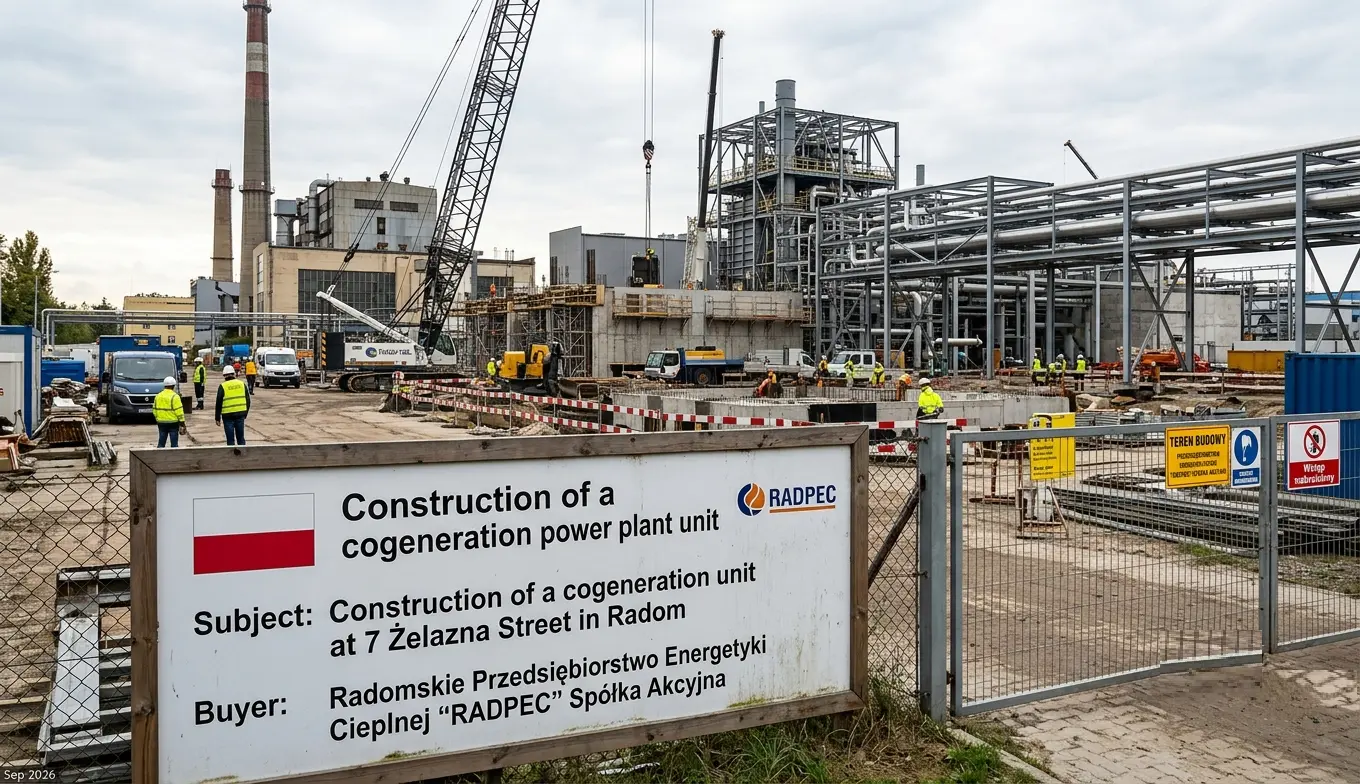
UNIBEP S.A. Secures 379 Million PLN Turnkey Cogeneration Plant Contract in Radom
14 Sep 2026
Standfirst UNIBEP S.A. has been awarded a major turnkey construction contract worth 379.4 million Polish zloty to build a new cogeneration block in Radom. The project, commissioned by Radomskie Przedsiębiorstwo Energetyki Cieplnej RADPEC Spółka Akcyjna, involves constructing a waste fueled boiler facility with a capacity of 60 000 Mg per year. This tender result highlights the ongoing investment in sustainable urban energy infrastructure across Poland using national environmental funds. Introduction The modernization of urban energy infrastructure remains a critical priority for municipal authorities across Europe. In Poland, the city of Radom is advancing its strategy to enhance sustainable heating and power generation through the acquisition of advanced cogeneration technology. The recent contract award for a new waste fueled boiler facility represents a significant step toward improving energy efficiency and reducing the environmental footprint of the local district heating network. By executing this procurement through a competitive dialogue procedure, the contracting authority ensures compliance with national public procurement regulations while addressing complex technical requirements. The selected contractor will be responsible for delivering the entire project, from foundational work to the final grid integration. This holistic approach guarantees that the new development meets all modern safety and environmental standards. Why This Contract Matters This procurement is vital for maintaining the operational reliability and accessibility of the Radom urban heating network. The introduction of a new cogeneration block will eliminate historical capacity constraints and improve living conditions for local residents by providing stable and efficient district heating. It directly addresses the growing demand for sustainable thermal energy in a rapidly developing urban center. For the domestic construction sector, this contract award validates the capability of Polish companies to meet stringent municipal technical requirements. It also demonstrates how public funds are actively deployed to upgrade urban infrastructure and promote sustainable community development. The project serves as a tangible example of how local governments can transition away from traditional fossil fuels toward alternative energy sources. Additionally, the project sets a new standard for waste to energy developments in the region. By mandating strict adherence to design documentation and requiring the contractor to secure all final usage permits, the authority mitigates project delivery risks. This ensures that taxpayers receive a fully functional and legally compliant asset upon project completion, without hidden liabilities or delays. Contract Timeline The procurement process concluded with the selection of the winning bidder following a rigorous competitive dialogue phase. Following standard administrative procedures, the formal contract was signed on August 26, 2026. The official contract awards notice was published in the Official Journal of the European Union on September 14, 2026. This timeline reflects a standard but rigorous procurement cycle for complex energy construction contracts in the Polish public sector. Contract Overview The agreement covers the turnkey construction of a complete cogeneration block based on an alternative fuel RDF or pre RDF boiler. The contract value is fixed at 379 461 868.83 Polish zloty, reflecting a substantial investment in municipal energy assets. The supplier is strictly required to deliver the project in full accordance with the provided technical documentation and secure all necessary usage permits. This turnkey approach places the onus of technical optimization and delivery risk squarely on the shoulders of the awarded firm. Key Contract Details Contract Title Budowa bloku kogeneracyjnego przy ul. Żelaznej 7 w Radomiu Contracting Authority Radomskie Przedsiębiorstwo Energetyki Cieplnej RADPEC Spółka Akcyjna Contract Value 379 461 868.83 PLN Procedure Type Competitive dialogue Number of Bids Received 3 Winner UNIBEP S.A. Contract Conclusion Date August 26, 2026 Main CPV Code 45251000 (Construction works for power plants and heating plants) Project Scope The core scope involves the construction of a complete cogeneration block with a capacity of 60 000 Mg per year and a power output of approximately 4.5 MWe and 17.5 MWt. The project includes the development of associated technological infrastructure, internal roads, and the connection of the block to the city heating and power grids. Additionally, the contractor is responsible for obtaining all necessary conditions, decisions, and approvals, culminating in the final usage permit for the entire complex. This extensive responsibility requires the winning bidder to possess strong project management capabilities and deep familiarity with local Polish building regulations. About the Contracting Authority Radomskie Przedsiębiorstwo Energetyki Cieplnej RADPEC Spółka Akcyjna is the primary buyer for this procurement. It is a municipal company responsible for organizing and managing the production, transport, and distribution of heat within the city of Radom. About the Organisations Involved Radomskie Przedsiębiorstwo Energetyki Cieplnej RADPEC Spółka Akcyjna is the contracting authority and buyer. It manages the public heating network in Radom and drives the procurement of new energy developments to expand sustainable infrastructure options for city residents. UNIBEP S.A. is the successful bidder and a large economic operator. It is a major Polish construction company specializing in the execution of complex residential, commercial, and industrial building projects across the country, bringing significant financial and operational capacity to this award. Krajowa Izba Odwoławcza is the review organisation. This body handles any legal appeals or disputes related to public procurement procedures in Poland, ensuring fair competition and strict regulatory compliance throughout the tendering process. Publications Office of the European Union acts as the TED eSender. It is responsible for the official publication of procurement notices to ensure transparency and equal market access across the European continent. Procurement Analysis The competitive dialogue procedure attracted three bids, demonstrating focused competition in the Polish energy construction market. The evaluation focused on a balance of price and technical criteria, which is common for well defined construction projects where technical specifications are strict and require iterative refinement. This evaluation method indicates that the technical baseline was considered a strict pass or fail requirement, but the dialogue phase allowed for optimization of the proposed solutions. Consequently, the competition focused on delivering optimal value without compromising the quality of the human resources and technical designs provided. Additional Procurement Facts The procurement is covered by the Government Procurement Agreement, allowing international competition, though all received bids were from domestic Polish entities. The project is not financed with European Union funds, relying instead on the municipal budget and internal resources of the local government. It is supplemented by the National Fund for Environmental Protection and Water Management, gathered on the account of the Modernisation Fund. This highlights a strategic national push toward alternative fuel utilization for energy purposes. Market & Industry Perspective The Polish urban energy construction market remains highly competitive, with domestic operators leveraging their proximity to secure major municipal contracts. The requirement for waste fueled cogeneration reflects a broader industry trend toward optimizing urban space and improving residential amenities through sustainable energy practices. This shift is driven by both national energy policies and European environmental directives. Suppliers must continuously innovate to meet evolving accessibility standards and integrate advanced technical infrastructure. The dominance of large economic operators in this space suggests that future RFPs and RFQs will continue to favor established contractors with proven supply chains. Smaller firms often lack the financial capacity to undertake such large scale turnkey projects independently. International competition remains present but limited, as evidenced by the lack of foreign bids in this specific tender. This dynamic suggests that foreign firms may find it challenging to compete without establishing strong local partnerships to navigate domestic regulatory and logistical landscapes. Local knowledge of Polish building codes and environmental permitting is a distinct competitive advantage. Economic Significance An investment of over 379 million Polish zloty represents a substantial injection of capital into the domestic urban energy sector. This supports skilled jobs in engineering, production, and technical training within Poland. The project will sustain employment for hundreds of workers throughout the 38 month execution period. Simultaneously, it upgrades public infrastructure for long term economic benefit by improving urban reliability and reducing environmental impact through better district heating efficiency. The transition to alternative fuels reduces the carbon footprint of the city while stabilizing energy costs for end consumers. The multiplier effect of this spending extends beyond the primary contractor, benefiting downstream material suppliers and logistics providers. Local businesses supplying concrete, steel, and specialized mechanical components will see increased demand, stimulating the broader regional economy and reinforcing the domestic supply chain. Future Procurement Opportunities Suppliers who were not successful should monitor the official Tenders Portal for upcoming energy renewals in other Polish cities. As urban networks expand, public institutions will continuously generate new tenders opportunities for infrastructure acquisitions and maintenance services. The success of this Radom project will likely inspire similar initiatives in neighboring municipalities. Stakeholders should also track the Latest Active Tenders Procurement notices to anticipate upcoming infrastructure projects in the broader Central European energy sector. The dynamic nature of public procurement means that new Live Notices for Tenders will emerge as regional authorities update their energy requirements to meet national climate goals. Additionally, the National Fund for Environmental Protection and Water Management continues to allocate significant resources for modernization projects. Companies that align their service offerings with the specific criteria of these funding programs will be well positioned to capture future contract awards in the alternative energy segments. Opportunities for Suppliers While the primary contract has been awarded to a consolidated firm, significant opportunities exist for specialized subcontractors. Firms with expertise in hardware supply, advanced telemetry installation, and the construction of boiler systems can position themselves as tier two suppliers to the winning contractor. These niche roles are critical for the successful execution of complex energy projects. Additionally, manufacturers of energy equipment and smart grid components may find opportunities to supply materials through the established procurement channels, provided they meet the stringent technical certifications required by the Polish energy authority. Early engagement with the primary contractor can secure favorable subcontracting agreements. Consulting firms specializing in environmental impact assessments and regulatory compliance may also find demand for their services. As the project progresses, the contractor will require expert guidance to navigate the complex web of local and national permitting requirements, creating a steady stream of professional service opportunities. What Businesses Should Watch Industry observers should monitor the delivery schedule of these operational services to gauge the manufacturing capacity and supply chain resilience of the winning bidder. The integration of advanced control systems will set a benchmark for future live tender announcements in the region. Any delays could signal broader supply chain issues affecting the domestic construction sector. Stakeholders should also review Live Notices for Tenders to anticipate upcoming transport modernization projects funded by municipal programs. The convergence of energy and transport infrastructure projects often creates synergistic opportunities for multidisciplinary contractors. In addition, businesses should watch for any legal challenges filed with the review organisation, although none are indicated in the current notice. The enforcement of strict building directives will be a key metric for future tender evaluations in similar energy categories, setting precedents for how technical compliance is assessed. PolandTenders.com Procurement Intelligence This contract represents a clear trend in European public procurement toward the acquisition of specialized, high capacity urban energy services to enhance living standards. By explicitly requiring full compliance with design documentation and mandating the acquisition of final operational permits, the contracting authority prioritized operational reliability and risk mitigation over experimental development. This approach ensures that public funds are invested in proven serial operation methods that can be immediately integrated into the existing urban network. Strategically, this award is important because it demonstrates the continued strength of domestic energy firms in securing major municipal infrastructure contracts. Suppliers can learn that strict adherence to technical baselines, such as system specifications and seasonal flexibility, is the primary gateway for winning these bids. To position themselves for future contracts, relevant suppliers must invest in modular system designs that can be easily adapted to specific municipal requirements outlined in GPNs and BOQs. Supplier Takeaways Strict technical compliance and proven construction methods are mandatory for winning municipal energy contracts. Domestic manufacturers hold a distinct advantage in understanding local operational conditions and municipal requirements. Subcontracting opportunities exist for specialized technology providers supplying energy or monitoring systems. Municipal funding continues to drive significant public procurement activity in the sustainable urban energy sector. Key Takeaways UNIBEP S.A. won the 379.4 million PLN cogeneration plant construction contract. The procurement covers a complete turnkey waste fueled boiler facility with a capacity of 60 000 Mg per year. Three bids were received, indicating focused competition among large economic operators. The contract duration is 38 months, with strict adherence to design and permitting requirements. The project is supplemented by the National Fund for Environmental Protection and Water Management. Conclusion This contract secures a modern and flexible energy system for the city of Radom, enhancing public infrastructure accessibility and operational efficiency. The transparent procurement process ensures optimal value for public money while supporting the domestic urban energy industry. Source: Tenders Electronic Daily (TED), Contract Award Notice 630188-2026, Official Journal of the European Union, published on 14/09/2026.
View Details
Nextbike Polska Secures 178 Million PLN Contract to Operate Pruszkow City Bike System
11 Sep 2026
Standfirst NEXTBIKE Polska S.A. has been awarded a major public procurement contract to organize, manage and operate the Pruszkow City Bike system. The agreement carries a total estimated value of 178,250,616.00 Polish zloty and spans multiple operational seasons through 2028. This tender result follows a competitive open procedure that attracted two bids from established micromobility operators. The award highlights the ongoing commitment of Polish municipalities to expand sustainable urban transport networks through structured public procurement. Introduction The modernization of urban mobility infrastructure remains a critical priority for local governments across Europe. In Poland, the city of Pruszkow has initiated a targeted procurement strategy to secure a reliable operator for its municipal bicycle sharing network. This recent contract award represents a significant step toward improving last mile connectivity and reducing traffic congestion in the region. By executing this procurement through a transparent open procedure, the contracting authority ensures compliance with national public procurement regulations while securing high quality operational services. The selected contractor will be responsible for the entire lifecycle of the system, from daily management and maintenance to the deployment of access control technology. This holistic approach guarantees that taxpayers receive a fully functional and legally compliant urban transport asset. The strategic allocation of municipal funds toward such large scale mobility projects underscores a commitment to sustainable urban growth. It also provides a stable pipeline of work for domestic transport firms, fostering economic stability within the local supply chain and encouraging further investment in green transit solutions. Why This Contract Matters This procurement is vital for maintaining the operational reliability and accessibility of the Pruszkow urban transport network. The introduction of a professionally managed bicycle sharing system will eliminate historical space constraints and improve living conditions for local residents. For the domestic micromobility sector, this contract award validates the capability of Polish companies to meet stringent municipal technical requirements. It also demonstrates how public funds are actively deployed to upgrade urban infrastructure and promote sustainable community development. Contract Timeline The procurement process concluded with the selection of the winning bidder on March 2, 2026. Following standard administrative procedures, the formal contract was signed on March 19, 2026. The official contract awards notice was published in the Official Journal of the European Union on September 11, 2026. This timeline reflects a standard and transparent execution of public procurement regulations in the Polish municipal sector. Contract Overview The agreement covers the organization, management and operation of the Pruszkow City Bike system. The contract value is fixed at 178,250,616.00 Polish zloty, reflecting a substantial investment in municipal transport assets. The supplier is strictly required to deliver the project in full accordance with the provided technical documentation and secure all necessary operational permits. This turnkey approach places the onus of technical optimization and delivery risk squarely on the shoulders of the awarded firm. Key Contract Details Contract Title Zorganizowanie, zarzadzanie i eksploatacja systemu Pruszkowskiego Roweru Miejskiego Contracting Authority Gmina Miasto Pruszkow Contract Value 178,250,616.00 PLN Procedure Type Open Procedure Number of Bids Received 2 Winner NEXTBIKE Polska S.A. Contract Conclusion Date March 19, 2026 Main CPV Code 50111100 (Vehicle fleet management services) Project Scope The core scope involves the daily management and operation of the municipal bicycle sharing network. The project includes the deployment of access control systems and the maintenance of bicycles without motors to ensure public safety and system reliability. The contractor must ensure all installations and networks function correctly according to the design documentation. Additionally, the contractor is responsible for adapting the system operation dates based on specific municipal options for the years 2026, 2027 and 2028, with the authority retaining the right to exercise these options up to four weeks before the scheduled start date. About the Contracting Authority Gmina Miasto Pruszkow is the primary buyer for this procurement. It is a local municipal authority responsible for organizing and managing general public services and urban mobility infrastructure within the city of Pruszkow. About the Organisations Involved Gmina Miasto Pruszkow is the contracting authority and buyer. It manages the public transport network in Pruszkow and drives the procurement of new mobility services to expand sustainable transit options for city residents. NEXTBIKE Polska S.A. is the successful bidder and a large economic operator. It is a major Polish company specializing in the execution and management of public bicycle sharing systems across the country, bringing significant operational capacity to this award. KIO is the review organisation. This body handles any legal appeals or disputes related to public procurement procedures in Poland, ensuring fair competition and strict regulatory compliance throughout the tendering process. Procurement Analysis The open procedure attracted two bids, demonstrating focused competition in the Polish micromobility market. The evaluation focused entirely on price, carrying a weight of 100 percent, which is common for well defined service contracts where technical specifications are strict. This binary evaluation method indicates that the technical baseline was considered a strict pass or fail requirement. Consequently, the competition focused purely on financial efficiency, driving down the cost for the public buyer while ensuring all baseline requirements were met. Additional Procurement Facts The procurement is covered by the Government Procurement Agreement, allowing international competition, though all received bids were from domestic Polish entities. The project is not financed with European Union funds, relying instead on the municipal budget and internal resources of the local government. Market & Industry Perspective The Polish urban transport market remains highly competitive, with domestic operators leveraging their proximity to secure major municipal contracts. The requirement for flexible seasonal operation reflects a broader industry trend toward optimizing urban space and improving residential amenities. Suppliers must continuously innovate to meet evolving accessibility standards and integrate advanced access control systems. The dominance of large economic operators in this space suggests that future RFPs and RFQs will continue to favor established contractors with proven supply chains. Economic Significance An investment of over 178 million Polish zloty represents a substantial injection of capital into the domestic urban mobility sector. This supports skilled jobs in logistics, maintenance and technical training within Poland. Simultaneously, it upgrades public infrastructure for long term economic benefit by improving urban mobility and reducing traffic congestion. Future Procurement Opportunities Suppliers who were not successful should monitor the official Tenders Portal for upcoming mobility renewals in other Polish cities. As urban networks expand, public institutions will continuously generate new tenders opportunities for transit acquisitions and maintenance services. Stakeholders should also track the Latest Active Tenders Procurement notices to anticipate upcoming infrastructure projects in the broader Central European transport sector. The dynamic nature of public procurement means that new Live Notices for Tenders will emerge as regional authorities update their transit requirements. Opportunities for Suppliers While the primary contract has been awarded to a consolidated firm, significant opportunities exist for specialized subcontractors. Firms with expertise in hardware supply, advanced telemetry installation and the construction of bicycle docking stations can position themselves as tier two suppliers to the winning contractor. What Businesses Should Watch Industry observers should monitor the delivery schedule of these operational services to gauge the manufacturing capacity and supply chain resilience of the winning bidder. The integration of advanced access control systems will set a benchmark for future live tender announcements in the region. Stakeholders should also review Live Notices for Tenders to anticipate upcoming transport modernization projects funded by municipal programs. In addition, businesses should watch for any legal challenges filed with the review organisation, although none are indicated in the current notice. PolandsTenders.com Procurement Intelligence This contract represents a clear trend in European public procurement toward the acquisition of specialized, high capacity urban mobility services to enhance living standards. By explicitly requiring full compliance with design documentation and mandating the acquisition of final operational permits, the contracting authority prioritized operational reliability and risk mitigation over experimental development. This approach ensures that public funds are invested in proven serial operation methods that can be immediately integrated into the existing urban network. Strategically, this award is important because it demonstrates the continued strength of domestic transport firms in securing major municipal infrastructure contracts. Suppliers can learn that strict adherence to technical baselines, such as system specifications and seasonal flexibility, is the primary gateway for winning these bids. To position themselves for future contracts, relevant suppliers must invest in modular system designs that can be easily adapted to specific municipal requirements outlined in GPNs and BOQs. Future contracts in this market are likely to feature even stricter environmental and digital integration mandates. As cities push for smarter transit networks, companies that proactively develop interoperable passenger information systems and energy efficient propulsion technologies will hold a distinct advantage when responding to future public procurement solicitations. The reliance on municipal funding also means that Active Tenders in this sector will remain closely tied to broader local sustainability goals. Supplier Takeaways Strict technical compliance and proven operational methods are mandatory for winning municipal mobility contracts. Domestic manufacturers hold a distinct advantage in understanding local operational conditions and municipal requirements. Subcontracting opportunities exist for specialized technology providers supplying access control or monitoring systems. Municipal funding continues to drive significant public procurement activity in the sustainable urban transport sector. Key Takeaways NEXTBIKE Polska S.A. won the 178.2 million PLN city bike system contract. The procurement covers the organization, management and operation of the Pruszkow City Bike network. Two bids were received, indicating focused competition among large economic operators. The contract duration extends to 2028, with strict adherence to seasonal operation options. The project is not financed with European Union funds, relying on municipal resources. Conclusion This contract secures a modern and flexible mobility system for the city of Pruszkow, enhancing public transport accessibility and operational efficiency. The transparent procurement process ensures optimal value for public money while supporting the domestic urban transport industry. Source: Tenders Electronic Daily (TED), Contract Award Notice 626412-2026, Official Journal of the European Union, published on 11/09/2026.
View Details
ERBUD S.A. Secures 158.9 Million PLN Contract for Multi Family Housing Complex in Poznań
10 Sep 2026
Standfirst ERBUD S.A. has been awarded a major construction contract worth 158.9 million Polish zloty to build a new multi family residential complex in Poznań. The project, commissioned by Poznańskie Towarzystwo Budownictwa Społecznego Sp. z o.o., involves the construction of twelve residential buildings, two above ground garages and associated technical infrastructure. This tender result follows a competitive open procedure that attracted six bids from major construction firms. The award highlights the ongoing investment in social and affordable housing infrastructure across Poland, driven by local municipal authorities. Introduction The development of modern residential infrastructure remains a critical priority for municipal authorities across Poland. In Poznań, the local social housing society has initiated a large scale procurement strategy to expand affordable housing options for its residents. The recent contract award for a new multi family housing complex represents a significant step toward addressing urban housing demands and improving living standards in the region. By executing this procurement through a transparent open procedure, the contracting authority ensures compliance with national public procurement regulations while securing high quality construction services. The selected contractor will be responsible for delivering the entire project, from foundational work to the final technical infrastructure integration. This holistic approach guarantees that the new development meets all modern safety and environmental standards. The strategic allocation of municipal funds toward such large scale residential projects underscores a commitment to sustainable urban growth. It also provides a stable pipeline of work for domestic construction firms, fostering economic stability within the local supply chain. Why This Contract Matters This procurement is vital for maintaining the operational reliability and accessibility of the Poznań urban housing network. The introduction of new residential units with integrated above ground garages will eliminate historical space constraints and improve living conditions for local families. For the domestic construction sector, this contract award validates the capability of Polish companies to meet stringent municipal technical requirements. It also demonstrates how public funds are actively deployed to upgrade urban infrastructure and promote sustainable community development. In addition, the project sets a new standard for social housing developments in the region. By mandating strict adherence to design documentation and requiring the contractor to secure all final usage permits, the authority mitigates project delivery risks. This ensures that taxpayers receive a fully functional and legally compliant asset upon project completion. Contract Timeline The procurement process concluded with the selection of the winning bidder on April 13, 2026. Following standard administrative procedures, the formal contract was signed on August 27, 2026. The official contract awards notice was published in the Official Journal of the European Union on September 10, 2026. The estimated duration for the complete delivery and commissioning of the housing complex is set at approximately 26 months. This timeline reflects a standard but rigorous procurement cycle for complex residential construction contracts in the Polish public sector. The extended execution period allows for phased construction, minimizing disruption to the surrounding urban environment while the new infrastructure is brought online and certified for public use. Contract Overview The agreement covers the construction of a complex consisting of twelve multi family residential buildings and two above ground garages. The contract value is fixed at 158.9 million Polish zloty, reflecting a substantial investment in municipal housing assets. The supplier is strictly required to deliver the project in full accordance with the provided design documentation and secure all necessary usage permits. This turnkey approach places the onus of technical optimization and delivery risk squarely on the shoulders of the awarded firm. The contractor must manage all aspects of the build, including site preparation, structural construction and the installation of all internal and external utility networks. Key Contract Details Contract Title Budowa zespołu budynków mieszkalnych wielorodzinnych z garażami nadziemnymi i infrastrukturą techniczną w Poznaniu przy ul. Żelaznej. Contracting Authority Poznańskie Towarzystwo Budownictwa Społecznego Sp. z o.o. Contract Value 158,900,000.00 PLN Procedure Type Open Procedure Number of Bids Received 6 Winner ERBUD S.A. Contract Conclusion Date August 27, 2026 Main CPV Code 45000000 (Construction work) Project Scope The core scope involves the construction of twelve multi family residential buildings along with two multi story above ground garages. The project also includes the development of associated technical infrastructure, internal roads, surface parking areas and small architectural elements. The contractor must ensure all installations and networks function correctly according to the design documentation. Additionally, the contractor is responsible for obtaining all necessary conditions, decisions and approvals, culminating in the final usage permit for the entire complex. This extensive responsibility requires the winning bidder to possess strong project management capabilities and deep familiarity with local Polish building regulations and permitting processes. About the Contracting Authority Poznańskie Towarzystwo Budownictwa Społecznego Sp. z o.o. is the primary buyer for this procurement. It is a municipal company responsible for organizing and managing social housing development within the city of Poznań. About the Organisations Involved Poznańskie Towarzystwo Budownictwa Społecznego Sp. z o.o. is the contracting authority and buyer. It manages the public social housing network in Poznań and drives the procurement of new residential developments to expand affordable housing options for city residents. ERBUD S.A. is the successful bidder and a large economic operator. It is a major Polish construction company specializing in the execution of complex residential and commercial building projects across the country, bringing significant financial and operational capacity to this award. Krajowa Izba Odwoławcza is the review organisation. This body handles any legal appeals or disputes related to public procurement procedures in Poland, ensuring fair competition and strict regulatory compliance throughout the tendering process. Publications Office of the European Union acts as the TED eSender. It is responsible for the official publication of procurement notices to ensure transparency and equal market access across the European continent. Procurement Analysis The open procedure attracted six bids, demonstrating healthy competition in the Polish residential construction market. The evaluation focused entirely on price, carrying a weight of 100 percent, which is common for well defined construction projects where technical specifications are strict. This binary evaluation method indicates that the technical baseline was considered a strict pass or fail requirement. Consequently, the competition focused purely on financial efficiency, driving down the cost for the public buyer while ensuring all baseline requirements were met. The absence of bids from micro, small or medium enterprises indicates the high capital and technical barriers inherent in large scale residential developments. Suppliers must therefore optimize their supply chains to offer the most competitive pricing while meeting strict technical baselines outlined in BOQs and GPNs. Additional Procurement Facts The procurement is covered by the Government Procurement Agreement, allowing international competition, though all received bids were from domestic Polish entities. The project is not financed with European Union funds, relying instead on the municipal budget and internal resources of the housing society. Market & Industry Perspective The Polish urban construction market remains highly competitive, with domestic manufacturers and developers leveraging their proximity to secure major municipal contracts. The requirement for integrated above ground garages reflects a broader industry trend toward optimizing urban space and improving residential amenities. Suppliers must continuously innovate to meet evolving accessibility standards and integrate advanced technical infrastructure. The dominance of large economic operators in this space suggests that future RFPs and RFQs will continue to favor established contractors with proven supply chains. International competition remains present but limited, as evidenced by the lack of foreign bids in this specific tender. This dynamic suggests that foreign firms may find it challenging to compete without establishing strong local partnerships to navigate domestic regulatory and logistical landscapes. Economic Significance An investment of over 158 million Polish zloty represents a substantial injection of capital into the domestic construction sector. This supports high skilled jobs in engineering, production and technical training within Poland. Simultaneously, it upgrades public infrastructure for long term economic benefit by improving urban housing availability and reducing market pressure. The multiplier effect of this spending extends beyond the primary contractor, benefiting downstream material suppliers, logistics providers and specialized trade organizations that support the deployment of new residential environments. This efficient allocation of public procurement resources stimulates the local technology and construction ecosystem. Future Procurement Opportunities Suppliers who were not successful should monitor the official Tenders Portal for upcoming residential renewals in other Polish cities. As urban networks expand, public institutions will continuously generate new tenders opportunities for housing acquisitions and maintenance services. Stakeholders should also track the Latest Active Tenders Procurement notices to anticipate upcoming infrastructure projects in the broader Central European housing sector. The dynamic nature of public procurement means that new Live Notices for Tenders will emerge as regional authorities update their housing requirements. Additionally, the success of this procurement model may prompt other municipal authorities to apply similar timelines to future tender processes, requiring suppliers to maintain a state of perpetual readiness. Opportunities for Suppliers While the primary contract has been awarded to a consolidated firm, significant opportunities exist for specialized subcontractors. Firms with expertise in environmental protection, specialized demolition, advanced telemetry installation and the construction of noise barriers can position themselves as tier two suppliers to the winning contractor. Additionally, manufacturers of residential energy equipment and smart home components may find opportunities to supply materials through the established procurement channels, provided they meet the stringent technical certifications required by the Polish housing authority. Companies offering specialized maintenance services may also position themselves for future support contracts once the new residential complex is operational. What Businesses Should Watch Industry observers should monitor the delivery schedule of these residential buildings to gauge the manufacturing capacity and supply chain resilience of the winning bidder. The integration of advanced technical infrastructure will set a benchmark for future live tender announcements in the region. Stakeholders should also review Live Notices for Tenders to anticipate upcoming housing modernization projects funded by municipal programs. In addition, businesses should watch for any legal challenges filed with the review organisation, although none are indicated in the current notice. The enforcement of strict building directives will also be a key metric for future tender evaluations in similar residential categories. PolandTenders.com Procurement Intelligence This contract represents a clear trend in European public procurement toward the acquisition of specialized, high capacity residential infrastructure to enhance urban living standards. By explicitly requiring full compliance with design documentation and mandating the acquisition of final usage permits, the contracting authority prioritized operational reliability and risk mitigation over experimental development. This approach ensures that public funds are invested in proven serial construction methods that can be immediately integrated into the existing urban network. Strategically, this award is important because it demonstrates the continued strength of domestic construction firms in securing major municipal infrastructure contracts. Suppliers can learn that strict adherence to technical baselines, such as building specifications and garage integration, is the primary gateway for winning these bids. To position themselves for future contracts, relevant suppliers must invest in modular building designs that can be easily adapted to specific municipal requirements outlined in GPNs and BOQs. Future contracts in this market are likely to feature even stricter environmental and digital integration mandates. As cities push for smarter residential networks, companies that proactively develop interoperable energy systems and sustainable construction technologies will hold a distinct advantage when responding to future public procurement solicitations. The reliance on municipal funding also means that Active Tenders in this sector will remain closely tied to broader local sustainability goals. Supplier Takeaways Strict technical compliance and proven construction methods are mandatory for winning residential contracts. Domestic manufacturers hold a distinct advantage in understanding local operational conditions and municipal requirements. Subcontracting opportunities exist for specialized technology providers supplying energy or monitoring systems. Municipal funding continues to drive significant public procurement activity in the sustainable urban housing sector. Key Takeaways ERBUD S.A. won the 158.9 million PLN housing supply contract. The procurement covers twelve multi family residential buildings and two above ground garages. Six bids were received, indicating strong competition among large economic operators. The contract duration is approximately 26 months, with strict prohibitions on non compliant solutions. The project is not financed with European Union funds, relying on municipal resources. Conclusion This contract secures a modern and flexible housing complex for the city of Poznań, enhancing public residential accessibility and operational efficiency. The transparent procurement process ensures optimal value for public money while supporting the domestic construction industry. Source: Tenders Electronic Daily (TED), Contract Award Notice 625859-2026, Official Journal of the European Union, published on 10/09/2026.
View Details