
Poland Awards Military Airfield Fertiliser Contracts to Blending and ADAR
21 Sep 2026
Standfirst Poland has awarded contracts for the supply of mineral fertilisers used to maintain turf surfaces at military airfields. The procurement, conducted by 3 Regionalna Baza Logistyczna in Kraków, was divided into 11 lots covering different fertiliser products. Blending Sp. z o.o. won five lots while ADAR Handl Nawozami Sztucznymi Sp. z o.o. won three lots, while Lots 9 to 11 closed without a winner. The TED notice reports PLN 207.86 million as the value of all contracts awarded in the notice, although the individual winning tender values disclosed for Lots 1 to 8 are substantially lower. Introduction Poland has completed a major multi lot procurement for mineral fertilisers intended to maintain turf surfaces at military airfields. The contract award notice, TED publication 648740 2026, was published in the Official Journal of the European Union on 21 September 2026. The procurement was organised by 3 Regionalna Baza Logistyczna, a Polish public law body operating in the defence sector. The requirement covered 11 separate tasks, allowing suppliers to submit offers for any number of lots rather than requiring participation across the entire procurement. The products covered a range of fertiliser categories, including granular superphosphate, enriched superphosphate, potassium salt, ammonium nitrate, Polifoska 5, magnesium sulphate, granular fertiliser urea and other products. All lots used CPV 24440000, Miscellaneous fertilisers. Eight lots resulted in awarded contracts. Blending Sp. z o.o. won Lots 1, 2, 6, 7 and 8, while ADAR Handl Nawozami Sztucznymi Sp. z o.o. won Lots 3, 4 and 5. Lots 9, 10 and 11 received tenders but were closed without a winner because all submitted tenders were withdrawn or found inadmissible. Why This Contract Matters The procurement illustrates how defence organisations can require specialised agricultural and grounds maintenance supplies as part of broader military infrastructure management. Military airfields depend on maintained turf areas for operational and safety related requirements, making the availability of suitable fertiliser products a recurring procurement consideration. Rather than combining all products into a single contract, the Polish buyer separated the requirement into 11 lots based on individual fertiliser types. This structure allows suppliers with capabilities in particular product categories to participate without necessarily having to supply the entire range. The result also provides useful market intelligence because several lots attracted multiple electronic tenders. Lots 1, 2 and 6 received two tenders each, while Lots 3, 4, 5, 7 and 8 received three tenders each. The three unsuccessful lots are equally important from a procurement intelligence perspective. Lots 9, 10 and 11 each received three tenders but no contract was awarded because the submitted tenders were withdrawn or considered inadmissible. Contract Timeline The procurement followed an open procedure under the Polish Public Procurement Law. The previous procurement notice was numbered 294902 2026 and the internal identifier for the procedure was 81/2026/D. For Lots 3, 4 and 5, the successful suppliers were selected on 25 June 2026 and the contracts were concluded on 15 July 2026. For Lots 6, 7 and 8, the winners were also selected on 25 June 2026, with contracts concluded on 8 July 2026. For Lots 1 and 2, the winner was selected on 17 July 2026 and contracts were concluded on 28 July 2026. The delivery period for the awarded lots is 16 weeks from contract conclusion, subject to the notice conditions and a final deadline of 30 October 2026. Contract Overview The procurement covers the supply of mineral fertilisers for the maintenance of turf surfaces at military airfields in Poland. The buyer did not provide an option right and required suppliers to submit documentary evidence confirming that their proposed products met the specified requirements. The procedure was conducted as an open tender. Price was the sole award criterion, carrying 100 points for the lots covered by the notice. The procurement was not financed with European Union funds. It was covered by the Government Procurement Agreement and did not use a framework agreement or a dynamic purchasing system. Key Contract Details CountryPoland Contracting Authority3 Regionalna Baza Logistyczna ProcurementSupply of mineral fertilisers for maintaining turf surfaces at military airfields TED Notice648740 2026 PublicationOJ S 182/2026, 21 September 2026 Main CPV24440000, Miscellaneous fertilisers ProcedureOpen procedure Total lots11 Lots awarded1 to 8 Lots without winner9 to 11 Primary WinnerBlending Sp. z o.o., Lots 1, 2, 6, 7 and 8 Second WinnerADAR Handl Nawozami Sztucznymi Sp. z o.o., Lots 3, 4 and 5 Notice Reported Award ValuePLN 207,859,500 Award CriterionPrice, 100 points EU FundingNo GPA CoveredYes Framework AgreementNo Dynamic Purchasing SystemNo Review OrganisationPrezes Krajowej Izby Odwoławczej Project Scope The procurement covers mineral fertilisers required to maintain turf surfaces at military airfields. The buyer divided the requirement into 11 product specific tasks and allowed suppliers to submit offers for any number of tasks. Lot 1 covered granular superphosphate 19 percent. Lot 2 covered enriched superphosphate 40 percent. Lot 3 concerned potassium salt 40 percent while Lot 4 covered potassium salt 60 percent. Lot 5 concerned ammonium nitrate 34 percent. Lot 6 covered Polifoska 5 and Lot 7 covered magnesium sulphate. Lot 8 covered granular fertiliser urea 46 percent. Lots 9 to 11 covered different types of agricultural lime products. The procurement documents specified product requirements and required suppliers to provide evidence demonstrating compliance. The notice states that deliveries could not begin before 1 September 2026 for the relevant tasks and were required to be completed within 16 weeks of contract conclusion, subject to the stated final deadline. About the Contracting Authority 3 Regionalna Baza Logistyczna is the contracting authority responsible for this defence procurement. The organisation operates from ul. Montelupich 3 in Kraków and is identified in the notice as a public law body whose contracting activity relates to defence. The organisation also performs several procurement functions in this procedure, including providing procurement information, signing contracts, financing the contracts and executing payments. About the Organisations Involved 3 Regionalna Baza Logistyczna is the buyer and contracting organisation. Its public procurement section managed the procedure and its budget is identified as the source used to pay for the contracts. Blending Sp. z o.o. is one of the two successful suppliers. The company is classified as a medium sized economic operator and is based in Zduny, Poland. It won Lots 1, 2, 6, 7 and 8. ADAR Handl Nawozami Sztucznymi Sp. z o.o. is the second successful supplier. The company is classified as a medium sized economic operator and is based in Pakość, Poland. It won Lots 3, 4 and 5. Prezes Krajowej Izby Odwoławczej, representing the Krajowa Izba Odwoławcza, is identified as the review organisation for the procurement. The review body is based in Warsaw. Publications Office of the European Union is identified as the TED publication organisation associated with the notice. Procurement Analysis The open procedure created an opportunity for suppliers to compete across multiple product categories. Because suppliers could bid for any number of lots, the structure allowed companies to target product categories aligned with their commercial capabilities. Price was the sole award criterion, with a weighting of 100 points. This creates a procurement environment in which compliant suppliers compete primarily through price once the required technical and documentary conditions have been satisfied. Competition varied by lot. Lots 1, 2 and 6 attracted two tenders each while Lots 3, 4, 5, 7 and 8 attracted three tenders each. The notice also records that the received tenders were submitted electronically and that the participating tenders came from micro, small or medium sized tenderers. The results show that two medium sized suppliers captured all eight awarded lots. This concentration occurred despite the procurement being divided into multiple product categories and allowing participation in any number of tasks. Additional Procurement Facts The procurement is governed by Directive 2014/24/EU and the Polish Public Procurement Law. The buyer did not require a bid bond or performance security before contract signature. The procurement documents required suppliers to provide subject matter evidence demonstrating compliance with the buyer's technical requirements. The contracting authority also retained the possibility of supplementing missing or incomplete evidence under the applicable Polish procurement rules. The notice records no EU funding. It also states that there is no framework agreement and no dynamic purchasing system. The Government Procurement Agreement applies to the procurement. The buyer also included eligibility and exclusion requirements linked to Polish procurement law and restrictions concerning entities covered by specified sanctions and security related provisions. Market & Industry Perspective The award provides a useful view of a specialised segment of defence procurement in which the products themselves are conventional agricultural inputs but the end use is linked to military infrastructure. This creates a procurement market where product compliance, documentation and delivery capability can be as important as general fertiliser market participation. The lot based structure also demonstrates how public buyers can divide a broad procurement requirement into commercially distinct product categories. Such structures can create opportunities for suppliers that specialise in individual fertiliser products rather than maintaining a complete product portfolio. The participation of medium sized suppliers across the awarded lots indicates that defence procurement can include opportunities for companies that are not among the largest industrial groups. However, suppliers still need to meet the buyer's documentary and technical requirements. Economic Significance The notice reports PLN 207,859,500 as the value of all contracts awarded in the notice. At the same time, the individual winning tender values disclosed for Lots 1 to 8 are much smaller and together amount to approximately PLN 1.69 million. This difference is important for procurement data users. The published notice level value should be reported as stated, but individual tender values should not be artificially adjusted to make them match the aggregate figure. The discrepancy should therefore be treated as a data point requiring caution when using the notice for price benchmarking. Future Procurement Opportunities The procurement suggests continuing demand for maintenance supplies associated with military airfield infrastructure. Future opportunities may include repeat purchases of the same fertiliser categories or new requirements resulting from operational maintenance schedules. The three lots that closed without a winner may also be relevant for future procurement monitoring. Lots 9, 10 and 11 received three tenders each but no winner was selected because all tenders were withdrawn or found inadmissible. Future procurement activity may therefore provide opportunities for suppliers able to address the reasons for non award and submit fully compliant offers. Businesses should monitor subsequent notices from the same contracting authority for revised requirements or new procedures. Opportunities for Suppliers Fertiliser manufacturers, distributors and specialist agricultural suppliers can monitor Polish defence procurement for similar requirements. The current procurement demonstrates that suppliers do not necessarily need to cover the entire product range because bids could be submitted for any number of lots. Companies should also focus on documentation and compliance. The contracting authority specifically required evidence confirming that proposed products met its requirements. A commercially competitive price therefore needed to be accompanied by an offer satisfying the procurement conditions. Medium sized suppliers may find this type of procurement particularly relevant because the awarded contracts demonstrate participation by companies classified as medium sized economic operators. What Businesses Should Watch Suppliers should monitor the procurement activity of 3 Regionalna Baza Logistyczna and other Polish defence purchasing bodies for future supply requirements. CPV 24440000 can be used as one useful classification for identifying fertiliser procurement notices. Businesses should also monitor unsuccessful lots separately from awarded lots. A lot that receives several tenders but ends without an award can indicate a future procurement opportunity if the authority subsequently restarts the requirement. Price should remain an important consideration for suppliers targeting comparable procurements because the current notice used price as the sole award criterion. However, suppliers should first establish that their products and supporting documentation satisfy the technical requirements. Finally, companies using contract award data for market intelligence should distinguish between aggregate notice values and individual lot tender values. The current notice demonstrates why both levels of procurement data need to be reviewed before drawing pricing conclusions. PolandTenders.com Procurement Intelligence From a procurement intelligence perspective, this award illustrates a broader trend toward increasingly granular public procurement. Instead of buying a broad category of fertiliser through one contract, the Polish defence buyer divided the requirement into 11 product specific lots. This creates a more detailed view of supplier capability, competition and pricing across individual product categories. The strategic significance of the procurement is also connected to the relationship between ordinary commercial products and specialised government end users. Fertilisers are widely traded products, but supplying a defence organisation introduces additional requirements relating to technical documentation, eligibility, delivery and procurement compliance. For suppliers, one of the most important lessons is the value of lot level tender monitoring. A business that monitors only the overall procurement title may overlook the fact that its specific product category is being procured separately. CPV based monitoring combined with product keyword intelligence can therefore provide a more precise picture of opportunities. The results also demonstrate the importance of analysing unsuccessful tenders. Lots 9, 10 and 11 attracted three tenders each but did not result in awards. For procurement intelligence purposes, these lots should not simply be treated as closed opportunities. They can remain relevant indicators of unresolved buyer demand, particularly if the authority later publishes a new procurement. Future contracts in this market could continue to use multiple lots to separate fertiliser types and encourage specialist participation. Suppliers that maintain strong product documentation, understand Polish public procurement requirements and track buyer specific procurement patterns can use award history to identify recurring demand and prepare earlier for subsequent competitions. Supplier Takeaways 3 Regionalna Baza Logistyczna procured mineral fertilisers for maintaining turf surfaces at Polish military airfields. The procurement was divided into 11 lots. Suppliers could submit offers for any number of lots. Blending Sp. z o.o. won Lots 1, 2, 6, 7 and 8. ADAR Handl Nawozami Sztucznymi Sp. z o.o. won Lots 3, 4 and 5. Lots 9, 10 and 11 closed without a winner. Price was the sole award criterion with a weighting of 100 points. Lots 1, 2 and 6 received two tenders each. Lots 3, 4, 5, 7 and 8 received three tenders each. The awarded suppliers were classified as medium sized economic operators. No EU funds were used. The procurement was covered by the GPA. No framework agreement or dynamic purchasing system was used. Product compliance documentation was an important part of the procurement requirements. Key Takeaways Country: Poland Buyer: 3 Regionalna Baza Logistyczna Sector: Defence and military infrastructure maintenance Requirement: Mineral fertilisers for military airfield turf surfaces CPV: 24440000, Miscellaneous fertilisers Procedure: Open procedure Total lots: 11 Lots awarded: 8 Lots without winner: 3 Blending winning lots: 1, 2, 6, 7 and 8 ADAR winning lots: 3, 4 and 5 Notice reported award value: PLN 207,859,500 Award criterion: Price, 100 points EU funding: No GPA: Yes Framework agreement: No DPS: No Review body: Prezes Krajowej Izby Odwoławczej Conclusion Poland's award of mineral fertiliser supply contracts for military airfields demonstrates how defence procurement can generate opportunities for specialised suppliers of conventional commercial products. The eight awarded lots were divided between Blending Sp. z o.o. and ADAR Handl Nawozami Sztucznymi Sp. z o.o., while three additional lots closed without a winner. For suppliers, the procurement highlights the importance of lot level opportunity tracking, technical compliance, competitive pricing and monitoring of unsuccessful procurement lots for potential future opportunities. Source: TED Contract or Concession Award Notice 648740 2026, Poland, OJ S 182/2026, published 21 September 2026.
View Details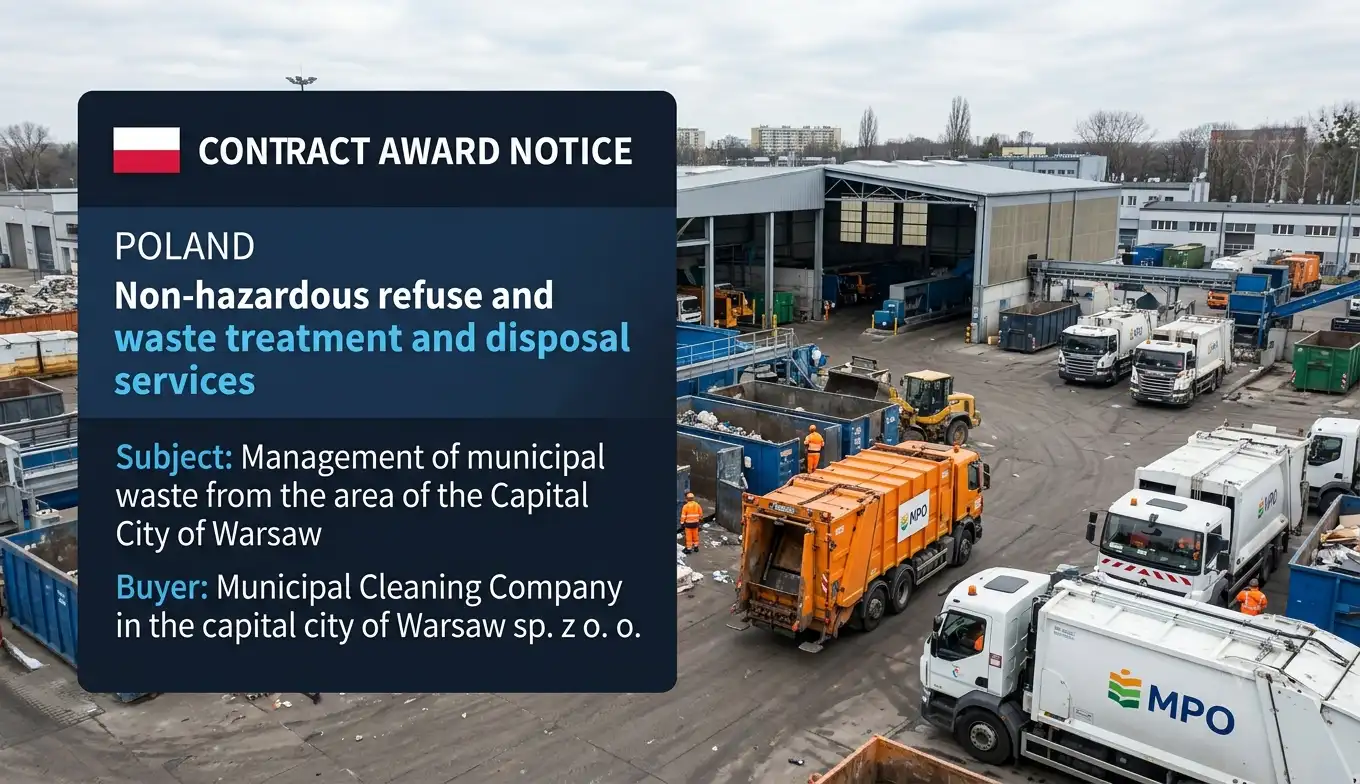
Poland Awards PLN 224.63 Million Warsaw Municipal Waste Management Contracts to ENERIS
18 Sep 2026
Standfirst: Poland has awarded three municipal waste management contracts covering up to 300,000 Mg of non hazardous municipal waste from Warsaw to ENERIS Ekologiczne Centrum Utylizacji Sp. z o.o. The contracts cover Lots 3, 4 and 5 under a procurement organised by Miejskie Przedsiębiorstwo Oczyszczania w m. st. Warszawie sp. z o.o. The combined value of the contracts is PLN 224.625 million including the stated renewals, while the value without renewals is PLN 179.7 million. Each lot provides for an initial 24 month period with one possible six month renewal. Introduction Miejskie Przedsiębiorstwo Oczyszczania w m. st. Warszawie sp. z o.o. has awarded three contracts for the management of municipal waste originating from the territory of the City of Warsaw. The procurement covers waste classified under code 20 03 01 and was divided into five tasks, with the published result covering Lots 3, 4 and 5. ENERIS Ekologiczne Centrum Utylizacji Sp. z o.o. was selected for all three lots. Each lot has a planned maximum quantity of 100,000 Mg and a declared minimum quantity of 50,000 Mg. The contracts have an initial duration of 24 months and may be renewed once for an additional six months. The award notice records a total value of PLN 224.625 million including renewals and specifically states that the value without renewals is PLN 179.7 million. The notice is also a change notice correcting the general information section of the earlier award publication. Why This Contract Matters The procurement is significant because it concerns the treatment and management of a substantial volume of municipal waste generated within Warsaw. The overall procurement was designed around a planned maximum of 500,000 Mg divided across five tasks, with the present result confirming awards for three of those tasks. Lots 3, 4 and 5 each provide for a maximum planned quantity of 100,000 Mg. The structure also provides procurement visibility into how a major urban waste requirement can be divided into separate service lots. The arrangement gives the contracting authority separate contractual capacity while establishing minimum quantities for each awarded task. This approach can help align contracted waste management capacity with actual waste generation levels and operational requirements. Contract Timeline The procurement used an open procedure and was identified under internal reference RZP.27.17.2026.KB. The winners for Lot 3 and Lot 5 were selected on 10 August 2026, while the winner for Lot 4 was selected on 5 August 2026. Contracts for Lots 3 and 5 were concluded on 21 August 2026 and the Lot 4 contract was concluded on 18 August 2026. The TED change notice was dispatched on 17 September 2026 and published on 18 September 2026 under publication number 645608 2026. The change was identified as a buyer correction relating to information included in the general information section. Contract Overview The procurement concerns services for the management of municipal waste originating from Warsaw. The main CPV classification is 90513000, covering non hazardous refuse and waste treatment and disposal services. The overall procurement was divided into five tasks with a planned maximum of 100,000 Mg for each task. The present award notice records contracts for Lots 3, 4 and 5. ENERIS Ekologiczne Centrum Utylizacji Sp. z o.o. is the winner for all three lots. The award criterion was cost, with the cost of the service carrying 100 percent of the stated award weighting for each lot. Key Contract Details Contracting AuthorityMiejskie Przedsiębiorstwo Oczyszczania w m. st. Warszawie sp. z o.o. ProcurementManagement of municipal waste originating from the territory of Warsaw CountryPoland LocationWarsaw, Poland Main CPV90513000, Non hazardous refuse and waste treatment and disposal services Total Award Value Including RenewalsPLN 224,625,000 Total Award Value Without RenewalsPLN 179,700,000 Lots AwardedLOT 0003, LOT 0004 and LOT 0005 WinnerENERIS Ekologiczne Centrum Utylizacji Sp. z o.o. Maximum Planned Quantity per Lot100,000 Mg Minimum Declared Quantity per Lot50,000 Mg Initial Duration24 months Maximum Renewals1 Renewal Period6 months Award CriterionCost of service, 100 percent ProcedureOpen procedure EU FundingNo GPA CoverageNo Project Scope The procurement covers the management of municipal waste originating from Warsaw. The overall procurement planned a maximum quantity of 500,000 Mg divided across five tasks. Lots 3, 4 and 5 each cover a planned maximum of 100,000 Mg of municipal waste with waste code 20 03 01. For each of the three awarded lots, the contracting authority declared that the order would be implemented to a minimum quantity of 50,000 Mg. At the same time, the notice states that the actual quantity delivered for management depends on the amount of waste generated by Warsaw residents and other factors specified in the procurement documentation. The notice also makes clear that the contractor does not have a claim for compensation if the quantity of waste delivered during the contract period is lower than the planned maximum. The procurement location is associated with Warsaw, while the actual installation and transfer station are to be identified by the contractor in its offer, subject to changes permitted under the contract. About the Contracting Authority Miejskie Przedsiębiorstwo Oczyszczania w m. st. Warszawie sp. z o.o. is the buyer and the organisation responsible for the procurement. The contracting authority is classified as a body governed by public law and its stated activity is housing and community amenities. Its procurement department is located at ul. Obozowa 43 in Warsaw. About the Organisations Involved Miejskie Przedsiębiorstwo Oczyszczania w m. st. Warszawie sp. z o.o. is the contracting authority and buyer for the municipal waste management procurement. The organisation's public procurement department handled the procurement and the notice provides its Warsaw address and procurement contact details. ENERIS Ekologiczne Centrum Utylizacji Sp. z o.o. is the successful tenderer and winner of Lots 3, 4 and 5. The TED notice classifies the economic operator as large. The organisation is registered in Poland and has its listed address in Rusko, Jaroszów, within the Wałbrzyski area. Krajowa Izba Odwoławcza is identified as the review organisation and as the organisation providing further information on review procedures. It is based in Warsaw and handles procurement review matters specified in the notice. Publications Office of the European Union is identified as the TED eSender responsible for transmitting the notice through the European Union's procurement publication system. Procurement Analysis The award is structured around three separate lots that share substantially the same service description, quantity structure and duration. Each lot has a maximum planned quantity of 100,000 Mg and a minimum declared quantity of 50,000 Mg. The three lots therefore represent a combined planned maximum of 300,000 Mg and a combined declared minimum of 150,000 Mg. Cost was the sole stated award criterion for each of the three lots, with the cost of the service receiving a 100 percent weighting. This makes price or service cost the central documented selection factor in the result notice. The notice records four tenders for Lot 3, two tenders for Lot 4 and three tenders for Lot 5. All three winning tenders were submitted electronically and were ranked. ENERIS did not indicate subcontracting for the awarded lots and the winning offers were not variants. The tender values reported in the award results were PLN 74.875 million for each lot including the stated renewal provision. Additional Procurement Facts The award notice records PLN 224.625 million as the value of all contracts awarded in the notice including renewals. However, the contracting authority added a correction explaining that the value without renewals is PLN 179.7 million. For each individual lot, the value including the renewal provision is PLN 74.875 million while the value without renewals is PLN 59.9 million. The procurement is not financed with European Union funds and is not covered by the Government Procurement Agreement. No framework agreement or dynamic purchasing system is used. The contract documentation also requires the contractor and or subcontractors to employ relevant personnel under employment contracts in accordance with Polish labour law. Market & Industry Perspective The Warsaw procurement demonstrates the scale of municipal waste management requirements in a major European capital. Large urban waste streams create continuing demand for collection interfaces, transfer arrangements, treatment capacity and compliant disposal or recovery services. Procurement divided into multiple lots can allow authorities to structure capacity around separate contractual tasks. The use of a maximum quantity alongside a declared minimum is also relevant to suppliers. Actual waste volumes can fluctuate according to population behaviour, waste generation patterns and other operational factors. Suppliers therefore need to account for volume variability when planning facilities, transportation arrangements, staffing and other resources required to deliver waste treatment services. The procurement also shows the importance of cost competitiveness in this market. With service cost carrying the full award weighting, suppliers participating in similar tenders need to understand the relationship between treatment capacity, operating costs and the pricing structure required by the contracting authority. Economic Significance The three awarded contracts have a combined value of PLN 224.625 million including renewals. Without the renewal provisions, the combined value is PLN 179.7 million. This represents a substantial municipal procurement programme covering up to 300,000 Mg of waste across the three awarded tasks. The contracts can also support continuity in waste treatment capacity for Warsaw over their initial 24 month periods. The potential six month renewal for each lot provides an additional contractual period subject to the terms specified in the procurement documentation. Future Procurement Opportunities The procurement notice indicates that the wider Warsaw requirement was divided into five tasks, while the present result concerns Lots 3, 4 and 5. Businesses monitoring the market should therefore distinguish this award notice from future procurement activity rather than assuming that all five tasks are represented by the present result. Future opportunities in Poland may arise across municipal waste treatment, waste transfer, recycling, recovery and disposal services. Suppliers should monitor procurement notices using relevant CPV classifications such as 90513000 and examine individual contracting authority requirements because quantities, treatment standards and commercial structures can differ between municipalities. Companies should also monitor renewals and contract completion periods. A procurement with an initial 24 month term and possible six month renewal can create a defined future point at which authorities reassess capacity or prepare subsequent procurement arrangements. Opportunities for Suppliers The award provides several practical signals for suppliers seeking municipal waste management contracts in Poland. Companies should maintain demonstrable treatment capacity, operational readiness and cost structures that can support large planned volumes while accommodating fluctuations in actual quantities. Because cost was weighted at 100 percent in each awarded lot, suppliers should pay close attention to the pricing methodology in tender documentation. Operational efficiency, facility utilisation and logistics planning can all affect the commercial position of waste management companies participating in price focused procurements. What Businesses Should Watch Waste management companies should monitor municipal procurement programmes where requirements are divided into multiple lots. A large overall requirement may create several individual contracting opportunities with separate quantities, contract terms and award outcomes. Businesses should also examine whether procurement documents establish minimum and maximum quantities. In this case, each awarded lot has a minimum declared quantity of 50,000 Mg and a maximum planned quantity of 100,000 Mg. The difference is important when estimating potential workload and revenue because the maximum planned quantity is not presented as a guaranteed delivery volume. Suppliers should also watch employment requirements and operational compliance conditions. The notice requires relevant personnel to be employed under employment contracts in accordance with Polish labour law, with detailed requirements set out in the proposed contract provisions and description of the subject matter. PolandTenders.com Procurement Intelligence From a procurement intelligence perspective, this award demonstrates why waste management opportunities should be analysed at the lot level rather than only at the headline procurement level. The overall Warsaw requirement was planned at 500,000 Mg across five tasks, yet the present award confirms three specific lots. Tracking individual lots allows suppliers to identify exactly which requirements have been awarded, which commercial values apply and which parts of the wider procurement remain relevant for future monitoring. The result also provides useful intelligence about the commercial structure of municipal waste services. The contracting authority used cost as the sole stated award criterion for the three awarded lots. This indicates that suppliers targeting comparable requirements need to understand not only technical eligibility but also the economics of providing waste treatment services at the required scale. Another important supplier lesson is the difference between planned capacity and guaranteed workload. Each awarded lot has a maximum planned quantity of 100,000 Mg but a declared minimum of 50,000 Mg. The notice expressly states that actual quantities depend on waste generated by Warsaw residents and other factors. Procurement intelligence should therefore capture minimum quantities, maximum quantities and renewal provisions separately rather than treating the maximum figure as guaranteed business. The award to the same organisation across Lots 3, 4 and 5 also provides a useful historical supplier signal. ENERIS Ekologiczne Centrum Utylizacji Sp. z o.o. appears in the notice as the winner of all three awarded lots. Such historical award information can help businesses map supplier participation across municipal waste procurement and identify organisations with experience in specific service categories. For future positioning, suppliers can use procurement history to identify contracting authorities, recurring CPV categories, typical lot sizes, quantity ranges and award criteria. Combining current tenders with historical awards can provide a more complete view of where municipal waste treatment demand is recurring and how authorities structure their purchasing requirements. Supplier Takeaways ENERIS Ekologiczne Centrum Utylizacji Sp. z o.o. won Lots 3, 4 and 5. Each awarded lot has a planned maximum quantity of 100,000 Mg. Each lot has a declared minimum quantity of 50,000 Mg. The three awarded lots therefore represent a combined planned maximum of 300,000 Mg. The combined contract value including renewals is PLN 224.625 million. The combined value without renewals is PLN 179.7 million. Each lot has an initial duration of 24 months. Each lot can be renewed once for six additional months. Cost carried 100 percent of the stated award weighting for each lot. Lot 3 received four tenders, Lot 4 received two tenders and Lot 5 received three tenders. The winning tenders did not include subcontracting. The procurement was not financed with EU funds. Key Takeaways Warsaw has awarded three municipal waste management contracts under a five task procurement. The contracting authority is Miejskie Przedsiębiorstwo Oczyszczania w m. st. Warszawie sp. z o.o. The successful supplier is ENERIS Ekologiczne Centrum Utylizacji Sp. z o.o. The awarded lots are LOT 0003, LOT 0004 and LOT 0005. The main CPV classification is 90513000. The contracts concern non hazardous municipal waste classified under code 20 03 01. The value including renewals is PLN 224.625 million. The value without renewals is PLN 179.7 million. The maximum planned quantity across the three awarded lots is 300,000 Mg. The declared minimum quantity across the three awarded lots is 150,000 Mg. Contracts for Lots 3 and 5 were concluded on 21 August 2026 and the Lot 4 contract was concluded on 18 August 2026. The notice was published as a change notice correcting the general information section of the previous publication. Conclusion The Warsaw municipal waste procurement has resulted in three contracts worth PLN 224.625 million including renewals being awarded to ENERIS Ekologiczne Centrum Utylizacji Sp. z o.o. for Lots 3, 4 and 5. The contracts cover substantial waste management volumes and provide an initial 24 month service period with a possible six month renewal. The procurement offers useful insight into the scale, lot structure, quantity conditions and cost focused evaluation approach used for municipal waste management services in Warsaw. Source: TED, Contract or concession award notice 645608 2026, OJ S 181/2026, published 18 September 2026.
View Details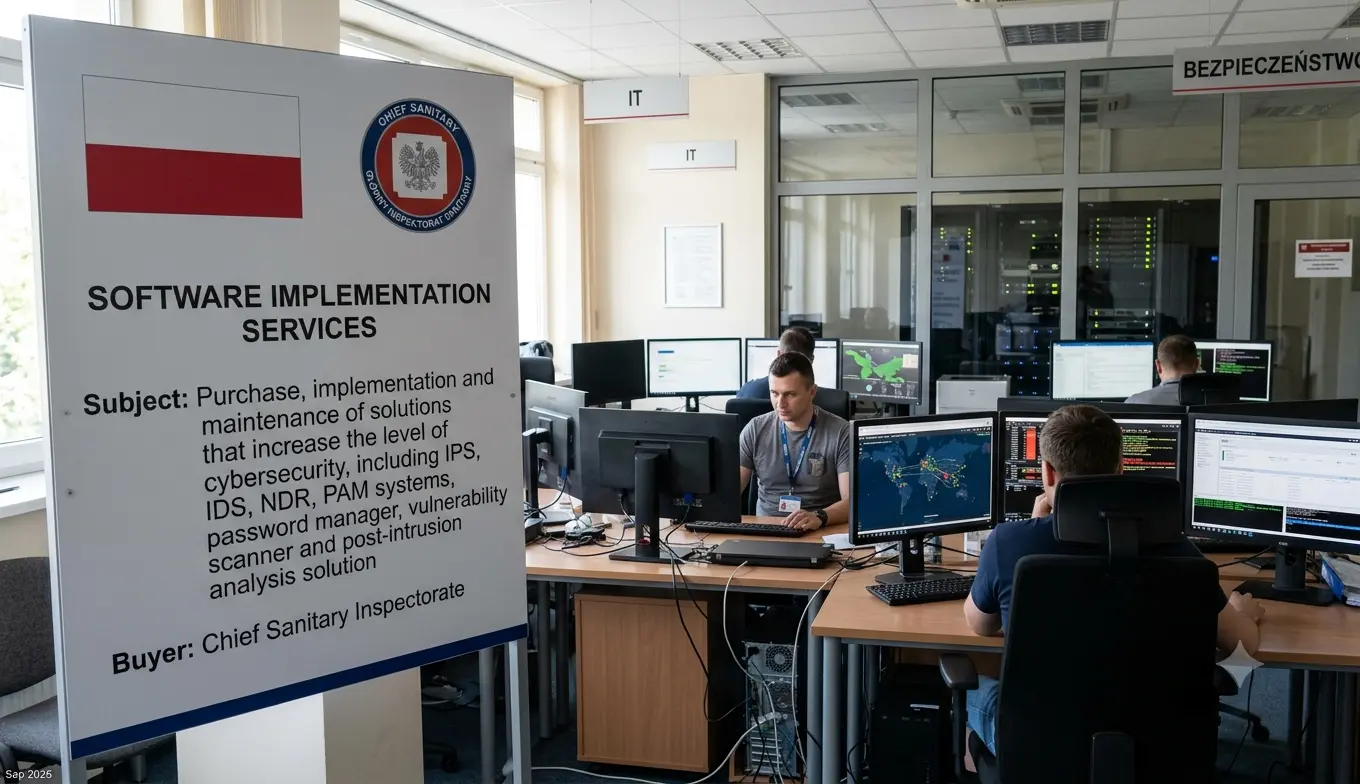
Poland Advances Cybersecurity Procurement for Sanitary Inspection Network with Seven Technology Lots
17 Sep 2026
Standfirst: Poland has published the results stage of a major cybersecurity procurement covering seven technology areas for the Chief Sanitary Inspectorate and subordinate border sanitary and epidemiological stations. The procurement covers implementation and maintenance of IPS, IDS, NDR, PAM, password management, vulnerability scanning and post incident analysis solutions. Six lots remain in an ongoing competition, while the third lot closed without receiving any tenders. The project is being financed with European Union funding under Poland's National Recovery and Resilience Plan and is intended to increase the institutional cyber resilience of units of the State Sanitary Inspection. Introduction Poland's Główny Inspektorat Sanitarny, or Chief Sanitary Inspectorate, is progressing with a multi lot procurement designed to strengthen cybersecurity capabilities across the State Sanitary Inspection network. TED publication 642655-2026 identifies the procurement as a services contract for the purchase, implementation and maintenance of cybersecurity solutions covering several complementary security functions. The procurement is divided into seven lots, allowing suppliers to bid for individual technology areas rather than requiring a single solution across the entire programme. The notice states that the project is being implemented for the Chief Sanitary Inspectorate and nine subordinate border sanitary and epidemiological stations. The procurement is part of the project titled “Zwiększenie instytucjonalnej cyberodporności jednostek Państwowej Inspekcji Sanitarnej”, translated as increasing the institutional cyber resilience of units of the State Sanitary Inspection. The notice links the project to the European Union funded National Recovery and Resilience Plan, specifically Priority C3 Cybersecurity and Measure C3.1.1 Cybersecurity, known as CyberPL. Why This Contract Matters The procurement is significant because it approaches cybersecurity as a collection of connected capabilities rather than a single software purchase. The seven lots address prevention, detection, privileged access, password management, vulnerability identification, network monitoring and post incident analysis. Together, these functions cover multiple stages of an organisation's cybersecurity operating environment. For public health institutions, strengthening digital resilience can support the continuity and protection of information systems used by administrative and operational units. The procurement also has a distributed implementation dimension because the notice identifies multiple subordinate border sanitary and epidemiological stations as beneficiaries of the project. This creates a broader institutional requirement than a solution intended only for the central authority. Contract Timeline The procurement carries internal identifier 17/2026/P and procedure identifier 8f5c05d4 6a14 4a51 8278 08ffd8b13a7a. The previous notice associated with the procurement is 575843-2026. TED publication 642655-2026 was published in Official Journal S issue 180/2026 on 17 September 2026 after being dispatched on 15 September 2026. The procurement uses an open procedure and is not identified as an accelerated procedure. Each of the seven lots has an estimated duration of 1,141 days. The current result notice does not record completed winner selection for six lots and records no winner for Lot 3 because no tenders were received. Contract Overview The procurement covers software implementation services under main CPV code 72263000, Software implementation services. Additional classifications are CPV 48000000 for software package and information systems and CPV 48517000 for IT software package. The place of performance is Warsaw, Poland, within the Miasto Warszawa NUTS region PL911. Rather than creating a framework agreement or dynamic purchasing system, the contracting authority is procuring the seven defined lots directly through the open procedure. The notice states that partial offers are permitted and suppliers may submit offers for any number of lots, with no maximum number of lots that can be awarded to the same supplier. Key Contract Details DetailInformation CountryPoland Contracting AuthorityGłówny Inspektorat Sanitarny ProcurementPurchase, implementation and maintenance of cybersecurity solutions ProcedureOpen procedure Internal Identifier17/2026/P Number of Lots7 Main CPV72263000, Software implementation services Additional CPVs48000000, 48517000 LocationWarsaw, Poland Lot Duration1,141 days FundingEuropean Union funds through the National Recovery and Resilience Plan GPA CoveredYes Framework AgreementNo Dynamic Purchasing SystemNo Current Result StatusSix lots ongoing; Lot 3 closed without tenders Project Scope The first lot concerns an Intrusion Prevention System, or IPS, intended to detect and block attacks in real time. The second lot covers an Intrusion Detection System, or IDS, focused on detecting intrusions, monitoring network traffic, analysing known threats and identifying suspicious activity or anomalies. These two areas provide complementary capabilities for monitoring and responding to network security events. The third lot covers post incident analysis software intended for active testing of computer systems, networks or applications to identify weaknesses that could potentially be exploited for unauthorised access or attacks. The fourth lot concerns a central password management solution for secure management, storage and transfer of passwords together with technical support. The fifth lot covers Privileged Access Management, or PAM, together with technical support. The sixth concerns vulnerability scanning software for automated identification of vulnerabilities in information and communications technology infrastructure. The seventh covers Network Detection and Response, or NDR, for network monitoring and threat response together with technical support. About the Contracting Authority Główny Inspektorat Sanitarny is the contracting authority named in the TED notice. The organisation is classified as a body governed by public law and its contracting authority activity is identified under the health sector. Its registered address is Targowa 65 in Warsaw. The procurement is intended not only for the central organisation but also for nine subordinate border sanitary and epidemiological stations located in Dorohusk, Elbląg, Gdynia, Hrebenne, Koroszczyn, Przemyśl, Suwałki, Szczecin and Warsaw. About the Organisations Involved Główny Inspektorat Sanitarny is the buyer and the principal public organisation responsible for the procurement. The notice gives its registration number as 5252147194 and identifies its Warsaw headquarters at Targowa 65. Krajowa Izba Odwoławcza is identified as the review organisation and as the organisation providing information on review procedures. It is based at ul. Postępu 17 in Warsaw and is associated with the procurement's formal review arrangements. Publications Office of the European Union is identified in the notice as the TED eSender. The organisation is based in Luxembourg and is responsible for the publication infrastructure through which the procurement notice appears in the Official Journal of the European Union. The notice does not identify a successful supplier for the six lots that remain open and therefore no awarded supplier should be named for those lots. For Lot 3, the notice explicitly records that no tenders, requests to participate or projects were received. Procurement Analysis The structure of this procurement indicates an effort to separate major cybersecurity functions into clearly defined procurement packages. This allows suppliers with specialised capabilities to compete for relevant lots while giving the contracting authority flexibility to source different categories of technology independently. The notice expressly permits partial bids for any number of lots. Another notable feature is the common CPV classification across the lots. Each lot uses software implementation services as its main classification with software package and information systems and IT software package as additional classifications. This reflects the fact that the procurement is not limited to supplying software products but also includes implementation and related support requirements. The procurement is also designed around a relatively long delivery period of 1,141 days for each lot. This creates a service component alongside implementation and means suppliers need to consider the ability to support the solutions throughout the stated contract period. Additional Procurement Facts The procurement is covered by the Government Procurement Agreement. The notice also confirms that it does not involve a framework agreement or dynamic purchasing system. Price is identified as the award criterion with a 100% weighting for each lot, with detailed methodology referred to in the procurement documents. The authority does not permit variant offers and does not provide for an electronic auction. It also permits equivalent solutions where the procurement documentation identifies trademarks, patents, origins, sources or specific processes, provided the proposed equivalent meets the requirements specified in the description of the subject matter of the procurement. Market & Industry Perspective The procurement demonstrates how public sector cybersecurity programmes can be divided into specialised technology categories. IPS, IDS and NDR address different aspects of network security, while PAM and password management focus on access control. Vulnerability scanning addresses identification of weaknesses and post incident analysis addresses activities following security events or security testing. For the cybersecurity technology market, this type of procurement can create opportunities for software vendors, implementation partners, systems integrators and technical support providers. Because suppliers can submit bids for individual lots, participation does not necessarily require a company to provide every capability listed in the overall procurement. The procurement also highlights the importance of implementation services. The principal CPV is not simply a software product classification but software implementation services, while the procurement description repeatedly combines technology acquisition with implementation and technical support. Economic Significance The notice does not state a total contract award value because the procurement has not reached completed award status for the six ongoing lots. Accordingly, no overall awarded value should be attributed to this notice. Its economic significance instead comes from the scale and breadth of the technology programme and its EU funding connection. The project is financed through the National Recovery and Resilience Plan under the cybersecurity component identified in the notice. Future Procurement Opportunities The current procurement status provides an important signal for suppliers tracking Polish public sector cybersecurity opportunities. Six lots remain listed as ongoing, covering IPS, IDS, password management, PAM, vulnerability scanning and NDR. Companies monitoring these categories should therefore distinguish this notice from a conventional completed award notice. Lot 3 may also be relevant for future market monitoring because it closed without receiving tenders. The notice identifies the subject as post incident analysis software and records that no tenders, requests to participate or projects were received. Future procurement activity may also emerge around maintenance, upgrades, renewals, additional security capabilities or related implementation services as public institutions continue developing cyber resilience programmes. The present notice alone, however, does not confirm any future procurement dates or contracts. Opportunities for Suppliers Suppliers specialising in one or more of the seven cybersecurity categories can assess the procurement on a lot by lot basis. The authority allows offers for any number of lots and does not set a maximum number of lots that may be awarded to the same supplier. The project also creates opportunities for suppliers capable of combining software implementation with continuing technical support. Companies considering participation should review the official procurement documentation and the detailed requirements in the relevant description of the subject matter and draft contractual provisions. What Businesses Should Watch Businesses should first watch the status of the six lots still shown as ongoing in TED. The result section does not identify winners for these lots, so suppliers and procurement intelligence teams should avoid treating the publication as a final award announcement. Second, businesses should monitor any subsequent notice concerning Lot 3 because the current publication records no tenders. A subsequent procurement or revised approach could create a new opportunity, although the present notice does not confirm that such a procurement will occur. Finally, suppliers should pay attention to the implementation and support requirements rather than viewing the procurement solely as a software licensing opportunity. The common CPV structure and the descriptions across the seven lots indicate that implementation is a central part of the procurement. PolandTenders.com Procurement Intelligence From a procurement intelligence perspective, this notice illustrates a broader shift toward modular cybersecurity procurement in public institutions. Instead of sourcing one broad cybersecurity platform, the authority has structured the requirement around distinct security capabilities that can be procured separately. This structure gives specialist technology providers an identifiable entry point into a wider public sector programme. The strategic importance of the procurement is also visible in its funding model. The project is connected to the National Recovery and Resilience Plan and specifically to the cybersecurity component of the programme. That connection shows how EU backed investment can translate into technology procurement across public institutions and their subordinate units. For suppliers, one of the clearest lessons is the value of precise positioning around individual cybersecurity capabilities. A company does not necessarily need to offer every technology listed in the overall procurement because the contracting authority has expressly permitted partial offers across the seven lots. This can allow specialised vendors and implementation partners to identify the lot that most closely matches their product and service portfolio. Supplier positioning should also account for the complete delivery lifecycle. The procurement descriptions combine acquisition and implementation with support in several technology areas, while each lot carries a duration of 1,141 days. Suppliers therefore need to assess their ability to provide implementation resources and sustained technical support rather than focusing only on the initial software component. Looking ahead, similar public sector cybersecurity procurements could increasingly combine network monitoring, identity and privileged access controls, vulnerability management and incident analysis within coordinated programmes. Whether future procurements use the same seven lot structure will depend on individual contracting authorities and their requirements, but this notice provides a useful example of how a public institution can divide a large cybersecurity requirement into specialised procurement categories. Supplier Takeaways Track all seven lots separately because their procurement outcomes are not identical. Six lots are currently shown as ongoing and do not have selected winners in this notice. Lot 3 closed without receiving any tenders, requests to participate or projects. Partial bidding is permitted and suppliers may bid for any number of lots. The award criterion for each lot is price with a stated 100% weighting. The main CPV is 72263000 for software implementation services. Implementation and technical support are important components across the procurement. The stated duration for each lot is 1,141 days. The procurement is funded through an EU backed National Recovery and Resilience Plan cybersecurity project. Suppliers should review the detailed SWZ and technical specifications before assessing eligibility or bid strategy. Key Takeaways Buyer: Główny Inspektorat Sanitarny. Country: Poland. Location: Warsaw, Poland. Procurement: Cybersecurity software purchase, implementation and maintenance. Lots: Seven. Technology areas: IPS, IDS, post incident analysis, password management, PAM, vulnerability scanning and NDR. Procedure: Open procedure. Main CPV: 72263000, Software implementation services. Additional CPVs: 48000000 and 48517000. Duration: 1,141 days per lot. Funding: European Union funds through the National Recovery and Resilience Plan. GPA: Yes. Framework agreement: No. DPS: No. Current result: Six lots remain ongoing and one lot closed without tenders. Conclusion Poland's seven lot cybersecurity procurement represents a broad digital resilience programme for the Chief Sanitary Inspectorate and its subordinate border sanitary and epidemiological stations. The current TED result notice should be understood as a procurement status update rather than a completed contract award, with six lots still ongoing and Lot 3 closed without tenders. For cybersecurity suppliers, the procurement provides a clear view of the technology categories being addressed and demonstrates the opportunities created by EU supported public sector cyber resilience investment in Poland. Source: TED, Contract or concession award notice, publication 642655-2026, OJ S 180/2026, published 17 September 2026.
View Details