298 Accidents, 34 Deaths, One Overloaded Road: Poland Starts Designing the Replacement for the DK75
Standfirst
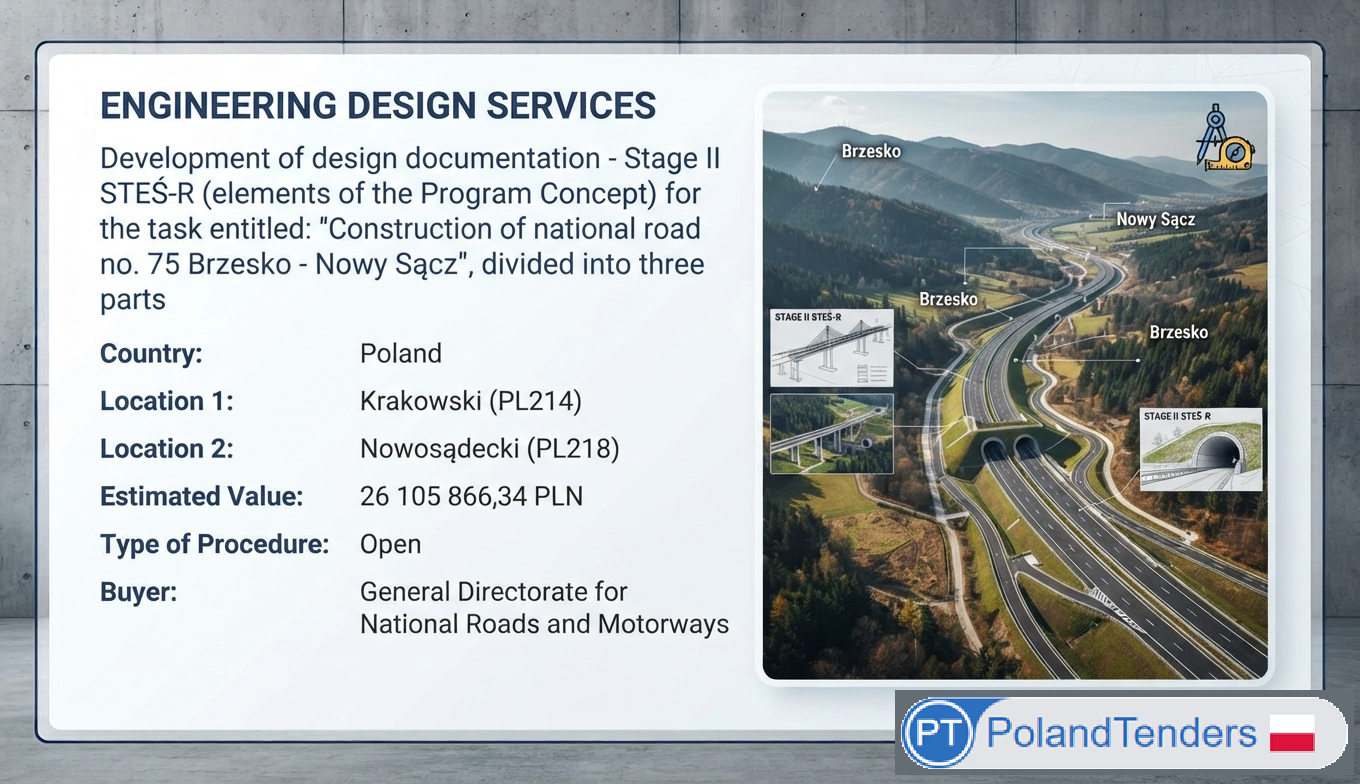
Between 2017 and 2024, the DK75 national road connecting Brzesko and Nowy Sącz in southern Poland recorded 298 accidents and 34 deaths, a quarter of them pedestrians, on a route now carrying up to 21,500 vehicles a day through terrain it was never built to handle at this volume. Poland's national roads authority has awarded the design contracts for two of the first three sections of its replacement, a new dual carriageway road known locally as the "Sądeczanka", to specialist engineering firms DATABOUT and a Transprojekt Warszawa led consortium.
Introduction
Some roads earn a nickname because people love them. The DK75 between Brzesko and Nowy Sącz has earned one, "Sądeczanka", after the Sądecki region it eventually reaches, because people are waiting with growing impatience for its replacement. The existing route winds through Małopolska's hill country carrying traffic volumes it was never designed for and the safety statistics attached to it are stark enough that Poland's Ministry of Infrastructure has folded its reconstruction into an approximately PLN 8 billion regional investment programme.
Before a single metre of new carriageway can be built, however, the road has to be designed and designing a nearly 47 kilometre dual carriageway route through varied and difficult terrain is itself a substantial undertaking. The General Directorate for National Roads and Motorways (GDDKiA), through its Kraków branch, has now awarded design contracts for two of the project's three initial sections, covering the technical, economic and environmental feasibility study stage, plus supporting geological and geotechnical work, to DATABOUT Sp. z o.o. and a consortium led by Biuro Projektowo Badawcze Dróg i Mostów TRANSPROJEKT WARSZAWA.
Why This Contract Matters
The case for rebuilding this stretch of road is written in its accident record. Between 2017 and 2024, the existing DK75 recorded 298 crashes along its roughly 47 kilometre length, resulting in 34 deaths and 439 injuries, 127 of them serious and roughly one in four fatalities was a pedestrian. Traffic near Nowy Sącz, Małopolska's third largest city, now reaches up to 21,500 vehicles a day on a route that was never engineered for this level of demand with quieter sections still carrying around 12,000 vehicles daily.
The planned new route, a genuine dual carriageway "GP class" road (Poland's classification for a main road built for accelerated traffic flow, broadly comparable to a grade separated expressway), is projected to cut travel time between Brzesko and Nowy Sącz from roughly 60 minutes to about 30, while providing a safer, grade separated connection to the A4 motorway and, through it, to Kraków and Tarnów. This design contract is the first concrete step toward that outcome for two of the route's three initial sections; without it, none of the safety, economic or connectivity benefits the project promises can begin to materialise.
Contract Timeline
| Date | Milestone |
|---|---|
| 27 September 2021 | GDDKiA formally initiates the environmental decision process for the Brzesko-Nowy Sącz route |
| March 2026 | Tenders for the programme concept and geological studies for the first three sections publicly announced |
| 14 July 2026 | Contracts concluded with DATABOUT (Section III / Part 2) and the Transprojekt Warszawa-Infra consortium (Section V / Part 3) |
| 21 July 2026 | Award notice dispatched to the EU Publications Office |
| 22 July 2026 | Notice published in OJ S 139/2026 |
| 2027–2028 | Further tenders planned for detailed design and construction of the route |
| 2030–2031 | Construction works expected to begin, per GDDKiA's public statements |
Contract Overview
GDDKiA's Kraków branch ran an open procedure, split into three parts, to procure Stage II STEŚ R design documentation, a Polish technical economic environmental feasibility study incorporating elements of a formal programme concept, for the new DK75 road between Brzesko and Nowy Sącz. This notice reports results for two of the three parts: Part 2 (Section III, from Wytrzyszczka to Łososina Dolna) and Part 3 (Section V, from Tęgoborze to Nowy Sącz). Part 1, covering Section I from Okocim to Uszew, does not appear in this notice's results and its outcome is not disclosed here.
DATABOUT Sp. z o.o., a Warsaw based medium sized engineering firm, won Part 2 with a tender of PLN 5,342,000, from a field of five bidders, four of them SMEs. A consortium led by Biuro Projektowo Badawcze Dróg i Mostów TRANSPROJEKT WARSZAWA, alongside partner Infra - Centrum Doradztwa, won Part 3 with a tender of PLN 10,176,900, from a field of two bidders, both SMEs. Both contracts require the winning designers to remain available to answer technical questions during the subsequent tender procedure for the construction contractor, a structural link between the design and construction phases common in major Polish road projects.
Key Contract Details
| Field | Detail |
|---|---|
| Contracting authority | Generalna Dyrekcja Dróg Krajowych i Autostrad (GDDKiA), Kraków Branch |
| Winning contractors | DATABOUT Sp. z o.o. (Part 2 / Section III); Konsorcjum Biuro Projektowo Badawcze Dróg i Mostów TRANSPROJEKT WARSZAWA (leader) Infra Centrum Doradztwa (Part 3 / Section V) |
| Title | Opracowanie dokumentacji projektowej -Etap II STEŚ R dla zadania "Budowa DK nr 75 Brzesko -Nowy Sącz" |
| CPV code | 71320000 -Engineering design services (plus geology, geotechnical, architectural and surveying classifications) |
| Procedure type | Open (using Poland's "reversed procedure" under Article 139(1) of the Public Procurement Law) |
| Legal basis | Directive 2014/24/EU |
| Estimated value (full three part procurement) | PLN 26,105,866.34 |
| Value of contracts awarded in this notice | PLN 15,518,900.00 |
| Part 2 (Section III) estimated value / awarded value | PLN 6,010,570.00 estimated / PLN 5,342,000.00 awarded |
| Part 3 (Section V) estimated value / awarded value | PLN 9,678,260.34 estimated / PLN 10,176,900.00 awarded |
| Award criteria | Price (60%); Road Designer Experience (20%); Geological Team Experience (20%) |
| Contract duration | Part 2: 30 months; Part 3: 27 months, extendable to a maximum 36 months if the contract option is exercised |
| Tenders received | Part 2: 5 (4 from SMEs); Part 3: 2 (both SMEs) |
| EU funding | None disclosed |
| GPA coverage | Yes |
| Framework agreement | None |
| Review body | Krajowa Izba Odwoławcza (National Appeals Chamber) |
| Place of performance | Krakowski and Nowosądecki sub regions, Małopolskie voivodeship, Poland |
Project Scope
Each part of this contract covers preparation of Stage II STEŚ R documentation, a combined technical, economic and environmental feasibility study with elements of a formal "Programme Concept", the stage of Polish road planning that follows initial corridor selection and precedes detailed engineering design. The work includes design mapping, traffic analysis and forecasting, geophysical surveys and geological engineering documentation, together with an obligation to respond to technical questions raised during the subsequent tender for the construction contractor.
Part 3 (Section V, Tęgoborze to Nowy Sącz) carries an additional contract option covering the stretch from roughly design kilometre 42+500 to the end of the section within the city of Nowy Sącz itself, the most technically and socially sensitive portion of the route, running through built up urban terrain. If GDDKiA exercises this option, the contractor's obligations expand to include design mapping, traffic forecasting, geophysical testing and geological engineering documentation specifically for this urban stretch, extending the maximum contract term to 36 months.
Across the wider, three part programme, the new road is planned as a roughly 47 kilometre, dual carriageway GP class route with two lanes in each direction and grade separated junctions eliminating direct property access points, a substantially different design standard from the existing single carriageway DK75 it will eventually replace.
About the Contracting Authority
Generalna Dyrekcja Dróg Krajowych i Autostrad (GDDKiA), Poland's General Directorate for National Roads and Motorways, is the central government authority responsible for planning, procuring and maintaining Poland's national road and motorway network. Its Kraków branch is managing this project given the route's location entirely within Małopolskie voivodeship and this design procurement sits within a broader, approximately PLN 8 billion investment programme covering the full Brzesko - Nowy Sącz corridor, part of Poland's National Road Construction Programme running to 2030, with a further planning horizon to 2033.
About the Organisations Involved
DATABOUT Sp. z o.o., Winning Tenderer (Part 2 / Section III)
DATABOUT, headquartered in Warsaw and classified as a medium sized enterprise, won the design contract for Section III, running from Wytrzyszczka to Łososina Dolna, with the winning tender disclosing planned subcontracting in geology and geotechnics, geodesy and traffic analysis and forecasting, indicating the firm will bring in specialist partners for specific technical disciplines while retaining overall project leadership.
Biuro Projektowo-Badawcze Dróg i Mostów TRANSPROJEKT-WARSZAWA Sp. z o.o., Winning Tenderer (Part 3 / Section V, Consortium Leader)
TRANSPROJEKT-WARSZAWA, a Warsaw based medium sized road and bridge design and research bureau, led the winning consortium for Section V, the segment running from Tęgoborze into Nowy Sącz itself, the most complex portion of the route given its urban terminus. The firm's specific focus on road and bridge engineering design and research reflects the kind of specialist technical pedigree that Polish national road procurement typically requires for the most technically demanding project segments.
Infra - Centrum Doradztwa Sp. z o.o., Winning Tenderer (Part 3 / Section V, Consortium Partner)
Infra -Centrum Doradztwa, also based in Warsaw and classified as a medium sized enterprise, joined TRANSPROJEKT WARSZAWA as consortium partner for Section V. As with DATABOUT's Section III award, the consortium's winning tender discloses planned subcontracting in geology, traffic analysis and forecasting and geodesy, again reflecting how these complex feasibility studies typically draw on a network of specialist subcontractors beyond the lead consortium members themselves.
Krajowa Izba Odwoławcza, Review Organisation
Poland's National Appeals Chamber, based in Warsaw, is the designated review body for this procurement, providing the formal legal channel through which unsuccessful bidders across either part could challenge the award, with further appeal possible to the Warsaw Regional Court's dedicated public procurement division.
Procurement Analysis
GDDKiA structured the evaluation for both parts identically: price counted for 60% of the score, with the remaining 40% split evenly between two quality criteria assessing the specific, named individuals a bidder proposes to lead the work, a "Road Designer Experience" criterion and a "Geological Team Experience" criterion, each further subdivided by specific expertise (a geologist and a geophysicist evaluated separately within the geological criterion). This individual expertise based scoring, common in Polish infrastructure design procurement, ties the evaluation directly to the track record of specific named professionals rather than the bidding firm's institutional credentials alone, a bidder proposing a road designer or geologist with a stronger personal history of comparable projects scores measurably higher, regardless of the firm's overall size or reputation.
The contrast in competitive intensity between the two awarded parts is worth noting. Section III (Part 2) drew five tenders, four from SMEs, a genuinely competitive field for a specialised engineering design contract. Section V (Part 3), arguably the more complex segment, given its urban terminus in Nowy Sącz and its attached contract option, drew only two tenders, both from SMEs, a narrower field consistent with the additional technical complexity and risk that section's scope likely represented to prospective bidders.
The absence of Section I (Part 1, Okocim–Uszew) from this notice's results is worth flagging plainly. Summing the two disclosed parts' estimated values (PLN 6,010,570 + PLN 9,678,260.34) against the overall three part estimated value of PLN 26,105,866.34 leaves a residual of approximately PLN 10.4 million implicitly attributable to Part 1, a section evidently included in the original tender but whose specific award outcome is not reported in this particular notice.
Additional Procurement Facts
Across the two disclosed parts, seven tenders were received in total (five for Part 2, two for Part 3), all submitted electronically, with six of the seven coming from micro, small or medium sized enterprises. No tenders were received from bidders registered in other EEA countries or outside the EEA for either part. Both winning tenderers disclosed planned subcontracting, though neither the specific value nor percentage of subcontracted work is disclosed in the notice. GDDKiA's procedure explicitly excludes contractors subject to EU Regulation 833/2014 sanctions connected to Russia's actions in Ukraine, a standard exclusion clause now embedded in Polish public procurement documentation. The project carries no EU funding and is confirmed as covered by the WTO Government Procurement Agreement.
Market & Industry Perspective
Polish road design and feasibility study work of this kind is served by a specialist field of domestic engineering and planning firms, DATABOUT, TRANSPROJEKT WARSZAWA and Infra - Centrum Doradztwa among them, many of which have long established track records delivering GDDKiA's STEŚ and STEŚ R studies across the country's national road network. Unlike the later construction phase, where large international contractors with heavy civil engineering capacity typically dominate, the design and feasibility stage tends to favour specialist Polish engineering consultancies with deep familiarity with national environmental impact assessment procedures, traffic modelling requirements and the specific documentation standards GDDKiA requires before a project can proceed to construction tender.
That both winning parties in this notice are Warsaw based firms, despite the project itself being located entirely within Małopolskie voivodeship in southern Poland, reflects how concentrated Poland's specialist road design engineering sector remains around the capital, even for projects located well outside it.
Economic Significance
At a combined awarded value of PLN 15.5 million across these two design contracts and an estimated PLN 26.1 million across the full three part design programme, this is a modest fraction of the roughly PLN 8 billion the wider Brzesko–Nowy Sącz road project is projected to cost when construction eventually proceeds, but it is an essential and unavoidable one. No construction tender and no construction funding commitment, can meaningfully proceed until this design and feasibility stage is complete, environmental approvals are secured and a preferred route corridor is finalised.
For the Małopolska region, the broader economic case rests on substantially improved connectivity between Nowy Sącz, the region's third largest city and the A4 motorway corridor linking Kraków and Tarnów, a connection expected to support both freight logistics and tourism access to southern Małopolska's mountain and lake districts.
Future Procurement Opportunities
With this design stage now under way for two of the project's three initial sections, GDDKiA's own public statements indicate further tenders covering detailed design and construction are planned for 2027 and 2028, with physical construction works expected to begin in 2030 and 2031. Section I (Okocim–Uszew), whose design contract result is not included in this notice, should also be watched for separate publication, either through a corrigendum to this notice or a standalone award notice.
Suppliers of traffic modelling, environmental impact assessment and geological survey services should watch for continued procurement activity as this project and comparable Małopolska road schemes, including the parallel S52 Bielsko Biała-Głogoczów expressway project referenced in GDDKiA's own regional investment planning, progress through their respective design stages over the coming two to three years.
Opportunities for Suppliers
Specialist geological, geophysical, traffic modelling and geodetic subcontractors should note that both winning consortia in this notice disclosed plans to bring in subcontractors for exactly these disciplines, suggesting genuine subcontracting opportunities beneath the two lead design contracts as work proceeds. Construction contractors with heavy civil engineering and mountainous terrain road building experience should begin tracking this project now, well ahead of the 2027-2028 construction tenders GDDKiA has publicly flagged, given the multi year lead time typical of major Polish national road procurement.
What Businesses Should Watch
Three developments are worth tracking as this project progresses. First, the outcome of Section I's design contract (Part 1, Okocim–Uszew), not disclosed in this notice, which would complete the picture of all three initial design awards. Second, whether GDDKiA exercises the contract option attached to Section V, extending the Transprojekt Warszawa–Infra consortium's scope to cover the technically demanding urban terminus within Nowy Sącz itself. Third, the timing and structure of the subsequent detailed design and construction tenders GDDKiA has indicated for 2027 and 2028, since these will represent substantially larger contract opportunities than the design stage awards covered in this notice.
PolandTenders.com Procurement Intelligence
This notice captures an early, unglamorous but essential stage in how major road infrastructure gets built in Poland: years of feasibility studies, environmental assessments and route corridor analysis precede a single construction contract and the specialist engineering firms who win these design stage contracts quietly shape decisions, route corridor, junction placement, environmental mitigation measures, that will determine the character of the eventual road for decades. The road safety statistics driving this specific project (298 accidents, 34 deaths, disproportionate pedestrian fatalities) illustrate why GDDKiA and Poland's Ministry of Infrastructure have prioritised this corridor within the broader national road programme, but the actual mechanism for delivering that safety improvement runs first through exactly this kind of specialist design procurement, years before any visible construction begins.
The individual expertise weighted evaluation criteria used here, scoring bidders on the specific named road designer and geological team members they propose, rather than institutional credentials alone, is a notable and replicable feature of Polish infrastructure design procurement, one that rewards firms able to demonstrate a genuinely experienced technical team rather than simply a strong corporate track record. Suppliers competing for comparable Polish road design contracts should recognise that assembling the right named personnel, with directly comparable prior project experience, can be as decisive to winning as price itself, given the 40% combined weighting attached to these criteria across both parts of this contract.
Looking ahead, the gap in this notice around Section I's award outcome is a reminder that complex, multi part infrastructure procurement does not always publish complete results in a single notice, tracking a major road corridor project of this kind properly requires following multiple related notices across its full design and construction lifecycle, not just the first one to appear.
Supplier Takeaways
- Polish national road design procurement rewards bidders who propose specific, individually experienced personnel (road designers, geologists, geophysicists), assembling the right named team can be as decisive as price given the substantial combined weighting these criteria typically carry.
- Specialist subcontracting opportunities in geology, geotechnics, traffic modelling and geodesy exist beneath major design consortia, as both winning bids in this notice demonstrate.
- Design stage contracts of this kind are the essential precursor to much larger detailed design and construction tenders, GDDKiA has publicly flagged 2027–2028 for the next tender wave on this specific project.
- Warsaw based specialist engineering consultancies continue to dominate Polish road design procurement even for projects located well outside the capital region.
- Watch for related notices covering any project section whose results are not disclosed in a given notice, since multi part infrastructure procurement often publishes results incrementally across several separate publications.
Key Takeaways
- GDDKiA's Kraków branch awarded design contracts for two of three initial sections of the new DK75 Brzesko–Nowy Sącz road ("Sądeczanka") to DATABOUT Sp. z o.o. (Section III, PLN 5,342,000) and a Transprojekt Warszawa led consortium (Section V, PLN 10,176,900).
- The wider road project responds to a serious safety record, 298 accidents and 34 deaths on the existing route between 2017 and 2024 and is projected to cost roughly PLN 8 billion when construction eventually proceeds.
- These design contracts cover Stage II STEŚ R feasibility and environmental study documentation, evaluated 60% on price and 40% on the named technical team's individual experience.
- Section I's design contract result is not disclosed in this notice.
- Construction on the wider project is expected to begin in 2030-2031, following further detailed design and construction tenders planned for 2027–2028.
Conclusion
No driver will ever see this contract reflected directly in the road they eventually use, feasibility studies and environmental documentation are, by design, invisible to the public they ultimately serve. But this unglamorous design work is precisely what stands between a stretch of road with a documented, tragic accident record and a safer, faster replacement more than a decade in the planning. For Małopolska's Sądecki region, this contract is a genuine, if quiet, first step toward that outcome.
Source: EU Official Journal, Contract Award Notice 504992-2026, OJ S 139/2026, published 22/07/2026. Contracting authority: Generalna Dyrekcja Dróg Krajowych i Autostrad.
Frequently Asked Questions (FAQs)

Fresh and verified Tenders from Poland. Find, search and filter Tenders/Call for bids/RFIs/RFPs/RFQs/Auctions published by the government, public sector undertakings (PSUs) and private entities.
- 1,000+ Tenders
- Verified Tenders Only
- New Tenders Every Day
- Tenders Result Data
- Archive & Historical Tenders Access
- Consultants for RFI/RFP/RFQ
- Tender Notifications & Alerts
- Search, Sort, and Filter Tenders
- Bidding Assistance & Consulting
- Customer Support
- Publish your Tenders
- Export data to Excel
- API for Tender Data
- Tender Documents

Fill out the form below and you will receive a call from us within 24 hours.
Get FREE SAMPLE TENDERS from Poland in your email inbox.
Copyright © 2014-2026 PolandTenders.com. All Rights Reserved.