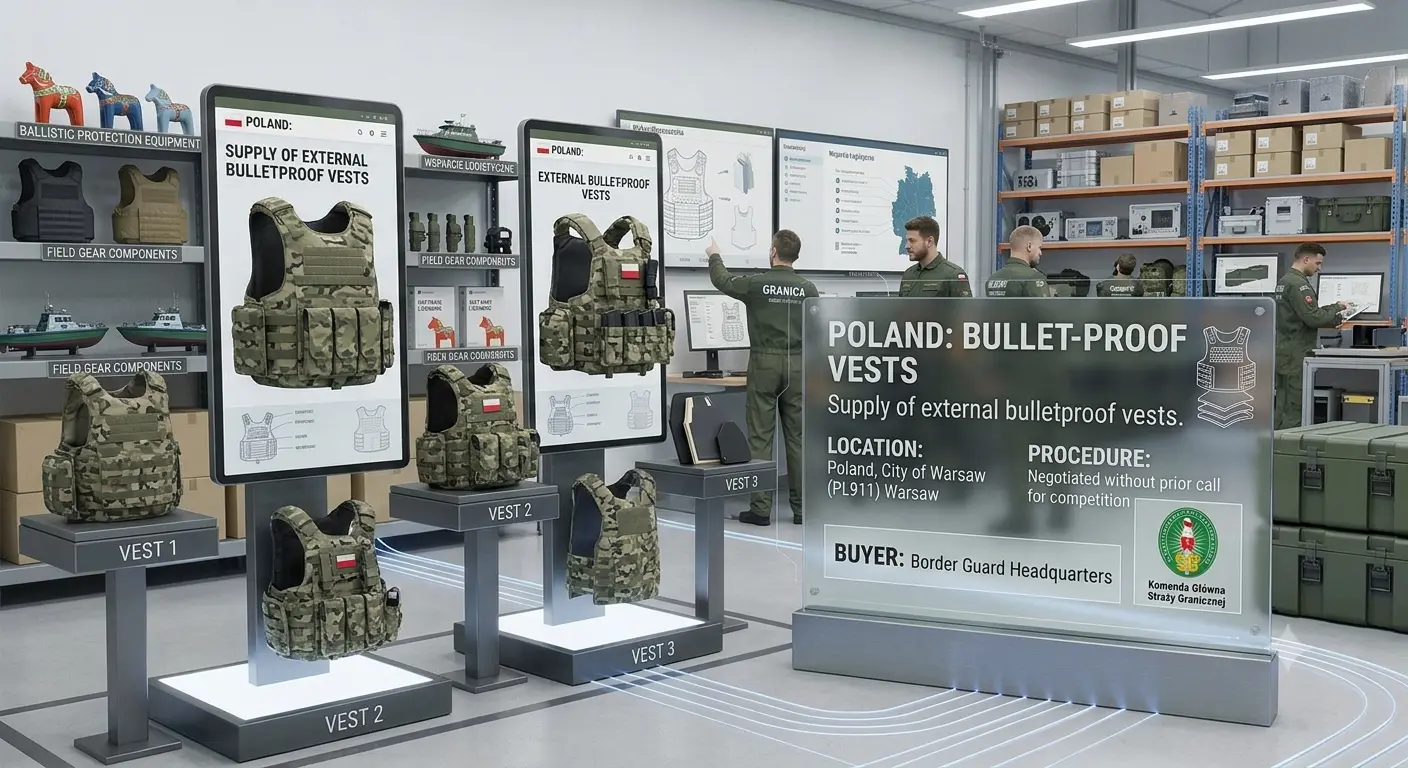
Poland's Border Guard Buys Bulletproof Vests in a Crisis Procedure Worth PLN 5.35 Million
21 Oct 2026
Standfirst Poland's Border Guard Headquarters has awarded a contract to HPE Polska Sp. z o.o. for the supply of external bulletproof vests, valued at PLN 5,350,500. The contract was awarded without a call for competition, under the defence and security exclusion for crisis situations. Only one tender was received, and the winner is a company registered in Kielce. The award cites the escalation of Russian aggression against Ukraine and the introduction of the CHARLIE terrorist alert level on selected railway lines as the basis for urgent procurement. Introduction Border guards are among the most exposed public officials in Europe. They work at crossing points, patrol the external frontier and respond to incidents that can escalate quickly. For Poland's Straż Graniczna, the Border Guard, the security environment changed sharply after Russia's full-scale invasion of Ukraine in 2022, and it has remained tense since. Threats that were once theoretical, including drone attacks near the border and sabotage directed at rail infrastructure, have become operational realities. Personal protection is a basic requirement in that environment. External bulletproof vests are worn over uniforms and provide protection against ballistic threats. They are not a one-off purchase. Vests wear out, are damaged in service and need replacement, and the force must maintain enough stock to equip officers deployed to high-risk locations. The Border Guard Headquarters has now procured a batch of external bulletproof vests through an urgent procedure, citing the crisis situation on the border with Ukraine. Why This Contract Matters This contract matters because it protects the officers who guard Poland's eastern border. The notice is unusually explicit about the threat. It refers to the escalation of armed aggression by the Russian regime against Ukraine, including the use of unmanned aerial vehicles to attack targets near the Polish-Ukrainian border. It also refers to the introduction of the third-level CHARLIE terrorist alert on selected railway lines managed by PKP Polskie Linie Kolejowe and PKP Linia Hutnicza Szerokotorowa, effective from 19 November 2025. It also matters because of the procurement route. The contract was awarded without a call for competition, using the defence and security exclusion for crisis situations under Article 415(2)(3) of the Polish Public Procurement Law, read with Article 408(3). That provision allows a contracting authority to act without the normal procedural timelines when immediate performance is required and the deadlines for a restricted tender or negotiated procedure with publication cannot be met. The notice sets out the justification in detail, and it is one of the clearer crisis justifications seen in recent Polish procurement. Finally, the contract matters because of the competition outcome. Only one tender was received, and the winner was HPE Polska Sp. z o.o., a company based in Kielce. The notice does not explain why only one bid was received, but the urgency of the procedure and the specialised nature of the product may have limited the field. The contracting authority has not disclosed this information. Contract Timeline Notice dispatched: 20 October 2026 Notice published: 21 October 2026 Winner selected: 18 October 2026 Contract end date: 29 December 2026 Contract Overview The contract covers the supply of external bulletproof vests for the Polish Border Guard. It is classified as a supplies contract, under CPV 35815100 (bullet-proof vests). It is a single-lot procurement, identified as LOT-0001, with the internal identifier 73/BF/BTiZ/26. The place of performance is Warsaw, postcode 02-148, in the Miasto Warszawa NUTS region (PL911). The value of all contracts awarded in the notice is PLN 5,350,500, which is also the value of the winning tender. The contract end date is 29 December 2026, which gives a short delivery window consistent with the urgent nature of the procurement. The procurement was conducted as a negotiated procedure without prior call for competition, under Directive 2009/81/EC, the EU defence and security procurement directive. It is not a framework agreement and does not use a dynamic purchasing system. It is not financed with EU funds. The award criterion was price, weighted at 100%. Key Contract Details Notice ID 726487-2026 OJ S issue 204/2026 Publication date 21 October 2026 Contracting authority Komenda Główna Straży Granicznej (Border Guard Headquarters) Contract type Supplies Main CPV code 35815100 – Bullet-proof vests Procedure type Negotiated without prior call for competition (direct award) Legal basis Directive 2009/81/EC and Polish Public Procurement Law Lot LOT-0001 Winner HPE Polska Sp. z o.o. Winning bid PLN 5,350,500.00 Number of bids 1 Award criterion Price – 100% Contract end date 29 December 2026 Framework agreement No EU funding No Subcontracting No Review body Krajowa Izba Odwoławcza Project Scope The scope is the supply of external bulletproof vests to the Polish Border Guard. The notice describes the subject in Polish as "Dostawa kamizelek kuloodpornych zewnętrznych," which translates as the supply of external bulletproof vests. External vests are worn over the uniform and provide ballistic protection without replacing the standard uniform. The notice does not disclose the number of vests being procured, the protection level required, the technical specification, the delivery schedule or the warranty terms. Those details would be in the procurement documents, which are not included in the TED notice. The contracting authority has not disclosed this information. The contract end date of 29 December 2026 gives a delivery window of roughly two months from the award date. That is consistent with the urgency of the procurement and with the notice's reference to the need for immediate delivery. The notice does not disclose whether the vests will be delivered in a single batch or in instalments. About the Contracting Authority The buyer is the Komenda Główna Straży Granicznej, the Border Guard Headquarters. It is classified as a central government authority with public order and safety as its main activity. Its registration number is 5212921032, and its address is Al. Niepodległości 100, Warszawa, postcode 02-585, in the Miasto Warszawa NUTS region (PL911). Its contact point is the Finance Bureau's public procurement unit, and its email address is zp.bf.kg@strazgraniczna.pl. The Border Guard is Poland's uniformed border protection service. It is responsible for protecting the country's borders, including the external EU border with Ukraine, Belarus and Russia, and for combating cross-border crime. It operates at border crossings, along the border line and at airports and seaports. Its officers are armed and equipped for police and security duties, and personal protective equipment is part of their standard kit. The headquarters is both the buyer and the organisation providing additional information about the procedure, offline access to the procurement documents and the contract signature. It defined the requirement, concluded the direct award and will manage delivery over the contract term. About the Organisations Involved Komenda Główna Straży Granicznej The Border Guard Headquarters is the contracting authority. It is Poland's central border protection authority, responsible for guarding the country's borders and for related law enforcement tasks. Its role in this procurement is as buyer and signatory of the contract. It is registered in Warsaw, with registration number 5212921032. It operates across Poland's land, sea and air borders, and it is directly affected by the security situation on the eastern border. The vests procured under this contract will be used by officers deployed to high-risk locations. HPE Polska Sp. z o.o. HPE Polska Sp. z o.o. is the winning bidder. Its registration number is 9592090259, and its address is ul. Długa 15, Kielce, postcode 25-650, in the Kielecki NUTS region (PL721). The notice does not classify the company by size, and it does not disclose an email address or telephone number. The notice does not describe HPE Polska's business in detail, but the name is associated with the Hewlett Packard Enterprise group, which is primarily a technology company rather than a textile or personal protective equipment manufacturer. That makes the award notable. The notice does not explain how the company will source or deliver the vests, whether it is acting as a reseller, an integrator or a manufacturer, or whether it has a specialist partner. The contracting authority has not disclosed this information. The company submitted the only tender for LOT-0001, identified as tender 1, valued at PLN 5,350,500. It declared no subcontracting. Its role is as tenderer and winner of LOT-0001. It will supply the external bulletproof vests to the Border Guard by 29 December 2026. Krajowa Izba Odwoławcza The Krajowa Izba Odwoławcza, Poland's National Appeal Chamber, is listed as the review organisation and the organisation providing more information on review procedures. Its registration number is 526223925, and its address is ul. Postępu 17a, Warszawa, postcode 02-676. Its email address is odwolania@uzp.gov.pl, and its telephone number is +48224587801. Its role is to hear appeals from suppliers who believe a procurement has been conducted improperly. The notice sets out the review deadlines, which depend on how the information about the contracting authority's action was communicated. In a direct award under the crisis exclusion, the scope for challenge is narrower than in a competitive procedure, but suppliers can still challenge the legality of the award if they believe the conditions for the exclusion were not met. No complaints were recorded. Publications Office of the European Union The Publications Office of the European Union is listed as the TED eSender. Its role is administrative: it operates Tenders Electronic Daily, the official journal supplement where EU procurement notices are published. It is based in Luxembourg and is not involved in the procurement itself. Other organisations The notice does not identify any other tenderers, consortium members, framework participants or subcontractors. Only one tender was received, from HPE Polska. No other organisation materially affects the understanding of this award. Procurement Analysis The procurement was conducted as a negotiated procedure without prior call for competition, which is a direct award. This is an exceptional procedure under EU defence and security procurement rules, and it is permitted only when specific conditions are met. The Polish Border Guard relied on Article 415(2)(3) of the Polish Public Procurement Law, read with Article 408(3), which allows a direct award in a crisis situation where immediate performance is required and the normal deadlines cannot be met. The justification is detailed and specific. The notice refers to the escalation of Russian armed aggression against Ukraine, including drone attacks on targets near the Polish-Ukrainian border. It refers to the introduction of the third-level CHARLIE terrorist alert on selected railway lines from 19 November 2025, and to the continued second-level BRAVO and BRAVO CRP alerts elsewhere in the country. It explains that these measures require increased readiness, including armed duty officers, round-the-clock supervision and evacuation planning, and that the Border Guard needs protective equipment urgently to safeguard officers working on the Ukrainian border section. Only one tender was received, from HPE Polska, which is consistent with a direct award. The award criterion was price, weighted at 100%. In a direct award with a single supplier, the price criterion serves mainly to document the basis on which the contract was concluded rather than to compare competing offers. The winning bid matched the contract value of PLN 5,350,500. No complaints were recorded. Additional Procurement Facts Legal basis: Directive 2009/81/EC and the Polish Public Procurement Law. Procedure: Negotiated without prior call for competition (direct award). Justification: Crisis situation under Article 415(2)(3) read with Article 408(3) of the Polish Public Procurement Law, linked to the war in Ukraine and the CHARLIE terrorist alert. Award criterion: Price – 100%. Number of bids: 1, from HPE Polska Sp. z o.o. SME participation: 1 SME tender received. Awarded value: PLN 5,350,500. Contract end date: 29 December 2026. EU funding: The procurement project is not financed with EU funds. Framework agreement: None. Dynamic purchasing system: None. Subcontracting: The winning tenderer declared no subcontracting. Review body: Krajowa Izba Odwoławcza. Complaints: None recorded. Market and Industry Perspective Poland's personal protective equipment market has expanded sharply since 2022. The war in Ukraine created urgent demand for body armour, helmets, plate carriers and ballistic plates, both for the Polish armed forces and for the uniformed services that support border security and civil defence. Domestic manufacturers and importers have competed for contracts, and procurement timelines have compressed as buyers seek to equip personnel quickly. This procurement reflects that environment. The Border Guard used a crisis exclusion to bypass normal timelines, and it awarded the contract to a single supplier on a short delivery window. That is consistent with the urgency of the threat and with the broader pattern of emergency procurement seen across Poland and its neighbours since 2022. The award to a technology company rather than a dedicated textile or protective equipment manufacturer is also notable. It suggests that the supply chain for body armour has broadened, with integrators and resellers assembling products from specialist manufacturers rather than relying solely on traditional textile suppliers. The use of Directive 2009/81/EC rather than the general public sector directive is significant. The defence and security directive gives buyers more flexibility than the general directive, including greater scope for direct awards in crisis situations. The Border Guard's reliance on that flexibility is a textbook example of how the directive is meant to work in an emergency. Economic Significance At PLN 5,350,500, this is a moderate-sized contract in absolute terms. It is small compared with major defence platforms, but it is significant for the supplier and for the officers who will wear the vests. The economic benefit flows to HPE Polska, a Polish company based in Kielce, which keeps the spending within the Polish economy, at least at the contract level. The notice does not disclose where the vests are manufactured, so the wider supply chain economic effect cannot be assessed. The contract also has a wider economic significance. Poland's border security is linked to the security of the EU's external frontier, and equipping border guards properly is part of that. A well-equipped Border Guard contributes to the stability of the border region, which supports trade, transport and investment. That value is difficult to quantify but real. The urgent nature of the procurement carries a cost. Crisis procedures reduce competition and limit the buyer's ability to test the market price. The Border Guard accepted that trade-off in exchange for speed, which is a rational choice in an emergency, but it also means the contract should be seen as an emergency measure rather than a benchmark for future procurement. Future Procurement Opportunities The most likely future opportunity is further supplies of bulletproof vests and other personal protective equipment. Body armour has a limited service life, and the Border Guard will need to replace and replenish stock as the security situation evolves. Suppliers should monitor the Border Guard's procurement activity for future notices, including any that return to competitive procedures once the crisis justification no longer applies. There may also be opportunities arising from the broader equipment needs of the Border Guard. The notice refers to increased readiness measures, including armed duty officers and round-the-clock supervision, which implies demand for a range of protective and operational equipment beyond vests. Suppliers in the defence and security sector should monitor the Border Guard's notices for related procurements. More broadly, Poland's uniformed services, including the police, the fire service and the military police, have similar personal protection needs. Suppliers with capability in body armour and tactical equipment should monitor procurement across those services. Opportunities for Suppliers Body armour suppliers: The Border Guard will need to replace and replenish vests over time. Suppliers should monitor its procurement notices. Tactical equipment suppliers: The notice refers to increased readiness measures that require protective and operational equipment beyond vests. Suppliers in that segment may find opportunities. Competitive re-procurement: If the crisis justification no longer applies, future vest purchases may return to competitive procedures, opening the field to more suppliers. Other Polish uniformed services: The police, fire service and military police have similar needs. Suppliers should monitor their procurement activity. Subcontracting and supply chain: The winner declared no subcontracting, but integrators and resellers may still source from specialist manufacturers. Suppliers in that chain may find opportunities. Monitoring the buyer: The Border Guard's procurement platform at kgsg.ezamawiajacy.pl is the best source for future opportunities. What Businesses Should Watch Whether future vest purchases return to competition: The crisis procedure was exceptional. Suppliers should watch whether future purchases use open or restricted procedures. Whether the delivery is completed on time: The contract end date is 29 December 2026. Suppliers should watch whether delivery is completed within the window. Whether the quantity and specification are disclosed: The notice does not disclose the number of vests or the protection level. Suppliers should watch for further information. Whether the security situation changes: The crisis justification is tied to the war in Ukraine and the terrorist alert. A change in either could affect future procurement. Whether HPE Polska's role is clarified: The winner is a technology company, and the notice does not explain its supply chain. Suppliers should watch for clarification. Whether other services follow suit: Other Polish uniformed services may also use crisis procedures for protective equipment. Suppliers should monitor their notices. PolandTenders.com Procurement Intelligence This contract represents a broader trend in European security procurement: crisis exclusions are being used to bypass normal timelines when threats are immediate. Poland's Border Guard invoked the crisis provision in the defence and security directive, citing drone attacks near the Ukrainian border and the CHARLIE terrorist alert on rail lines, and awarded a PLN 5.35 million vest contract to a single supplier with a short delivery window. That is a rational response to a genuine emergency, but it also illustrates the trade-off between speed and competition that crisis procurement inevitably involves. The award is strategically important because it protects officers on the front line of EU border security. The Border Guard's officers work in an environment where the threat is not theoretical, and the vests procured under this contract will be worn by people who may need them. The notice's detailed justification is also notable: it shows how a contracting authority can document a crisis exclusion properly, with specific references to the threat, the alert level and the operational need. That level of detail reduces the risk of successful legal challenge and provides a record for audit. Suppliers can learn several things from this procurement. First, crisis procedures are real and can bypass normal competition. Suppliers that are not positioned to respond quickly may miss opportunities. Second, the defence and security directive is more flexible than the general directive, and buyers will use that flexibility when the situation demands it. Third, documentation matters. The Border Guard's detailed justification is a model for how to invoke a crisis exclusion defensibly. Fourth, single-bid outcomes are possible in urgent procurements, but they should not be treated as benchmarks for future pricing. Fifth, the supply chain for protective equipment has broadened. A technology company won a body armour contract, which suggests that integrators and resellers are playing a larger role in the market. Suppliers should position themselves accordingly. Body armour manufacturers and integrators should ensure they can respond quickly to crisis procedures, including short delivery windows and single-source negotiations. They should also monitor the Border Guard's procurement activity for future competitive purchases once the crisis justification no longer applies. And suppliers in adjacent segments, including tactical equipment, helmets and ballistic plates, should watch for related notices. The contract is a reminder that in a tense security environment, procurement speed can matter as much as price, and suppliers that can deliver quickly will be valued accordingly. Supplier Takeaways The Polish Border Guard Headquarters awarded a contract for external bulletproof vests to HPE Polska Sp. z o.o. The contract value is PLN 5,350,500. The contract was awarded without competition under the crisis exclusion in the Polish Public Procurement Law and Directive 2009/81/EC. The justification cites the escalation of Russian aggression against Ukraine, drone attacks near the Polish-Ukrainian border and the CHARLIE terrorist alert on selected railway lines. Only one tender was received, from HPE Polska, an SME based in Kielce. The award criterion was price – 100%. The contract end date is 29 December 2026. The winning tenderer declared no subcontracting. The contract is not a framework agreement, not a dynamic purchasing system and not EU-funded. The review body is the Krajowa Izba Odwoławcza. Key Takeaways The Komenda Główna Straży Granicznej awarded a PLN 5,350,500 contract for external bulletproof vests to HPE Polska Sp. z o.o. The contract was awarded without a call for competition, using the crisis exclusion in Article 415(2)(3) of the Polish Public Procurement Law. The justification cites the war in Ukraine, drone attacks near the border and the CHARLIE terrorist alert on selected railway lines. Only one tender was received, and the award criterion was price – 100%. The contract has a short delivery window ending on 29 December 2026. The winner, HPE Polska, is an SME based in Kielce and declared no subcontracting. The contract is governed by Directive 2009/81/EC on defence and security procurement. The contract is not a framework agreement, not a dynamic purchasing system and not EU-funded. The notice does not disclose the number of vests, the protection level or the technical specification. The review body is the Krajowa Izba Odwoławcza. Conclusion Poland's Border Guard has moved quickly to equip its officers with external bulletproof vests, awarding a PLN 5.35 million contract to HPE Polska Sp. z o.o. under a crisis procedure. The notice cites the escalation of Russian aggression against Ukraine, drone attacks near the Polish-Ukrainian border and the CHARLIE terrorist alert on selected railway lines as the basis for urgent procurement. Only one tender was received, and the contract must be delivered by 29 December 2026. The contract is a practical response to a real threat, and it shows how the defence and security procurement rules can be used to bypass normal timelines when speed matters. It also highlights the trade-offs involved: crisis procedures limit competition and reduce price testing, but they allow the buyer to act when the alternative is delay. For suppliers, the lesson is that crisis procurement is a genuine route to market in the current security environment, and that responsiveness can be as valuable as price. The notice leaves some questions unanswered, including the number and specification of the vests and the winner's supply chain, but the core award is clear: HPE Polska will deliver the vests, and the Border Guard will use them to protect officers on the front line of EU border security. Source: Tenders Electronic Daily (TED), Contract Award Notice 726487-2026, Official Journal of the European Union, OJ S 204/2026, published on 21 October 2026.
View Details
Weibel Scientific Secures 24.5 Million PLN Mobile Tracking Radar Contract for Polish Military Institute
20 Oct 2026
Standfirst The Polish Military Institute of Armament Technology has awarded a restricted defence contract for a mobile Doppler tracking radar system. A Danish enterprise won the 24.5 million PLN tender to supply equipment capable of registering 155 mm artillery projectiles. This single bid outcome highlights the specialized nature of military ballistics measurement technology. Introduction Modern artillery development requires precise ballistic measurement systems to validate range and accuracy. The Polish Armed Forces rely on advanced radar technology to test new munitions and optimize firing solutions. This specific procurement addresses the critical need for a mobile Doppler radar capable of tracking 155 mm artillery shells over extended distances. Executed through a restricted procedure under defence directives this tender limits participation to prequalified entities. Publishing such contract awards on the official Tenders Portal provides essential market intelligence for the defence sector. It demonstrates how public procurement secures vital testing capabilities while maintaining regulatory transparency across the European Economic Area. Directing capital toward specialized measurement infrastructure reflects a mature approach to military research and development. The supply chain impact involves cross border collaboration within the European Economic Area. This ensures that critical defence testing assets are supported by validated technological partners possessing niche radar expertise. Why This Contract Matters Operational readiness in artillery testing depends on accurate trajectory measurement. Doppler radar systems form the technological foundation for validating projectile performance and fuze functionality. Any failure in these measurement tools can delay certification processes making reliable hardware acquisition a fundamental requirement for defence research. The award to a Danish enterprise validates the capacity of the European defence technology sector. It proves that cross border procurement can successfully deliver highly specialized measurement equipment. This reduces the risk of technological stagnation and strengthens industrial cooperation within the European defence market. This contract drives continuous improvement through its specific procedural framework. By utilizing a restricted procedure the buyer mitigates the risk of engaging unqualified suppliers. This approach ensures that only entities with proven radar manufacturing capabilities can participate in the bidding process for critical military assets. Contract Timeline The formal conclusion of the contract took place on 29/09/2026. The notice was subsequently published in the Official Journal of the European Union on 20/10/2026. The review deadlines allow interested parties a standard window to appeal the award decision if necessary. The estimated duration for the project execution and delivery spans 24 months. This timeline allows the contractor sufficient time to manufacture integrate and test the complex radar system. The schedule aligns with the operational testing cycles of the Military Institute to ensure rapid deployment. Contract Overview This agreement covers the supply of a mobile tracking radar measurement system. The total contract value is set at 24 529 980.00 PLN. The arrangement is a specific contract rather than a framework agreement providing a defined scope of work. Supplier responsibilities include delivering the Doppler radar integrated with a specialized trailer. The system must guarantee a minimum registration range of 50 km for 155 mm artillery projectiles. The contractor must also provide personnel training to ensure effective operation and maintenance of the equipment. Key Contract Details Contract TitleŚledzący radarowy system pomiarowy Contracting AuthorityWojskowy Instytut Techniczny Uzbrojenia Contract Value24 529 980.00 PLN Procedure TypeRestricted Number of Bids Received1 Winner(s)Weibel Scientific A/S Contract Conclusion Date29/09/2026 Main CPV Code35722000 Radar Project Scope The deliverables encompass a mobile radar system based on the Doppler effect. The primary goal is to enable precise tracking of artillery projectiles during test firings. The technical requirements demand strict adherence to military specifications for mobility and measurement accuracy. The geographic scope of performance is centered in Zielonka and Stalowa Wola Poland. The radar will be integrated with a trailer equipped with a standard automotive hitch for rapid deployment. The contractor must manage the full lifecycle of the delivery from manufacturing to final personnel training. About the Contracting Authority The buyer is the Wojskowy Instytut Techniczny Uzbrojenia. This central military research institution manages testing and certification for the Polish Armed Forces. Its primary responsibility is ensuring the military possesses validated and effective weapon systems. It operates under strict national and European public procurement regulations specific to the defence sector. About the Organisations Involved Wojskowy Instytut Techniczny Uzbrojenia Acting as the primary buyer this entity oversees defence research acquisitions. It ensures all procurement activities comply with applicable legal frameworks and security requirements. Weibel Scientific A/S This large economic operator serves as the sole winner of the contract. The company specializes in radar and acoustic measurement systems and possesses the technical capacity to handle complex military tracking requirements. Krajowa Izba Odwoławcza This body functions as the review organisation. It provides oversight and handles any potential disputes or appeals related to the procurement process ensuring legal compliance. Publications Office of the European Union This entity acts as the TED eSender. It facilitates the electronic transmission of the notice to the Official Journal ensuring standardized formatting and distribution. Procurement Analysis The restricted procedure yielded exactly three requests to participate and one final tender. This lack of competition at the final stage is a critical analytical point. It indicates a market with limited qualified suppliers capable of meeting the strict Doppler radar specifications for artillery tracking. The award criteria allocated 100 percent of the scoring to price. The buyer evaluated the economic offer based on the fulfillment of the specified technical requirements. This structure indicates a mature procurement baseline where technical capability was prequalified during the restricted phase. The fact that only one bid was submitted highlights the extreme specialization required for military ballistics measurement. The buyer effectively secured the only available qualified supplier for this specific defence upgrade. This reflects the consolidated nature of this niche European radar market. Additional Procurement Facts The procurement project is not financed with European Union Funds. The legal basis for this procedure is Directive 2009/81/EC. This specific directive governs defence and security procurement across the European Economic Area. The use of this directive allows the buyer to apply restricted procedures and protect sensitive security information. It provides the necessary flexibility for acquiring critical defence testing infrastructure without exposing classified operational details to the open market. Market and Industry Perspective The military measurement sector operates under unique constraints regarding technical complexity and security. Suppliers must maintain specialized engineering teams and secure facilities to handle classified ballistic data. This creates high barriers to entry and naturally limits the number of active bidders. Future RFPs and RFQs in this domain will likely continue to emphasize mobile deployment and extended range capabilities. Suppliers must align their proposals with detailed BOQs and respond promptly to GPNs. The market will reward firms that can demonstrate both technical excellence and strict adherence to military operational requirements. Economic Significance This contract injects direct financial value into the European defence technology sector. It supports specialized radar engineering jobs and sustains advanced technical capabilities within the Danish industrial base. The cross border transaction strengthens the integrated European defence market. The multiplier effect extends to local Polish entities providing training and logistical support. Specialized transport firms and local testing facility operators will also benefit from the sustained operation of this critical system. This supports a broader ecosystem of defence suppliers centered around the military research hubs. Future Procurement Opportunities Suppliers interested in this sector should actively monitor the official Tenders Portal. Tracking Active Tenders and Live Notices for Tenders is essential for capturing early market intelligence regarding military testing requirements. Early engagement allows firms to prepare their technical proposals and secure necessary security clearances. Military research institutes across the region are likely to issue similar requirements as they modernize their artillery testing infrastructure. Companies should prepare to respond to upcoming live tender opportunities by maintaining updated security certifications and clear capacity statements. Opportunities for Suppliers The contract structure creates immediate opportunities for niche equipment manufacturers. Firms offering specialized trailer components or local training facilities can position themselves as valuable partners through subcontracting arrangements. Building these relationships early is crucial for securing a share of the contract value. Building relationships with prime contractors before a tender is announced is a highly effective strategy. Suppliers must monitor Latest Active Tenders Procurement updates to identify these collaborative opportunities early. Specialized knowledge of military testing protocols will make subcontractors highly attractive to prime bidders. What Businesses Should Watch Industry participants must track the enforcement of quality criteria in future awards. Shifts in the weighting between price and technical merit signal changing buyer priorities in military testing. Observing how the buyer values mobility and range specifications will inform future bidding strategies. Observing government defence research budget allocations is also critical. Increases in artillery modernization funding will directly correlate with a higher volume of public procurement notices in the testing sector. This will create new tenders opportunities across the armed forces. PolandTenders.com Procurement Intelligence Strategic trend analysis reveals a clear reliance on specialized European manufacturers for critical military testing equipment. Buyers are prioritizing technical compatibility and measurement precision over broad market competition for highly specialized radar systems. This transition creates significant barriers for new entrants in the defence measurement sector. The importance of this award lies in its demonstration of cross border defence integration. When a Danish firm wins a major Polish military contract it highlights the effectiveness of the European defence market in delivering niche capabilities. It also secures advanced testing infrastructure critical for artillery modernization. The future evolution of this market will likely incorporate stricter digital data integration and automated reporting mandates. Defence contractors will need to prove that their radar solutions meet both national security protocols and advanced data analytics requirements. This will drive innovation in signal processing and secure data transmission. Supplier Takeaways Restricted defence procedures often yield single bid outcomes due to the extreme technical barriers in military measurement systems. Price only award criteria indicate that technical baselines were firmly established and prequalified during the initial restricted phase. Cross border defence integration remains highly effective for delivering niche technological capabilities within the European Economic Area. Subcontracting opportunities exist for specialized trailer manufacturers and local training providers supporting the prime radar contractor. Key Takeaways The contract value is 24 529 980.00 PLN for the supply of a mobile Doppler tracking radar measurement system. Only one tender was received from a Danish enterprise indicating a highly specialized and consolidated supplier market. The award criteria allocated 100 percent of the scoring to the total net tender price following technical prequalification. The procurement is governed by Directive 2009/81/EC for defence and security allowing restricted procedures to protect sensitive information. The project duration is 24 months requiring precise manufacturing and integration of the radar system with a specialized mobile trailer. Conclusion This contract ensures the Polish Military Institute possesses the advanced radar infrastructure required to validate artillery performance and maintain operational readiness. It highlights the unique dynamics of defence procurement where technical precision and cross border industrial cooperation drive award decisions. Source: Tenders Electronic Daily (TED), Contract Award Notice 723020-2026, Official Journal of the European Union, published on 20/10/2026.
View Details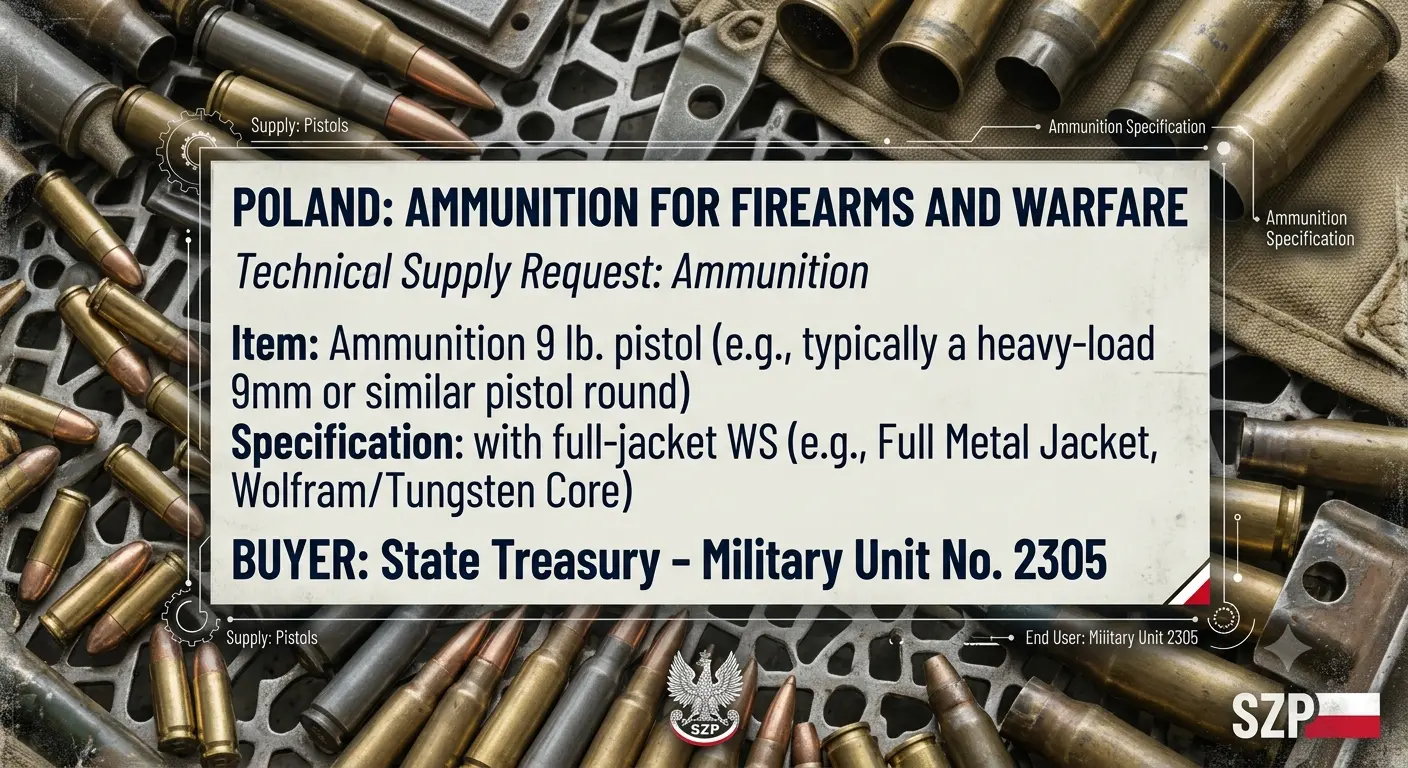
CENZIN Sp. z o.o. Secures 16.9 Million PLN 9mm Ammunition Contract for Polish Special Forces
19 Oct 2026
Standfirst The Polish special operations community has secured a critical supply of small arms munitions through a restricted defence procedure. A domestic medium enterprise won the 16.9 million PLN contract to deliver 9mm full metal jacket ammunition. This award highlights the vital role of small and medium enterprises in sustaining national defence capabilities. Introduction Military readiness depends on continuous access to reliable small arms munitions. Special operations units require high quality ammunition for both rigorous training and active deployments. This procurement addresses the fundamental need for 9mm pistol ammunition within the Polish armed forces. Executed through a restricted procedure under defence directives this tender limits participation to prequalified entities. Publishing such contract awards on the official Tenders Portal provides essential market intelligence for defence manufacturers. It demonstrates how public procurement secures vital military capabilities while maintaining regulatory transparency. Directing capital toward domestic ammunition production reflects a mature approach to force sustainment. The supply chain impact is concentrated on national enterprises capable of handling strict military logistics. This ensures that critical defence inventory remains supported by validated local industrial partners. Why This Contract Matters Operational readiness is the primary driver for this acquisition. Small arms ammunition forms the baseline of individual combat effectiveness. Any shortage in these essential supplies can halt training cycles and compromise mission preparation making reliable supply contracts a fundamental requirement for national security. The award to a local medium enterprise validates the capacity of the domestic defence sector. It proves that national firms possess the technical depth to meet the stringent demands of special operations forces. This reduces reliance on foreign manufacturers for sensitive munitions and strengthens national technological sovereignty. This contract drives continuous improvement through its specific award criteria. By weighting warranty periods heavily alongside price the buyer mitigates the risk of selecting a supplier based solely on initial cost. This structured approach ensures that the selected supplier is incentivized to maintain high quality standards and shelf life guarantees. Contract Timeline The winner selection occurred on 31/07/2026. The formal conclusion of the contract took place shortly after on 07/10/2026. The notice was subsequently published in the Official Journal of the European Union on 19/10/2026. The estimated duration for the supply and delivery of the ammunition spans 100 days. This timeline requires the contractor to execute rapid manufacturing and logistics operations. The schedule aligns with the operational training cycles of the special forces to minimize disruption. Contract Overview This agreement covers the supply of 9mm pistol ammunition with full metal jacket bullets. The total contract value is set at 16,974,000.00 PLN. The arrangement is a specific contract rather than a framework agreement providing a defined scope of work. Supplier responsibilities include manufacturing and delivering the munitions within the specified timeframe. The contract also includes options for additional quantities providing flexibility for the contracting authority. The contractor must ensure all ammunition meets strict military specifications and safety standards. Key Contract Details Contract TitleDostawa amunicji 9 nb. pist. z poc. pełnopłaszczowym WS Contracting AuthoritySkarb Państwa, Jednostka Wojskowa Nr 2305 Contract Value16,974,000.00 PLN Procedure TypeRestricted Number of Bids Received5 Winner(s)CENZIN Sp. z o.o. Contract Conclusion Date07/10/2026 Main CPV Code35331000 Ammunition for firearms and warfare Project Scope The deliverables encompass 9mm pistol ammunition featuring full metal jacket projectiles. The primary goal is to replenish and expand the existing inventory of the special operations units. The technical requirements demand strict adherence to military standards and safety protocols. The geographic scope of performance is centered in Warsaw and surrounding military installations. The contractor must manage the full lifecycle of the delivery from initial production to final secure transport. Compliance with hazardous materials regulations is mandatory throughout the execution phase. About the Contracting Authority The buyer is Military Unit No. 2305 operating under the Polish Ministry of National Defence. This specialized military unit is responsible for special operations and counter terrorism missions. Its primary responsibility is ensuring elite forces possess the necessary equipment and munitions. It operates under strict national and European public procurement regulations specific to the defence sector. About the Organisations Involved Skarb Państwa, Jednostka Wojskowa Nr 2305 Acting as the primary buyer this entity oversees defence acquisitions. It ensures all procurement activities comply with applicable legal frameworks and security requirements. CENZIN Sp. z o.o. This medium enterprise serves as the sole winner of the contract. The company specializes in defence supplies and possesses the technical capacity to handle complex military logistics. Krajowa Izba Odwoławcza This body functions as the review organisation. It provides oversight and handles any potential disputes or appeals related to the procurement process ensuring legal compliance. Publications Office of the European Union This entity acts as the TED eSender. It facilitates the electronic transmission of the notice to the Official Journal ensuring standardized formatting and distribution. Procurement Analysis The restricted procedure yielded exactly five tenders. All five bids were submitted by small and medium enterprises registered in Poland. This indicates a highly capable domestic manufacturing sector that can meet the technical demands of special operations munitions. The award criteria allocated 60 points to price and 40 points to the warranty period. This structure indicates a mature procurement baseline where long term reliability and shelf life are prioritized alongside cost efficiency. The fact that all bidders were domestic entities highlights the strategic preference for national supply chains in sensitive defence sectors. The buyer effectively secured a competitive outcome while maintaining strict control over the security of the supply base. Additional Procurement Facts The procurement project is not financed with European Union Funds. The legal basis for this procedure is Directive 2009/81/EC. This specific directive governs defence and security procurement across the European Economic Area. The use of this directive allows the buyer to apply restricted procedures and protect sensitive security information. It provides the necessary flexibility for acquiring critical defence munitions without exposing classified operational details to the open market. Market and Industry Perspective The military ammunition sector operates under unique constraints regarding technical complexity and safety. Suppliers must maintain specialized manufacturing facilities and certified quality control teams. This creates high barriers to entry and naturally limits the number of active bidders in any given tender process. Future RFPs and RFQs in this domain will likely continue to emphasize strict quality assurance and extended shelf life. Suppliers must align their proposals with detailed BOQs and respond promptly to GPNs. The market will reward firms that can demonstrate both technical excellence and strict adherence to military operational requirements. Economic Significance This contract injects direct financial value into the Polish defence manufacturing sector. It supports specialized production jobs and sustains advanced technical capabilities within the domestic industrial base. The investment reinforces the local manufacturing supply chain and high technology production capabilities. The multiplier effect extends beyond the primary contractor. Local material suppliers and specialized logistics firms will also benefit from the production activity. This sustains a broader ecosystem of defence suppliers centered around the national manufacturing hubs. Future Procurement Opportunities Suppliers interested in this sector should actively monitor the official Tenders Portal. Tracking Active Tenders and Live Notices for Tenders is essential for capturing early market intelligence regarding military munitions requirements. Early engagement allows firms to prepare their technical proposals and secure necessary security clearances. Military branches across the region are likely to issue similar requirements as they modernize their small arms inventories. Companies should prepare to respond to upcoming live tender opportunities by maintaining updated security certifications and clear capacity statements. Opportunities for Suppliers The contract structure creates immediate opportunities for niche equipment manufacturers. Firms offering specialized raw materials or advanced quality testing services can position themselves as valuable partners to the prime contractor through subcontracting arrangements. Building relationships with prime contractors before a tender is announced is a highly effective strategy. Suppliers must monitor Latest Active Tenders Procurement updates to identify these collaborative opportunities early and align their service offerings with market needs. What Businesses Should Watch Industry participants must track the enforcement of quality criteria in future awards. Shifts in the weighting between price and technical merit signal changing buyer priorities in military munitions and evolving maintenance methodologies. Observing government defence budget allocations is also critical. Increases in small arms funding will directly correlate with a higher volume of public procurement notices in the ammunition sector creating new tenders opportunities across the armed forces. PolandTenders.com Procurement Intelligence Strategic trend analysis reveals a clear reliance on domestic small and medium enterprises for critical military consumables. Buyers are prioritizing supply chain security and national sovereignty over purely cost driven international competition for essential munitions. This transition creates significant opportunities for local manufacturers capable of meeting strict defence standards. The importance of this award lies in its demonstration of SME competitiveness in the defence sector. When smaller firms win major ammunition contracts it highlights the effectiveness of policies designed to broaden public procurement participation. It also secures national manufacturing capabilities in a critical area of combat preparation. The future evolution of this market will likely incorporate stricter environmental mandates for propellants and digital tracking requirements for inventory management. Defence contractors will need to prove that their manufacturing solutions meet both national safety protocols and advanced logistical requirements. This will drive innovation in green chemistry and automated production lines favoring firms with integrated engineering capabilities. Supplier Takeaways Restricted defence procedures often yield competitive outcomes from domestic small and medium enterprises when technical baselines are clearly defined. Quality criteria heavily weighting warranty periods signal a buyer focus on long term reliability and total cost of ownership for military consumables. Subcontracting opportunities exist for specialized raw material providers and quality testing laboratories supporting the prime contractor. Suppliers must maintain strict security certifications and specialized manufacturing facilities to participate in future military procurement. Key Takeaways The contract value is 16,974,000.00 PLN for the supply of 9mm pistol ammunition with full metal jacket projectiles. Five tenders were received all from domestic small and medium enterprises indicating a capable local supply base. The award criteria weighted price at 60 points and quality at 40 points specifically evaluating the warranty period. The procurement is governed by Directive 2009/81/EC for defence and security allowing restricted procedures. The project duration is 100 days requiring rapid manufacturing and secure logistics execution. Conclusion This contract ensures the Polish special operations forces possess the critical small arms munitions required to maintain operational readiness. It highlights the unique dynamics of defence procurement where domestic capability and supply chain security drive award decisions. Source: Tenders Electronic Daily (TED), Contract Award Notice 720852-2026, Official Journal of the European Union, published on 19/10/2026.
View Details