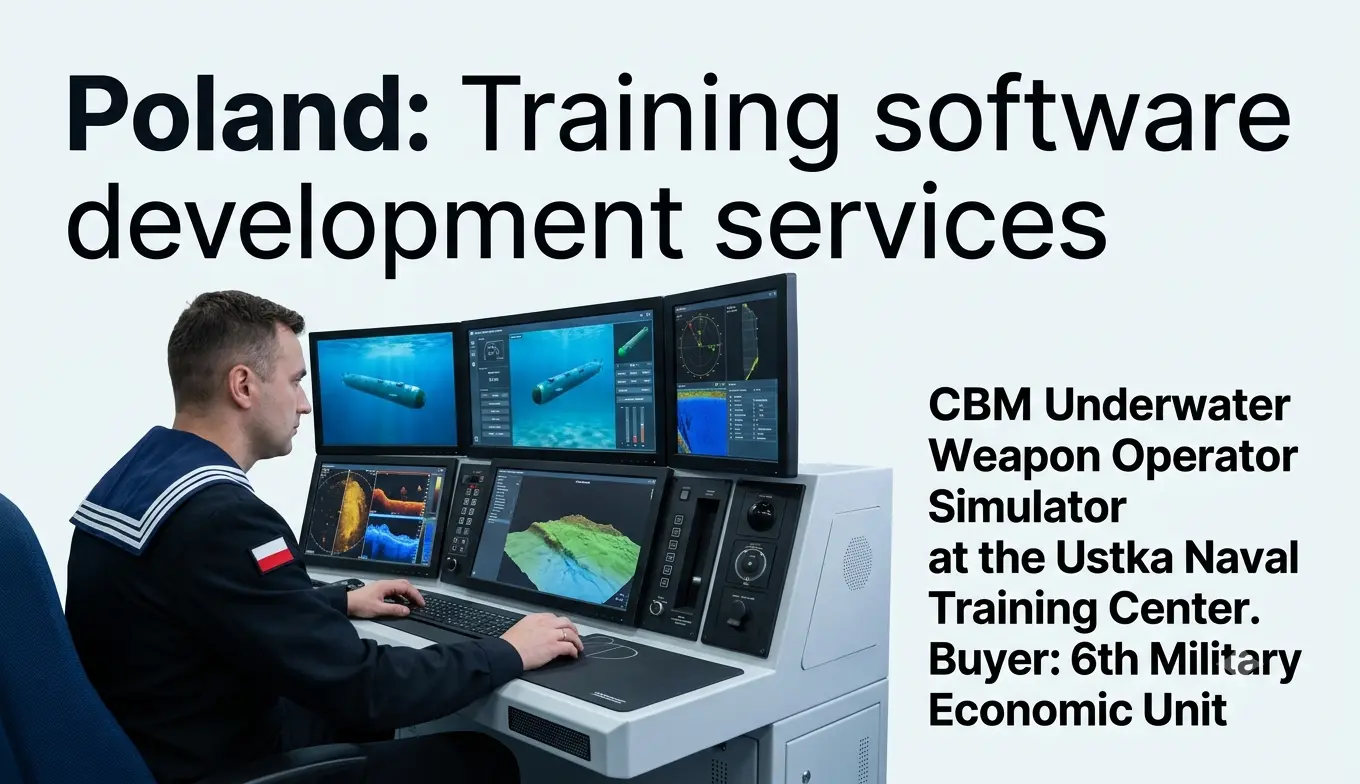
Autocomp Management Secures 13.6 Million PLN Submarine Simulator Upgrade for Polish Navy
13 Oct 2026
Standfirst The Polish Navy is modernizing its submarine training infrastructure through a critical software and hardware upgrade. This restricted procedure highlights the specialized nature of military simulation. A single bid was received, reflecting the high technical barriers in this specific defence sector. Introduction Naval warfare increasingly relies on advanced sonar arrays and unmanned underwater vehicles to detect and neutralize threats. The Polish Armed Forces must ensure their submarine crews are trained on the latest tactical systems to maintain deterrence in the Baltic region. This procurement addresses the urgent need to restore and upgrade the CBM submarine weapon operator simulator. Executed via a restricted procedure under defence directives, this tender limits participation to prequalified entities. Publishing such contract awards on the official Tenders Portal provides essential market intelligence for the defence sector. It demonstrates how public procurement secures vital training capabilities while maintaining regulatory transparency and fair competition. Directing capital toward simulation sustainment reflects a mature approach to military lifecycle management. The supply chain impact is focused on domestic technology firms capable of handling complex hardware and software integration. This ensures that critical training infrastructure remains under sovereign control and aligned with national security objectives. Why This Contract Matters Operational readiness is the primary driver for this acquisition. Simulators form the backbone of modern naval crew certification by replicating complex tactical scenarios without the risks of live exercises. Any downtime in these training systems can delay crew deployments, making reliable maintenance and upgrade contracts a fundamental requirement for defence efficiency. The award to a local enterprise validates the capacity of the domestic technology sector. It proves that national firms can meet the stringent technical demands of naval warfare simulation. This reduces reliance on foreign vendors for sensitive military training systems and strengthens national technological autonomy in a volatile geopolitical environment. This contract drives continuous improvement through its specific procedural framework. By utilizing a restricted procedure, the buyer mitigates the risk of engaging unqualified suppliers. This approach ensures that only entities with proven capabilities and secure facilities can participate in the bidding process for critical defence assets. Contract Timeline The formal conclusion of the contract took place on 02/10/2026. The notice was subsequently published in the Official Journal of the European Union on 13/10/2026. The review deadline is set at 10 days from the publication date, allowing unsuccessful bidders a standard window to appeal. The estimated duration for the project execution is 13 months. This timeline allows the contractor sufficient time to execute both the hardware repairs and the complex software modifications required. The schedule is tightly aligned with the operational training cycles of the Naval Training Center in Ustka to minimize disruption. Contract Overview This agreement covers the main repair and modification of the CBM simulator. The total contract value is set at 13,656,675.42 PLN. The arrangement is a specific contract rather than a framework agreement, providing a defined scope of work and fixed financial parameters. Supplier responsibilities include restoring full technical functionality and upgrading software capabilities. The contractor must ensure the simulator accurately reflects modern sonar systems and unmanned vehicle operations. This requires a deep understanding of both naval tactics and advanced software architecture to deliver a fully operational training environment. Key Contract Details Contract TitleNaprawa główna i modyfikacja Symulatora Operatorów Broni Podwodnej CBM w Centrum Szkolenia Marynarki Wojennej Ustka Contracting Authority6 Wojskowy Oddział Gospodarczy Contract Value13,656,675.42 PLN Procedure TypeRestricted Number of Bids Received1 Winner(s)AUTOCOMP MANAGEMENT Sp. z o.o. Contract Conclusion Date02/10/2026 Main CPV Code72212931 Training software development services Project Scope The deliverables encompass a complete hardware overhaul and software modernization. The primary goal is to restore full technical functionality to the simulator. This includes replacing outdated hardware components with current technological equivalents to ensure long term reliability. Software modifications will integrate capabilities for modern sonar systems and unmanned vehicles in mine countermeasures operations. The upgrade also expands the navigation bridge simulation to include dynamic positioning for ships. The geographic scope of performance is centered in Ustka, Poland, requiring on site engineering presence. About the Contracting Authority The buyer is the 6 Wojskowy Oddział Gospodarczy. This central military logistics authority manages procurement activities for the Polish Armed Forces. Its primary responsibility is ensuring the military possesses the necessary equipment and services. It operates under strict national and European public procurement regulations specific to the defence sector. About the Organisations Involved 6 Wojskowy Oddział Gospodarczy Acting as the primary buyer, this entity oversees defence acquisitions. It ensures all procurement activities comply with applicable legal frameworks and security requirements. AUTOCOMP MANAGEMENT Sp. z o.o. This small and medium enterprise serves as the sole winner of the contract. The company specializes in technology and simulation solutions and possesses the technical capacity to handle complex military upgrades. Krajowa Izba Odwoławcza This body functions as the review organisation. It provides oversight and handles any potential disputes or appeals related to the procurement process, ensuring legal compliance. Publications Office of the European Union This entity acts as the TED eSender. It facilitates the electronic transmission of the notice to the Official Journal, ensuring standardized formatting and distribution. Procurement Analysis The restricted procedure yielded exactly one tender. This lack of competition is a critical analytical point for market observers. It indicates a market with limited qualified suppliers or a highly specific set of requirements that only one entity could meet during the prequalification phase. The award criteria allocated 60 points to price and 40 points to quality. The quality metric specifically evaluated the warranty repair time, offering options of 5, 7 or 10 working days. This structure indicates a mature procurement baseline where minimizing simulator downtime is prioritized alongside cost efficiency. The fact that the lowest and highest admissible tender values are identical confirms the single bid outcome. This highlights the extreme specialization required for submarine weapon system simulation. The buyer effectively secured the only available qualified supplier for this critical upgrade, reflecting the consolidated nature of this niche market. Additional Procurement Facts The procurement project is not financed with European Union Funds. The legal basis for this procedure is Directive 2009/81/EC. This specific directive governs defence and security procurement across the European Economic Area. The use of this directive allows the buyer to apply restricted procedures and protect sensitive security information. It provides the necessary flexibility for acquiring critical defence training infrastructure without exposing classified operational details to the open market. Market and Industry Perspective The defence simulation sector operates under unique constraints regarding technical complexity and security. Suppliers must maintain specialized engineering teams and secure facilities to handle classified tactical data. This creates high barriers to entry and naturally limits the number of active bidders in any given tender process. Future RFPs and RFQs in this domain will likely continue to emphasize the integration of unmanned systems and advanced sonar. Suppliers must align their proposals with detailed BOQs and respond promptly to GPNs. The market will reward firms that can demonstrate both technical excellence and strict adherence to naval operational requirements. Economic Significance This contract injects direct financial value into the Polish technology and defence sector. It supports specialized software engineering jobs and sustains advanced technical capabilities within the domestic industrial base. The investment reinforces the local digital economy and high technology manufacturing supply chain across the region. The multiplier effect extends beyond the primary contractor. Local hardware providers and specialized logistics firms will also benefit from the sustained operation of this critical system. This supports a broader ecosystem of technology suppliers centered around the Pomeranian region and creates stable employment for technical professionals. Future Procurement Opportunities Suppliers interested in this sector should actively monitor the official Tenders Portal. Tracking Active Tenders and Live Notices for Tenders is essential for capturing early market intelligence regarding defence simulation requirements. Early engagement allows firms to prepare their technical proposals and secure necessary security clearances. Military branches across the region are likely to issue similar requirements as they modernize their training infrastructure. Companies should prepare to respond to upcoming live tender opportunities by maintaining updated security certifications and clear capacity statements. Demonstrating past performance in similar naval simulation projects will be a key differentiator. Opportunities for Suppliers The contract structure creates immediate opportunities for niche equipment manufacturers. Firms offering specialized hardware components or advanced software modules can position themselves as valuable partners to the prime contractor through subcontracting arrangements. Building these relationships early is crucial for securing a share of the contract value. Building relationships with prime contractors before a tender is announced is a highly effective strategy. Suppliers must monitor Latest Active Tenders Procurement updates to identify these collaborative opportunities early and align their service offerings with market needs. Specialized knowledge of naval tactical systems will make subcontractors highly attractive to prime bidders. What Businesses Should Watch Industry participants must track the enforcement of quality criteria in future awards. Shifts in the weighting between price and technical merit signal changing buyer priorities in defence simulation and evolving training methodologies. Observing how the buyer values rapid repair turnaround times will inform future bidding strategies. Observing government defence budget allocations is also critical. Increases in virtual training funding will directly correlate with a higher volume of public procurement notices in the simulation sector. This will create new tenders opportunities across the armed forces as they seek to maximize training efficiency and reduce operational costs. PolandsTenders.com Procurement Intelligence Strategic trend analysis reveals a clear shift toward virtual and simulation based training in European defence procurement. Buyers are moving away from exclusive reliance on live sea trials and specifying simulator upgrades that offer superior tactical preparation at a fraction of the operational cost. This transition creates significant opportunities for domestic technology providers. The importance of this award lies in its demonstration of domestic capability in highly specialized military simulation. When a local small and medium enterprise wins a major naval simulator contract, it highlights the effectiveness of policies designed to broaden public procurement participation. It also secures technological sovereignty in a critical area of naval warfare preparation. The future evolution of this market will likely incorporate stricter interoperability mandates with allied naval networks and digital twin technologies. Defence contractors will need to prove that their simulation solutions meet both national security protocols and allied interoperability requirements. This will drive innovation in secure software architecture and networked training environments. Supplier Takeaways Specialized defence simulation markets often yield single bid outcomes due to high technical barriers. Restricted procedures prequalify technical capability, leaving price and specific quality metrics as the primary differentiators. Quality criteria focusing on repair turnaround times directly address the operational risk of training schedule delays. Suppliers must maintain strict security certifications and specialized engineering teams to participate in future public procurement. Key Takeaways The contract value is 13,656,675.42 PLN for the main repair and modification of the CBM submarine simulator. Only one tender was received, indicating a highly specialized supplier market with significant entry barriers. The award criteria weighted price at 60 points and quality at 40 points, specifically evaluating warranty repair times. The procurement is governed by Directive 2009/81/EC for defence and security, allowing restricted procedures. The project duration is 13 months, aligning with the operational training cycles of the Naval Training Center. Conclusion This contract ensures the Polish Navy possesses the advanced simulation infrastructure required to train submarine crews on modern weapon systems. It highlights the unique dynamics of defence procurement where technical capability and domestic sovereignty drive award decisions. Source: Tenders Electronic Daily (TED), Contract Award Notice 706263-2026, Official Journal of the European Union, published on 13/10/2026.
View Details
Mostostal Warszawa Secures 105,595,500 PLN Abrams Training Center Contract for Polish Military Infrastructure
12 Oct 2026
Standfirst The Polish Military Infrastructure Management Board has awarded a major design and build contract for the Abrams training center in Biedrusko. This multiple stage procedure attracted six bids from small and medium enterprises. A notable chronological anomaly exists regarding the reported project start date. Introduction Integrating advanced main battle tanks requires specialized facilities for crew training and vehicle maintenance. The Polish Armed Forces are expanding their infrastructure to support the new Abrams fleet. This specific procurement addresses the critical need for a dedicated training block at the Biedrusko facility. Executed through an other multiple stage procedure under defence directives, this tender reflects the regulatory framework governing military construction. Such contract awards published on the official Tenders Portal provide vital market intelligence for construction firms. They illustrate how public procurement balances operational urgency with competitive transparency. The strategic allocation of capital toward physical infrastructure indicates a long term commitment to force modernization. Supply chain impact is concentrated on domestic construction firms capable of handling secure military sites. This ensures that critical defence infrastructure remains supported by validated national industrial partners. Why This Contract Matters Operational readiness is the primary driver for this acquisition. Advanced tank systems require highly specific training environments to simulate combat conditions. Failure to provide adequate facilities can delay crew certification, making reliable construction contracts a matter of national security rather than mere administrative routine. The receipt of six bids validates the competitive nature of the domestic construction sector. It suggests that small and medium enterprises possess the capacity to compete for major military infrastructure projects. This broadens the supply base and reduces reliance on a few dominant prime contractors. This contract drives continuous improvement through its specific award criteria. By weighting quality at 40 percent, the buyer mitigates the risk of selecting a contractor based solely on cost. This structured approach ensures that the selected supplier is incentivized to maintain high construction standards throughout the project duration. Contract Timeline The formal conclusion of the contract took place on 09/09/2026. The notice was subsequently published in the Official Journal of the European Union on 12/10/2026. The review deadline is set at 10 days from the publication date. An anomaly exists in the reported start date of 03/04/2025. This date precedes the contract conclusion by over a year. This discrepancy indicates a potential data entry error in the original notice or references a preliminary design phase that was not updated in the final award details. Contract Overview This agreement covers the design and construction of the training block. The total contract value is set at 105,595,500.00 PLN. The estimated value was initially reported as 160,439,024.33 PLN. The significant difference between the estimated and awarded values demonstrates effective market competition. Supplier responsibilities include both the architectural design and the physical execution of the build. The contractor must deliver a fully functional facility that meets strict military specifications. Key Contract Details Contract TitleZadanie 55310 Budowa bloku szkoleniowego ośrodka szkolenia Abrams Biedrusko Contracting AuthorityWojskowy Zarząd Infrastruktury Contract Value105,595,500.00 PLN Procedure TypeOther multiple stage procedure Number of Bids Received6 Winner(s)MOSTOSTAL WARSZAWA S.A. Contract Conclusion Date09/09/2026 Main CPV Code45000000 Construction work Project Scope The deliverables encompass the complete design and construction of a training block. This facility is specifically intended for the Abrams training center located in Biedrusko. The technical requirements demand strict adherence to military construction standards and security protocols. The geographic scope of performance is centered in the city of Poznań. This aligns with the existing military installations in the region. The contractor must manage all phases of the project from initial architectural planning to final handover. About the Contracting Authority The buyer is the Wojskowy Zarząd Infrastruktury. This central military authority manages infrastructure projects for the Polish Armed Forces. Its primary responsibility is ensuring the military possesses the necessary physical facilities to fulfill its defence mandates. It operates under strict national and European public procurement regulations specific to the defence sector. About the Organisations Involved Wojskowy Zarząd Infrastruktury Acting as the primary buyer, this entity oversees defence construction acquisitions. It ensures all procurement activities comply with applicable legal frameworks and security requirements. MOSTOSTAL WARSZAWA S.A. This economic operator serves as the winner of the contract. The company specializes in large scale construction and possesses the technical capacity to handle complex military infrastructure tasks. Krajowa Izba Odwoławcza This body functions as the review organisation. It provides oversight and handles any potential disputes or appeals related to the procurement process, ensuring legal compliance. Publications Office of the European Union This entity acts as the TED eSender. It facilitates the electronic transmission of the notice to the Official Journal, ensuring standardized formatting and distribution. Procurement Analysis The other multiple stage procedure yielded exactly six tenders. A critical analytical point is that all six bids were submitted by small and medium enterprises. This is highly unusual for a project exceeding 100 million PLN. This indicates a highly capable domestic small and medium enterprise sector or a specific structuring of the tender that encouraged smaller firms to participate. The award criteria allocated 60 points to price and 40 points to quality. This balanced structure indicates a mature procurement baseline. The buyer recognizes that the lowest price does not always guarantee the best outcome for complex military facilities. Quality metrics ensure the final structure meets operational demands. The significant discount from the estimated value to the awarded value highlights intense competition. It suggests that domestic firms are highly motivated to secure large defence contracts, possibly due to the stable funding and long term revenue they provide. Additional Procurement Facts The procurement project is not financed with European Union Funds. The legal basis for this procedure is Directive 2009/81/EC. This specific directive governs defence and security procurement across the European Economic Area. The use of this directive allows the buyer to apply specific procedures tailored to military needs. It provides the necessary flexibility for acquiring critical defence infrastructure while maintaining core principles of transparency and equal treatment. Market and Industry Perspective The military construction sector is experiencing significant growth due to ongoing force modernization programs. Suppliers must maintain specialized capabilities to handle secure sites and complex technical requirements. Future RFPs and RFQs in this domain will likely continue to emphasize design and build methodologies. Suppliers must align their proposals with detailed BOQs and respond promptly to GPNs. The market will reward firms that can demonstrate both technical excellence and financial stability. Economic Significance This contract injects direct financial value into the Polish construction sector. It supports specialized engineering jobs and sustains advanced technical capabilities within the domestic industrial base. The multiplier effect extends beyond the primary contractor. Local material suppliers and specialized logistics firms will also benefit from the construction activity. This sustains a broader ecosystem of construction suppliers centered around the Poznań region. Future Procurement Opportunities Suppliers interested in this sector should actively monitor the official Tenders Portal. Tracking Active Tenders and Live Notices for Tenders is essential for capturing early market intelligence regarding military infrastructure requirements. Defence commands regularly issue new requirements for facility expansion and modernization. Companies should prepare to respond to upcoming live tender opportunities by maintaining updated certifications and clear capacity statements. Opportunities for Suppliers The contract structure creates immediate opportunities for niche equipment providers. Firms offering specialized training simulators or secure communication infrastructure can position themselves as valuable partners. Building relationships with prime contractors before a tender is announced is a highly effective strategy. Suppliers must monitor Latest Active Tenders Procurement updates to identify these collaborative opportunities early. What Businesses Should Watch Industry participants must track the enforcement of quality criteria in future awards. Shifts in the weighting between price and technical merit signal changing buyer priorities in military construction. Observing government defence budget allocations is also critical. Increases in infrastructure funding will directly correlate with a higher volume of public procurement notices in the construction sector. PolandTenders.com Procurement Intelligence Strategic trend analysis reveals a clear preference for design and build methodologies in military construction. Buyers are increasingly transferring design risk to the contractor to ensure fixed costs and predictable delivery schedules. The importance of this award lies in its demonstration of small and medium enterprise competitiveness. When smaller firms win major infrastructure contracts, it highlights the effectiveness of policies designed to broaden public procurement participation. The future evolution of this market will likely incorporate stricter sustainability mandates for military facilities. Defence contractors will need to prove that their construction methods minimize environmental impact while maintaining the durability required for heavy military use. Supplier Takeaways Design and build methodologies transfer significant risk to the contractor but offer higher profit potential. Small and medium enterprises can successfully compete for major military infrastructure projects. Quality criteria remain a crucial differentiator in complex construction tenders. Suppliers must meticulously verify data consistency in their own tender submissions to avoid reporting anomalies. Key Takeaways The contract value is 105,595,500.00 PLN for the Abrams training center construction. Six tenders were received, all from small and medium enterprises. A data discrepancy exists between the reported start date and the contract conclusion date. The award criteria weighted price at 60 points and quality at 40 points. The procurement is governed by Directive 2009/81/EC for defence and security. Conclusion This contract ensures the Polish Armed Forces possess the necessary infrastructure to train Abrams tank crews effectively. It highlights the competitive dynamics of military construction where domestic capability and quality metrics drive award decisions. Source: Tenders Electronic Daily (TED), Contract Award Notice 703988-2026, Official Journal of the European Union, published on 12/10/2026.
View Details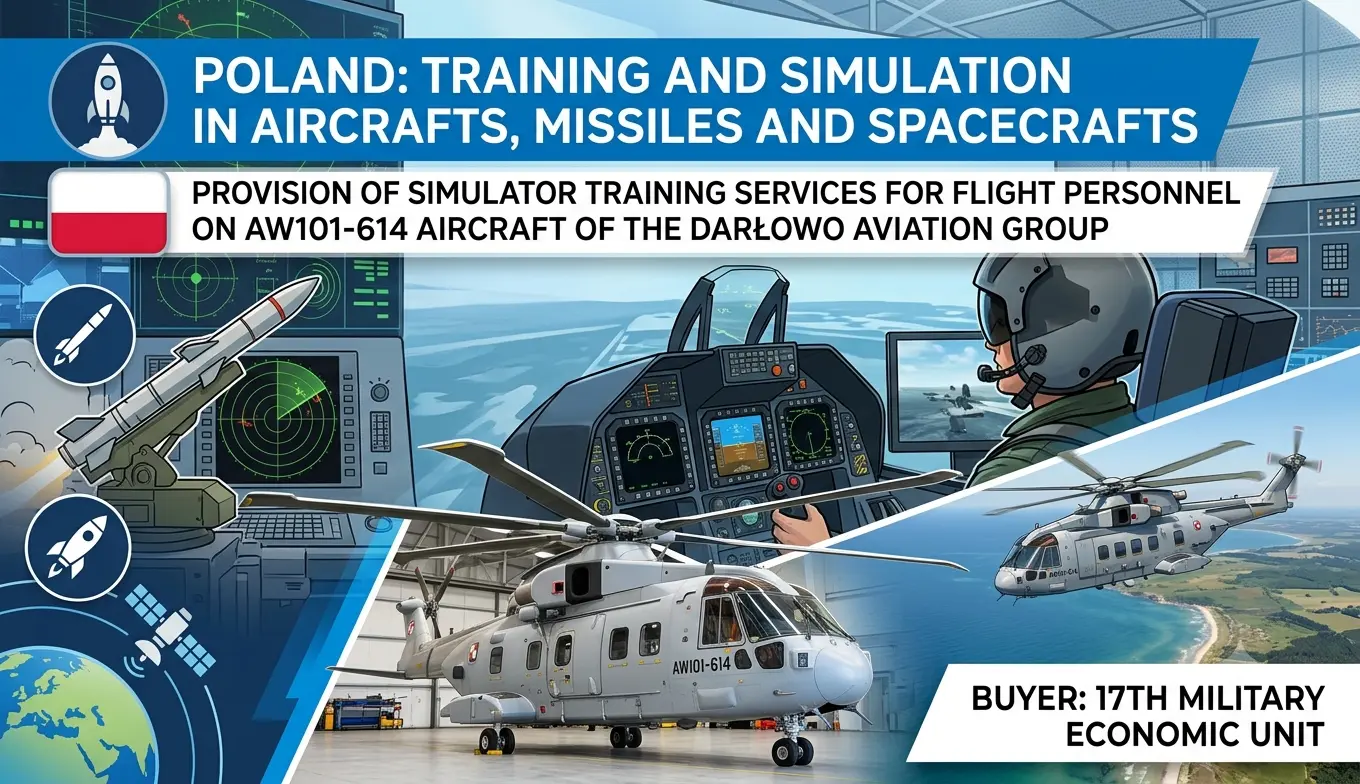
Poland Awards PLN 6.56 Million AW101 Helicopter Simulator Training Contract to Leonardo PZL-Świdnik
09 Oct 2026
Standfirst Poland has awarded a PLN 6.56 million contract for specialist simulator training for flying personnel operating AW101 helicopters associated with the Darłowo Aviation Group. The training will take place at Leonardo's Norwegian Training Centre in Sola, Norway, and cover basic simulator instruction, Performance-Based Navigation (PBN) and combat flying. The contract was awarded to LEONARDO PZL-ŚWIDNIK S.A. under an accelerated restricted procurement procedure. The result highlights the importance of advanced flight simulation and international training infrastructure in military aviation readiness. Introduction Poland has awarded a specialist military aviation training contract worth PLN 6,563,975.32 to LEONARDO PZL-ŚWIDNIK S.A. The procurement covers simulator-based training for flying personnel operating AW101 helicopters associated with the Darłowo Aviation Group. The training is to be conducted using the AW101 Full Flight Simulator (FSS) at Leonardo's Norwegian Training Centre in Sola, Norway. The award is recorded in European Union public procurement notice 698757-2026, published in the Official Journal of the European Union under OJ S 196/2026 on 9 October 2026. The contracting authority is 17 WOJSKOWY ODDZIAŁ GOSPODARCZY, a Polish public-law body whose principal activity is defence. The training programme covers three areas: Basic Training, Performance-Based Navigation and Combat Flying. These areas address foundational simulator instruction, navigation-related competencies and mission-oriented flying scenarios. The notice identifies the main procurement classification as CPV 80650000, covering training and simulation in aircraft, missiles and spacecraft. The contract demonstrates how military aviation training can involve cross-border delivery arrangements. The buyer is based in Poland, the successful supplier is registered in Poland and the specified training location is in Norway. The procurement therefore connects national defence requirements with specialist aviation training infrastructure located outside the buyer's country. Why This Contract Matters Military aviation readiness depends on more than aircraft availability. Personnel must be trained to operate complex aircraft systems, follow approved procedures and respond to demanding operational situations. Simulator-based instruction provides a structured environment for developing and practising these capabilities without relying exclusively on live aircraft training. The AW101 is a sophisticated helicopter platform, and the procurement specifically identifies an AW101 Full Flight Simulator. The use of this platform-specific simulator allows the training programme to focus on the relevant aircraft environment. The published notice does not disclose the number of pilots, individual training hours or detailed performance outcomes, so the precise training capacity cannot be established from the award notice alone. The contract is also significant because it includes combat flying training alongside basic simulator training and PBN instruction. This combination indicates that the required service extends beyond introductory familiarisation. It encompasses different training objectives within one procurement, although the notice does not provide a detailed breakdown of the number of sessions or the allocation of the contract value among the three components. For the defence procurement market, the award illustrates demand for specialised services that combine aircraft-specific knowledge, simulator availability and qualified training delivery. Such contracts can be relevant to aviation manufacturers, simulator operators, military training providers and companies supporting defence aviation programmes. Contract Timeline 20 May 2026: The contracting authority selected the winning tender. 25 May 2026: The contract was concluded under contract identifier 139/05/03/26/R. 8 October 2026: The award notice was dispatched for publication. 9 October 2026: Notice 698757-2026 was published in OJ S 196/2026. The notice identifies the procedure as accelerated and restricted. It does not state the specific reason for acceleration in the fields available in the published result. The stated review deadline information is 10 days. Suppliers considering any legal or procedural action should consult the original procurement documents and applicable Polish procurement rules to establish how that deadline is calculated and applied. Contract Overview The procurement was organised by 17 WOJSKOWY ODDZIAŁ GOSPODARCZY, based in Koszalin, Poland. Its role was to obtain specialist simulator training for flying personnel associated with the Darłowo Aviation Group and AW101 helicopter 614, as stated in the procurement title. The successful tenderer was LEONARDO PZL-ŚWIDNIK S.A., registered in Świdnik, Poland. The training itself is specified to take place at Leonardo Norway Training Centre in Sola, Norway. The result notice records one lot and a contract value of PLN 6,563,975.32. The supplier's tender value matches the total value of all contracts awarded under the notice. The award criterion was price, weighted at 100 points. The published result does not identify a separate quality score or technical merit weighting. This should not be taken to mean that technical requirements were absent; rather, the reported award criterion was price, while the detailed service requirements were established through the procurement description and associated documents. Key Contract Details TED notice number698757-2026 Publication referenceOJ S 196/2026 Publication date9 October 2026 Country of buyerPoland Contracting authority17 WOJSKOWY ODDZIAŁ GOSPODARCZY Contract titleAW101 flying personnel simulator training at Leonardo's Norwegian Training Centre Successful supplierLEONARDO PZL-ŚWIDNIK S.A. Contract valuePLN 6,563,975.32 Contract identifier139/05/03/26/R Winner selected20 May 2026 Contract signed25 May 2026 ProcedureAccelerated restricted procedure Number of lotsOne Award criterionPrice, 100 points Main CPV code80650000 Training locationLeonardo Norway Training Centre, Sola, Norway SubcontractingNo, according to the result notice Framework agreementNo Applicable legal basisDirective 2009/81/EC Project Scope The contract's central objective is the delivery of specialist simulator training for pilots using the AW101 FSS at Leonardo Norway Training Centre in Sola. The notice specifies three training components. Basic Training: Foundational simulator instruction for the relevant flying personnel. The award notice does not provide the detailed syllabus or number of training sessions. Performance-Based Navigation: Training in PBN procedures and associated navigation competencies. The precise navigation modules and assessment requirements are not detailed in the result notice. Combat Flying: Training related to the application of flying skills in combat-oriented scenarios. The notice does not disclose specific mission profiles or tactical exercises. The services are to be delivered in accordance with the requirements set out in the description of the contract subject and the draft agreement attached to the procurement invitation. These underlying documents would be needed to determine the full syllabus, instructor requirements, training schedule, acceptance conditions and any reporting obligations. The specified simulator is an AW101 Full Flight Simulator. Using a simulator designed for the relevant aircraft type provides a platform for structured practice in a controlled setting. The contract description does not, however, specify simulator certification details, device configuration, fidelity standards or the extent to which the training is integrated with other elements of the operators' training programmes. About the Contracting Authority 17 WOJSKOWY ODDZIAŁ GOSPODARCZY is the contracting authority named in the TED notice. It is identified as a body governed by public law and its activity is classified as defence. The organisation is located at 4-go Marca 3, Koszalin, postcode 75-901, Poland. The notice lists the contracting authority's website as https://17wog.wp.mil.pl/ and provides the procurement contact email 17wog.przetargi@ron.mil.pl. Its role in this procurement was to arrange the specialist training service required for the relevant flying personnel. The notice also identifies the Polish Ministry of Defence, Kaitseministeerium, as the organisation whose budget pays for the contract. The result notice does not provide further details about the internal budget allocation or the specific military programme associated with this expenditure. About the Organisations Involved 17 WOJSKOWY ODDZIAŁ GOSPODARCZY: The Polish public-law contracting authority responsible for the procurement. The notice lists its REGON number as 321203128 and NIP number as 6692516785. LEONARDO PZL-ŚWIDNIK S.A.: The successful tenderer and contract award recipient. Its registered location is Świdnik, postcode 21-045, Poland. The result notice identifies the company as the winner of LOT-0001 and records no subcontracting for its tender. Leonardo Norway Training Centre: The training facility identified in the contract description. It is located in Sola, Norway, and is the specified venue for the AW101 FSS training. The notice identifies the facility in the service description but does not list it separately as the awarded supplier. Publications Office of the European Union: The organisation identified as the TED eSender. It supports publication of procurement notices through the EU's official procurement notice system and is not identified as a contracting party to this training contract. Procurement Analysis The use of an accelerated restricted procedure is an important procedural feature. A restricted procedure generally separates the selection of suitable candidates from the submission and evaluation of tenders. The result notice confirms the procedure type and records that it was accelerated, but does not explain the specific justification for acceleration. That justification should therefore not be inferred from the contract's defence context alone. Price was the sole published award criterion, carrying 100 points. This is a clear signal for suppliers reviewing the award structure: price was the stated basis for comparing tenders at the award stage. Nonetheless, bidders for specialist military training should also expect to demonstrate compliance with all mandatory technical, security and operational requirements set out in the procurement documents. The legal basis is Directive 2009/81/EC, the EU framework for certain defence and security procurement contracts. This distinguishes the procurement from a standard civilian services award under Directive 2014/24/EU. Companies seeking similar opportunities should assess whether they can satisfy the relevant defence procurement, qualification, confidentiality and security requirements. The contract was concluded on 25 May 2026, five days after the winner was selected on 20 May 2026. The result notice does not provide the tender submission deadline, the initial publication date of the procurement invitation or the detailed evaluation record. Consequently, a complete assessment of the procurement's overall duration and competitive process cannot be made from this result notice alone. Additional Procurement Facts The contract covers one lot, LOT-0001. There is no framework agreement, so the award is not reported as a multi-supplier framework arrangement. The result notice also records no subcontracting by the winning tenderer. The published statistics contain an inconsistency that deserves attention. The result notice records one tender from a micro, small or medium-sized enterprise and one electronic tender, while the general submission category records one tender. It also reports zero tenders from other European Economic Area countries and zero tenders from outside the EEA. These fields should be read as the notice's separate statistical classifications rather than added together as if they represented distinct submissions. The notice also displays zero submissions in the category for tenderers registered in other EEA countries and zero for tenderers registered outside the EEA, while reporting one tender overall and one from an SME. The available fields do not explain this statistical presentation. The safest interpretation is that the notice records one overall tender, but its category-level reporting should be verified against the underlying procurement record if precise participation statistics are required. The contract's total recorded value is PLN 6,563,975.32. The result notice does not provide a separate breakdown for Basic Training, PBN or Combat Flying, so it is not possible to calculate the value attributable to each component. It also does not state the number of pilots to be trained or the contract's detailed delivery period. Market and Industry Perspective The award reflects a specialised segment of defence procurement in which the service requirement is linked to a particular aircraft platform and simulator environment. Unlike generic professional training, aircraft-specific simulator training depends on access to suitable equipment, an appropriate curriculum and personnel with relevant technical and instructional expertise. The arrangement also demonstrates the cross-border nature of European defence supply chains. A Polish authority procured a service delivered at a training centre in Norway, with a Polish company named as the award recipient. This shows how the location of service delivery can differ from the buyer's country and the successful supplier's registered country. For the aviation training market, opportunities may arise not only in pilot instruction but also in simulator support, training programme development, technical documentation, scheduling, assessment and maintenance of training systems. These are potential areas of market activity, not additional services confirmed as part of this particular award. Suppliers should distinguish between opportunities to provide the full training service and opportunities to support a prime contractor. This award states that the winning tenderer will not subcontract the contract, so the notice does not establish any subcontracting opportunity under this specific agreement. Economic Significance The contract value of PLN 6.56 million represents a targeted investment in specialist military aviation training. The immediate economic purpose is the purchase of training services rather than the procurement of additional aircraft. The award therefore concerns the development and maintenance of personnel capability associated with an existing aviation platform. Specialist training contracts can support demand for simulator facilities, instructor expertise and associated operational resources. Where training takes place abroad, delivery can also involve international coordination, travel and scheduling. However, the notice does not quantify the economic impact on the training centre, the number of staff involved or the distribution of expenditure between Poland and Norway. The value should be understood as the reported contract award amount. It should not be treated as evidence of wider programme expenditure, additional aircraft procurement or future training commitments that are not specified in the notice. Future Procurement Opportunities The award may be relevant to suppliers tracking future defence aviation training requirements in Poland and across Europe. Organisations should monitor procurement notices for simulator-based training, aircraft crew qualification, navigation instruction, mission preparation and other platform-specific services. Potential future opportunities could include additional training sessions, refresher programmes, instructor support or simulator services for other aircraft types. These are possible market developments rather than confirmed follow-on contracts. The published notice does not announce an extension, renewal or additional procurement phase. Companies interested in this market should monitor TED notices and the contracting authority's procurement profile. The applicable CPV classification, the defence procurement legal framework and the named aircraft platform can help suppliers identify comparable opportunities. Searches should also include relevant training and simulation terms because procurement descriptions may use detailed technical wording not fully reflected in a single classification code. Opportunities for Suppliers Aircraft-specific training providers: Organisations with AW101 simulator capability and relevant instructor expertise can monitor similar training requirements and assess the qualification conditions published in future notices. Military aviation training specialists: Providers of basic, navigation and combat-oriented simulator instruction can track procurement programmes involving other aircraft platforms. Simulator operators: Facilities offering suitable full-flight simulation infrastructure may find opportunities to support defence customers, subject to technical and security requirements. Defence service contractors: Prime contractors can assess whether future procurements permit subcontracting or require the supplier to deliver all services directly. Procurement intelligence teams: Businesses can use buyer names, CPV codes, aircraft platform references and training location details to identify relevant notices and map potential competitors. Potential bidders should review the complete tender documentation before deciding whether to participate. In a restricted procedure, suppliers may need to satisfy selection requirements before they are invited to submit a tender. The precise requirements for this contract are not fully reproduced in the award notice. What Businesses Should Watch Future AW101 training requirements: Monitor notices for further simulator training and qualification services related to the AW101 platform. Defence procurement procedures: Review whether new opportunities use restricted, accelerated or other procedures and identify the applicable submission requirements. Training facility locations: Check where services must be delivered, particularly when the buyer, supplier and training venue are based in different countries. Technical qualification requirements: Assess simulator specifications, instructor qualifications, security conditions and mandatory training outcomes in the original tender documents. Price evaluation: Identify the stated award criteria and weighting rather than assuming that all defence training contracts use the same evaluation model. Notice statistics: Verify tender participation data against source documents when category-level counts appear inconsistent with the reported total. PolandTenders.com Procurement Intelligence This award represents the specialised services segment of defence procurement, where the availability of a suitable training environment and platform-specific expertise can be central to contract delivery. The requirement combines basic simulator instruction, PBN and combat flying for AW101 personnel, illustrating how a single procurement can address several related training objectives. The strategic importance lies in supporting the competence of flying personnel associated with a military helicopter capability. Simulator-based training offers a controlled environment for practising aircraft procedures and operational scenarios. The notice confirms the intended training categories but does not disclose the number of participants, the detailed syllabus or measurable training outcomes. Suppliers can learn from the use of a restricted and accelerated procedure, the application of Directive 2009/81/EC and the 100-point price award criterion. Companies targeting similar opportunities should monitor defence procurement notices early, check selection requirements carefully and ensure that their technical offer directly addresses the aircraft platform and training scope specified by the buyer. Future procurement activity may include further aircraft simulator training, refresher instruction and services for other defence aviation platforms, although no follow-on contract is confirmed in this notice. Suppliers should track relevant CPV classifications alongside aircraft model names, training-centre references and contracting authority profiles. polandTenders.com can help procurement teams identify relevant notices, review award information and monitor opportunities across defence and aviation training markets. Supplier Takeaways The awarded contract is worth PLN 6,563,975.32 and covers AW101 simulator training. LEONARDO PZL-ŚWIDNIK S.A. was selected as the winning supplier. The specified training location is Leonardo Norway Training Centre in Sola, Norway. The programme covers Basic Training, Performance-Based Navigation and Combat Flying. The procurement used an accelerated restricted procedure under Directive 2009/81/EC. Price was the stated award criterion, weighted at 100 points. The notice reports one overall tender, but its category-level tender statistics warrant caution. Future bidders should examine the complete procurement documents for technical, qualification and security requirements. Key Takeaways Buyer: 17 WOJSKOWY ODDZIAŁ GOSPODARCZY, Poland. Winner: LEONARDO PZL-ŚWIDNIK S.A. Value: PLN 6,563,975.32. Scope: Specialist AW101 Full Flight Simulator training for flying personnel associated with the Darłowo Aviation Group. Training venue: Sola, Norway. Contract date: 25 May 2026. Main CPV: 80650000, Training and simulation in aircraft, missiles and spacecraft. Procurement lesson: Aircraft-specific expertise, access to suitable simulator facilities and compliance with defence procurement requirements are important considerations for suppliers targeting similar opportunities. Conclusion Poland's PLN 6.56 million award to LEONARDO PZL-ŚWIDNIK S.A. secures specialist simulator training for flying personnel associated with the Darłowo Aviation Group's AW101 helicopter operations. The programme includes basic training, PBN and combat flying at Leonardo's Norwegian Training Centre in Sola. With the award evaluated on price under an accelerated restricted procedure, the contract offers a useful example of cross-border delivery in the European defence training market. For suppliers, the main lesson is the importance of tracking platform-specific defence requirements and understanding the technical and procedural conditions behind each opportunity. The result notice provides the award value, winner and broad training scope, while detailed information about training volume, delivery scheduling and individual course components remains in the underlying procurement documentation. Source: European Union, Tenders Electronic Daily (TED), Contract or concession award notice 698757-2026, OJ S 196/2026, published 9 October 2026. View the official TED notice.
View Details