Local Security Firm Secures 28-Month Katowice Hospital Protection Contract in Competitive Three-Bidder Race
Introduction
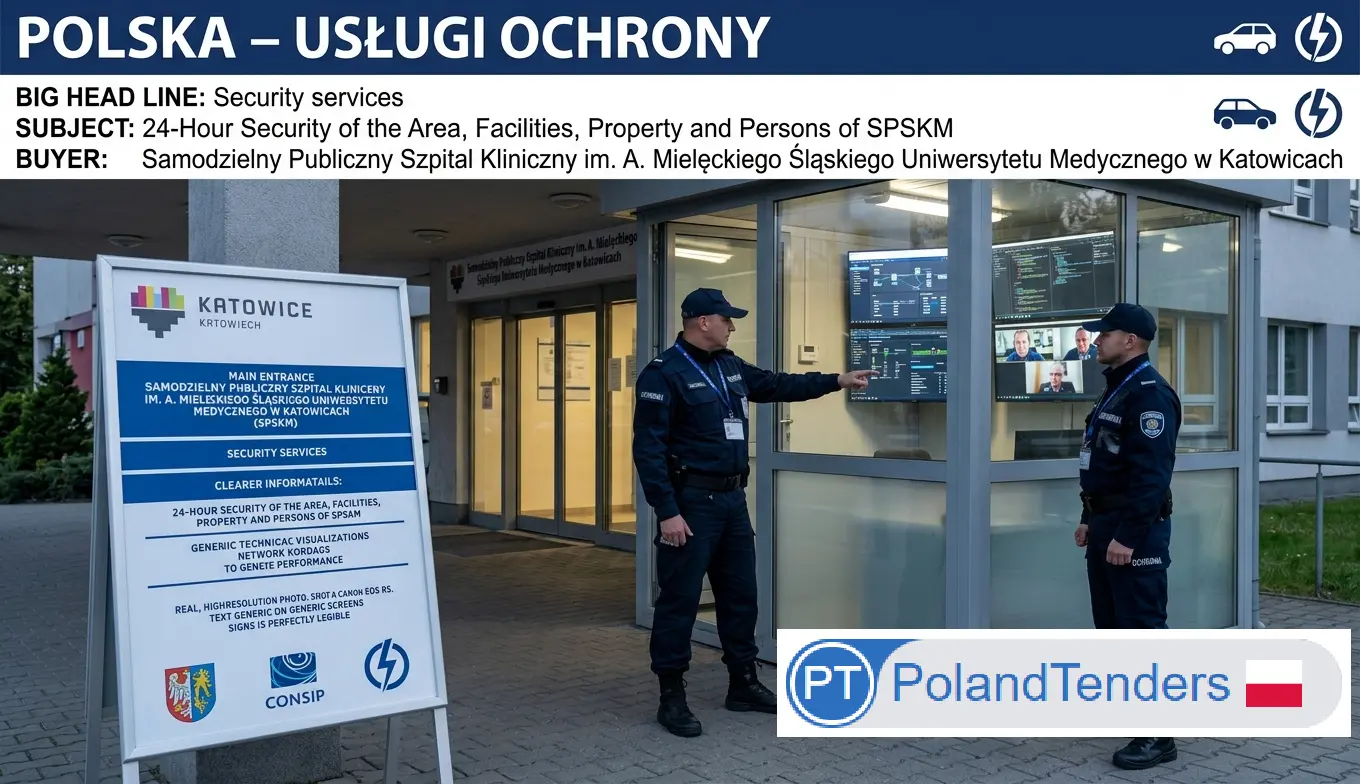
Protecting healthcare infrastructure requires a delicate balance of patient safety, asset security and operational continuity. A regional Polish security provider has won a 28-month contract to safeguard a major clinical hospital in Katowice.
This award demonstrates the viability of local small and medium enterprises in public sector security procurement. It also highlights the healthcare sector's ongoing effort to secure sensitive environments through standardized, cost-effective service agreements.
Why This Contract Matters
Hospital security extends far beyond guarding main entrances. It involves managing complex environments where public access intersects with sensitive medical operations and valuable pharmaceutical inventories.
This contract ensures continuous, professional oversight of the hospital’s perimeter, facilities and personnel. It mitigates risks associated with theft, vandalism and unauthorized access, allowing medical staff to focus entirely on patient care.
Contract Timeline
The contracting authority selected the winning bidder on 10 August 2026. The formal contract was concluded shortly thereafter on 26 August 2026.
The official notice was published in the Tenders Electronic Daily on 27 August 2026. The 28-month service period is scheduled to commence on 1 September 2026.
Contract Overview
This is a single-lot service contract for the 24-hour protection of the hospital's area, facilities, property and persons. The agreement covers the entire campus of the Independent Public Clinical Hospital of the Medical University of Silesia in Katowice.
The procurement was conducted under specific provisions of Polish public procurement law governing social and other specific services. This indicates a tailored approach designed to balance competitive pricing with the unique social responsibilities of healthcare security.
Key Contract Details
| Contracting Authority | Samodzielny Publiczny Szpital Kliniczny im. A.Mielęckiego Śląskiego Uniwersytetu Medycznego w Katowicach |
| Procedure Type | Open Procedure |
| Contract Type | Services (Security services) |
| CPV Code | 79710000 (Security services) |
| Contract Duration | 28 Months (Starting 01/09/2026) |
| Contract Value | 5,025,587.43 PLN (excluding VAT) |
| Award Criterion | Price (100%) |
| Number of Bids Received | 3 (all from micro, small, or medium enterprises) |
Project Scope
The supplier is responsible for providing round-the-clock physical security across the hospital campus. This includes monitoring the perimeter, securing internal facilities, protecting medical and administrative property and ensuring the safety of patients, visitors and staff.
The scope is strictly limited to physical security services. The notice does not mention the supply or maintenance of electronic security infrastructure, such as CCTV or access control systems, under this specific agreement.
About the Contracting Authority
Samodzielny Publiczny Szpital Kliniczny im. A.Mielęckiego Śląskiego Uniwersytetu Medycznego w Katowicach
This is a major independent public clinical hospital affiliated with the Medical University of Silesia. It serves as a key healthcare provider in the region, requiring robust operational support to maintain a safe environment for complex medical treatments.
About the Organisations Involved
Samodzielny Publiczny Szpital Kliniczny im. A.Mielęckiego Śląskiego Uniwersytetu Medycznego w Katowicach
The contracting authority and buyer. It initiated the procurement to secure its facilities and will execute payments under the resulting contract.
Sky One sp. z o.o.
The successful bidder. Classified as a micro, small, or medium enterprise, this security services company is based in Mysłowice, within the same regional subdivision as the hospital. Its local presence likely contributed to its operational competitiveness.
Krajowa Izba Odwoławcza
The National Chamber of Appeal. This is the official review organisation responsible for handling legal disputes and complaints related to public procurement procedures in Poland.
Procurement Analysis
The open procedure attracted three tender submissions. Notably, all three bids were submitted by micro, small, or medium-sized enterprises. This indicates a healthy, localized competitive landscape for regional healthcare security contracts.
The award was determined solely on the lowest price, with a 100% weighting. The contracting authority justified this by treating the technical requirements for physical security as fully standardized, making cost the only differentiating factor.
The price competition was significant. The lowest admissible tender was valued at 5,025,587.43 PLN, while the highest admissible tender reached 7,548,764.81 PLN. This 33 percent variance highlights the importance of lean operational models in winning price-driven public security contracts.
Additional Procurement Facts
- The procurement is not financed by EU funds.
- The agreement is not covered by the Government Procurement Agreement (GPA).
- Subcontracting is not permitted or disclosed for this contract.
- The procedure explicitly references Articles 359 to 361 of the Polish Public Procurement Law (Pzp), which govern the specific rules for awarding social and other specific services.
Market & Industry Perspective
The Polish private security market is highly fragmented. While national giants dominate large-scale corporate contracts, regional SMEs frequently win public sector healthcare and municipal contracts.
Success in this niche depends on local operational capacity, familiarity with healthcare-specific protocols and the ability to maintain tight cost controls. The victory of a Mysłowice-based firm for a Katowice hospital underscores the advantage of geographic proximity in labor-intensive security services.
Economic Significance
For the hospital, securing a fixed-price, 28-month contract provides budget predictability. It shields the institution from short-term wage inflation in the security sector while guaranteeing continuous service.
For the local economy, the award channels public healthcare spending directly into a regional business. This supports local employment and reinforces the economic ecosystem of the Silesian region.
Future Procurement Opportunities
As this 28-month term progresses, the hospital may issue separate tenders for complementary security technologies. Opportunities will likely arise for upgraded CCTV systems, electronic access control and cybersecurity for connected medical devices.
Furthermore, upon the expiration of this contract, a follow-on procurement will be required. Suppliers should begin monitoring the hospital’s procurement profile for preliminary market engagement or prior information notices well before the 28-month term concludes.
Opportunities for Suppliers
Security firms targeting public healthcare contracts should emphasize their SME status and local operational capacity. Demonstrating specific experience in medical facility management, including patient de-escalation training, is a strong competitive differentiator.
Suppliers must also ensure full compliance with the specific Polish legal frameworks governing social and healthcare-related services, as these often carry distinct procedural requirements compared to standard supply tenders.
What Businesses Should Watch
Market participants should monitor how Polish public hospitals integrate physical security with emerging digital health infrastructure. Changes in national healthcare security regulations could trigger new compliance-driven procurement waves.
Observers should also track wage developments in the Polish security sector. Significant increases in the statutory minimum wage for security guards will directly impact the pricing dynamics of future hospital security tenders.
PolandTenders.com Procurement Intelligence
This award reflects a broader European trend where public healthcare entities prioritize localized, agile service providers over monolithic national contractors. Decentralized, region-specific procurement allows hospitals to secure vendors who understand their unique operational culture.
Strategically, the 100% price weighting indicates that the contracting authority views basic physical security as a commoditized service. Suppliers must learn that in such environments, operational efficiency and lean cost structures are the primary competitive advantages, not value-added proposals.
Relevant suppliers should position themselves by optimizing their labor scheduling and local logistics to submit aggressively competitive bids. However, they must balance this with the risk of underpricing, which can lead to service degradation and contractual penalties.
Future contracts in this sector will likely evolve to demand hybrid physical-digital security solutions. Authorities will increasingly reward suppliers who can seamlessly integrate traditional guarding with smart facility management and real-time threat detection systems.
Supplier Takeaways
- Local proximity and regional operational capacity are decisive advantages in labor-intensive public security contracts.
- When technical specifications are standardized, 100% price weighting makes lean cost structures the primary path to victory.
- Understanding the specific legal frameworks for social and healthcare services (such as Polish Pzp Articles 359-361) is mandatory for compliance.
- Future opportunities will increasingly blend physical guarding with electronic security system management.
Key Takeaways
- Sky One sp. z o.o. secured a 28-month, 5.02 million PLN contract to protect a major clinical hospital in Katowice.
- The open procedure attracted three bids, all from micro, small, or medium-sized enterprises.
- The award was based entirely on the lowest price, with a significant 33 percent variance between the lowest and highest admissible bids.
- The contract covers 24-hour physical security of the hospital's area, facilities, property and persons.
- No subcontracting is permitted, ensuring the winning SME retains full operational control and liability.
Conclusion
This procurement successfully secures a vital operational function for a major Polish healthcare institution. By awarding the contract to a regional SME, the hospital balances cost efficiency with localized service delivery.
As the healthcare sector continues to modernize, the baseline requirement for reliable, professional physical security remains unchanged. This contract establishes a stable foundation for the hospital’s operations over the next 28 months.
Source: Tenders Electronic Daily (TED), Contract Award Notice 593247-2026, Official Journal of the European Union, published on 27/08/2026.
Frequently Asked Questions (FAQs)

Fresh and verified Tenders from Poland. Find, search and filter Tenders/Call for bids/RFIs/RFPs/RFQs/Auctions published by the government, public sector undertakings (PSUs) and private entities.
- 1,000+ Tenders
- Verified Tenders Only
- New Tenders Every Day
- Tenders Result Data
- Archive & Historical Tenders Access
- Consultants for RFI/RFP/RFQ
- Tender Notifications & Alerts
- Search, Sort, and Filter Tenders
- Bidding Assistance & Consulting
- Customer Support
- Publish your Tenders
- Export data to Excel
- API for Tender Data
- Tender Documents

Fill out the form below and you will receive a call from us within 24 hours.
Get FREE SAMPLE TENDERS from Poland in your email inbox.
Copyright © 2014-2026 PolandTenders.com. All Rights Reserved.