Poland's Army Target Lifters Tender Collapses After Winning Bidder Refuses to Sign
Standfirst
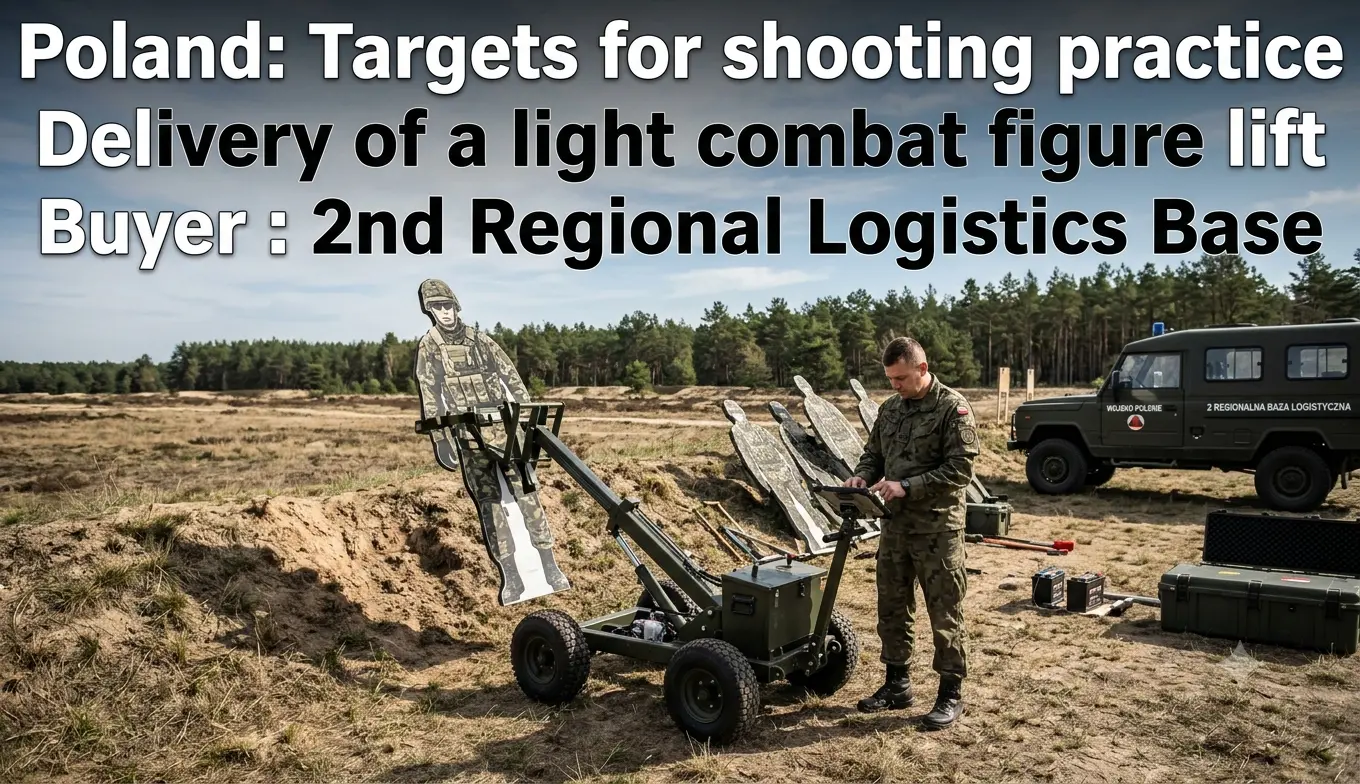
Poland's 2 Regional Logistics Base has closed its tender for 20 sets of light target lifters with no award after the highest ranked bidder refused to sign the contract. Two SMEs tendered and price carried 60 per cent against warranty at 40. The notice does not name the bidder or explain the refusal.
Introduction
Marksmanship is a perishable skill. Soldiers must train regularly, and training requires targets that appear, move and fall in a realistic way. The light target lifter is the mechanism that makes that possible. Without it, ranges revert to static paper and the realism of the exercise drops.
Poland's 2 Regional Logistics Base, based in Warsaw, ran an open procedure for 20 sets of light target lifters, split between a base order and an option. Two small firms tendered. The evaluation produced a winner. Then the highest ranked bidder refused to sign the contract, and the buyer has closed the procedure with no award. The notice does not identify the firm or explain the refusal.
Why This Contract Matters
Target lifters are the equipment that connects live fire training to realistic combat conditions. They raise, hold and drop targets so that soldiers practise engaging fleeting targets at unpredictable intervals. That is a more demanding exercise than shooting at a fixed frame.
The contract matters because the Polish armed forces are engaged in a sustained programme of training and equipment renewal. Small items like target lifters are part of the training infrastructure that supports that effort. Twenty sets is a modest order, but it is a practical one.
It also matters as a procurement signal. A tender that produced two bids, an evaluation and then a collapse at signature is a case study in contract risk. The buyer did the work, ran the competition and still ended with nothing. The notice does not explain why the winner walked away, but the outcome illustrates a real hazard in public procurement: a price that wins on paper can prove undeliverable at signature.
Contract Timeline
The result notice was dispatched on 09/11/2026 at 11:30:12 GMT and published in the Official Journal on 10/11/2026 under OJ S issue 218/2026. A previous notice is referenced under number 325143-2026, which is the earlier stage of the same procedure. The internal identifier is D/57/2026.
The lot carried a start date of 11/05/2026 and a duration end date of 27/11/2026. The notice states that this start date is the date on which the contract notice was sent for publication, not the actual start of performance, which would be the date of signature. Delivery was required within 120 days of contract signature and in any event no later than 27/11/2026. Optional deliveries had a 90 day window from notification, again capped at 27/11/2026. Editorial analysis: with no contract signed, those deadlines are now academic for this procedure.
Contract Overview
The buyer is 2. Regionalna Baza Logistyczna, the 2nd Regional Logistics Base, a central government authority with defence as its activity, based at ul. Marsa 110 in Warsaw, postcode 04-470. The procurement was an open procedure under Directive 2014/24/EU, not accelerated.
It covers one lot, LOT-0001, for the supply of 20 sets of light target lifters. The base order was 10 sets and the optional order a further 10 sets. The contract is classified as supplies under CPV 35210000 for targets for shooting practice. The place of performance is Warsaw, with specific delivery locations described in the procurement documentation. The procurement is GPA covered and not EU funded.
The result is a no award. No winner was chosen and the competition is closed. The stated reason is that the highest ranked tenderer or tenderers refused to sign the contract.
Key Contract Details
| Buyer | 2. Regionalna Baza Logistyczna |
| Winner | No winner. The highest ranked tenderer refused to sign the contract. |
| Title | Dostawa podnośnik lekkich figur bojowych (Supply of light target lifters) |
| Procedure | Open, not accelerated |
| Legal basis | Directive 2014/24/EU |
| CPV | 35210000 Targets for shooting practice |
| Estimated value | The contracting authority has not disclosed this information. |
| Awarded value | None. No contract awarded. |
| Ceiling or maximum | The contracting authority has not disclosed this information. |
| Award criteria and weights | Price 60 points; warranty period 40 points |
| Duration and renewals | Delivery within 120 days of signature, no later than 27/11/2026. Option deliveries within 90 days of notification, no later than 27/11/2026. No renewals. |
| Tenders received | 2, both electronic, both from SMEs, none from other EEA or non EEA countries |
| EU funding | No. Procurement project not financed with EU Funds. |
| GPA | Yes, covered by the Government Procurement Agreement |
| Subcontracting | The contracting authority has not disclosed this information. |
| Key dates | Lot start 11/05/2026; end date 27/11/2026; notice dispatched 09/11/2026; published 10/11/2026 |
| Place of performance | Warszawa (PL911), Poland, with delivery locations per the procurement documents |
| Review body | Krajowa Izba Odwoławcza |
Project Scope
The scope is the supply of 20 sets of light target lifters, made up of 10 base sets and 10 optional sets. The detailed requirements sit in annex 1 to the procurement specification and the rest of the tender documentation, which the notice does not reproduce.
The option mechanism is set out in some detail. The buyer may exercise the option repeatedly up to the maximum quantity in the draft contract. It may exercise the option during the base contract period but no later than 29/08/2026 according to the notice text, though the delivery deadline is stated as 27/11/2026. Editorial observation: those two dates are inconsistent and the notice does not reconcile them. The buyer must notify the contractor in writing or documentary form, and the contractor has no claim to require the buyer to order optional quantities.
That option clause is standard. It gives the buyer flexibility without obliging it to spend. The notice does not describe the technical specification of the lifters, their operating mechanism, their durability standards or the warranty terms required. The contracting authority has not disclosed those details.
About the Contracting Authority
2. Regionalna Baza Logistyczna is the 2nd Regional Logistics Base of the Polish armed forces. It is a central government authority with defence as its activity, based at ul. Marsa 110 in Warsaw, postcode 04-470, in the Miasto Warszawa NUTS region. Its registration number is 521-340-81-99 and the responsible unit is the Public Procurement Section. Its internet address is www.2rblog.wp.mil.pl and its procurement platform is platformazakupowa.pl.
The base holds two roles in this notice. It is the buyer and the organisation providing offline access to the procurement documents. Readers who want to compare how military logistics bases across Europe structure their procurement can explore the contracting authority directory.
About the Organisations Involved
2. Regionalna Baza Logistyczna
The buyer and the body providing offline access to documents. A Polish military logistics base in Warsaw. It owns the target lifter requirement and managed the procedure. It will need to decide how to proceed after the collapse.
Krajowa Izba Odwoławcza
The review organisation and the body providing information on review procedures. It is Poland's National Appeal Chamber, based at ul. Postępu 17A in Warsaw, postcode 02-676, with registration number 5262239325. It hears public procurement appeals and is the forum for any challenge.
Publications Office of the European Union
Listed with the role of TED eSender. It operates the Tenders Electronic Daily platform and is not a party to the contract. It appears because the notice was transmitted through TED.
The notice does not name the two tenderers or identify which one was highest ranked and refused to sign. That is a notable absence. In a no award notice of this type, naming the firm that withdrew would normally help the market understand what happened. The notice does not do so, and the contracting authority has not disclosed the identity.
Procurement Analysis
An open procedure is the standard route for a supplies contract of this value under Directive 2014/24/EU. It was not accelerated, consistent with a planned equipment purchase rather than an urgent operational need. The choice is appropriate and transparent.
Competition was thin but real. Two tenders arrived, both electronic, both from SMEs. That is a narrow field, though not unusual for a specialised defence training item. The notice does not disclose the participation conditions or technical thresholds that might explain the small number of bidders.
The award criteria are balanced. Price carried 60 points and warranty period carried 40. That is a meaningful quality weighting for warranty, which tells bidders the buyer cared about how long the equipment would be supported. A bidder offering a longer warranty could offset a higher price. Editorial analysis: the structure is sensible for durable training equipment, where reliability and support matter over the life of the product.
The outcome is the interesting part. The procedure ran, tenders were evaluated and a winner emerged. Then the highest ranked tenderer refused to sign. The notice does not explain why. Editorial analysis: possible reasons include an error in the bid, a change in the firm's capacity, an inability to meet the delivery deadline of 27/11/2026, or a commercial reassessment after the price was submitted. None of these is confirmed by the notice. The buyer has closed the procedure rather than awarding to the second ranked bidder, which suggests the buyer chose to re tender rather than accept the next offer. The notice does not explain that decision either.
The delivery timetable is a relevant factor. The contract required delivery within 120 days of signature and no later than 27/11/2026. With the procedure still unresolved in late 2026, that deadline was already tight. Editorial observation: a supplier examining the timetable at the point of signature may have concluded it could not be met, which would make refusal to sign a rational decision. The notice does not confirm this.
The estimated value is not disclosed. That is a material gap. Without a value, the market could not assess the size of the opportunity from the notice alone, and the competitiveness of any bid cannot be judged. The notice does not discuss this.
Two further facts shape the context. The procurement is GPA covered, so qualified suppliers from GPA member countries could in principle bid. And it is not EU funded. In practice, a specialised military training item procured in Polish is a domestic market, and the GPA coverage had little practical effect.
Additional Procurement Facts
The notice sets out extensive participation requirements. Bidders had to show they met the conditions and were not subject to exclusion under Article 108(1) and Article 109(1) points 1, 4 and 7 of the Polish public procurement law. They had to submit a European Single Procurement Document with their offer. The buyer stated it would first evaluate the offers and then verify the qualifications of the highest ranked bidder. A bid bond was required, and a performance bond of 2 per cent of the gross contract price was required from the winner.
The notice does not disclose the estimated value, the number of sets per delivery location, the technical specification or the subcontracting arrangements. These are material gaps. The contracting authority has not disclosed this information.
The review route is set out in general terms. Contractors have the legal remedies provided in Part IX of the Polish public procurement law, including appeal to the Krajowa Izba Odwoławcza. The notice does not state a specific deadline figure or whether any review request was filed. The notice also states that the buyer may cancel the procedure under Article 257 if the public funds it intended to use are not granted.
Market and Industry Perspective
Military training equipment is a specialised market. Target lifters are mechanical systems that must withstand repeated use, harsh weather and rough handling on ranges. The suppliers are typically small engineering firms rather than large defence primes, which matches the two SME bidders recorded here.
The collapse at signature is a market signal. It suggests that the winning price or the delivery terms did not hold up when the contract was presented for signature. That happens in small firm procurement when a bidder underestimates costs, miscalculates a delivery schedule or finds that its supply chain cannot meet the required timeline. The notice does not confirm any of these.
The wider context is that European military forces are investing in training infrastructure alongside major equipment programmes. Range equipment, targetry and simulation are part of that spending. Small contracts like this one matter to the firms that supply them. Readers tracking how defence training equipment contracts are structured across Europe can review sector coverage for context.
Economic Significance
The direct economic effect is that a target lifter procurement produced no contract. For the two SME bidders, that is wasted bid effort. For the logistics base, it is a delay in a planned training equipment purchase and a need to decide how to proceed.
The wider significance is in what the collapse reveals about small firm defence supply. A contract that runs through evaluation and then fails at signature wastes public resources on both sides. The buyer must re tender, which adds cost and delay. The supplier may face consequences if the refusal is judged to be unjustified. The notice does not indicate whether any such consequence applies.
For suppliers, the economic signal is that public sector training equipment work is available but the delivery terms matter. A contract with a tight deadline and a performance bond is not risk free. Firms that bid should be confident they can deliver within the stated window before committing.
Future Procurement Opportunities
The most likely future opportunity is a relaunch of the target lifter procurement. The logistics base still needs the equipment. The notice does not confirm a relaunch or give a date. Editorial projection: a new tender is the logical next step, potentially with a longer delivery window, a revised option schedule or a re tender among the existing bidders.
A second possibility is that the buyer awards to the second ranked bidder. The notice states the procedure is closed with no winner, which suggests this did not happen. However, the notice does not explain why. The buyer could in principle run a new procedure rather than accept the next offer.
A third possibility is a direct negotiation or a revised specification. The notice does not disclose any such plan. Suppliers can monitor these possibilities through live European tender notices and by tracking the base's publications on its buyer profile.
Opportunities for Suppliers
For engineering firms that make range and targetry equipment, this closure is a live signal that the logistics base has an unmet requirement. A buyer that has just closed a procedure is a buyer that will need a new route to market. Firms with target lifter capability should prepare for a relaunch.
The practical steps are clear. Review the original procurement documents in the document library if they remain available, to understand the specification, the option mechanism and the delivery deadline. Assess whether the timetable is achievable and what warranty period would score well against the 40 point criterion. Consider whether the delivery deadline of 27/11/2026 was the reason the winner withdrew, and whether a relaunch might offer a longer window.
Suppliers should also watch for other range and training equipment tenders from the same base. Setting alerts through registration helps capture those opportunities. The price led criteria with a meaningful warranty weight mean bidders should prepare a competitive price and a strong support offer, but also a delivery plan they can actually meet.
What Businesses Should Watch
Watch for a relaunch of the target lifter procurement, possibly with revised delivery terms. Watch for other range and training equipment contracts from the same logistics base. Watch for any notice that identifies the firm that withdrew or explains the circumstances.
Watch the review environment too. The notice names the Krajowa Izba Odwoławcza as the review body and refers deadlines to the Polish public procurement law. Any challenge would go through that chamber. Businesses with an interest in defence training equipment procurement should monitor the base's buyer profile and the relevant CPV codes. The keyword search tool can help track themes such as target lifters, range equipment or military training infrastructure.
poland tenders.com Procurement Intelligence
The broader trend this notice represents is the fragility of small defence equipment procurements. Buyers run open procedures, receive a handful of bids from small firms, evaluate them and then discover at signature that the winning offer cannot be delivered on the stated terms. That is a recurring pattern in specialised mechanical equipment, where bid pricing is difficult and delivery timelines can be tight.
The strategic importance of the award, or rather the non award, lies in what it reveals about contract risk. Two SME bids and a winner who refused to sign tells us the commercial terms did not hold. The notice does not identify the cause, but the tight delivery deadline of 27/11/2026 is visible in the document. Suppliers should read this as a market where delivery capability matters as much as price. A bid that wins on paper but cannot be delivered costs the buyer time and the supplier credibility.
For positioning, suppliers should focus on realistic pricing, achievable delivery schedules and a warranty offer that scores well against the 40 point criterion. The performance bond of 2 per cent is a modest requirement, but the refusal to sign may carry consequences under Polish procurement law. Firms should understand those consequences before bidding. Future contracts in this space are likely to follow the same template: open procedure, price led with a warranty weight, small SME field and a defined delivery window. Firms that prepare technical documentation, a realistic timetable and a strong support offer in advance will be better placed when the relaunch appears. The buyer may also adjust the timetable, which would be a welcome change for suppliers who found the original deadline unworkable.
Supplier Takeaways
- Two SMEs tendered. The highest ranked bidder refused to sign and the procedure closed with no award.
- Price carried 60 points and warranty period 40 points.
- The contract required delivery within 120 days of signature and no later than 27/11/2026.
- The notice does not name the withdrawing bidder, disclose the estimated value or explain the refusal.
- The requirement for 20 sets, split 10 base and 10 optional, remains unmet.
Key Takeaways
- 2. Regionalna Baza Logistyczna closed its light target lifter tender with no winner.
- The stated reason is that the highest ranked tenderer refused to sign the contract.
- The procurement was open, GPA covered and not EU funded, under Directive 2014/24/EU.
- The notice carries an inconsistency between the option exercise deadline of 29/08/2026 and the delivery deadline of 27/11/2026.
- A relaunch is the likely next step. The notice does not confirm it.
Conclusion
A tender that fails at signature is a costly outcome for everyone involved. Poland's 2nd Regional Logistics Base ran an open procedure for light target lifters, received two SME bids, evaluated them and then found that the winner would not sign. The equipment is still needed, the training requirement has not gone away and the procedure has to start again.
The next move belongs to the buyer, whether that is a relaunch with revised delivery terms, a re tender among the existing bidders or a different approach altogether. Suppliers should watch closely and prepare a bid they can actually deliver. The full picture of how European public procurement works, including no award outcomes and contract signature risk, is available through public procurement guidance. Readers who want to discuss the implications for their own bidding strategy can use the contact page.
Source: Tenders Electronic Daily (TED), Contract Award Notice 782117 2026, Official Journal of the European Union, OJ S issue 218/2026, published on 10/11/2026.

Fresh and verified Tenders from Poland. Find, search and filter Tenders/Call for bids/RFIs/RFPs/RFQs/Auctions published by the government, public sector undertakings (PSUs) and private entities.
- 1,000+ Tenders
- Verified Tenders Only
- New Tenders Every Day
- Tenders Result Data
- Archive & Historical Tenders Access
- Consultants for RFI/RFP/RFQ
- Tender Notifications & Alerts
- Search, Sort, and Filter Tenders
- Bidding Assistance & Consulting
- Customer Support
- Publish your Tenders
- Export data to Excel
- API for Tender Data
- Tender Documents

Fill out the form below and you will receive a call from us within 24 hours.
Get FREE SAMPLE TENDERS from Poland in your email inbox.
Copyright © 2014-2026 PolandTenders.com. All Rights Reserved.