Poland’s Military Engineering Institute Awards 1.01 Million PLN Ground Penetrating Radar Contract to SUBGEO
Empowering Global Suppliers to Navigate EU Defence Eprocurement & Tender Opportunities
Standfirst
The Wojskowy Instytut Techniki Inżynieryjnej in Wrocław has awarded a 1,006,017 PLN contract for a ground penetrating radar system to SUBGEO Jarosław Majewski. Only one bid arrived. Price carried 60 per cent, delivery time 20 and warranty 20, and the award came in about 10 per cent below the institute's estimate.
Introduction
Before engineers build a road, lay a pipeline or clear a route for military movement, they need to know what lies beneath the surface. Unexploded ordnance, old foundations, buried utilities and unstable ground all matter. A ground penetrating radar, known as a georadar, is one of the tools that turns an invisible subsurface into a readable picture.
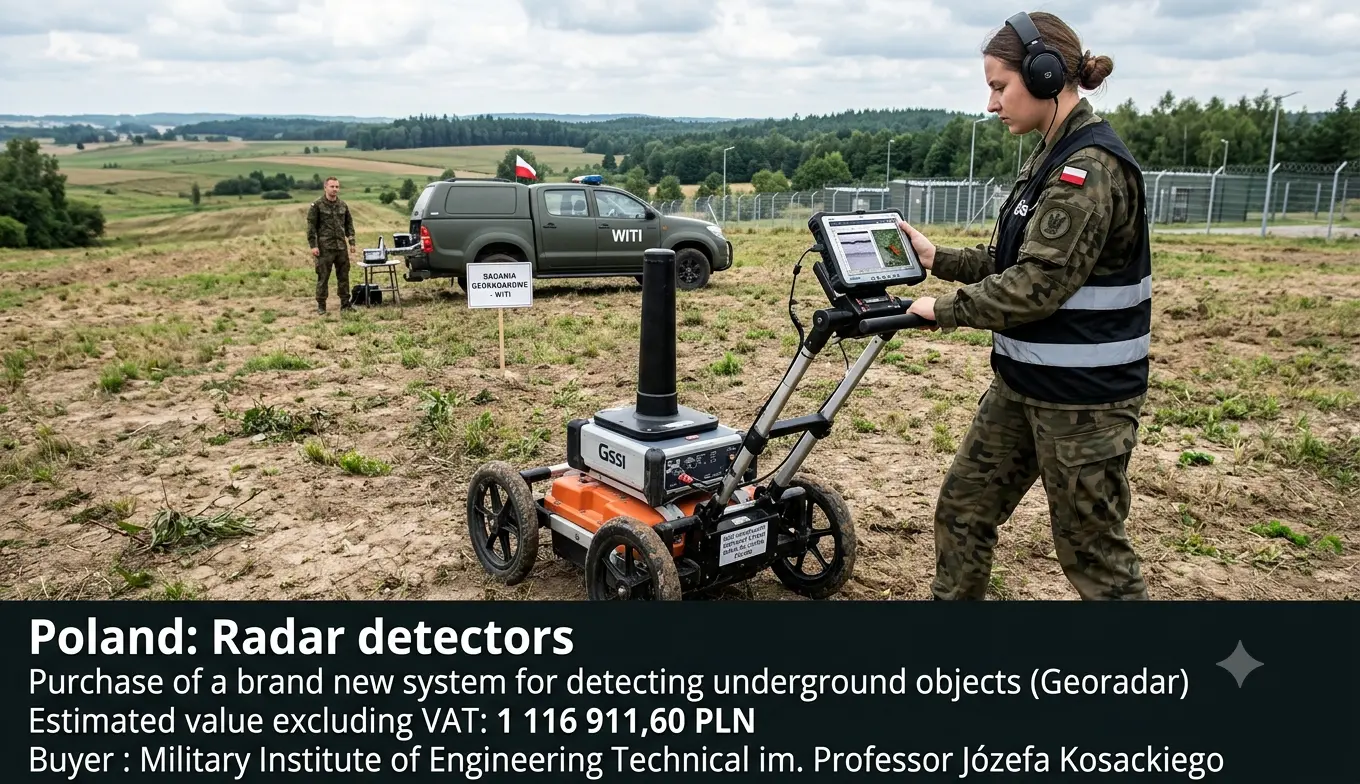
Poland's military engineering institute in Wrocław has bought one. The contract covers a factory new georadar system, delivery and training for institute staff. The winner is SUBGEO Jarosław Majewski, a small firm based in the Wrocław area. It was the only bidder. The value is 1,006,017 PLN and the delivery window is 120 days.
Why This Contract Matters
Military engineering is about making ground usable and safe. Detecting subsurface objects before construction or deployment prevents accidents, protects equipment and avoids costly redesign. For an institute that develops and tests engineering techniques for the armed forces, having its own georadar capability is a working asset, not a lab curiosity.
The contract matters because it combines equipment with training. The institute is not simply buying a box. It is buying the ability to operate the system independently. That is a deliberate choice. It builds in house capability rather than relying on external survey contractors for every task.
It also matters as a procurement signal. A defence research institute ran an open procedure for a specialised instrument and received one bid. That tells us the market for this type of equipment is narrow, at least in the way the requirement was specified. The notice does not explain why only one firm bid.
Contract Timeline
The winner was selected on 28/10/2026 and the contract was concluded on 02/11/2026. The result notice was dispatched on 04/11/2026 at 12:41:15 Central European Time and published in the Official Journal on 05/11/2026 under OJ S issue 215/2026. The notice identifier version is recorded as 02, which suggests an earlier version existed.
The contract duration is 120 days. Editorial projection: counting from the conclusion date of 02/11/2026, a 120 day delivery period would run to around early March 2027. The notice does not state the exact delivery start date. The contracting authority has not disclosed that information. The notice also does not explain the gap between winner selection and contract conclusion, which was five days, a normal interval.
Contract Overview
The buyer is the Wojskowy Instytut Techniki Inżynieryjnej im. profesora Józefa Kosackiego, the Military Institute of Engineering Technology named after Professor Józef Kosacki. It is a body governed by public law controlled by a central government authority, with defence as its activity, based in Wrocław. The procurement was an open procedure under Article 132 of the Polish Public Procurement Law and Directive 2014/24/EU.
It covers one lot, LOT-0001, for the purchase, delivery and training on a factory new ground penetrating radar system. The quantity is recorded as one piece. The contract is classified mainly as supplies, with services as an additional nature, reflecting the training component. The main CPV code is 35121900 for radar detectors, with an additional code of 38600000 for optical instruments. The place of performance is the institute's address at ul. Obornicka 136 in Wrocław.
The estimated value was 1,116,911.60 PLN excluding VAT. The contract was awarded at 1,006,017.00 PLN. That is the value of all contracts awarded in the notice and also the winning tender value.
Key Contract Details
| Buyer | Wojskowy Instytut Techniki Inżynieryjnej im. profesora Józefa Kosackiego |
| Winner | SUBGEO Jarosław Majewski |
| Title | Zakup fabrycznie nowego systemu do detekcji obiektów podziemnych (Georadar) (Purchase of a factory new system for the detection of underground objects, a georadar) |
| Procedure | Open |
| Legal basis | Directive 2014/24/EU; Polish Public Procurement Law, Article 132 |
| CPV | 35121900 Radar detectors; 38600000 Optical instruments |
| Estimated value | 1,116,911.60 PLN excluding VAT |
| Awarded value | 1,006,017.00 PLN |
| Ceiling or maximum | The contracting authority has not disclosed this information. |
| Award criteria and weights | Gross price 60 per cent; delivery time 20 per cent; warranty 20 per cent |
| Duration and renewals | 120 days. Renewals not disclosed. |
| Tenders received | 1, submitted electronically |
| EU funding | No. Procurement project not financed with EU Funds. |
| GPA | No |
| Subcontracting | No |
| Key dates | Winner selected 28/10/2026; contract concluded 02/11/2026; notice dispatched 04/11/2026; published 05/11/2026 |
| Place of performance | ul. Obornicka 136, Wrocław, postcode 50-961 (PL514), Poland |
| Review body | Wojskowy Instytut Techniki Inżynieryjnej im. profesora Józefa Kosackiego, with appeal to the Krajowa Izba Odwoławcza |
Project Scope
The scope is a factory new georadar system, delivered and commissioned, plus training for the buyer's staff. The notice describes the training as covering operation to the extent necessary to begin using the system. That is a practical handover requirement, not an extensive skills programme.
The notice does not describe the technical parameters of the radar. It refers to parameters indicated in the description of the subject matter, which is not reproduced in the result notice. The contracting authority has not disclosed the technical specification, the depth range, the antenna configuration or the software included.
The quantity is one piece, which means a single system. That is consistent with an institute buying a capability for its own use rather than a fleet wide deployment. The 120 day delivery window is the only performance timeline disclosed. There is no framework agreement, no dynamic purchasing system and no options described.
About the Contracting Authority
The Wojskowy Instytut Techniki Inżynieryjnej is a Polish military research institute specialising in engineering technology. It is named after Professor Józef Kosacki, the Polish engineer associated with the development of the mine detector. It is a body governed by public law controlled by a central government authority, with defence as its activity. Its registered office is at ul. Obornicka 136 in Wrocław, postcode 50-961, in the Miasto Wrocław NUTS region. Its registration numbers are NIP 8960004811 and REGON 930064508.
The institute holds an unusually broad set of roles in this procurement. It is the buyer, the organisation providing additional information, the organisation providing offline access to documents, the review organisation, the body providing information on review procedures, the mediation organisation and the organisation signing the contract. That concentration is common in smaller defence research bodies that run their own procurement without a central purchasing unit. Readers who want to compare how defence research bodies across Europe structure their procurement can explore the contracting authority directory.
About the Organisations Involved
Wojskowy Instytut Techniki Inżynieryjnej im. profesora Józefa Kosackiego
The buyer and every procedural role listed above. A Polish military engineering research institute based in Wrocław. It owns the georadar requirement and will operate the system after delivery and training.
SUBGEO Jarosław Majewski
The winner. The notice describes it as a micro, small or medium sized economic operator registered in Poland under number PL 894 236 47 75, based at ul. Borowa 28A in Wilczyce, postcode 51-361, in the Wrocławski NUTS region. Its contact email is on the subgeo.eu domain. Its roles are tenderer and winner of LOT-0001. It submitted tender number 1, valued at 1,006,017.00 PLN, ranked first, with no variant and no subcontracting. The firm is based in the Wrocław area, close to the institute. No parent company, group structure or product portfolio is disclosed.
Krajowa Izba Odwoławcza
The national appeal chamber, named in the review deadline information as the body to which appeals are made after the institute's own review stage. It is not listed as a separate organisation entry in the notice but is referenced in the review procedure text. It is based in Warszawa and hears public procurement appeals.
No unsuccessful tenderers are named because there were none. The notice records one electronic tender received.
Procurement Analysis
An open procedure under Article 132 of the Polish Public Procurement Law is the standard route for a supplies contract above the EU thresholds. It is transparent and invites any qualified supplier. The choice fits a planned equipment purchase rather than an urgent operational need.
Competition was absent. One electronic tender arrived. That is a thin result for a contract of this value, though not surprising for a specialised defence engineering instrument. The notice does not disclose any participation conditions or technical thresholds that might explain the single bidder. Editorial analysis: the combination of a defence context, a specialised georadar specification and a modest contract value may have limited interest to a narrow field of specialist suppliers. The notice does not confirm this.
The award criteria are balanced. Price carried 60 per cent, delivery time carried 20 and warranty carried 20. That is a practical structure for an equipment purchase. The buyer cared most about cost, but also about how quickly the system would arrive and how long the supplier would stand behind it. The combined 40 per cent on delivery and warranty gives bidders room to differentiate on service terms even in a single bidder field.
The price outcome is healthy for the buyer. The awarded value of 1,006,017.00 PLN is below the estimated value of 1,116,911.60 PLN. Editorial calculation: the reduction is 110,894.60 PLN, or about 9.9 per cent against the estimate. That is a meaningful saving. Since no ceiling is disclosed, the estimate is the only reference point and it should not be treated as a maximum. A single bidder still came in below estimate, which may reflect a conservative estimate rather than an aggressive bid.
Subcontracting is declared as no. The winner will deliver with its own resources. For a georadar supply and training contract, that is consistent with a specialist vendor or reseller model. The notice does not disclose whether the winner manufactures the system or supplies a third party product.
The procurement is not covered by the Government Procurement Agreement and is not EU funded. Both facts point to a domestic market. The Polish language requirement and the defence context would in practice limit the field to Polish or locally established suppliers.
Additional Procurement Facts
The notice refers to a previous notice under number 609326-2026, which is the earlier stage of the same procedure. The internal identifier is 05/WITI/2026. The contract identifier is 25/P/2026. These identifiers allow the full procedure history to be traced through the Polish procurement platform.
The review procedure is set out in detail. Appeals to the Krajowa Izba Odwoławcza must generally be lodged within 10 days of the relevant information where it was communicated electronically, or 15 days where it was communicated otherwise. For challenges to the content of the contract notice or the procurement documents, the deadline is 10 days from publication in the Official Journal or from posting the documents online. A further appeal against the chamber's ruling lies to the District Court in Warsaw.
The notice does not disclose the technical specification, the delivery start date, the warranty period offered by the winner or the scoring of the single tender. These are material gaps for anyone assessing the commercial terms.
Market and Industry Perspective
Ground penetrating radar is a specialised instrument market. Suppliers range from large geophysical equipment manufacturers to small specialist distributors and survey firms. The technology is used in civil engineering, archaeology, utility detection, environmental assessment and military engineering. A defence institute's requirement adds security, durability and operational reliability to the usual technical demands.
The single bidder outcome suggests the field able to meet the specification was narrow. That is common in defence equipment procurement, where the technical requirement is precise and the number of capable vendors is small. The fact that the winner is a small local firm rather than a large manufacturer suggests it operates as a specialist supplier or integrator in the segment.
The wider context is that military engineering is investing in detection and survey capability. As armies modernise their engineering equipment, ground radar and subsurface detection become part of the standard toolset. Polish defence procurement has been active across many categories, and research institutes are part of that activity. Readers tracking how defence equipment contracts are distributed across Europe can review sector coverage for context.
Economic Significance
The direct economic effect is a 1,006,017 PLN contract to a small firm based near Wrocław. That keeps the spending in the regional economy and supports a local specialist supplier. The winner declared no subcontracting, so the value stays at the prime contractor level.
The wider economic value lies in the capability the institute acquires. An in house georadar allows the institute to test engineering techniques, assess ground conditions and support military construction and route clearance work. That capability supports the institute's research mission and, indirectly, the operational effectiveness of the armed forces.
For the local supplier base, the award shows that a small firm can win a defence research contract when it meets the technical and security requirements. That is encouraging for regional SMEs, though the single bidder outcome means the competitive test was limited.
Future Procurement Opportunities
The most immediate follow on opportunity is inside the contract. The 120 day delivery and the training component mean the institute will need support as it adopts the system. The notice does not disclose any maintenance, calibration or software support arrangement. However, a georadar typically requires calibration, software updates and occasional repair. A separate support contract is a plausible future step. That is an editorial projection, not a disclosed plan.
A second opportunity lies in related engineering detection equipment. The institute develops and tests military engineering technology, and its procurement plan may include other instruments in future. The notice does not list such contracts, but a research institute with a detection capability is likely to need complementary tools and consumables.
Suppliers can monitor these possibilities through live European tender notices and by tracking the institute's future publications on its buyer profile.
Opportunities for Suppliers
For georadar suppliers and specialist distributors, this award confirms that the Wrocław institute is an active buyer of subsurface detection equipment. The price led criteria with meaningful delivery and warranty weights suggest that bidders should compete on cost while offering a realistic delivery plan and a strong warranty.
The single bidder outcome also suggests the field is not crowded. A firm that can meet a defence grade specification and provide training and after sales support may face limited competition. Reviewing the original tender documents in the document library would help firms understand the technical parameters and the evaluation method. Building a track record with defence and engineering research bodies would strengthen future bids.
Suppliers should also watch for calibration, maintenance and training follow ons. Setting alerts through registration helps capture those opportunities. The defence context means security and confidentiality requirements should be expected, even if the notice does not state them.
What Businesses Should Watch
Watch for follow on calibration, maintenance or software support contracts related to the georadar. Watch for further detection or survey equipment procurements from the institute. Watch for any correction or additional notice that fills the gaps in this result, such as the technical specification or the warranty period.
Watch the review environment too. The institute acts as the first review body and the Krajowa Izba Odwoławcza is the appeal chamber. The notice sets out detailed appeal deadlines of 10 or 15 days depending on how information was communicated. Businesses with an interest in defence engineering procurement should monitor the institute's buyer profile and the relevant CPV codes. The keyword search tool can help track themes such as georadar, subsurface detection or military engineering equipment.
Poland tenders.com Procurement Intelligence
The broader trend this contract represents is the equipment led modernisation of military engineering. Research institutes are buying specialised detection and survey instruments to build in house capability. The supplier market for that equipment is narrow, and price led evaluation with service weights is the norm. The Wrocław institute's award to a small local firm fits that pattern.
The strategic importance of the award lies in the combination of criteria and outcome. Price carried 60 per cent, but delivery time and warranty carried 20 each, which means the buyer wanted more than a cheap box. It wanted a supplier that could deliver promptly and stand behind the equipment. The winner came in about 9.9 per cent below estimate, which is a good result for the buyer even without competitive tension.
For positioning, suppliers should focus on demonstrated georadar capability, a realistic delivery plan and a strong warranty offer. The absence of subcontracting suggests the winner delivered as a prime. Future contracts in this space are likely to follow the same template: open procedure, price led with service weights, specialised technical requirement and thin competition. Firms that prepare technical documentation and references in advance will be better placed when the next detection equipment tender appears. The follow on support market is also worth tracking, since an installed instrument creates a service tail.
Supplier Takeaways
- Only one tender arrived. The competition was effectively absent.
- Price carried 60 per cent, delivery time 20 and warranty 20.
- The award of 1,006,017.00 PLN is about 9.9 per cent below the estimate of 1,116,911.60 PLN.
- The contract includes delivery and staff training for a single factory new georadar system.
- The winner is a small firm based near Wrocław, with no subcontracting declared.
Key Takeaways
- The Wojskowy Instytut Techniki Inżynieryjnej awarded SUBGEO Jarosław Majewski a 1,006,017 PLN georadar contract.
- The procurement was open under the Polish Public Procurement Law and Directive 2014/24/EU.
- The contract runs 120 days and covers supply, delivery and training.
- The notice does not disclose the technical specification, warranty period or delivery start date.
- The project is not GPA covered and not EU funded. The review path runs through the institute and then the Krajowa Izba Odwoławcza.
Conclusion
Seeing beneath the ground is a practical military engineering skill. The Wrocław institute has bought a georadar from a small local supplier, at a price below its own estimate and on terms that weighted delivery speed and warranty alongside cost. The single bidder outcome is the most notable feature, and it tells us that the field of capable suppliers for this kind of equipment is narrow.
The next chapter is adoption. The institute will take delivery, train its staff and begin using the system in its engineering work. Suppliers should watch for the support and calibration market that follows an installed instrument. The full picture of how European public procurement works, including single bidder outcomes and defence equipment awards, is available through public procurement guidance. Readers who want to discuss the implications for their own bidding strategy can use the contact page.
Source: Tenders Electronic Daily (TED), Contract Award Notice 771101 2026, Official Journal of the European Union, OJ S issue 215/2026, published on 05/11/2026.
Frequently Asked Questions (FAQs)

Fresh and verified Tenders from Poland. Find, search and filter Tenders/Call for bids/RFIs/RFPs/RFQs/Auctions published by the government, public sector undertakings (PSUs) and private entities.
- 1,000+ Tenders
- Verified Tenders Only
- New Tenders Every Day
- Tenders Result Data
- Archive & Historical Tenders Access
- Consultants for RFI/RFP/RFQ
- Tender Notifications & Alerts
- Search, Sort, and Filter Tenders
- Bidding Assistance & Consulting
- Customer Support
- Publish your Tenders
- Export data to Excel
- API for Tender Data
- Tender Documents

Fill out the form below and you will receive a call from us within 24 hours.
Get FREE SAMPLE TENDERS from Poland in your email inbox.
Copyright © 2014-2026 PolandTenders.com. All Rights Reserved.