Poland's Military Vehicle Repair Tender Fails to Attract a Single Bid in Gdańsk
Standfirst
A Polish military unit has closed one part of its 23 lot vehicle repair framework after zero tenders arrived for Mercedes vehicles up to 3.5 tonnes in Gdańsk. The lot carried price at 60 per cent, workshop authorisation at 20 and parts discount at 20. The notice covers only that lot. The other 22 lots are not reported here.
Introduction
Military vehicles break down like any others. They need servicing, bodywork, paint and repair, often at short notice and to standards that civilian garages do not routinely meet. For the Polish armed forces, keeping that work flowing means contracting a network of authorised workshops across the country.
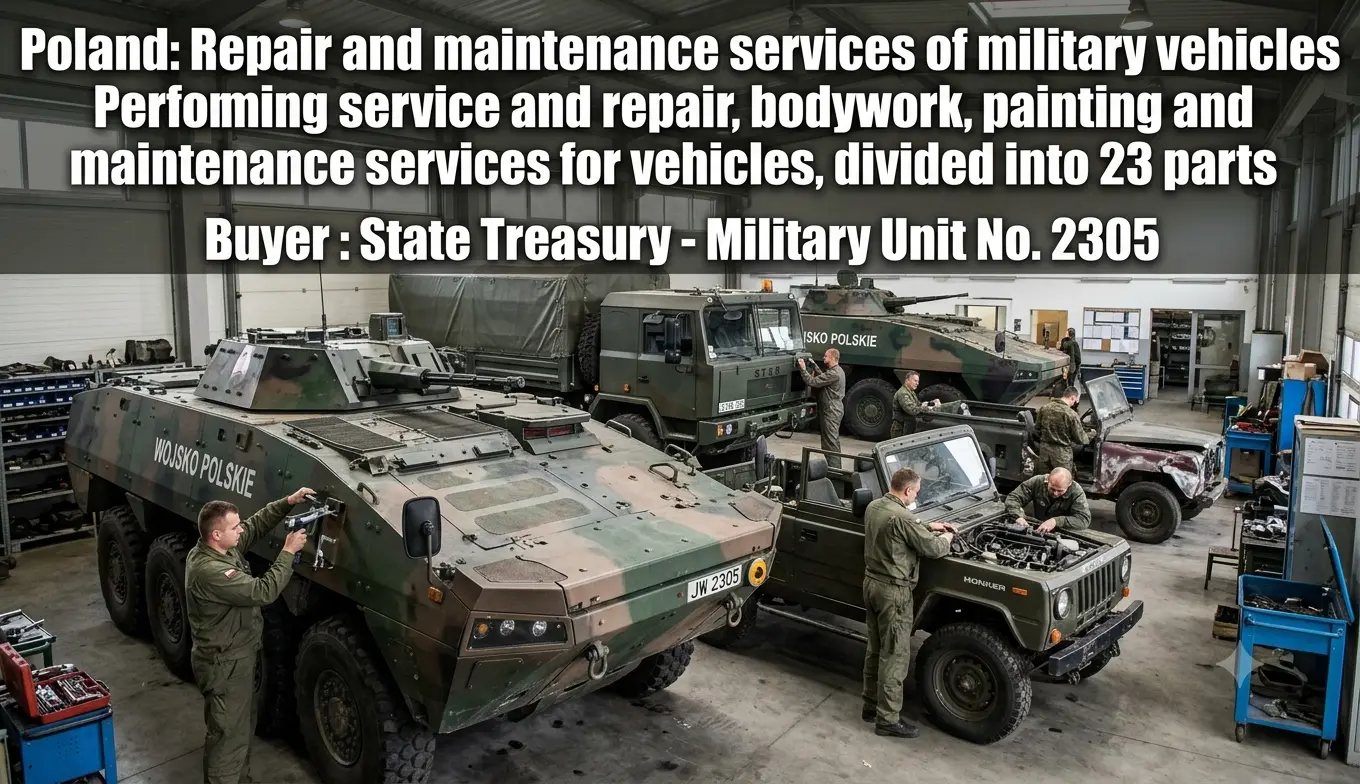
Jednostka Wojskowa Nr 2305, a Polish military unit based in Warsaw, ran an open procedure divided into 23 parts for vehicle maintenance, repair, bodywork and painting services. Part 5 covered Mercedes vehicles up to 3.5 tonnes gross vehicle weight in Gdańsk. Not one tender arrived. The buyer has closed that part with no winner. The notice records only this lot, so the outcome of the other 22 parts is not disclosed here.
Why This Contract Matters
Vehicle availability is a readiness issue. A unit that cannot service its transport fleet loses operational flexibility. Repair and maintenance contracts for military vehicles are therefore not routine admin. They are part of the logistics backbone that keeps units moving.
The contract matters because the requirement is specific. Part 5 was not a general garage contract. It targeted Mercedes vehicles up to 3.5 tonnes in a defined location, Gdańsk. That combination of brand, weight class and geography narrows the pool of workshops that can credibly bid. When a lot like that attracts no interest, the practical effect is that those vehicles have no contracted repair route through this framework.
It also matters as a procurement signal. The buyer divided a large requirement into 23 parts, presumably to widen competition and let local workshops bid for what they can serve. Part 5 still failed. That tells us the geographic or brand specific market in Gdańsk was not willing or able to engage on these terms.
Contract Timeline
The result notice was dispatched on 05/11/2026 at 16:01:23 GMT and published in the Official Journal on 09/11/2026 under OJ S issue 217/2026. A previous notice is referenced under number 749053-2025, which is the earlier stage of the same procedure. The internal identifier is ZP-59/2025.
The lot has a stated duration end date of 31/12/2026, with other duration recorded as unknown. The notice does not disclose when the tender was launched, when the deadline for bids fell or when the buyer decided to close part 5. The contracting authority has not disclosed those dates. Editorial analysis: the 31/12/2026 end date suggests the framework was structured around annual service periods, which fits the renewal mechanism described below.
Contract Overview
The buyer is Skarb Państwa - Jednostka Wojskowa Nr 2305, which translates as the State Treasury - Military Unit Number 2305. It is a central government authority with defence as its activity, based at ul. Marsa 80 in Warsaw, postcode 04-520. The procurement was an open procedure under Directive 2014/24/EU. It was not accelerated.
It covered vehicle maintenance, repair, bodywork, paint and conservation services divided into 23 parts. This notice reports only part 5, LOT-0005, for Mercedes vehicles up to 3.5 tonnes gross vehicle weight in Gdańsk. The lot is classified as services under CPV 50630000 for repair and maintenance services of military vehicles. It is GPA covered and not EU funded. There is no framework agreement and no dynamic purchasing system, though the lot carries renewal options.
The result is clear. No winner was chosen and the competition is closed. The stated reason is that no tenders, requests to participate or projects were received.
Key Contract Details
| Buyer | Skarb Państwa - Jednostka Wojskowa Nr 2305 |
| Winner | No winner chosen. Competition closed. |
| Title | Wykonywanie usług obsługowo-naprawczych oraz blacharsko-lakierniczych i konserwacyjnych pojazdów z podziałem na 23 części (Performance of maintenance and repair, bodywork and paint and conservation services for vehicles, divided into 23 parts) |
| Procedure | Open, not accelerated |
| Legal basis | Directive 2014/24/EU |
| CPV | 50630000 Repair and maintenance services of military vehicles |
| Estimated value | The contracting authority has not disclosed this information for lot 5. |
| Awarded value | None. No contract awarded. |
| Ceiling or maximum | The contracting authority has not disclosed this information. |
| Award criteria and weights | Price 60 per cent; workshop authorisation 20 per cent; parts discount 20 per cent |
| Duration and renewals | End date 31/12/2026, other duration unknown. Maximum renewals 3, covering 12 month periods for 2027, 2028, 2029 or until funds are exhausted |
| Tenders received | 0 |
| EU funding | No. Procurement project not financed with EU Funds. |
| GPA | Yes, covered by the Government Procurement Agreement |
| Subcontracting | The contracting authority has not disclosed this information. |
| Key dates | Notice dispatched 05/11/2026; published 09/11/2026. Tender and decision dates not disclosed. |
| Place of performance | Gdańsk, with the buyer address in Warszawa (PL911), Poland |
| Review body | Krajowa Izba Odwoławcza |
Project Scope
Part 5 covered maintenance, repair, bodywork, paint and conservation services for Mercedes vehicles up to 3.5 tonnes gross vehicle weight in Gdańsk. The detailed description sits in Part III of the procurement specification, which the notice does not reproduce.
The lot included an option. The notice states that the buyer anticipates an optional contract in accordance with the procurement documentation. It also sets out a renewal mechanism. The buyer reserves the right to increase the scope of services by awarding a contract under Article 31(2) of the Polish public procurement law. Renewal is defined as performance of the contract for a further 12 months, for 2027, 2028, 2029, or until the funds in the original contract are exhausted. The maximum number of renewals is three.
That structure matters. It means the lot was designed as a recurring service arrangement with annual extensions, not a single repair job. A workshop bidding for it would be committing to a multi year relationship. The notice does not disclose the estimated annual value or the expected volume of work.
About the Contracting Authority
Skarb Państwa - Jednostka Wojskowa Nr 2305 is a Polish military unit acting on behalf of the State Treasury. It is a central government authority with defence as its activity. Its registered address is ul. Marsa 80 in Warsaw, postcode 04-520, in the Miasto Warszawa NUTS region. Its NIP registration number is 9521818707 and the responsible department is the Public Procurement Group. Its internet address is www.grom.wp.mil.pl and its procurement platform is platformazakupowa.pl.
The unit holds two roles in this notice. It is the buyer and the organisation providing additional information about the procedure. Readers who want to compare how military procurement units across Europe structure their maintenance contracts can explore the contracting authority directory.
About the Organisations Involved
Skarb Państwa - Jednostka Wojskowa Nr 2305
The buyer and the body providing procedural information. A Polish military unit based in Warsaw. It owns the vehicle maintenance requirement and managed the 23 part procedure. It will need to decide how to proceed for part 5 after the closure.
Krajowa Izba Odwoławcza
The review organisation, the mediation organisation and the body providing information on review procedures. It is Poland's National Appeal Chamber, based at ul. Postępu 17a in Warsaw, postcode 04-520. It hears public procurement appeals and handles mediation. The notice refers review deadlines to the relevant provisions of the Polish public procurement law rather than stating a figure.
Publications Office of the European Union
Listed as ORG-0000 with the role of TED eSender. It operates the Tenders Electronic Daily platform and is not a party to the contract. It appears because the notice was transmitted through TED.
No winners or tenderers appear in this notice because none existed for part 5. There are none to profile. That absence is the central fact of the document.
Procurement Analysis
An open procedure is the standard route for a services contract under Directive 2014/24/EU. It maximises transparency and invites any qualified supplier. Dividing a large national requirement into 23 parts is a deliberate design choice. It lowers the barrier for local workshops and avoids concentrating the whole fleet maintenance need in a few large contractors. On paper, that is a sensible structure.
Part 5 still attracted zero bids. The notice does not explain why. Several factors are visible from the document and worth setting out, without asserting a cause the notice does not state. First, the requirement is brand specific. It targets Mercedes vehicles in a defined weight class. A workshop must be able to service that brand to the standard the buyer expects. Second, the location is fixed. The work is in Gdańsk, so a workshop elsewhere cannot easily compete. Third, the award criteria reward workshop authorisation at 20 per cent. That suggests the buyer expected an authorised or officially recognised workshop, which narrows the field further.
The price weight is 60 per cent, with 20 per cent on workshop authorisation and 20 per cent on parts discount. That is a price led structure with meaningful quality proxies. A bidder would need to offer competitive labour rates, demonstrate authorisation and give a discount on parts. Editorial analysis: for a small local workshop, the administrative effort of bidding for a 23 part framework, combined with the specific brand and authorisation requirements, may have outweighed the expected return. The notice does not confirm this.
The renewal mechanism is a relevant factor. With up to three annual renewals, the lot could run for several years. That should make it more attractive, not less. But the notice also states that renewals run until funds in the original contract are exhausted, which introduces uncertainty about volume. A workshop weighing a multi year commitment with an undefined work volume may have concluded the risk reward balance did not work. The notice does not say.
The estimated value for lot 5 is not disclosed. That is a material gap. Without a value, the market could not assess the size of the opportunity from the notice alone. Editorial observation: a published estimate might have helped attract bidders. The notice does not discuss this.
Two further facts shape the context. The procurement is GPA covered, so qualified suppliers from GPA member countries could in principle bid. And it is not EU funded. In practice, a local vehicle repair contract in Gdańsk for Polish military vehicles is a domestic market, and the GPA coverage had little practical effect.
Additional Procurement Facts
The notice does not disclose the volume of vehicles covered, the expected number of service jobs per year, the estimated annual value or the subcontracting arrangements. These are material gaps for anyone assessing the opportunity. The contracting authority has not disclosed this information.
The lot carries no strategic procurement aim and no Green Public Procurement criteria. The award is a straightforward price led service contract with quality proxies, not a sustainability driven procurement.
The review route is set out in general terms. Contractors have the legal remedies provided in Part IX of the Polish public procurement law, including appeal to the Krajowa Izba Odwoławcza and a complaint to the district court, filed in the manner and within the deadlines set by that law. The notice does not state a specific deadline figure or whether any review request was filed.
Market and Industry Perspective
Military vehicle repair is a specialised service market. It requires workshops that can handle military specifications, security requirements and often brand specific diagnostic equipment. The supplier base is a mix of authorised dealer networks and independent specialist garages. Geographic proximity matters because vehicles must be physically brought to the workshop.
The zero bid outcome for part 5 suggests that in Gdańsk, the combination of brand, weight class, authorisation requirement and contract terms did not align with the local market. That is a localised signal rather than a national one. The notice does not report the outcome of the other 22 parts, so we cannot tell whether the framework as a whole succeeded. Editorial analysis: it is possible that other parts attracted bids and only part 5 failed. The notice does not confirm this either way.
The wider context is that European military forces are investing in fleet readiness and maintenance contracting. Multi lot service frameworks are a common model because they combine national coverage with local delivery. When one lot fails, the buyer typically has to re tender it, procure directly or accept reduced coverage in that area. Readers tracking how defence maintenance contracts are structured across Europe can review sector coverage for context.
Economic Significance
The direct economic effect is that a vehicle repair service lot in Gdańsk produced no contract. For the local workshop market, that is a lost opportunity. For the military unit, it is a gap in the contracted repair network for Mercedes vehicles in that area.
The wider significance is in what the failure reveals about the 23 part structure. Splitting a national requirement into many local lots is meant to widen competition. When a local lot attracts no interest, the buyer may need to reconsider the terms, the value disclosure or the bundling of nearby areas. The notice does not say what the buyer will do next.
For suppliers, the economic signal is that public sector vehicle repair work is available but the terms matter. A lot with a specific brand, an authorisation criterion and an undefined volume may not appeal even when the underlying need is real. Workshops that can meet the requirements should watch for a relaunch on revised terms.
Future Procurement Opportunities
The most likely future opportunity is a relaunch of part 5 or a revised approach to the Gdańsk Mercedes requirement. The military unit still needs maintenance and repair services for those vehicles. The notice does not confirm a relaunch or give a date. Editorial projection: a new tender is the logical next step, potentially with a published estimate, a revised authorisation requirement or a different lot boundary.
A second possibility is that the buyer absorbs the Gdańsk requirement into another part or procures it directly. The notice does not disclose the outcome of the other 22 parts, so it is not possible to say whether a neighbouring lot could cover the gap.
A third possibility is that the requirement returns under the renewal mechanism. The lot allows up to three annual renewals, but with no winner there is nothing to renew. Any future contract would need a fresh competition. Suppliers can monitor these possibilities through live European tender notices and by tracking the unit's publications on its buyer profile.
Opportunities for Suppliers
For vehicle repair workshops in and around Gdańsk, this closure is a live signal that the military unit has an unmet requirement. A buyer that has just closed a lot for lack of interest is a buyer that will need a new route to market. Workshops with Mercedes servicing capability and any form of official authorisation should prepare for a relaunch.
The practical steps are clear. Review the original procurement documents in the document library if they remain available, to understand the specification, the authorisation requirement and the parts discount mechanism. Assess whether the terms were workable for your business and what changes would make a bid viable. Consider whether a partnership with an authorised Mercedes workshop could strengthen a future offer.
Suppliers should also watch for the other 22 parts. The notice reports only part 5, so the outcome of the rest is undisclosed. If some parts were awarded and others failed, there may be further relaunch opportunities. Setting alerts through registration helps capture those openings. The price led criteria with authorisation and parts discount weights mean bidders should prepare a competitive rate card and evidence of brand capability.
What Businesses Should Watch
Watch for a relaunch of the Gdańsk Mercedes lot, with a published estimate or revised terms. Watch for result notices covering the other 22 parts, which will show whether the framework succeeded elsewhere. Watch for any direct award or alternative procurement for the Gdańsk vehicles.
Watch the review environment too. The notice names the Krajowa Izba Odwoławcza as the review and mediation body and refers deadlines to the Polish public procurement law. Any challenge would go through that chamber. Businesses with an interest in defence maintenance procurement should monitor the unit's buyer profile and the relevant CPV codes. The keyword search tool can help track themes such as military vehicle repair, Mercedes servicing or Gdańsk defence contracts.
poland tenders.com Procurement Intelligence
The broader trend this notice represents is the difficulty of matching multi lot defence service frameworks to local market capacity. Buyers split requirements to widen competition and support local suppliers. That works when the local market can meet the brand, authorisation and volume conditions. It fails when those conditions narrow the field to zero. The Gdańsk Mercedes lot is a clear example.
The strategic importance of the award, or rather the non award, lies in what it reveals about lot design. A brand specific lot with an authorisation criterion and an undisclosed estimate in a single city is a narrow proposition. The three part award criteria, price at 60, authorisation at 20 and parts discount at 20, tell bidders what the buyer values. But without a visible estimate and with an uncertain volume, the commercial case may not close for a local workshop. The notice does not identify the cause, but the structure is visible.
For positioning, suppliers should treat failed lots as scheduled future opportunities. A buyer that has closed a lot for lack of interest has an unmet need and a reason to re engage. Workshops that understand why the first attempt failed and can propose workable terms will be better placed on the second attempt. Future contracts in this space are likely to be either a revised local lot or a broader regional bundle. Suppliers should prepare for both, with evidence of brand capability, authorisation status and a competitive rate card. The renewal mechanism is also worth noting: a successful bid could run for several years, so the long term value may be greater than the first year suggests. Firms that prepare documentation in advance will be better placed when the relaunch appears.
Supplier Takeaways
- Zero tenders arrived for the Gdańsk Mercedes lot. The competition closed with no award.
- Price carried 60 per cent, workshop authorisation 20 and parts discount 20.
- The lot allowed up to three annual renewals, running to 2029 or until funds are exhausted.
- The notice does not disclose the estimated value, the vehicle volume or the outcome of the other 22 parts.
- The notice covers only part 5. The status of the remaining lots is undisclosed here.
Key Takeaways
- Jednostka Wojskowa Nr 2305 closed part 5 of its 23 part vehicle repair procedure with no winner.
- Part 5 covered Mercedes vehicles up to 3.5 tonnes in Gdańsk.
- The procedure was open, GPA covered and not EU funded, under Directive 2014/24/EU.
- The lot end date is 31/12/2026 with up to three 12 month renewals.
- The requirement for those vehicles remains unmet by this framework.
Conclusion
A lot that attracts no bids is a quiet but useful document. A Polish military unit set out to contract repair services for Mercedes vehicles in Gdańsk, with a price led evaluation and a multi year renewal structure. No workshop came forward. The buyer has closed the lot and the vehicles have no contracted repair route through this framework.
The requirement has not gone away. Those vehicles still need servicing and repair. The next move belongs to the buyer, whether that is a relaunch with revised terms, a broader regional bundle or a different procurement approach. Workshops should watch closely and prepare. The full picture of how European public procurement works, including multi lot defence frameworks and no bid outcomes, is available through public procurement guidance. Readers who want to discuss the implications for their own bidding strategy can use the contact page.
Source: Tenders Electronic Daily (TED), Contract Award Notice 777582 2026, Official Journal of the European Union, OJ S issue 217/2026, published on 09/11/2026.

Fresh and verified Tenders from Poland. Find, search and filter Tenders/Call for bids/RFIs/RFPs/RFQs/Auctions published by the government, public sector undertakings (PSUs) and private entities.
- 1,000+ Tenders
- Verified Tenders Only
- New Tenders Every Day
- Tenders Result Data
- Archive & Historical Tenders Access
- Consultants for RFI/RFP/RFQ
- Tender Notifications & Alerts
- Search, Sort, and Filter Tenders
- Bidding Assistance & Consulting
- Customer Support
- Publish your Tenders
- Export data to Excel
- API for Tender Data
- Tender Documents

Fill out the form below and you will receive a call from us within 24 hours.
Get FREE SAMPLE TENDERS from Poland in your email inbox.
Copyright © 2014-2026 PolandTenders.com. All Rights Reserved.