Poland's Most Congested Motorway Finally Gets Its Fix: STRABAG Wins €49 Million Contract to Widen the A2 Between Warsaw and Łódź
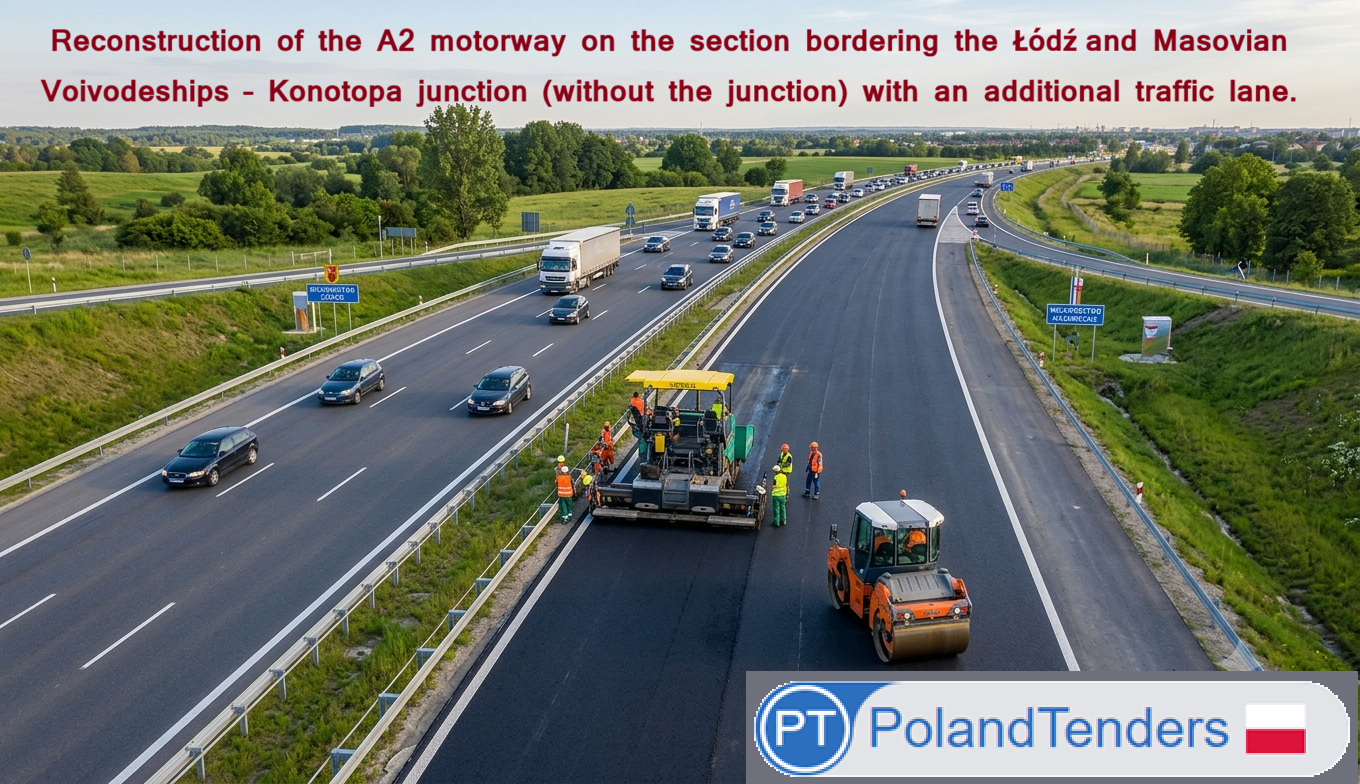
Standfirst
Up to 100,000 vehicles a day squeeze onto the A2 motorway between Warsaw and Łódź, a route that has outgrown its own capacity within thirteen years of opening. Poland's national roads authority has now awarded the contract for one of four widening segments, a 17.2 kilometre stretch running to the Konotopa junction on Warsaw's doorstep, to Austrian construction group STRABAG, for just over PLN 208.9 million.
Introduction
Some roads become victims of their own success and the A2 motorway between Łódź and Warsaw is a textbook case. Opened just over a decade ago as a modern, two lane each way link between Poland's two largest urban centres, it now carries traffic volumes its designers never planned for, nearly 60,000 vehicles a day near Łódź, climbing toward 100,000 as the road approaches Warsaw. What was built to relieve congestion has itself become congested.
The Polish General Directorate for National Roads and Motorways (GDDKiA) is now fixing that, segment by segment. The latest contract covers "Segment D", a 17.2 kilometre stretch from the Łódzkie Mazowieckie regional border to the Konotopa interchange on Warsaw's western approach and has been awarded to STRABAG Sp. z o.o., the Polish arm of the Austrian construction group, for a contract value of PLN 208,865,875.37, roughly €49 million.
Why This Contract Matters
This is not an isolated road widening job. It is one of four segments in a single, coordinated 92 kilometre widening programme covering the entire A2 corridor between the Łódź Północ interchange and the Mazowieckie regional border, of which Segment D is the piece closest to Warsaw and, not coincidentally, the busiest. Roughly 89 of those 92 kilometres will gain new traffic lanes; the remainder will see pavement and lighting renewal at the complex Łódź Północ interchange, where the A1 and A2 motorways cross.
The corridor's importance goes beyond commuter convenience. It is the principal road link between Poland's capital and its third largest city and it also serves growing traffic tied to CPK, Poland's planned Solidarity Transport Hub (branded "Port Polska"), the new central airport and rail hub project southwest of Warsaw. A motorway that cannot handle current traffic volumes is a genuine constraint on regional logistics and passenger travel, not merely a source of driver frustration.
Contract Timeline
| Date | Milestone |
|---|---|
| 2018 | Preparatory work begins on widening the A2 between Łódź Północ and Konotopa |
| June 2021 | Environmental decision issued enabling continued preparation of the Mazowieckie side widening |
| 6 February 2026 | Winner selected for Segment D |
| 26 June 2026 | Contract concluded with STRABAG Sp. z o.o. |
| Autumn 2026 | Main carriageway works expected to begin |
| 16 July 2026 | Award notice dispatched to the EU Publications Office |
| 17 July 2026 | Notice published in OJ S 136/2026 |
| 2027–2029 | Construction period across the full four segment programme, according to GDDKiA's public statements |
Contract Overview
GDDKiA's Łódź branch ran an open procedure to award the reconstruction of the A2 motorway's Segment D, from km 436+917 to km 454+100, covering the stretch from the Łódzkie Mazowieckie border to (but excluding) the Konotopa junction, widening each carriageway by 3.0 to 3.5 metres using the motorway's existing wide central reservation. The widening converts the carriageway configuration from two lanes in each direction to three lanes for most of the segment and to four lanes each way on the final stretch between the Pruszków and Konotopa junctions.
Three tenders were received, all from large Polish or Poland based contractors, none from SMEs and none from tenderers based outside Poland. STRABAG's bid of PLN 208,865,875.37 was both the winning tender and the lowest of the three admissible bids submitted, against a highest admissible tender of PLN 294,169,722.33, a spread of more than PLN 85 million between the top and bottom bids.
Key Contract Details
| Field | Detail |
|---|---|
| Contracting authority | Generalna Dyrekcja Dróg Krajowych i Autostrad (GDDKiA), Łódź Branch |
| Winning contractor | STRABAG Sp. z o.o. |
| Title | Reconstruction of the A2 motorway, Segment D (km 436+917 to km 454+100), Grodzisk Mazowiecki area to Konotopa junction |
| CPV code | 45000000 – Construction work (plus 13 additional CPV classifications covering site preparation, earthmoving, drilling, civil engineering, electrical and building installation work and safety equipment installation) |
| Procedure type | Open |
| Legal basis | Directive 2014/24/EU |
| Contract value | PLN 208,865,875.37 (approximately €49 million) |
| Award criteria | Price (80%); non price criterion, effective use of reclaimed asphalt pavement material ("destrukt") from the demolished existing surface (20%) |
| Contract duration | 17 months |
| Tenders received | 3, all from large contractors; 0 from SMEs; 0 from outside Poland |
| Range of admissible tenders | PLN 208,865,875.37 (lowest) to PLN 294,169,722.33 (highest) |
| Subcontracting | Yes, value and percentage not disclosed; covers works, services and material supply excluding key tasks reserved for personal execution |
| EU funding | Fully or partially financed with EU funds |
| GPA coverage | Yes |
| Review body | Krajowa Izba Odwoławcza (National Appeals Chamber) |
| Place of performance | Łódzkie and Warszawski Wschodni regions, Poland |
Project Scope
The core works widen both carriageways of Segment D by adding a lane in each direction, a 3.0 metre widening on the inner side for the stretch from the start of the segment to the Pruszków junction and 3.5 metres from Pruszków onward to Konotopa, using space already reserved within the motorway's existing central median. The result converts the road from a 2/2 lane configuration to 2/3 for most of the segment and to 2/4 for the final stretch nearest Konotopa.
Beyond the core widening, the contract carries two significant optional scopes under Poland's "prawo opcji" mechanism. Option 2 covers traffic flow corrections at fifteen named intersections and interchanges scattered across a wide area of Mazowieckie voivodeship, from Brzeziny in the north to Ożarów Mazowiecki in the south, reflecting how a single motorway widening project can ripple out into adjustments across a much broader regional road network. Option 1 requires the contractor to design, install, maintain and eventually dismantle temporary traffic management and detour signage for the entire four segment widening programme, for a minimum of 24 months, with additional monthly compensation payable if that period is extended, a meaningful undertaking given that the winning contractor here effectively becomes responsible for coordinating detour signage across a project spanning multiple separate construction contracts.
About the Contracting Authority
Generalna Dyrekcja Dróg Krajowych i Autostrad (GDDKiA), Poland's General Directorate for National Roads and Motorways, is the central government authority responsible for planning, procuring and maintaining Poland's national road and motorway network. Its Łódź branch is managing this specific contract, reflecting the corridor's position straddling the Łódzkie and Mazowieckie regions. GDDKiA has publicly stated it is currently delivering more than 1,500 kilometres of new roads nationally and the A2 widening programme sits within that broader modernisation effort, specifically targeting one of the network's most heavily used and increasingly congested corridors.
About the Organisations Involved
STRABAG Sp. z o.o., Winning Tenderer
STRABAG is the Polish subsidiary of STRABAG SE, one of Europe's largest construction and infrastructure groups, headquartered in Austria with operations spanning road and rail infrastructure, tunnelling, building construction and real estate development across the continent. Notably, STRABAG's Polish registered address sits in Pruszków, one of the towns the very motorway segment it will now widen runs directly through, giving the contractor an established local and regional presence in exactly the area where this project is based. STRABAG's win, with the lowest of three submitted bids, continues the company's substantial track record delivering major Polish motorway infrastructure for GDDKiA.
Krajowa Izba Odwoławcza, Review Organisation
The National Appeals Chamber, based in Warsaw, is Poland's dedicated tribunal for public procurement disputes, empowered to hear challenges brought by bidders against contracting authority decisions under the Polish Public Procurement Law. Its role in this contract is purely as the designated review body, providing unsuccessful bidders or interested parties a formal route to contest the award, with further appeal possible to the Warsaw Regional Court's dedicated public procurement division.
Procurement Analysis
GDDKiA ran a standard open procedure, evaluating bids on an 80% price, 20% non price basis, with the non price criterion tied specifically to how effectively each bidder proposed to reuse reclaimed asphalt pavement material salvaged from demolishing the existing road surface. That is a deliberately circular economy oriented technical criterion: rather than scoring bidders on abstract sustainability commitments, GDDKiA is rewarding contractors for a concrete, measurable practice, recycling the material stripped from the motorway's own current surface back into the reconstruction itself, reducing both waste and the demand for freshly quarried aggregate.
The wide spread between the lowest and highest admissible tenders, PLN 208.9 million versus PLN 294.2 million, a difference of more than 40%, is a substantial gap for a well defined civil infrastructure project of this kind and suggests real variation in how the three bidding contractors priced risk, resourcing or their approach to the demanding logistical requirement of building alongside live motorway traffic for the duration of construction. That all three tenderers were large firms with no SME or foreign participation is unsurprising given the scale, technical complexity and financial capacity required for a project of this size and duration.
Additional Procurement Facts
None of the three tenders received were disqualified as inadmissible and none were found to involve abnormally low pricing requiring separate verification. Subcontracting is confirmed for the winning bid, covering works, services and material supply, with the notice specifically excluding "key tasks reserved for personal execution" per the contractor's own tender documentation, a standard mechanism in Polish public works contracts that requires the prime contractor to directly perform certain critical elements of the works itself rather than delegating them entirely to subcontractors. The project is confirmed as EU funded and covered by the WTO Government Procurement Agreement.
Market & Industry Perspective
Major Polish motorway construction and widening work remains dominated by a relatively small group of large international and domestic contractors capable of mobilising the resourcing, bonding capacity and technical expertise required for projects of this scale, firms including STRABAG, Budimex, Mirbud, Ferrovial linked joint ventures and others with established track records delivering GDDKiA contracts. The A2 widening programme as a whole illustrates this concentration clearly: GDDKiA has been awarding its four constituent segments to different large contractors as each competition concludes, with STRABAG's win on Segment D following a separate STRABAG award for another stretch of the same corridor further west, near Łyszkowice.
The requirement that whichever contractor wins a given segment also assume responsibility for coordinating temporary traffic management across the entire four segment programme (under Option 1 in this contract) is a further sign of how GDDKiA is managing the practical complexity of running multiple simultaneous, physically adjacent construction contracts along a single, continuously operating motorway corridor.
Economic Significance
At roughly €49 million for a 17.2 kilometre segment, this is one component of what is, in aggregate, a substantially larger investment across the full 92 kilometre A2 widening programme, one that Polish transport officials have described as among the most significant road infrastructure priorities in central Poland, given the corridor's role connecting the country's two largest urban economies and feeding traffic toward the planned CPK transport hub southwest of Warsaw.
For STRABAG, the win extends an already substantial order book of Polish motorway construction work, while for the wider Polish construction sector, a coordinated four segment national motorway widening programme of this scale represents a meaningful, multi year source of civil engineering work for whichever contractors continue to win segments as GDDKiA works through the remaining stretches of the corridor.
Future Procurement Opportunities
With Segment D now awarded, attention turns to the remaining stretches of the same 92 kilometre widening programme, at least one of which, the section further west toward Łyszkowice, has already been separately awarded, also to STRABAG, according to Polish transport press reporting. Suppliers of road construction materials, lighting and signage systems and traffic management equipment should watch for GDDKiA's continued procurement activity as the remaining segments of this corridor wide programme progress toward contract award and construction.
Beyond the immediate widening works, GDDKiA's own public statements indicate the reconstructed corridor will incorporate energy independent, renewable powered road lighting and weather monitoring stations supported by battery storage, a detail that points to complementary procurement opportunities for renewable energy and smart infrastructure suppliers as the wider programme moves from design into delivery.
Opportunities for Suppliers
Civil engineering contractors, asphalt and paving material suppliers and traffic management system providers should track GDDKiA's continued procurement activity across the remaining segments of the A2 corridor widening programme, given the clear precedent this and prior awards set for contract structure, scale and evaluation criteria. Suppliers with genuine capability in reclaimed asphalt pavement processing and reuse are particularly well positioned given the explicit 20% weighting GDDKiA has attached to this criterion, a detail likely to recur across the programme's remaining segments. Renewable energy and battery storage suppliers should also watch for opportunities tied to the corridor's planned shift toward energy independent lighting and monitoring infrastructure.
What Businesses Should Watch
Three things are worth tracking as this programme progresses. First, whether the remaining segments of the four part A2 widening programme are awarded on a similar timeline and to a similarly concentrated group of large domestic and international contractors. Second, how effectively the optional temporary traffic management scope (Option 1) is implemented across the whole corridor, given the scale of coordinating detours and signage across multiple concurrent construction sites on a live, heavily trafficked motorway. Third, whether the corridor's stated ambition toward energy independent lighting and weather monitoring infrastructure generates a distinct, separate wave of procurement activity as the wider project moves from road widening into smart infrastructure implementation.
PolandTenders.com Procurement Intelligence
This contract is a clear illustration of how national road authorities across Central Europe are managing infrastructure that has been overtaken by its own success. The A2 between Łódź and Warsaw was a modern, adequately sized motorway when it opened barely over a decade ago; sustained economic growth and rising vehicle ownership have since pushed daily traffic volumes toward the road's structural limits years ahead of what its original design anticipated. GDDKiA's response, a coordinated, corridor wide widening programme split into four segments rather than one enormous single contract, reflects a now common approach to large linear infrastructure projects: breaking the work into manageable, separately tendered segments while still requiring a degree of cross segment coordination, in this case through the shared temporary traffic management obligation attached to whichever contractor wins each individual piece.
The explicit, measurable reclaimed asphalt reuse criterion embedded in the award methodology is also worth flagging as a genuine, replicable model for infrastructure procurement more broadly. Rather than scoring bidders on generic environmental commitments, GDDKiA has built a concrete, quantifiable circular economy requirement directly into how contractors are evaluated and paid, a structure that other national road authorities pursuing similar widening or resurfacing programmes could reasonably adopt.
Looking ahead, the corridor's stated ambition toward renewable powered lighting and weather monitoring infrastructure suggests this project's economic footprint will extend well beyond the road widening contracts themselves, into a further wave of smart infrastructure and renewable energy procurement as the programme matures from construction into long term, lower carbon operation.
Supplier Takeaways
- GDDKiA is running Poland's A2 corridor widening as four separately tendered segments rather than a single mega contract, expect continued, sequential award activity as remaining segments progress.
- The 20% weighted reclaimed asphalt pavement reuse criterion rewards concrete, measurable circular economy practice rather than generic sustainability commitments; contractors with strong reclaimed material processing capability have a genuine competitive edge in similar future tenders.
- Whichever contractor wins any individual segment on this corridor also inherits responsibility for coordinating temporary traffic management across the entire four segment programme, a scope worth pricing carefully given its cross project coordination demands.
- Renewable energy and smart infrastructure suppliers should watch for a distinct wave of procurement tied to the corridor's stated shift toward energy independent lighting and weather monitoring systems.
- Large scale Polish motorway widening work remains concentrated among a small group of major domestic and international contractors; smaller firms are more likely to find opportunities as subcontractors on materials, signage and specialist civil works.
Key Takeaways
- GDDKiA awarded the contract to widen Segment D of the A2 motorway, between the Łódzkie Mazowieckie border and the Konotopa junction near Warsaw, to STRABAG Sp. z o.o. for PLN 208,865,875.37 (approximately €49 million).
- The 17.2 kilometre segment is part of a wider 92 kilometre widening programme addressing chronic congestion on one of Poland's busiest motorway corridors, carrying up to nearly 100,000 vehicles daily near Warsaw.
- STRABAG submitted the lowest of three tenders received, all from large contractors, in a range spanning PLN 208.9 million to PLN 294.2 million.
- The award criteria weighted price at 80% and reclaimed asphalt pavement reuse at 20%, reflecting a concrete circular economy requirement.
- The contract, running 17 months, carries substantial optional scope covering regional traffic flow corrections and corridor wide temporary traffic management and is fully or partially EU funded.
Conclusion
Thirteen years after it opened as a modern relief route between two of Poland's largest cities, the A2 motorway has become a case study in how quickly infrastructure can be overtaken by the growth it was built to serve. STRABAG's award to widen the segment nearest Warsaw is one piece of a larger, coordinated national response, proof that fixing a congested motorway corridor increasingly means treating it as a single, connected engineering problem, broken into manageable contracts, rather than a series of unrelated local repairs.
Frequently Asked Questions
Who won this contract?
STRABAG Sp. z o.o., the Polish subsidiary of the Austrian construction group STRABAG SE.
Who is the buyer?
Generalna Dyrekcja Dróg Krajowych i Autostrad (GDDKiA), acting through its Łódź branch.
What is the contract worth?
PLN 208,865,875.37, approximately €49 million.
What does the project cover?
Widening a 17.2 kilometre segment of the A2 motorway from the Łódzkie Mazowieckie border to the Konotopa junction, adding an extra lane in each direction, plus optional traffic flow corrections at fifteen regional intersections and corridor wide temporary traffic management.
How long will construction take?
17 months for the base contract scope.
How many companies bid for the contract?
Three, all large contractors; none from SMEs and none based outside Poland.
Is this contract part of a larger project?
Yes. It is one of four segments in a 92 kilometre widening programme covering the entire A2 corridor between the Łódź Północ interchange and the Mazowieckie regional border.
Was any EU funding involved?
Yes. The notice confirms the project is fully or partially financed with EU funds.
How was the winner decided?
On an 80% price and 20% non price basis, with the non price criterion assessing each bidder's proposed reuse of reclaimed asphalt pavement material from the existing road surface.
Source: EU Official Journal, Contract Award Notice 497575-2026, OJ S 136/2026, published 17/07/2026. Contracting authority: Generalna Dyrekcja Dróg Krajowych i Autostrad.

Fresh and verified Tenders from Poland. Find, search and filter Tenders/Call for bids/RFIs/RFPs/RFQs/Auctions published by the government, public sector undertakings (PSUs) and private entities.
- 1,000+ Tenders
- Verified Tenders Only
- New Tenders Every Day
- Tenders Result Data
- Archive & Historical Tenders Access
- Consultants for RFI/RFP/RFQ
- Tender Notifications & Alerts
- Search, Sort, and Filter Tenders
- Bidding Assistance & Consulting
- Customer Support
- Publish your Tenders
- Export data to Excel
- API for Tender Data
- Tender Documents

Fill out the form below and you will receive a call from us within 24 hours.
Get FREE SAMPLE TENDERS from Poland in your email inbox.
Copyright © 2014-2026 PolandTenders.com. All Rights Reserved.