Poland's Regional Funds Ministry Renews Its Web Portal Contract
Winning B2B Government IT Tenders, Web Portal Development, Software Maintenance, and Eprocurement in Poland & Europe
Standfirst:
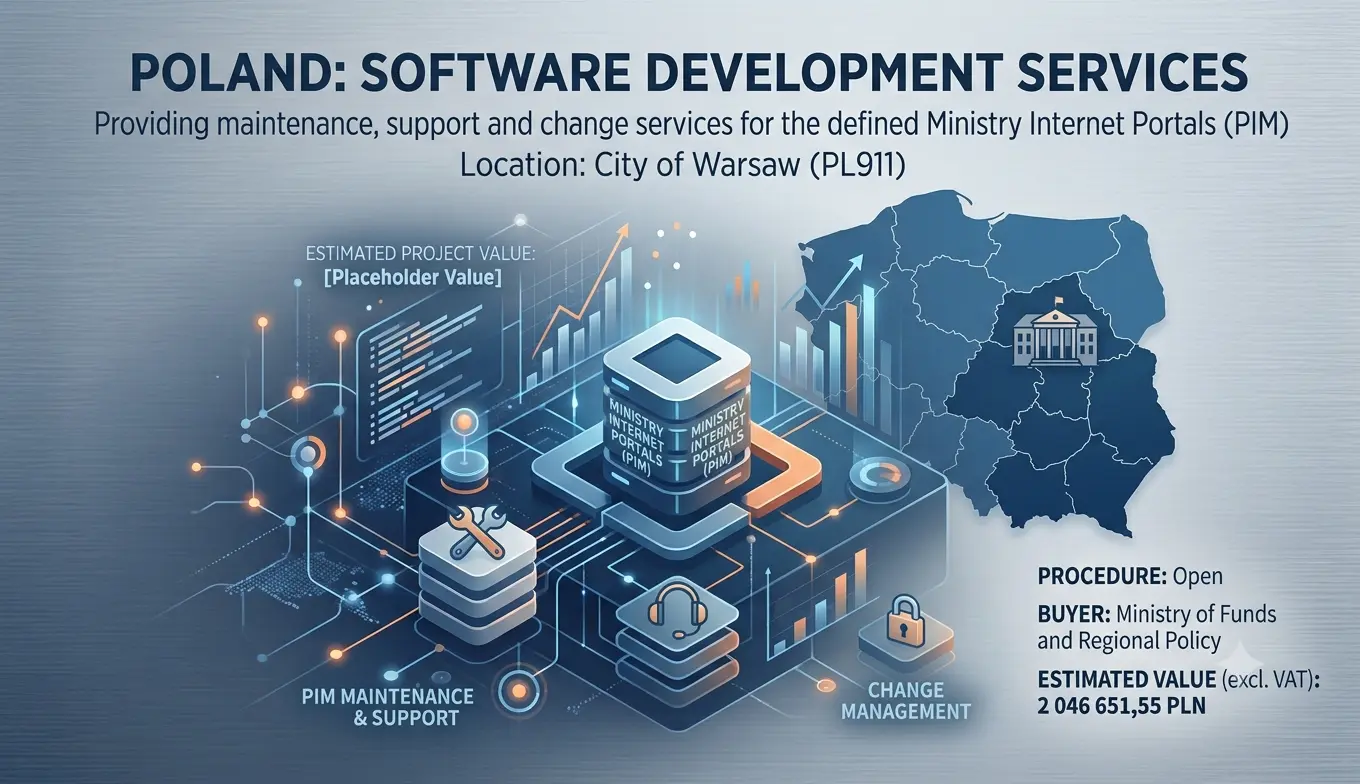
Poland's Ministry of Funds and Regional Policy has awarded a 30-month contract for the maintenance, support and modification of its ministerial internet portals, known by the Polish acronym PIM. The contract went to Centrum Informatyki "ZETO" S.A., a medium-sized IT company based in Białystok, at a value of PLN 1,639,590. Two bids were received, both from SMEs, and the contract is co-financed by the European Regional Development Fund. The scope includes migrating the portals, hosting them, providing technical support and delivering a defined change.
Introduction
Government ministries run on information. Portals that publish funding programmes, explain how to apply for EU money, track project progress and communicate with beneficiaries are not decorative. They are the operational front door for billions of euros in public investment. If those portals go down, or if they are slow, unclear or insecure, the consequences reach far beyond the IT department.
Poland's Ministerstwo Funduszy i Polityki Regionalnej, the Ministry of Funds and Regional Policy, manages the country's access to European Union funding. It runs the programmes that distribute cohesion and recovery money to regions, businesses, universities and public bodies. Its network of ministerial internet portals — Portale Internetowe Ministerstwa, or PIM — is central to that work.
The ministry has now awarded a contract for the maintenance, support and defined modification of those portals. The contract is worth PLN 1,639,590 over 30 months and has gone to Centrum Informatyki "ZETO" S.A., a Polish IT company. Two bids were received, both from SMEs, and the award was decided through a mixed price-and-quality evaluation. The contract is co-financed by the European Regional Development Fund under the Technical Assistance for European Funds programme.
This article examines what was procured, who was involved, how the procurement was structured and what the award signals for suppliers in Poland's public sector IT market.
Why This Contract Matters
This contract matters because it keeps a critical piece of EU funding infrastructure running. Poland is the largest beneficiary of EU cohesion policy, and the Ministry of Funds and Regional Policy is the body that manages much of that money. The PIM portals are the interface between the ministry and the beneficiaries, applicants and citizens who depend on EU funding.
It also matters because of how it was structured. The contract combines four distinct services: migration of the portals to the contractor's or the ministry's infrastructure, ongoing hosting and maintenance, technical support and software changes, and a defined change identified by the ministry. Bundling these into one contract gives the ministry a single point of accountability for the portals' operation and evolution.
The procurement was also competitive by the standards of Polish public sector IT. Two bids were received, both from SMEs, which suggests that the requirements were accessible to smaller suppliers and that the contract terms were attractive enough to justify the cost of bidding. The winner, ZETO S.A., is a medium-sized company based in Białystok, not in Warsaw, which shows that regional suppliers can compete for central government work.
Finally, the contract matters because of its evaluation model. Price carried only 50% of the score, while service level agreement conditions and the migration concept carried 15% and 35% respectively. That is a quality-sensitive evaluation. The ministry was not simply buying the cheapest hosting and support arrangement. It was buying a carefully planned migration and a committed service level.
Contract Timeline
- Previous notice: 453931-2026
- Winner selected: 24 August 2026
- Contract concluded: 1 October 2026
- Notice dispatched: 5 October 2026
- Notice published: 6 October 2026
- Estimated duration: 30 months
Contract Overview
The contract covers the maintenance, support and defined change of the Ministry of Funds and Regional Policy's internet portals, known as PIM. It is a services contract, classified under CPV 72262000 (software development services), with additional classifications covering programming services, software configuration services, software implementation services, website operation and hosting services, general IT services and system support services.
It is a single-lot procurement, identified as LOT-0001, with the internal identifier BDG-V.2611.27.2026.ML. The place of performance is Miasto Warszawa (PL911), Poland. The estimated value excluding VAT was PLN 2,046,651.55, and the awarded value was PLN 1,639,590.
The procurement was conducted as an open procedure under Directive 2014/24/EU. It is not a framework agreement and does not use a dynamic purchasing system. It is not covered by the Government Procurement Agreement. The contract is fully or partially financed with EU funds, specifically the European Regional Development Fund under the Technical Assistance for European Funds programme 2021-2027.
Key Contract Details
| Notice ID | 689077-2026 |
| OJ S issue | 193/2026 |
| Publication date | 6 October 2026 |
| Contracting authority | Ministerstwo Funduszy i Polityki Regionalnej (Ministry of Funds and Regional Policy) |
| Contract type | Services |
| Main CPV code | 72262000 – Software development services |
| Procedure type | Open procedure |
| Legal basis | Directive 2014/24/EU |
| Lot | LOT-0001 |
| Winner | Centrum Informatyki "ZETO" S.A. |
| Winning bid | PLN 1,639,590.00 |
| Estimated value excluding VAT | PLN 2,046,651.55 |
| Number of bids | 2 |
| Award criteria | Price – 50%; SLA conditions – 15%; migration concept – 35% |
| Estimated duration | 30 months |
| Framework agreement | No |
| Dynamic purchasing system | No |
| EU funding | Yes – European Regional Development Fund, Technical Assistance for European Funds 2021-2027 |
| GPA covered | No |
| Subcontracting | No |
| SME participation | 2 SME tenders received |
| Contract identifier | DI/BDG-III/34/2026 |
Project Scope
The scope is set out in four separate attachments to the tender specification, each covering a different service. They are: maintenance services, migration services, support services and the defined change service.
Migration services cover moving the PIM portals to the contractor's IT infrastructure or to infrastructure designated by the ministry. That is a significant undertaking. Migrating live government portals requires careful planning, testing and rollback arrangements, because any downtime affects beneficiaries and citizens who depend on the portals.
Maintenance services cover the provision of the hardware and software infrastructure needed for the PIM portals to operate, and ensuring continuity of production operation. This is essentially a hosting and availability obligation, backed by service level agreements.
Support services cover technical support for the PIM portals and the delivery of changes to the PIM software. This is the day-to-day operational work of keeping the portals current, fixing problems and implementing smaller changes.
The defined change service is a single, identified change to the PIM software that the ministry specified in advance. Bidders were required to submit a "migration concept" as part of their offer, describing how they would deliver that change.
The notice does not disclose which specific portals are covered, how many users they serve, what technology stack they run on, or what the defined change involves. The contracting authority has not disclosed this information.
An important practical detail is that the ministry offered bidders the opportunity to inspect the PIM system's source code and technical documentation on site. That is unusual in public procurement, where access to source code is often restricted. It gave bidders a rare opportunity to understand the system before pricing their offers, and it likely contributed to the quality of the two bids received.
About the Contracting Authority
The buyer is the Ministerstwo Funduszy i Polityki Regionalnej, the Ministry of Funds and Regional Policy. It is classified as a central government authority with economic affairs as its main activity. Its registration number is 5262895199, and its address is Wspólna 2/4, Warszawa, postcode 00-926.
The ministry is responsible for Poland's regional development policy and for managing the country's access to European Union funds. It oversees the operational programmes that distribute cohesion and recovery money, and it is the body that negotiates with the European Commission on Poland's funding allocations.
The ministry's procurement department handled this tender under the internal reference BDG-V.2611.27.2026.ML. Its email address for procurement matters is zamowienia@mfipr.gov.pl, and its telephone number is 22 250 01 30. The tender documents were published on the ministry's procurement platform at zamowienia.mfipr.gov.pl.
The ministry is both the buyer and the organisation signing the contract. It also acts as the beneficiary of the EU funding that co-finances the contract. Its role is to define the requirements, run the procurement, evaluate the two bids and manage the contract over its 30-month term.
About the Organisations Involved
Ministerstwo Funduszy i Polityki Regionalnej
The Ministry of Funds and Regional Policy is the contracting authority. It is a Polish central government ministry responsible for regional development and the management of EU funds. Its role in this procurement is as buyer, signatory of the contract and beneficiary of the EU funding.
It is registered in Warsaw, with registration number 5262895199. Its address is Wspólna 2/4, 00-926 Warszawa. It runs the PIM portals that are the subject of this contract, and it will manage the contractor's performance over the 30-month term.
The ministry's decision to combine migration, maintenance, support and a defined change into a single contract reflects its need for a coherent operational arrangement. Rather than procuring each service separately, it has bundled them into one engagement, with a single supplier accountable for the portals' operation and evolution.
Centrum Informatyki "ZETO" S.A.
Centrum Informatyki "ZETO" S.A. is the winning bidder. It is classified as a medium-sized economic operator. Its registration number is 5420202807, and its registered office is at Skorupska 9, Białystok, postcode 15-048. The notice records its NUTS region as Miasto Warszawa (PL911), which is inconsistent with its Białystok address, but the address itself is clearly stated.
ZETO is a Polish IT company with a long history in public sector computing. It submitted the winning tender for LOT-0001, valued at PLN 1,639,590. It declared no subcontracting, meaning it will deliver the full scope itself. The notice does not disclose its technical approach, the migration concept it proposed, or the SLA conditions it committed to. The contracting authority has not disclosed this information.
The company's role is as tenderer and winner of LOT-0001. It will migrate the PIM portals, host and maintain them, provide technical support and deliver the defined change over the 30-month contract term.
Krajowa Izba Odwoławcza
The Krajowa Izba Odwoławcza (National Appeal Chamber) is Poland's central review body for public procurement disputes. It is listed as the review organisation. Its registration number is 5262239325, and its address is Postępu 17, Warszawa, postcode 02-676.
Its role is to hear appeals from bidders who believe a procurement has been conducted improperly. The notice sets out the review rights available to bidders and other interested parties under Title IX of the Polish Public Procurement Law, and notes that organisations on the list maintained under Article 469(15) of the law, as well as the Ombudsman for Small and Medium-sized Enterprises, also have access to legal remedies.
Publications Office of the European Union
The Publications Office of the European Union is listed as the TED eSender. Its role is administrative: it operates Tenders Electronic Daily, the official journal supplement where EU procurement notices are published. It is based in Luxembourg and is not involved in the procurement itself.
Other organisations
The notice does not identify the non-winning bidder by name. It records that two tenders were received, both from SMEs, but only the winner is named. No consortium members, framework participants or subcontractors are disclosed. No other organisation materially affects the understanding of this award.
Procurement Analysis
The procurement was conducted as an open procedure under Directive 2014/24/EU. The open procedure is the standard route for a contract of this size and allows any qualifying supplier to bid.
The evaluation was structured around three criteria. Price carried 50% of the score. Service level agreement conditions carried 15%. The migration concept carried 35%. This is a quality-sensitive evaluation: half the score was determined by non-price factors, and the migration concept alone was worth more than twice the SLA criterion.
The weighting reflects the ministry's priorities. Migrating live government portals is the riskiest part of the contract, because downtime or data loss would directly affect beneficiaries and citizens. By weighting the migration concept at 35%, the ministry signalled that it wanted a carefully planned, well-evidenced approach rather than the cheapest possible migration. The SLA criterion, at 15%, addressed the ongoing service quality, while price at 50% kept cost discipline in the evaluation.
Two bids were received, both submitted electronically, and both from micro, small or medium-sized enterprises. No bids came from other EEA countries or from outside the EEA. The competition was therefore domestic but genuinely contested between two SMEs.
Both admissible tenders were valued at PLN 1,639,590. That is notable. The notice records the value of the lowest admissible tender and the highest admissible tender as identical, which means both bidders submitted the same price. If that is correct, the decision was determined entirely by the quality criteria — the SLA conditions and the migration concept. The notice does not disclose which bidder scored higher on those criteria, but the winner must have done so.
The winning bid of PLN 1,639,590 came in below the estimated value of PLN 2,046,651.55. The awarded value is approximately 80% of the estimate. That suggests either that the ministry's estimate was conservative or that competition brought the price down.
The contract is not covered by the Government Procurement Agreement. The notice does not explain why, but the contract is co-financed by EU funds and is open to EEA suppliers under the general EU procurement rules. The GPA exclusion may reflect the specific nature of the funding or the contract.
The contract is not a framework agreement and does not use a dynamic purchasing system. It is a direct contract with a single supplier for a defined 30-month term.
A notable procedural feature is the ministry's decision to allow bidders to inspect the PIM system's source code and technical documentation on site. This is unusual. Access to source code is often restricted for security and intellectual property reasons, and giving bidders direct access creates a risk of information leakage. But it also gives bidders a much clearer understanding of the system they are bidding to maintain, which improves the quality of bids and reduces the risk of post-award disputes about scope. The ministry appears to have judged that the benefits outweighed the risks.
The ministry also applied the so-called reversed procedure, evaluating and scoring the bids before carrying out the subjective qualification of the winning bidder. That speeds up the process but means bidders must be confident in their qualification status before bidding.
Additional Procurement Facts
- Legal basis: Directive 2014/24/EU.
- Procedure: Open procedure, not accelerated, with reversed evaluation under Article 139(1) of the Polish Public Procurement Law.
- Award criteria: Price – 50%; SLA conditions – 15%; migration concept – 35%.
- Number of bids: 2, both from SMEs, both submitted electronically.
- Estimated value: PLN 2,046,651.55 excluding VAT.
- Awarded value: PLN 1,639,590.00.
- Estimated duration: 30 months.
- EU funding: Yes – European Regional Development Fund, Technical Assistance for European Funds 2021-2027.
- GPA: Not covered by the Government Procurement Agreement.
- Framework agreement: None.
- Dynamic purchasing system: None.
- Subcontracting: The winning tenderer declared no subcontracting.
- Source code access: Bidders could inspect the PIM system's source code and technical documentation on site.
- Review body: Krajowa Izba Odwoławcza (National Appeal Chamber).
- Data note: Both admissible tenders are recorded at the same value, PLN 1,639,590, which suggests the decision was determined by the quality criteria.
Market & Industry Perspective
Poland's public sector IT market is one of the largest in Central and Eastern Europe. Central government ministries, agencies and regional authorities spend significant sums on software development, maintenance and hosting. The market includes large international integrators, established Polish IT companies and a long tail of smaller regional suppliers.
This contract sits in the maintenance and support segment, which is less visible than new system development but often more valuable over time. Government portals that publish funding information must remain available, secure and current. The work is continuous rather than project-based, and it requires a supplier with the infrastructure, staffing and processes to deliver reliable service over years.
ZETO S.A., based in Białystok, is an example of a regional Polish IT company competing successfully for central government work. Its victory over another SME shows that the market is not dominated exclusively by Warsaw-based suppliers or large international firms. That is a positive sign for competition in the Polish public sector IT market.
The migration concept criterion is notable from a market perspective. Migration is often the riskiest and least visible part of an IT contract. By weighting it at 35%, the ministry put it at the centre of the evaluation. Suppliers bidding for similar contracts should expect to invest significant effort in preparing a credible migration plan, including methodology, risk management, testing and rollback arrangements.
The source code access provision is also notable. It suggests that the ministry wants bidders to understand the system they are taking on, rather than bidding blind. That is good practice in maintenance contracts, where the incumbent supplier often has an information advantage. It may become more common in Polish public sector IT procurement if it proves effective.
Economic Significance
At PLN 1.64 million over 30 months, this contract is modest in absolute terms. It is small relative to Poland's overall public sector IT spending and small relative to the ministry's budget. Its economic significance lies mainly in what it enables: the continued operation of the portals through which EU funding is communicated and managed.
Poland receives tens of billions of euros in EU cohesion funding. The portals that explain programmes, accept applications and track projects are the operational interface for that money. If they fail, the consequences reach beneficiaries, businesses, universities and regional authorities. The contract therefore protects a small but critical piece of the EU funding pipeline.
The contract also has a direct economic effect. The money flows to ZETO S.A., a medium-sized Polish company, and supports employment in Białystok and beyond. Because the winner declared no subcontracting, the economic benefit is concentrated in the winning company rather than spread across a supply chain.
The EU funding dimension is important. The contract is co-financed by the European Regional Development Fund under the Technical Assistance for European Funds programme. That means part of the cost is borne by the EU budget rather than solely by Polish taxpayers. It also means the procurement is subject to EU rules and published in TED, which increases transparency.
Future Procurement Opportunities
The most obvious future opportunity is the renewal or replacement of this contract. The contract duration is 30 months. The notice does not disclose a start date, but the contract was concluded on 1 October 2026, so it is likely to run into early 2029. A follow-on procurement could be expected as that date approaches.
There may also be opportunities arising from the defined change and from subsequent changes to the PIM portals. The contract includes one defined change, but government portals evolve continuously as programmes change, new funding rounds open and user requirements shift. The ministry may need additional changes beyond the current contract, either through this contract or through a separate procurement.
More broadly, the Ministry of Funds and Regional Policy is likely to have ongoing IT needs as it manages EU funding programmes. Suppliers with capability in portal development, hosting, maintenance and EU funding systems should monitor the ministry's procurement platform at zamowienia.mfipr.gov.pl for future notices.
Other Polish ministries and agencies also run portals and information systems that require maintenance and support. Suppliers with a proven track record in this segment may find opportunities across central government. The contract is co-financed by EU funds, which means similar arrangements may exist in other programmes and institutions.
Opportunities for Suppliers
- Portal maintenance and hosting providers: Suppliers with experience in hosting and maintaining government portals are the most likely candidates for similar contracts.
- Migration specialists: The migration concept was weighted at 35%. Suppliers with proven migration methodology and risk management capability are better positioned.
- SLA-focused service providers: The SLA criterion was worth 15%. Suppliers with strong service management credentials and measurable performance commitments will score better.
- SME suppliers: Both bids came from SMEs, which shows that the contract was accessible to smaller companies. Regional suppliers should not assume central government contracts are out of reach.
- EU-funded projects: The contract is co-financed by the ERDF. Suppliers should monitor EU-funded IT procurements across Polish central government.
- Monitoring the buyer: The ministry's procurement platform at zamowienia.mfipr.gov.pl is the best source for future opportunities.
What Businesses Should Watch
- Whether the contract is renewed or replaced: The 30-month term will end in early 2029. Suppliers should watch for a follow-on procurement.
- Whether additional changes are procured: Government portals evolve continuously. Additional change work may be needed beyond the current contract.
- Whether source code access becomes standard: The ministry allowed bidders to inspect the PIM source code. If this practice spreads, it could change how maintenance contracts are bid.
- Whether the value discrepancy is explained: Both admissible tenders are recorded at the same value. Suppliers should watch for clarification of the evaluation outcome.
- Whether other ministries follow suit: If this contract model works well, other Polish ministries may adopt similar approaches to portal maintenance.
- Whether competition improves: Only two bids were received. If future procurements attract more bidders, that would indicate a healthier market.
PolandTenders.com Procurement Intelligence
This contract represents a broader procurement trend in EU-funded public administration: ministries are bundling the migration, hosting, maintenance and evolution of their digital portals into single contracts with quality-sensitive evaluation. That approach recognises that a government portal is not a one-off project but a continuous service. It also recognises that migration is the highest-risk element, and that weighting the migration concept heavily is a rational way to manage that risk.
The award is strategically important because it keeps a critical piece of Poland's EU funding infrastructure running. The PIM portals are the interface between the Ministry of Funds and Regional Policy and the beneficiaries, applicants and citizens who depend on EU money. The contract ensures that those portals will be migrated, hosted, supported and changed over the next 30 months. The fact that the contract is co-financed by the ERDF underlines its importance to the EU funding pipeline.
Suppliers can learn several things from this procurement. First, migration planning matters. The migration concept was worth 35% of the score, more than twice the SLA criterion and second only to price. Suppliers bidding for similar contracts must invest in a credible, detailed migration plan. Second, service levels matter. The SLA criterion at 15% shows that the ministry cares about ongoing performance, not just the initial transition. Third, price still matters most. At 50%, price was the single largest criterion, and both bidders apparently priced identically. Fourth, source code access can be a differentiator. The ministry allowed bidders to inspect the system, which improved bid quality and reduced information asymmetry. Fifth, SMEs can compete. Both bids came from SMEs, and the winner is a regional company based in Białystok.
Suppliers should position themselves accordingly. They should develop a repeatable migration methodology with clear risk management, testing and rollback arrangements. They should be able to commit to measurable service levels. They should be prepared to compete on price without sacrificing quality. And they should monitor EU-funded IT procurements across Polish central government, because these contracts are often published in TED and open to EEA suppliers.
Future contracts in this market are likely to evolve in two directions. First, more ministries will bundle portal migration, hosting, maintenance and change into single contracts, following the logic that a portal is a service rather than a project. Second, quality criteria such as migration concept and SLA commitments will become more important, particularly where the risk of downtime or data loss is high. Suppliers that can demonstrate strong migration and service management capability, alongside competitive pricing, will be well positioned. Suppliers that compete on price alone will find themselves in a market where the real value lies in reliable delivery.
Supplier Takeaways
- The migration concept was weighted at 35%, making it the second most important criterion after price. Suppliers must invest in a credible migration plan.
- Price was weighted at 50%, and both admissible tenders were valued identically at PLN 1,639,590. Quality decided the outcome.
- SLA conditions were weighted at 15%. Suppliers should be able to commit to measurable service levels.
- Both bids came from SMEs, and the winner is a regional company based in Białystok. Central government contracts are accessible to smaller suppliers.
- The contract is co-financed by the European Regional Development Fund under the Technical Assistance for European Funds 2021-2027 programme.
- The contract covers four services: migration, maintenance, support and a defined change.
- Bidders were allowed to inspect the PIM system's source code and technical documentation on site. This is unusual and improves bid quality.
- The winner declared no subcontracting. Suppliers should be prepared to deliver the full scope themselves.
- The contract runs for 30 months from a date not disclosed in the notice. A follow-on procurement is likely in early 2029.
- The review body is the Krajowa Izba Odwoławcza (National Appeal Chamber).
Key Takeaways
- The Polish Ministry of Funds and Regional Policy awarded a contract for the maintenance, support and defined change of its PIM internet portals to Centrum Informatyki "ZETO" S.A.
- The contract value is PLN 1,639,590, against an estimated value of PLN 2,046,651.55.
- Two bids were received, both from SMEs and both submitted electronically. Both admissible tenders were valued at the same price.
- Award criteria were price (50%), SLA conditions (15%) and migration concept (35%).
- The procurement was an open procedure under Directive 2014/24/EU, with reversed evaluation under Article 139(1) of the Polish Public Procurement Law.
- The contract is co-financed by the European Regional Development Fund under the Technical Assistance for European Funds 2021-2027 programme.
- It is not a framework agreement, not a dynamic purchasing system and not GPA-covered.
- The winning bidder declared no subcontracting.
- The contract covers migration, maintenance, support and a defined change to the PIM portals.
- The review body is the Krajowa Izba Odwoławcza (National Appeal Chamber).
Conclusion
Poland's Ministry of Funds and Regional Policy has renewed the operational arrangement for its ministerial internet portals, awarding a 30-month contract to Centrum Informatyki "ZETO" S.A. for PLN 1,639,590. The contract covers the migration, hosting, maintenance, support and modification of the PIM portals, which are central to how the ministry communicates and manages EU funding.
The procurement was competitive by Polish standards, with two SME bids and a quality-sensitive evaluation that weighted the migration concept at 35% and SLA conditions at 15%. Both bidders priced identically, which means the decision turned entirely on quality. The winner, a medium-sized company based in Białystok, will deliver the full scope without subcontracting.
For suppliers, the contract reinforces the importance of migration planning, service level commitment and quality differentiation alongside competitive pricing. For the ministry, the challenge will be to manage the migration without disrupting the portals that beneficiaries and citizens depend on. The notice leaves some questions unanswered — the start date, the specific portals covered, the defined change itself — but the core award is clear: ZETO will keep Poland's EU funding portals running and evolving for the next two and a half years.
Source: Tenders Electronic Daily (TED), Contract Award Notice 689077-2026, Official Journal of the European Union, OJ S 193/2026, published on 6 October 2026.
Frequently Asked Questions (FAQs)

Fresh and verified Tenders from Poland. Find, search and filter Tenders/Call for bids/RFIs/RFPs/RFQs/Auctions published by the government, public sector undertakings (PSUs) and private entities.
- 1,000+ Tenders
- Verified Tenders Only
- New Tenders Every Day
- Tenders Result Data
- Archive & Historical Tenders Access
- Consultants for RFI/RFP/RFQ
- Tender Notifications & Alerts
- Search, Sort, and Filter Tenders
- Bidding Assistance & Consulting
- Customer Support
- Publish your Tenders
- Export data to Excel
- API for Tender Data
- Tender Documents

Fill out the form below and you will receive a call from us within 24 hours.
Get FREE SAMPLE TENDERS from Poland in your email inbox.
Copyright © 2014-2026 PolandTenders.com. All Rights Reserved.