Szczecin University Hospital Awards PLN 161.58 Million Drug Supply for Cancer Treatment
Empowering Global Suppliers to Navigate EU Healthcare Eprocurement & Tender Opportunities
Standfirst
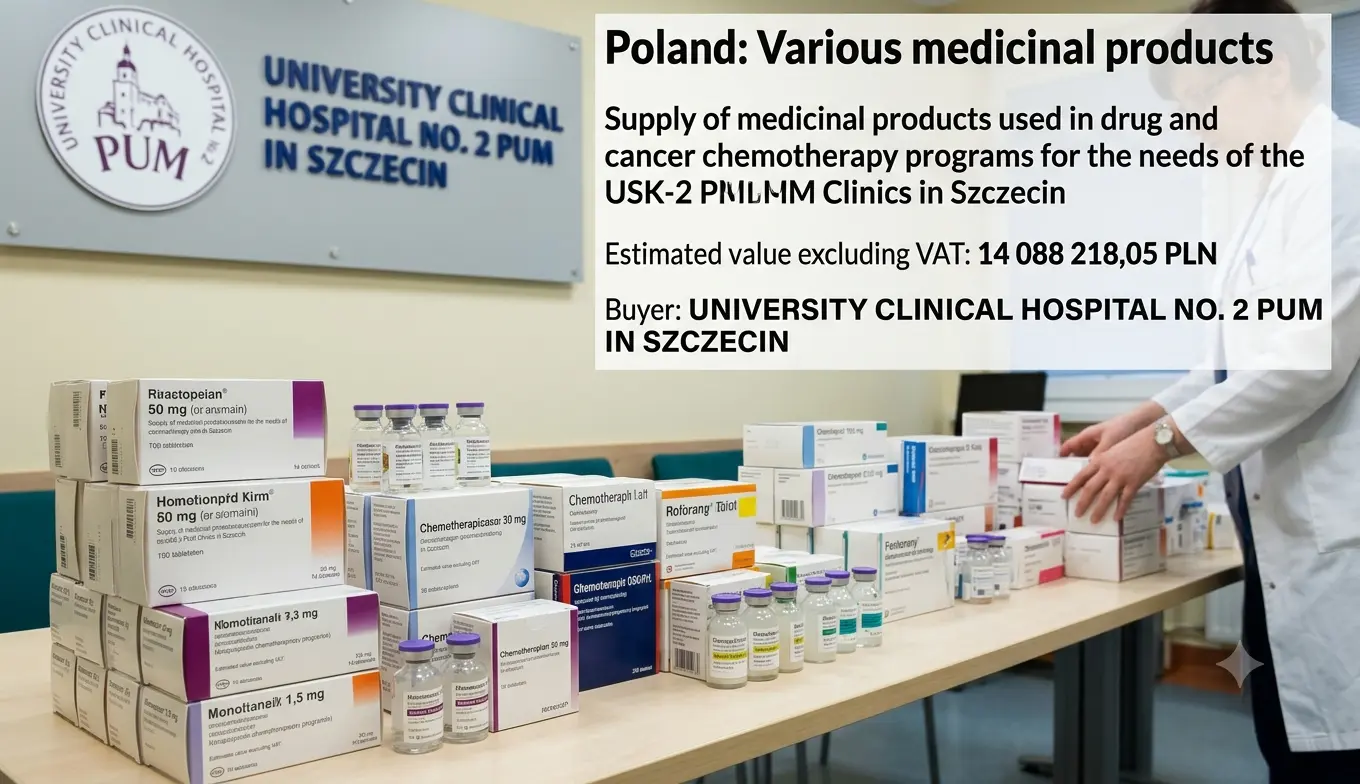
University Clinical Hospital No. 2 of the Pomeranian Medical University in Szczecin has concluded an eight lot procurement for medicines used in oncology chemotherapy and national drug programmes. The contracts cover a range of treatments, including medicines for urothelial cancer, kidney cancer, ovarian cancer and other specialist conditions. Seven suppliers were selected across the eight lots, with the reported tender values totalling approximately PLN 161.58 million.
Introduction
A major pharmaceutical supply procurement in Poland has reached the contract award stage, giving University Clinical Hospital No. 2 of the Pomeranian Medical University in Szczecin a group of suppliers for medicines used in specialist treatment programmes and cancer care.
The award notice, published in the Official Journal of the European Union on 3 November 2026, records eight lots covering different medicine categories and treatment areas. The hospital used an open procedure under the standard public procurement regime. Contracts were concluded with seven suppliers, with URTICA Sp. z o.o. securing two lots.
The procurement is designed to support the hospital’s clinical requirements over a 24 month period. The notice makes clear that actual quantities may change according to patient needs and eligibility under programmes determined by Poland’s Ministry of Health and National Health Fund. It also states that the hospital is not committing to purchase the full estimated quantities.
Why This Contract Matters
The procurement matters because it links public purchasing directly with the continuity of specialist medical treatment. Hospitals running oncology and other national drug programmes need access to medicines that meet regulatory and reimbursement requirements. Supply arrangements must therefore accommodate clinical demand while ensuring that products are available when required.
The eight lots cover several treatment areas. These include urothelial cancer, kidney cancer, ovarian cancer, lipid disorders and pulmonary arterial hypertension. The procurement also includes normal human intravenous immunoglobulin and rituximab for use outside drug programmes.
For pharmaceutical manufacturers and distributors, the award provides a view of the medicines being procured by a major clinical institution in Szczecin. It also shows how hospitals can divide medicine requirements into separate lots while retaining a common procurement process.
Contract Timeline
- Previous procurement notice: Notice 589756-2026 is identified as the previous notice associated with the procedure.
- Winner selection: The award information records 15 October 2026 as the winner selection date for the reported contracts.
- Contract conclusion: The notice records 28 October 2026 as the contract conclusion date in the contract result information.
- Award notice publication: 3 November 2026.
- Contract duration: 24 months from the date of contract conclusion, as specified in the procurement description.
The notice does not provide a separate delivery calendar for each medicine or a detailed schedule of individual orders. The contracting authority has not disclosed this information in the award notice.
Contract Overview
The procurement, titled in Polish as the delivery of medicinal products used in drug programmes and cancer chemotherapy for the clinics of USK-2 PUM in Szczecin, is a supply contract. Its main classification is CPV 33690000, covering various medicinal products.
The estimated total value was PLN 14,088,218.05 excluding VAT. The procurement was conducted as an open procedure and was not accelerated. The legal basis cited in the notice is Directive 2014/24/EU.
The procurement documentation describes eight tasks, each corresponding to a separate lot. Although the hospital organised the requirements within one procedure, it did not permit partial tenders or variant tenders under the conditions stated in the notice. The award results nevertheless identify separate successful suppliers for the individual lots.
The hospital requires medicines to be legally authorised for marketing and use in Poland under the applicable pharmaceutical law. For medicines covered by drug programmes, the notice generally requires the products to appear in Annex B of the Ministry of Health’s list of reimbursed medicines. The notice specifies an exception for task six.
Key Contract Details
| Contracting authority | UNIWERSYTECKI SZPITAL KLINICZNY NR 2 PUM W SZCZECINIE |
| Country | Poland |
| Location | Al. Powstańców Wielkopolskich 72, Szczecin, 70-111 |
| Procedure title | Delivery of medicinal products used in drug programmes and cancer chemotherapy for the hospital clinics in Szczecin |
| Procedure type | Open procedure |
| Notice type | Contract or concession award notice, standard regime |
| Estimated total value | PLN 14,088,218.05 excluding VAT |
| Main CPV | 33690000 – Various medicinal products |
| Number of lots | Eight |
| Successful suppliers | Seven organisations |
| Contract duration | 24 months from contract conclusion |
| Legal basis | Directive 2014/24/EU |
| Award criteria | Gross price: 95%; delivery time: 5% |
| Previous notice | 589756-2026 |
| Winner selection date | 15 October 2026, as recorded in the contract result information |
| Contract conclusion date | 28 October 2026, as recorded in the contract result information |
| EU funding | The notice marks the procurement as fully or partially financed by EU funds |
| Government Procurement Agreement | Not covered |
| Framework agreement | No |
| Dynamic purchasing system | No |
| Review body | Krajowa Izba Odwoławcza |
Project Scope
The procurement covers medicines for hospital clinics in Szczecin. The eight lots identify specific treatment programmes and medicine categories:
- LOT-0001: Drug programme B.141.FM for the treatment of urothelial cancer. The successful supplier is Astellas Pharma Sp. z o.o.
- LOT-0002: Drug programme B.10 for the treatment of kidney cancer. The successful supplier is URTICA Sp. z o.o.
- LOT-0003: Normal human intravenous immunoglobulin. The successful supplier is Takeda Pharma Sp. z o.o.
- LOT-0004: Drug programme B.101 for the treatment of lipid disorders. The successful supplier is Hurtownia Farmaceutyczna Ismed sp.j. mgr Janina Gierłowska-Andrzej Gierłowski.
- LOT-0005: Drug programme B.50 for the treatment of ovarian cancer. The successful supplier is AstraZeneca Kft.
- LOT-0006: Rituximab for use outside drug programmes. The successful supplier is LEK S.A.
- LOT-0007: Treatment of patients with ovarian and fallopian tube cancer under drug programme B.50. The successful supplier is NEUCA S.A.
- LOT-0008: Drug programme B.31 for the treatment of pulmonary arterial hypertension. The successful supplier is URTICA Sp. z o.o.
The hospital states that quantities in the pricing schedule are estimates used to calculate and compare tenders. Actual orders may increase or decrease between individual product positions depending on clinical requirements. The total contract value cannot be exceeded, but the hospital does not guarantee that it will purchase the full quantities or complete the entire estimated scope.
All offered products are required to have a minimum shelf life of 12 months from delivery to the hospital. This condition is important for suppliers managing medicine stocks, distribution and delivery planning.
About the Contracting Authority
UNIWERSYTECKI SZPITAL KLINICZNY NR 2 PUM W SZCZECINIE, or University Clinical Hospital No. 2 of the Pomeranian Medical University in Szczecin, is the contracting authority. The notice identifies it as a body governed by public law and records health as its principal area of activity.
The hospital is responsible for procuring the medicines required by its clinics. It also provides additional information about the procurement procedure, access to procurement documents and information concerning the general regulatory framework for taxes, environmental protection and employment conditions applicable at the place of performance.
The hospital’s procurement contact email is zamowienia@usk2.szczecin.pl. Further information about the institution and its procurement activity can be explored through the public authority directory and the public procurement information section on PolandTenders.com.
About the Organisations Involved
Astellas Pharma Sp. z o.o. was selected for LOT-0001, covering the urothelial cancer drug programme.
URTICA Sp. z o.o. won LOT-0002 and LOT-0008. Its awards cover the kidney cancer programme and the pulmonary arterial hypertension programme.
Takeda Pharma Sp. z o.o. was selected for LOT-0003, covering normal human intravenous immunoglobulin.
Hurtownia Farmaceutyczna Ismed sp.j. mgr Janina Gierłowska-Andrzej Gierłowski won LOT-0004, covering medicines for the lipid disorders programme.
AstraZeneca Kft. was selected for LOT-0005, the ovarian cancer drug programme.
LEK S.A. won LOT-0006 for rituximab used outside drug programmes.
NEUCA S.A. was selected for LOT-0007, covering treatment for ovarian and fallopian tube cancer under programme B.50.
Krajowa Izba Odwoławcza is identified as the review organisation and the body providing further information on review procedures. The notice does not assign it a role in the supply or clinical management of the contracts.
Procurement Analysis
The hospital used an open procedure, allowing interested suppliers to submit tenders under the published requirements. The award model placed 95% of the evaluation weight on gross price and 5% on delivery time. This means price dominated the scoring while delivery speed provided a smaller but explicit differentiator.
The result information records varying levels of competition across the lots. LOT-0001 received one tender. LOT-0002 received two tenders. LOT-0006 received two tenders and LOT-0008 received two tenders. The notice also records one tender for LOT-0007. These figures show that competition was not uniform across the medicine categories.
In particular, the single tender recorded for LOT-0001 and LOT-0007 indicates limited competition for those specific requirements in this procurement. It does not, by itself, establish why other suppliers did not participate. The award notice does not provide a detailed explanation of market availability, supplier capacity or reasons for non participation.
The 95% price weighting places significant importance on accurate cost calculations. However, suppliers also needed to meet the regulatory conditions, product eligibility requirements and the minimum shelf life requirement. A low price would not compensate for failure to meet mandatory product conditions.
Additional Procurement Facts
The procedure identifier is a416598c-7e2c-4962-ba67-03d3b4881cb2 and the hospital’s internal reference is ZP.220.112.26. The award notice identifies notice 589756-2026 as the previous notice connected with the procedure.
The procurement was divided into eight tasks, but the hospital did not permit partial tenders or variant tenders under the procedure description. The result notice nevertheless identifies a separate successful tender and contract reference for each lot. No framework agreement or dynamic purchasing system was used.
The notice marks the procurement as fully or partially financed by European Union funds. It does not specify the funding programme, the amount of EU support or the proportion of the procurement financed through those funds. The procurement is not covered by the Government Procurement Agreement.
The award information records no subcontracting for the successful tenders where this detail is reported. The notice does not identify a subcontractor network supporting the medicine deliveries.
Market and Industry Perspective
The award illustrates the role of specialist pharmaceutical suppliers and distributors in supporting hospital treatment programmes. Different lots attract different market participants, depending on the medicine category and the commercial and regulatory conditions attached to the product.
The presence of manufacturers and pharmaceutical wholesalers among the successful organisations shows that public hospital supply contracts can involve different types of market participants. Manufacturers may participate directly where their product portfolios align with the requirements, while distributors can compete where they can source and deliver eligible medicines under the required conditions.
For suppliers, the procurement also highlights the importance of stock management. A minimum 12 month shelf life at the point of delivery places a clear condition on product rotation and inventory planning. Suppliers need to ensure that medicines can be delivered within the required period without creating avoidable expiry risk.
The variable number of tenders across lots also suggests that suppliers should assess each medicine category separately. Competition in one treatment area cannot automatically be used to predict the number of competitors in another.
Economic Significance
The hospital estimated the overall procurement at PLN 14.09 million excluding VAT. The individual tender values reported in the award results add up to approximately PLN 161.58 million. This aggregate is an editorial calculation based on the eight reported tender values.
The difference between the estimated overall value and the sum of the reported tender values is substantial. The estimated value is expressly stated as excluding VAT, while the tender evaluation criterion is described as gross price. The award notice does not provide a reconciliation explaining the difference in basis or amount. These figures should therefore not be treated as directly comparable contract values without checking the underlying pricing schedules and contract documentation.
The reported tender values are PLN 84.21 million for LOT-0001, PLN 1.20 million for LOT-0002, PLN 277,486.56 for LOT-0003, PLN 783,999.22 for LOT-0004, PLN 73.92 million for LOT-0005, PLN 44,712 for LOT-0006, PLN 651,138.28 for LOT-0007 and PLN 478,677.60 for LOT-0008.
The two largest reported tender values relate to LOT-0001 and LOT-0005. Together, they account for a substantial share of the aggregate tender value. The notice does not provide enough detail to determine whether the difference reflects product quantities, pricing units, tax treatment or another feature of the underlying pricing schedules. This is an important point for suppliers and procurement analysts reviewing the award.
Future Procurement Opportunities
The 24 month contract period creates a defined supply horizon for the hospital’s current medicine requirements. Suppliers should monitor future notices from the hospital for additional requirements, new treatment programmes or procurement procedures launched as existing arrangements approach their end.
The hospital explains that actual medicine quantities depend on patient eligibility under criteria established by the Ministry of Health and the National Health Fund. This means that demand can change during the contract period. Suppliers should pay attention to changes in reimbursement lists, programme eligibility and clinical requirements that could affect the products hospitals need to purchase.
Businesses can monitor new tender opportunities, review contract award notices and explore relevant procurement sectors to identify comparable public healthcare purchasing activity.
Opportunities for Suppliers
Pharmaceutical manufacturers, authorised distributors and wholesalers supplying the Polish healthcare market can use this award as a reference point for understanding the hospital’s medicine requirements. The lot structure provides insight into the treatment areas included in the procurement and the organisations selected for each category.
Potential bidders should review the product eligibility conditions before preparing a tender. Medicines must meet the applicable Polish pharmaceutical law requirements and, where relevant, the reimbursement list conditions for drug programmes. Suppliers should also check whether a specific lot is covered by an exception, as the notice identifies task six as an exception to the Annex B condition.
Pricing teams should carefully examine the gross price weighting and the delivery time criterion. Logistics teams should confirm that stock can meet the 12 month minimum shelf life requirement at delivery. The hospital’s right to vary quantities also means that suppliers need to understand how the contract handles ordering changes and stock availability.
Companies looking for procurement documentation and market intelligence can consult the document library and search using relevant procurement keywords. Suppliers can also register for tender information to follow relevant opportunities.
What Businesses Should Watch
- Medicine reimbursement requirements: Changes to Poland’s reimbursed medicines list may affect which products qualify for drug programme supply.
- Clinical demand: Patient eligibility and treatment requirements may influence the hospital’s actual ordering volumes.
- Delivery performance: The award criteria gave delivery time a 5% weighting, while the contract requires at least 12 months of shelf life at delivery.
- Price and value reporting: The difference between the estimated value and the aggregate tender values warrants review against the underlying pricing schedules.
- Future procurement notices: Suppliers should monitor additional medicine tenders and contract awards published by the hospital.
- Supplier competition: The number of tenders varied by lot, with some requirements attracting only one tender.
Companies seeking further information about tender monitoring or procurement coverage can use the contact page to reach the PolandTenders.com team.
PolandTenders.com Procurement Intelligence
This award offers a useful view of how a public hospital structures medicine procurement around treatment programmes rather than relying on a single undifferentiated supply requirement. The eight lot arrangement separates distinct clinical needs and provides a clearer route for identifying which suppliers are active in each category.
For market intelligence purposes, the most important findings are the different supplier profiles across the lots, the uneven tender participation and the high weighting assigned to gross price. The results also show that one supplier, URTICA Sp. z o.o., secured two lots, while the remaining successful suppliers each won one.
The value figures require particular care. The aggregate of the tender values is far above the estimated value published for the procedure. Since the estimate is explicitly exclusive of VAT and the award criterion refers to gross price, the figures may reflect different pricing bases. However, the notice does not explain the difference. Procurement analysts should avoid presenting the aggregate as a confirmed final expenditure figure until the contract schedules and pricing basis have been checked.
Another important point is the hospital’s statement that it cannot guarantee full utilisation of the estimated quantities. Demand depends on patient qualification under national programme rules. Suppliers therefore need to assess not only the headline award value but also the ordering provisions, product mix and potential demand variability in the contract documents.
For businesses tracking public healthcare procurement in Europe, the notice provides a useful example of how medicine supply contracts combine regulatory eligibility, reimbursement requirements, shelf life conditions and delivery performance in a competitive award process.
Supplier Takeaways
- Review each lot separately and identify the relevant medicine category and treatment programme.
- Confirm that products meet Polish pharmaceutical law and reimbursement requirements where applicable.
- Check the specific exception relating to task six before applying the Annex B condition.
- Build pricing around the 95% gross price weighting and the 5% delivery time criterion.
- Maintain sufficient stock rotation to meet the 12 month minimum shelf life requirement.
- Assess the contract’s variable quantity provisions and do not assume that all estimated volumes will be ordered.
- Verify the pricing basis carefully when comparing estimated values with reported tender values.
Key Takeaways
- University Clinical Hospital No. 2 of the Pomeranian Medical University in Szczecin concluded an eight lot medicine supply procurement.
- Seven suppliers were selected, with URTICA Sp. z o.o. winning two lots.
- The procurement covers oncology medicines, specialist drug programmes and other medicinal products.
- The contracts are intended to run for 24 months from conclusion.
- Gross price carried 95% of the award weighting and delivery time carried 5%.
- The hospital may adjust quantities according to actual clinical demand and does not guarantee full utilisation.
- The aggregate of the reported tender values differs substantially from the procedure’s estimated value and requires careful interpretation.
Conclusion
The Szczecin hospital procurement has established a group of suppliers for medicines supporting oncology chemotherapy and several specialist treatment programmes. The eight lot structure has resulted in awards to seven organisations, with contract arrangements planned for a 24 month period.
For suppliers, the result highlights the importance of regulatory compliance, reimbursement eligibility, competitive gross pricing and dependable delivery. For procurement observers, the award provides insight into public hospital purchasing priorities while also raising a material question about the difference between the published estimate and the aggregate tender values. The underlying contract documentation will be important for understanding the final financial commitments and the expected supply volumes.
Source
Source: Tenders Electronic Daily (TED), Contract Award Notice 761672 2026, Official Journal of the European Union, OJ S issue 213/2026, published on 03/11/2026. View the original TED notice.
Frequently Asked Questions (FAQs)

Fresh and verified Tenders from Poland. Find, search and filter Tenders/Call for bids/RFIs/RFPs/RFQs/Auctions published by the government, public sector undertakings (PSUs) and private entities.
- 1,000+ Tenders
- Verified Tenders Only
- New Tenders Every Day
- Tenders Result Data
- Archive & Historical Tenders Access
- Consultants for RFI/RFP/RFQ
- Tender Notifications & Alerts
- Search, Sort, and Filter Tenders
- Bidding Assistance & Consulting
- Customer Support
- Publish your Tenders
- Export data to Excel
- API for Tender Data
- Tender Documents

Fill out the form below and you will receive a call from us within 24 hours.
Get FREE SAMPLE TENDERS from Poland in your email inbox.
Copyright © 2014-2026 PolandTenders.com. All Rights Reserved.