Poland's Third Largest City Just Split Its Entire Waste Problem Four Ways And Rewarded Whoever Lives Closest
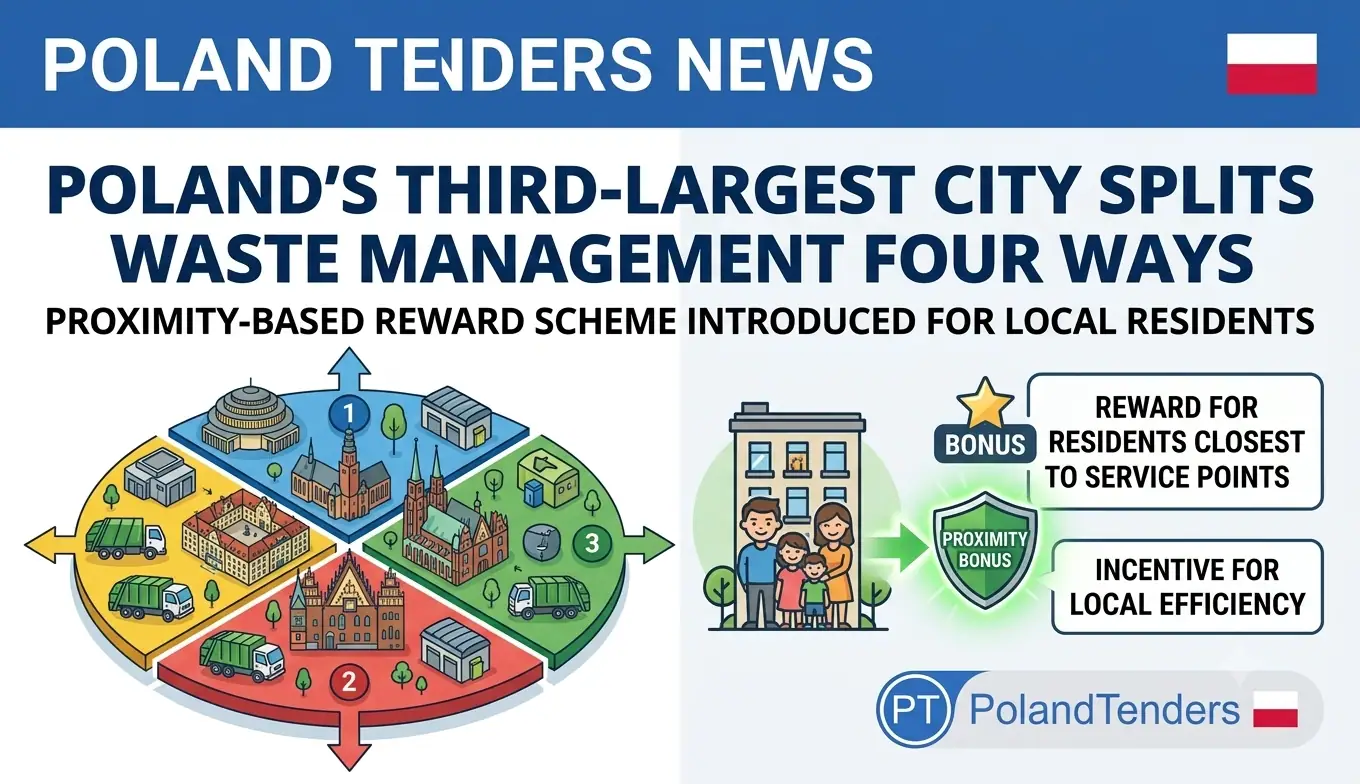
Łódź has locked in two years of waste processing worth over 258 million złoty across four companies, using a scoring system that pays contractors extra for staying close to the city, recycling more and burying less.
Standfirst
The city of Łódź has awarded ten separate contracts, together worth more than 258 million złoty, to process the mixed household waste and biodegradable kitchen scraps its residents produce between February 2027 and January 2029. German waste giant Remondis took the largest share, followed by a Polish consortium, the Schwarz Group's PreZero and a small specialist biowaste firm that beat larger rivals for the city's food waste. The contract's scoring system rewards contractors for operating close to Łódź, recycling more and sending less to landfill, a live example of the EU's circular economy targets shaping how a city actually buys waste disposal services.
Introduction
Every city produces waste faster than most residents ever think about it and someone has to be paid, continuously, to make it disappear responsibly. Łódź, Poland's third largest city, just finished deciding who that someone will be for the next two years, splitting the job into ten pieces and handing them to four different companies.
The details of how it made that decision and what it chose to reward say more about where European waste policy is heading than the tonnage figures alone ever could.
Why This Contract Matters
Waste processing contracts of this scale are essential, recurring infrastructure decisions: get them wrong and a city's rubbish either piles up or gets shipped further than it needs to travel, at greater cost and environmental impact. Get them right and a city can meaningfully improve its recycling performance and cut landfill use without residents noticing any change in their weekly collection.
This contract also matters as a live illustration of EU environmental policy reaching into the fine print of a municipal tender. Łódź built financial rewards directly into its scoring system for contractors who recycle more, landfill less and process waste close to the city rather than trucking it across the country, exactly the outcomes the EU's waste and landfill rules are designed to encourage.
Contract Timeline
- 22 June 2026, The earliest recorded contract conclusion date across the ten lots (Remondis' three contracts, parts I - III).
- 1 February 2027, The contracts' service period begins.
- 31 January 2029, All ten contracts are scheduled to end, marking a two year term.
- 8 July 2026, The result notice was dispatched for publication.
- 9 July 2026, The notice was published in the Official Journal of the EU (OJ S 130/2026).
The notice references an earlier related notice, confirming this result follows an original tender announcement published separately.
Contract Overview
Łódź ran a single open procedure, split into ten separately awarded lots, to secure processing capacity for two waste streams: unsegregated (mixed) municipal household waste and biodegradable kitchen waste. Bidders were free to tender for any single lot or any combination of lots, with each lot evaluated and awarded independently.
Eight of the ten lots cover mixed municipal waste, split into differently sized batches, three lots of 45,000 tonnes each, four lots of 30,000 tonnes each and one lot of 21,000 tonnes, while the remaining two lots each cover 14,000 tonnes of biodegradable kitchen waste. Across the full two year contract term, that adds up to 276,000 tonnes of mixed waste and 28,000 tonnes of kitchen waste passing through the winning contractors' facilities.
Key Contract Details
| Detail | Information |
|---|---|
| Contracting authority | City of Łódź - Łódź City Hall (Miasto Łódź - Urząd Miasta Łodzi) |
| Procedure title | Processing of mixed municipal waste and biodegradable kitchen waste from Łódź, 1 February 2027 - 31 January 2029 |
| Main CPV code | 90500000 - Refuse and waste related services |
| Additional CPV codes | 90510000 - Refuse disposal and treatment; 90514000 - Refuse recycling services; 90533000 - Waste tip management services |
| Procedure type | Open procedure (not accelerated), 10 lots |
| Total waste volume covered | 276,000 tonnes mixed municipal waste; 28,000 tonnes biodegradable kitchen waste |
| Contract duration | 1 February 2027 - 31 January 2029 (2 years), all lots |
| Award criteria (Lots I–VIII) | Price (50 pts); recycling rate bonus (15 pts); reduced landfilling bonus (10 pts); proximity to Łódź (25 pts) |
| Award criteria (Lots IX–X) | Price (60 pts); R3 biowaste recovery rate bonus (15 pts); proximity to Łódź (25 pts) |
| Total value of contracts awarded | 258,133,000 PLN (excl. VAT) |
| EU funding | Not financed with EU funds |
| GPA coverage | Yes (all lots) |
| Legal basis | Directive 2014/24/EU |
| Review body | Krajowa Izba Odwoławcza (Poland's National Appeal Chamber) |
| Distinct winning companies | 4 |
Project Scope
Contractors under this agreement take responsibility for processing waste collected across Łódź: unsegregated household waste under Polish waste code 20 03 01 and biodegradable kitchen waste under code 20 01 08. All facilities used to process the waste must belong to the winning contractor and the city explicitly evaluated how far each contractor's processing facility sits from Łódź's city boundary as part of its scoring.
Beyond simple processing, the tender's technical requirements pushed contractors to commit to specific performance levels: for mixed waste, a minimum recycling and reuse preparation rate, plus a target for how much biodegradable material within that mixed waste avoids landfill altogether; for kitchen waste specifically, a minimum rate of material recovered through what waste engineers call the "R3" process, essentially recycling organic material back into usable resources such as compost or biogas rather than simply disposing of it.
About the Contracting Authority
The City of Łódź, acting through Łódź City Hall's Public Procurement Department, is Poland's third largest city and the contracting authority for this tender. It is classified in the notice as a local authority with general public services as its main activity, consistent with a municipal government managing essential services on behalf of its residents.
As the body legally responsible for managing the city's municipal waste under Polish and EU law, Łódź designed this tender's scoring system specifically to advance national and EU waste policy goals, higher recycling rates, less landfilling and shorter transport distances, rather than treating price as the only meaningful factor in choosing a contractor.
About the Organisations Involved
City of Łódź - Łódź City Hall, Buyer
Based on Piotrkowska Street in central Łódź, the city's Public Procurement Department structured this ten lot tender, evaluated all bids received and signed the resulting contracts with four separate winning companies.
Krajowa Izba Odwoławcza, Review Organisation
Poland's National Appeal Chamber, based in Warsaw, is the designated review body for every lot in this tender, available to hear any formal challenge from an unsuccessful bidder under Poland's Public Procurement Law.
Remondis Sp. z o.o., Winner of Lots I, II and III
Remondis is based in Warsaw and classified as a large economic operator. It is the Polish arm of Remondis, one of Germany's largest waste management and recycling groups, with an international presence spanning dozens of countries. Remondis won all three of the largest individual lots in this tender, parts I, II and III, each covering 45,000 tonnes of mixed municipal waste, at 39,105,000 złoty per lot, facing two other bidders in each case. Its clean sweep of the tender's biggest lots reflects the scale of processing capacity a company of Remondis' size can bring to bear.
Konsorcjum firm: FBSerwis Zielony Kamieńsk Sp. z o.o. / FBSerwis Zielony Wrocław Sp. z o.o., Winner of Lots IV, V and VIII
This is a joint bidding consortium of two regional subsidiaries within the FBSerwis group, both registered at Kamieńsk in the Łódź region and classified together as a large economic operator. The consortium won three lots: parts IV and V, each covering 30,000 tonnes of mixed waste at 26,340,000 złoty per lot and part VIII, covering 21,000 tonnes at 18,438,000 złoty, facing a single competing bidder in each case.
PreZero Service Centrum Sp. z o.o., Winner of Lots VI and VII
PreZero Service Centrum is based in Kutno, in the Łódź region and classified as a large economic operator. It is part of PreZero, the international waste management and recycling arm of Germany's Schwarz Group, the parent company of the Lidl and Kaufland retail chains, which operates hundreds of waste processing locations across Europe and North America. PreZero won two lots, parts VI and VII, each covering 30,000 tonnes of mixed waste at 25,890,000 złoty per lot, against two other bidders in each case.
Bioodpady.pl Sp. z o.o., Winner of Lots IX and X
Bioodpady.pl is based in Warsaw and classified as a small economic operator, the only winner in this tender not designated large. It won both of the biodegradable kitchen waste lots, parts IX and X, each covering 14,000 tonnes at 8,960,000 złoty per lot. Notably, one of the two bids received for these lots came from a micro, small or medium enterprise, likely Bioodpady.pl itself, meaning a specialist smaller firm outcompeted the field for the tender's most specifically technical waste stream.
Procurement Analysis
Łódź structured its award criteria to reward far more than the lowest price. For the eight mixed waste lots, price counted for half the available score, with the remaining half split between three technical bonuses: an extra 15 points for exceeding the minimum recycling and reuse preparation rate, up to 10 points for reducing how much biodegradable waste within the mixed stream ends up at landfill and up to 25 points, a full quarter of the total score, for operating a processing facility within 65 kilometres of the city's boundary. For the two biowaste lots, price counted for 60% of the score, with 15 points for exceeding a minimum organic recovery rate and 25 points again reserved for proximity.
That proximity criterion carrying as much weight as price's largest single competitor is a clear policy signal: Łódź is willing to pay a premium, within limits, to keep its waste processed nearby rather than trucked long distances, reducing transport emissions and keeping the city less dependent on distant capacity.
Competition varied sharply by lot type. The mixed waste lots each attracted two or three bidders, uniformly from large operators with no small or medium enterprise interest recorded. The two biowaste lots, by contrast, drew interest from a smaller specialist alongside a larger competitor and the smaller firm won both, evidence that niche organic waste processing remains a viable market for focused, smaller operators even where the broader mixed waste segment is dominated by scale players.
All ten lots are confirmed covered by the WTO Government Procurement Agreement and not financed by EU funds and none of the lots involve a framework agreement or dynamic purchasing system, each is a standalone, directly awarded service contract for the full two year term.
Additional Procurement Facts
The notice's overall stated value, 258,133,000 złoty, reconciles exactly with the sum of the ten individual lot values disclosed in the same document, a reassuring contrast to some other large multi lot notices, where headline totals and itemised figures do not always agree.
One smaller inconsistency is worth flagging: the tender's own descriptive text states in one place that the contract covers 21,000 tonnes of biodegradable kitchen waste in total, while a separate passage in the same description states that the final two lots together cover 28,000 tonnes of kitchen waste, a figure that matches the two lots' individually disclosed volumes of 14,000 tonnes each. The 28,000 tonne figure appears to be the accurate one, consistent with the lot level detail; the 21,000 tonne reference elsewhere in the same procedure description appears to be a drafting inconsistency in the underlying Polish tender documentation.
Market & Industry Perspective
This award is a snapshot of the waste management competitive landscape now active in Poland: German multinational Remondis and the Schwarz Group's PreZero, both established international players with deep processing capacity, sit alongside a Polish regional consortium and a small, focused domestic specialist and all four found a place to compete and win.
For the broader European waste sector, the emphasis on proximity and recycling performance in the scoring formula reflects a wider trend among municipal buyers translating EU circular economy and landfill reduction policy directly into competitive scoring criteria, rather than treating environmental performance as a compliance checkbox separate from the commercial award decision.
Economic Significance
At over 258 million złoty for two years of service, this is a substantial recurring cost for the city of Łódź and a meaningful, multi year revenue base for the four winning companies. Splitting the volume across ten lots and four different contractors also reduces the city's dependency on any single operator, a resilience consideration for a service residents rely on every week without exception.
For Remondis, PreZero and the FBSerwis consortium, securing multiple lots each provides steady, contracted throughput for processing facilities that require continuous volume to operate efficiently. For Bioodpady.pl, winning both biowaste lots represents a significant win relative to its smaller scale, underscoring that specialised processing niches can support smaller operators even within a market otherwise dominated by large, diversified waste companies.
Future Procurement Opportunities
Because all ten contracts run for a fixed two year term ending 31 January 2029, Łódź will need to retender this entire waste processing requirement again before that date, giving both incumbent winners and companies that did not win this round a clear future opportunity to compete again.
Other Polish cities managing similar mixed waste and biowaste processing needs are likely to structure comparable multi lot tenders on similar cycles and the scoring formula used here, rewarding recycling performance, reduced landfilling and proximity, may increasingly become a template other Polish municipalities adopt as they align local waste tenders with national and EU recycling targets.
Opportunities for Suppliers
- Specialist biowaste processors have a proven route to compete. Bioodpady.pl's win against a larger rival shows that focused organic waste expertise, rather than broad scale, can be decisive for kitchen waste specific lots.
- Facility location matters as much as price for a meaningful share of the score. Companies investing in processing capacity within Łódź's surrounding region gain a structural scoring advantage worth up to a quarter of the available points.
- Recycling and landfill diversion performance is directly monetised, not just regulatory box ticking; contractors that can credibly commit to higher recycling and lower landfill rates gain real points against competitors relying on price alone.
- Track the 2029 retender cycle now; with all ten contracts expiring simultaneously, early engagement with Łódź's procurement department ahead of the next tender could offer a meaningful head start.
What Businesses Should Watch
Watch how the four winning contractors perform against their declared recycling, landfill reduction and R3 recovery rate commitments over the two year term, since underperformance against declared targets could affect future competitiveness or trigger contractual consequences.
Watch for Łódź's approach to retendering as the 2029 expiry approaches, particularly whether the city adjusts its scoring weights, especially the strong proximity criterion, in light of how this round's competitive dynamics played out.
Watch the broader Polish municipal waste sector for similar tenders adopting comparable recycling and proximity weighted scoring formulas, particularly as national recycling targets under EU law continue to tighten.
Polandtenders.com Procurement Intelligence
This tender is a clear, well documented example of environmental policy being built directly into the mechanics of a public procurement scoring formula, rather than sitting alongside it as a separate compliance requirement. Rewarding proximity with up to a quarter of the total score and offering meaningful points for recycling performance and reduced landfilling, means a contractor cannot simply undercut competitors on price alone, it has to also commit credibly to environmental outcomes the city can hold it to over the following two years.
The result, four different winners, ranging from a German multinational to a small Polish specialist, suggests this approach worked as intended, producing genuine competition rather than a single dominant winner sweeping every lot. That outcome is worth watching as other European cities design or redesign their own municipal waste tenders: a scoring formula that rewards specific measurable outcomes, rather than price and generic quality criteria, appears capable of supporting a genuinely diverse supplier base, including smaller specialists in niche categories like biowaste, alongside the large multinational operators that typically dominate this sector.
For suppliers, the lesson is that environmental performance criteria in municipal waste tenders are no longer a minor tie breaker. In this tender, they represented as much or more of the available score as price itself and companies that can substantiate strong environmental commitments, not just competitive rates, are increasingly the ones taking home the largest lots.
Supplier Takeaways
- Invest in facilities within the geographic radius municipal buyers are likely to reward; this tender's 65 kilometre proximity threshold for full points is a concrete benchmark worth benchmarking against.
- Build a credible, verifiable track record on recycling rates and reduced landfilling; these were worth a substantial share of the available score and are likely to recur in future Polish municipal waste tenders.
- Smaller, specialist operators should target niche waste streams, such as biodegradable kitchen waste, where scale advantages matter less and technical focus can be decisive.
- Prepare early for Łódź's 2029 retender, since all ten current contracts expire simultaneously, creating a single, large, predictable future competitive event.
Key Takeaways
- Łódź awarded ten separate waste processing contracts worth a combined 258.1 million złoty, running from February 2027 to January 2029.
- Four companies won: Remondis (three lots), an FBSerwis consortium (three lots), PreZero Service Centrum (two lots) and small specialist firm Bioodpady.pl (two biowaste lots).
- The award formula gave up to a quarter of the total score to contractors operating close to Łódź, alongside meaningful points for recycling performance and reduced landfilling.
- The notice's total value reconciles exactly with its individual lot figures, though a minor inconsistency exists in the tender's own descriptive text regarding total kitchen waste volume.
- The mixed waste lots attracted competition exclusively from large operators, while the biowaste lots saw a smaller specialist firm win against larger competition.
Conclusion
Łódź did not simply buy the cheapest available waste disposal capacity for the next two years. It built a scoring system that pays for proximity, recycling performance and reduced landfilling and the result was a genuinely mixed field of winners, from a German multinational to a small Polish biowaste specialist. For a city managing an essential, unglamorous service that residents notice only when it fails, that is arguably the more interesting story than the tonnage or the total price alone.
Frequently Asked Questions
Q1. Why did Łódź split this tender into ten separate lots?
Splitting the requirement by waste type and volume allowed different companies, including smaller specialists, to compete for individual portions rather than requiring one contractor to handle the city's entire waste stream.
Q2. Why did proximity to the city carry so much weight in the scoring?
Awarding up to 25 of 100 points for operating within a defined distance of Łódź reduces the environmental and logistical cost of transporting waste long distances, aligning the award criteria directly with sustainability goals rather than treating them as separate from the commercial decision.
Q3. What is the "R3" process mentioned for biodegradable waste?
R3 refers to a recognised waste recovery process, effectively recycling organic material back into usable resources, such as compost or biogas, rather than sending it to landfill or incineration without recovery.
Q4. Why did a small company win the biowaste lots against larger competition?
Bioodpady.pl, classified as a small economic operator, won both biodegradable kitchen waste lots, suggesting specialist expertise in this narrower waste category outweighed the scale advantages that larger operators held in the broader mixed waste segment.
Q5. Is this contract financed by the EU?
No. All ten lots are confirmed as not financed with EU funds, though all are covered by the WTO Government Procurement Agreement.
Q6. How much waste does this contract actually cover?
Across the full two year term, the contracts cover 276,000 tonnes of mixed municipal waste and 28,000 tonnes of biodegradable kitchen waste, according to the individual lot volumes disclosed in the notice.
Q7. When will Łódź need to retender this waste processing requirement?
All ten contracts are scheduled to run until 31 January 2029, meaning the city will need to run a new competitive process before that date to secure processing capacity beyond the current term.
Source: EU Official Journal, Contract Award Notice 473062-2026, OJ S 130/2026, published 9 July 2026. Contracting authority: Miasto Łódź - Urząd Miasta Łodzi.

Fresh and verified Tenders from Poland. Find, search and filter Tenders/Call for bids/RFIs/RFPs/RFQs/Auctions published by the government, public sector undertakings (PSUs) and private entities.
- 1,000+ Tenders
- Verified Tenders Only
- New Tenders Every Day
- Tenders Result Data
- Archive & Historical Tenders Access
- Consultants for RFI/RFP/RFQ
- Tender Notifications & Alerts
- Search, Sort, and Filter Tenders
- Bidding Assistance & Consulting
- Customer Support
- Publish your Tenders
- Export data to Excel
- API for Tender Data
- Tender Documents

Fill out the form below and you will receive a call from us within 24 hours.
Get FREE SAMPLE TENDERS from Poland in your email inbox.
Copyright © 2014-2026 PolandTenders.com. All Rights Reserved.