UNIBEP and Track Tec Secure 874 Million PLN Railway Contract in Poland
Upgrading Tri-City Rail Infrastructure for Modern, High-Capacity Transit
Standfirst
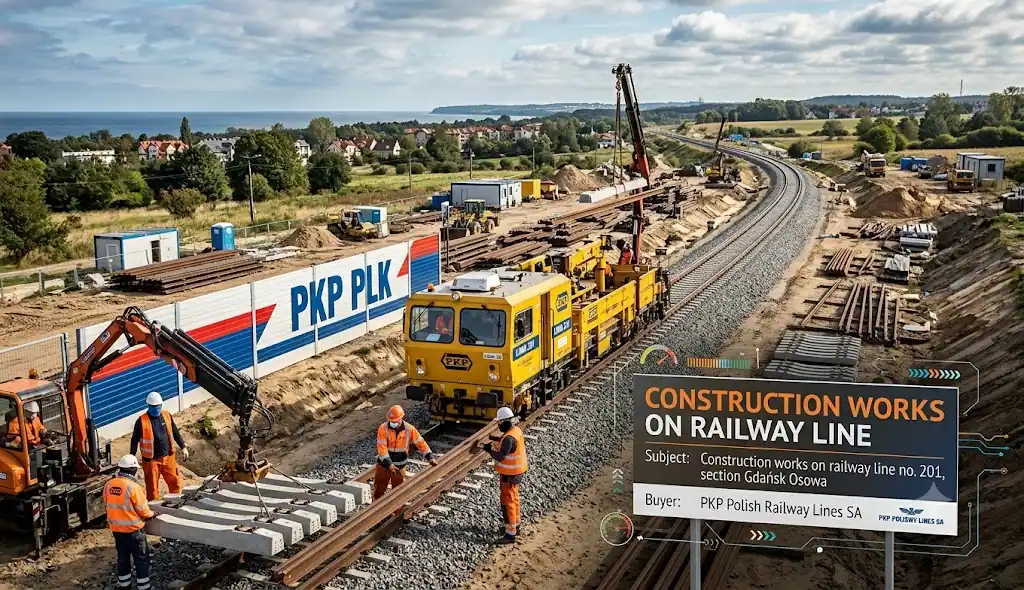
A consortium led by UNIBEP S.A. and including Track Tec Construction sp. z o.o. has been awarded a major design-and-build contract worth 874.1 million PLN to modernize a critical railway corridor in northern Poland. The project, commissioned by PKP Polskie Linie Kolejowe S.A., focuses on upgrading railway line 201 between Gdańsk Osowa and Gdynia Główna.
This strategic infrastructure investment aims to increase rail capacity, introduce a third track and modernize signalling systems across the densely populated Trójmiasto metropolitan area. The award follows a highly competitive open procedure that attracted ten bids from major construction and engineering firms, highlighting the consolidation of expertise required for complex national infrastructure projects.
Introduction
The modernization of Poland’s railway network represents a cornerstone of the country’s broader strategy to shift freight and passenger transport from congested roads to more sustainable and efficient rail corridors. The Trójmiasto region, encompassing Gdańsk, Gdynia and Sopot, is a vital economic hub that requires robust, high-capacity rail infrastructure to support its growing population and industrial base.
PKP Polskie Linie Kolejowe S.A. has initiated a comprehensive upgrade program to eliminate historical bottlenecks and improve travel times along the Baltic coast. The awarding of this 874.1 million PLN contract marks a significant milestone in the execution of the "Works on the Kościerzyna - Gdynia section" project.
By consolidating design and construction responsibilities into a single consortium, the contracting authority seeks to streamline project delivery and mitigate interface risks. This approach reflects a mature understanding of the complexities involved in upgrading active railway lines within dense urban environments.
Why This Contract Matters
This contract is fundamentally about unlocking latent capacity in one of Poland’s most congested railway corridors. The addition of a third track and the comprehensive overhaul of signalling and traffic control systems will dramatically improve the reliability and frequency of both regional passenger services and cross-border freight trains.
For the local economy, the reduction in transit times and the enhancement of rail freight reliability will strengthen the competitive advantage of the Gdańsk-Gdynia port complex. Efficient rail links are critical for the port to handle increasing cargo volumes and maintain its status as a primary logistics gateway for Central and Eastern Europe.
Furthermore, the project incorporates significant environmental and civil engineering components, including the demolition of obsolete structures and the implementation of modern noise barriers. The successful execution of this project will serve as a blueprint for subsequent modernization efforts along the broader Baltic coast rail network.
Contract Timeline
The procurement process culminated in the formal conclusion of the contract on August 24, 2026, following a rigorous evaluation of the submitted tenders. The official contract award notice was subsequently published in the Official Journal of the European Union on September 3, 2026, ensuring full transparency and compliance with EU procurement directives.
The project itself is slated for a substantial execution period of 69 months, reflecting the complexity of the civil engineering and railway systems integration required. This extended timeline allows for phased construction, minimizing disruption to existing rail services while the new infrastructure is brought online and certified.
Contract Overview
The procurement is structured as a comprehensive design-and-build contract, requiring the successful bidder to manage the project from initial engineering design through to final commissioning and handover. The scope encompasses a wide array of disciplines, including track construction, railway signalling, traction power systems, telecommunications and extensive civil engineering works.
The contractor is responsible for securing all necessary permits, updating existing project documentation and ensuring full compliance with Polish and European railway safety standards. This turnkey approach places the onus of technical optimization and delivery risk squarely on the shoulders of the awarded consortium.
Key Contract Details
| Contract Title | Design and construction works for Section C – construction works on railway line no. 201, Gdańsk Osowa – Gdynia Główna section |
| Contracting Authority | PKP Polskie Linie Kolejowe S.A. |
| Contract Value | 874,123,058.20 PLN |
| Procedure Type | Open Procedure |
| Number of Bids Received | 10 |
| Winning Consortium | UNIBEP S.A. (Leader) and Track Tec Construction sp. z o.o. |
| Contract Conclusion Date | August 24, 2026 |
| Estimated Duration | 69 Months |
| Main CPV Code | 45000000 (Construction work) |
Project Scope
The core of the project involves the modernization of the double-track railway line 201 between kilometer 191+731 and 205+200, alongside upgrades to line 202 between kilometer 16+900 and 21+500. A critical component of this scope is the construction of a new third track, designated as railway line 794, which will provide dedicated capacity to separate fast passenger services from heavy freight operations.
The works extend far beyond simple track laying, encompassing the strengthening of the track bed and subgrade, the construction of new engineering structures and the complete overhaul of the railway traffic control (SRK) and telemetry systems. The contractor must navigate complex hydrological challenges and implement robust traffic organization plans to maintain partial rail operations during the construction phases.
The contract also mandates extensive site preparation and environmental management, including the felling of trees, demolition of obsolete cubic structures and the relocation of non-traction utility lines. Additionally, the contracting authority has retained several optional rights, which may be activated during the contract period to expand the project's scope.
These optional rights include the update of the European Train Control System (ETCS) to Level 2 and the design and construction of two new passenger stops: "Gdynia Źródło Marii" and "Gdynia Mały Kack". An interface option is also available, allowing for seamless integration with future or adjacent infrastructure projects as the broader network evolves.
About the Contracting Authority
PKP Polskie Linie Kolejowe S.A. is the state-owned infrastructure manager responsible for the maintenance, modernization and development of the Polish national railway network. As a public undertaking, it operates under the regulatory framework of the EU Utilities Directive, managing billions of zlotys in annual infrastructure investments.
The organization plays a pivotal role in executing Poland’s National Railway Program, aiming to bring the country’s rail infrastructure up to modern European standards while ensuring the safe and efficient movement of goods and passengers.
About the Organisations Involved
PKP Polskie Linie Kolejowe S.A. is the primary contracting authority and buyer for this project. It is the state-owned entity responsible for managing and developing Poland's railway infrastructure, ensuring the strategic modernization of key transport corridors.
UNIBEP S.A. is the leader of the successful tendering consortium and a major Polish construction and development company. With a large-scale operational footprint, the company brings extensive experience in complex civil engineering and infrastructure projects, providing the financial and managerial backbone for this major railway contract.
Track Tec Construction sp. z o.o. is the consortium member partnering with the leader on this award. This entity specializes in railway construction and track-related engineering works, providing the highly specialized technical expertise required for the core railway systems integration and track laying components of the project.
Krajowa Izba Odwoławcza serves as the designated review organisation for this procurement. This independent body is responsible for adjudicating any legal challenges or appeals lodged by unsuccessful tenderers, ensuring the procurement process remains fair, transparent and compliant with Polish public procurement law.
Sąd Polubowny przy Prokuratorii Generalnej is the designated mediation organisation. This arbitration court provides a mechanism for resolving potential contractual disputes between the contracting authority and the contractor outside of the traditional, lengthier state court system, promoting efficient conflict resolution.
Publications Office of the European Union acts as the TED eSender for this notice. This institution is responsible for the official publication of procurement notices in the Supplement to the Official Journal of the European Union, guaranteeing continent-wide transparency and market access.
Procurement Analysis
The contracting authority utilized an open procedure, which maximized market participation and resulted in the receipt of ten distinct tenders. Notably, the award criteria were based entirely on price, carrying a 100% weighting, which is a bold strategy for a complex design-and-build railway contract.
This approach suggests that the technical specifications and functional requirements outlined in the tender documents were sufficiently rigorous to ensure a baseline of quality, allowing the authority to drive maximum financial efficiency. The absence of bids from micro, small, or medium-sized enterprises indicates that the scale and risk profile of the project naturally restricted competition to large, well-capitalized construction groups.
Additional Procurement Facts
The notice explicitly states that this specific procurement project is not financed with EU Funds, indicating that the capital is being sourced from the Polish state budget or the contracting authority's own financial resources. Furthermore, the procurement is not covered by the Government Procurement Agreement (GPA), reflecting its status as a domestic utility contract governed primarily by EU Directive 2014/25/EU and corresponding Polish national legislation.
Market & Industry Perspective
The Polish railway construction market is currently characterized by a high degree of consolidation, with a select group of large domestic contractors dominating major infrastructure tenders. The success of the UNIBEP S.A. and Track Tec Construction sp. z o.o. consortium highlights the market preference for joint ventures that combine broad civil engineering capacity with niche railway systems expertise.
International competition remains present but limited, as evidenced by only one tender received from another European Economic Area country. This dynamic suggests that foreign firms may find it challenging to compete without establishing strong local partnerships or joint ventures to navigate domestic regulatory and logistical landscapes.
Economic Significance
An investment of 874.1 million PLN represents a substantial injection of capital into the Pomeranian Voivodeship’s economy. The project will generate hundreds of direct and indirect jobs over its 69-month lifespan, stimulating demand for local construction materials, engineering services and specialized logistics.
Beyond the immediate construction phase, the long-term economic significance lies in the enhanced productivity of the regional transport network. By reducing delays and increasing freight capacity, the upgraded railway will lower logistics costs for businesses operating in and around the Port of Gdańsk, one of the largest and fastest-growing ports in the Baltic Sea.
Future Procurement Opportunities
The immediate future procurement opportunities lie within the contract itself, specifically the activation of the four optional rights retained by the contracting authority. These include the ETCS Level 2 system update and the construction of two new passenger stops, which will require additional design and construction resources from the incumbent consortium.
Beyond this specific contract, PKP Polskie Linie Kolejowe S.A. is likely to continue tendering subsequent sections of the Kościerzyna – Gdynia railway modernization program using similar design-and-build frameworks. Suppliers should monitor the authority’s long-term investment plans for adjacent rail corridors that will eventually connect to this newly upgraded segment.
Opportunities for Suppliers
While the main contract has been awarded to a consolidated consortium, significant opportunities exist for specialized subcontractors. Firms with expertise in environmental protection, specialized demolition, advanced telemetry installation and the construction of noise barriers can position themselves as tier-two suppliers to the winning consortium.
Additionally, manufacturers of railway signalling equipment and traction power components may find opportunities to supply materials through the consortium’s established procurement channels, provided they meet the stringent technical certifications required by the Polish railway authority.
What Businesses Should Watch
Industry observers should closely monitor the consortium’s ability to execute the complex "optimize and build" methodology within the dense urban environment of the Tri-City area. Any delays in securing environmental permits or coordinating with local municipal authorities could impact the project’s 69-month timeline.
Furthermore, businesses should watch for the activation of the optional rights, particularly the ETCS Level 2 upgrade, as this will signal a broader national push toward advanced, interoperable European railway signalling systems. The performance of this consortium will also set a benchmark for how PKP Polskie Linie Kolejowe S.A. evaluates and manages large-scale design-build contractors in future tenders.
PolandTenders.com Procurement Intelligence
This contract represents a clear and accelerating trend in European public infrastructure procurement: the shift toward comprehensive design-and-build contracts for complex railway projects. By bundling design, permitting and construction into a single agreement, public authorities transfer significant interface and delivery risk to the private sector, demanding higher levels of contractor maturity.
Strategically, this award is important because it demonstrates that Polish state-owned enterprises are willing to rely on 100% price-based evaluation criteria for highly complex works, provided the functional specifications are tightly controlled. This indicates a maturing market where the buyer trusts the baseline technical competence of pre-qualified large contractors to deliver on stringent operational requirements.
Suppliers can learn from this procurement that forming strategic consortiums is no longer optional but essential for winning mega-projects in the railway sector. The partnership between a large general contractor and a specialized railway firm proved to be the winning formula, balancing financial robustness with technical precision.
To position themselves for future contracts, suppliers must develop robust joint venture frameworks and invest in digital engineering capabilities, such as Building Information Modeling (BIM), which are increasingly critical for managing complex railway design and construction interfaces. Future contracts in this market are likely to evolve by incorporating even stricter environmental and sustainability criteria alongside the technical specifications.
As the European Union pushes for greener transport, we anticipate that future railway tenders will mandate higher percentages of recycled materials, stricter noise reduction standards and comprehensive carbon footprint reporting, even if the primary award criterion remains price. Suppliers who proactively develop sustainable construction methodologies will gain a distinct competitive advantage in upcoming bids.
Supplier Takeaways
- Consortium formation is essential for competing in large-scale railway design-and-build tenders.
- Price-only evaluation criteria are being used for complex projects when technical specifications are rigorously defined.
- Specialized subcontractors can still access value by targeting niche components like environmental management and telemetry.
- Understanding and preparing for optional contract rights is crucial for long-term revenue planning in infrastructure projects.
Key Takeaways
- A consortium led by UNIBEP S.A. and Track Tec Construction sp. z o.o. won the 874.1 million PLN contract.
- The project modernizes railway lines 201 and 202, including the addition of a third track in the Tri-City area.
- Ten bids were received, indicating strong competition among large construction firms.
- The contract duration is 69 months, with several optional rights for future expansion retained by the buyer.
- The award criteria were based 100% on price, reflecting confidence in the baseline technical requirements.
Conclusion
This contract represents a transformative investment in Poland’s northern railway infrastructure, promising enhanced capacity and reliability for decades to come. The successful partnership between UNIBEP S.A. and Track Tec Construction sp. z o.o. will be closely watched as a model for future large-scale, design-build railway projects in Central Europe.
Source: Tenders Electronic Daily (TED), Contract Award Notice 608368-2026, Official Journal of the European Union, published on 03/09/2026.
Frequently Asked Questions (FAQs)

Fresh and verified Tenders from Poland. Find, search and filter Tenders/Call for bids/RFIs/RFPs/RFQs/Auctions published by the government, public sector undertakings (PSUs) and private entities.
- 1,000+ Tenders
- Verified Tenders Only
- New Tenders Every Day
- Tenders Result Data
- Archive & Historical Tenders Access
- Consultants for RFI/RFP/RFQ
- Tender Notifications & Alerts
- Search, Sort, and Filter Tenders
- Bidding Assistance & Consulting
- Customer Support
- Publish your Tenders
- Export data to Excel
- API for Tender Data
- Tender Documents

Fill out the form below and you will receive a call from us within 24 hours.
Get FREE SAMPLE TENDERS from Poland in your email inbox.
Copyright © 2014-2026 PolandTenders.com. All Rights Reserved.