ZTM Warsaw Awards PLN 5.78M Software Subscription Contract
Winning B2B Enterprise IT Tenders, Public Transport Procurement, Software Licenses, and Eprocurement in Poland & Europe
Standfirst
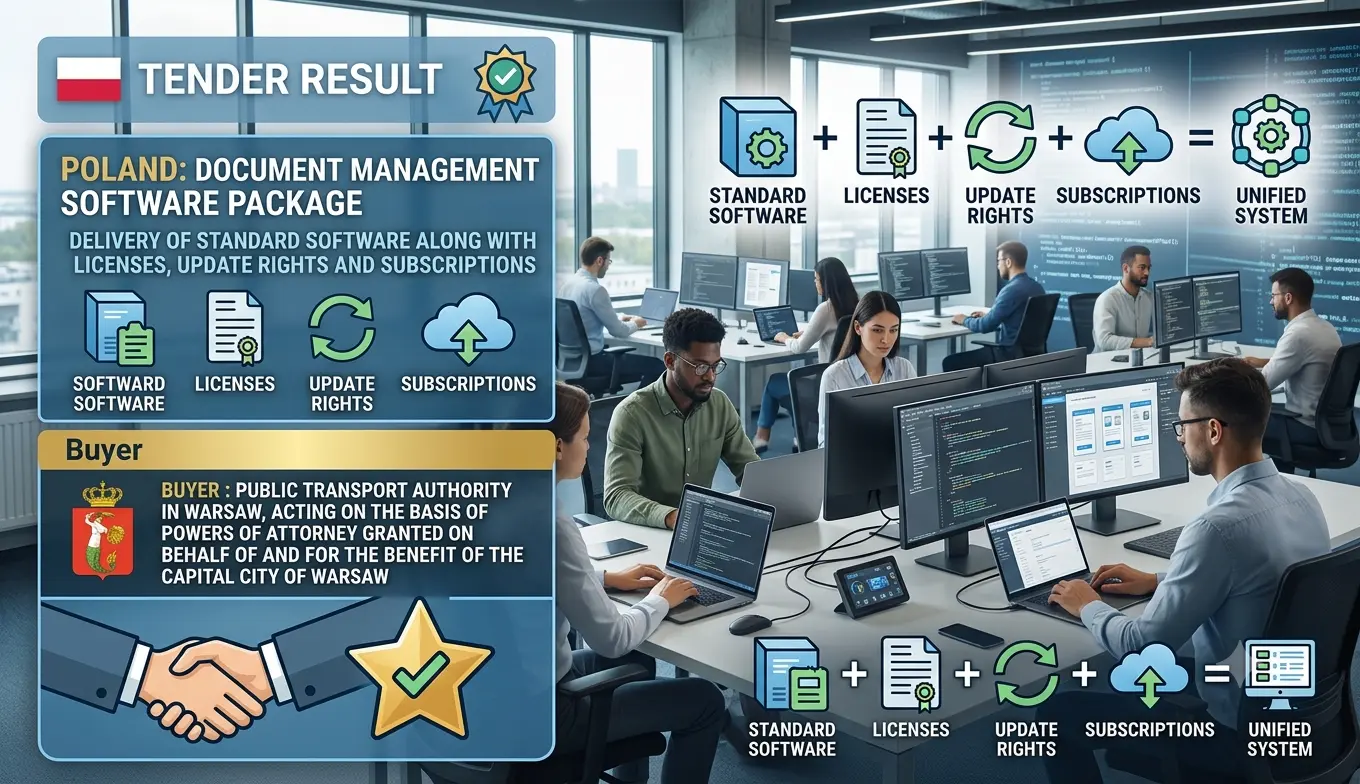
Warsaw's public transport authority has locked in a three-year software licensing and subscription arrangement to keep the digital backbone of its operations running. The contract, awarded to SPAN POLSKA Sp. z o.o., covers standard software, licences, update rights and subscriptions for the city's transport management body. The deal matters because it is not a one-off purchase: it is a recurring subscription model, and it shows how public transport operators are shifting from owning software to renting it.
The winning bid was PLN 5,780,061.60, narrowly beating a rival offer of PLN 5,829,026.40. Only two bids were received, both from large Polish companies, and price was the only award criterion. The contract runs for 36 months, starting from 1 November 2026, with an option for additional products during the first and second subscription periods.
Introduction
Public transport authorities across Europe are running increasingly complex digital operations. Timetables, vehicle scheduling, ticketing, passenger information and internal administration all depend on software that must be licensed, updated and supported continuously. Buying that software outright is no longer the norm. Subscription licensing has become the default model for many public buyers because it spreads costs, guarantees access to updates, and reduces the risk of running outdated systems.
The Zarząd Transportu Miejskiego w Warszawie, the body that manages Warsaw's bus and tram network, has just completed a procurement for exactly this kind of arrangement. The contract is for standard software, licences, update rights and subscriptions. It is a supplies contract, not a services contract, but the subscription structure means the authority is effectively paying for ongoing access rather than a permanent transfer of ownership.
This article examines what was bought, who won, how the procurement was structured, and what the award signals for suppliers and for the wider public transport software market.
Why This Contract Matters
Warsaw's tram and bus network is one of the largest urban transport systems in Central Europe. Keeping it running requires reliable software for planning, operations and administration. When that software is licensed on a subscription basis, the authority is not just buying a product. It is committing to a long-term relationship with a supplier that must keep the software current, secure and compatible with the authority's existing systems.
The contract also matters because of how it was procured. The authority used an open procedure under the EU's utilities directive, which governs procurement by entities operating in the water, energy, transport and postal services sectors. That choice reflects the fact that the transport authority is a utility-sector buyer, not a general public administration buyer. The rules are slightly different, and suppliers need to understand them.
Finally, the contract matters because of its size relative to the market. A PLN 5.78 million subscription deal over three years is significant for the Polish software licensing sector. It shows that public transport authorities are willing to pay for continuity and compliance, not just for the cheapest available product.
Contract Timeline
- Previous notice: 551996-2026
- Winner selected: 10 September 2026
- Contract concluded: 25 September 2026
- Notice dispatched: 29 September 2026
- Notice published: 30 September 2026
- Subscription period begins: 1 November 2026
- Subscription duration: 36 months
Contract Overview
The contract is for the supply of standard software, together with licences, update rights and subscriptions. It is a single-lot procurement. The authority has structured it as a basic scope plus an option right.
The basic scope covers delivery and activation of subscriptions. The first subscription period starts on 1 November 2026. If the contract is signed after that date, the supplier must ensure continuity of the authority's licensing rights in line with the manufacturer's licensing rules. Subsequent subscription periods begin immediately after the previous one ends, for a total subscription period of 36 months.
The option right covers additional product deliveries during the first and second subscription periods. The authority has explicitly stated that it does not guarantee purchases under the option right. Option purchases will happen as needed and as budget allows. Unit prices for subscription products under the option must be identical to the unit prices for the corresponding basic products in the supplier's offer.
The authority has also specified that the supplier must hold an official document from Microsoft confirming Licensing Solution Provider (LSP) status in Poland. If equivalent products are offered, the supplier must hold an official document from the manufacturer confirming official distributor status in Poland. The supplier must also declare and guarantee that ICT products and services, including cloud services, comply with Poland's National Cybersecurity System Act.
Key Contract Details
| Notice ID | 673943-2026 |
| OJ S issue | 189/2026 |
| Publication date | 30 September 2026 |
| Contracting authority | Zarząd Transportu Miejskiego w Warszawie, acting on behalf of the City of Warsaw |
| Contract type | Supplies |
| Main CPV code | 48311000 – Document management software package |
| Procedure type | Open procedure |
| Legal basis | Directive 2014/25/EU; Polish Public Procurement Law (PZP) |
| Lot | LOT-0001 |
| Winner | SPAN POLSKA Sp. z o.o. |
| Winning bid | PLN 5,780,061.60 |
| Non-winning bidder | A.P.N. PROMISE S.A. – PLN 5,829,026.40 |
| Number of bids | 2 |
| Award criterion | Price – 100% |
| Contract duration | 36 months |
| Subscription start | 1 November 2026 |
| Options | Additional deliveries in first and second subscription periods; not guaranteed |
| Framework agreement | No |
| Dynamic purchasing system | No |
| GPA covered | No |
| Subcontracting | No |
| SME participation | 0 SME tenders received |
| Contract identifier | ZTM/UM/0541/2026/EU |
Project Scope
The scope is the supply of standard software, licences, update rights and subscriptions. The notice does not disclose the specific software products or the manufacturer, beyond the requirement that the supplier must be a Microsoft Licensing Solution Provider or an equivalent authorised distributor.
The authority has built in a detailed equivalence regime. Where the specification refers to trademarks or specific products, the authority allows equivalent products to be offered. However, the burden of proving equivalence falls on the bidder. Bidders offering equivalent products must submit one copy of the equivalent product with their offer, along with instructions on how to access it. The authority will then test the product in production conditions within its existing system, using its own peripherals, spreadsheets, databases and files, and connecting to its Active Directory service. A negative test result leads to rejection of the offer.
This is a rigorous approach. It means bidders cannot simply claim equivalence on paper. They must demonstrate it in the authority's own environment. That raises the cost of bidding for suppliers offering alternatives to the named products, and it favours incumbents or suppliers with deep familiarity with the authority's systems.
The subscription structure is also notable. The authority is not buying perpetual licences. It is buying access for 36 months, with the option to buy more during the first two subscription periods. This aligns with the broader shift in enterprise software toward subscription and cloud-based models.
About the Contracting Authority
The Zarząd Transportu Miejskiego w Warszawie is the public transport authority for Warsaw. It manages the city's bus, tram and trolleybus network. It operates under delegated authority from the City of Warsaw, meaning it acts on behalf of the municipality in procurement matters.
The authority is classified as a local authority buyer with general public services activity, but it also has a specific activity classification for urban railway, tramway, trolleybus or bus services. That dual classification matters because it determines which procurement rules apply. As a utility-sector buyer, the authority operates under Directive 2014/25/EU rather than the general public sector directive.
The authority's registered office is at ul. Grochowska 316/320, 03-839 Warszawa. Its procurement department is the Dział Zamówień Publicznych. It uses an electronic procurement platform at ztmwaw.ezamawiajacy.pl.
About the Organisations Involved
Zarząd Transportu Miejskiego w Warszawie
As the contracting authority, the Zarząd Transportu Miejskiego w Warszawie is the buyer and the organisation signing the contract. It is also the organisation providing additional information about the procurement procedure and offline access to the procurement documents. Its role is central: it defined the scope, ran the procedure, evaluated the bids and will manage the contract.
The authority acts on the basis of powers of attorney granted by the City of Warsaw. This means that while the authority is the operational buyer, the legal and financial responsibility ultimately rests with the municipality.
SPAN POLSKA Sp. z o.o.
SPAN POLSKA Sp. z o.o. is the winning bidder. It is classified as a large economic operator. Its registered office is at Domaniewska 39A, 00-078 Warszawa. Its registration number is 5253047595.
The notice confirms that SPAN POLSKA submitted the winning tender for LOT-0001 with a value of PLN 5,780,061.60. It was ranked first. The company has no subcontracting arrangements for this contract, according to the notice.
SPAN POLSKA is a Polish company. The notice does not disclose its parent company, its ownership structure or its specific capabilities beyond its status as a large economic operator and its winning bid. It is a tenderer and the winner of LOT-0001.
A.P.N. PROMISE S.A.
A.P.N. PROMISE S.A. is the non-winning tenderer. It submitted the second-ranked bid for LOT-0001, valued at PLN 5,829,026.40. Its registered office is at ul. Domaniewska 44a, 02-672 Warszawa. Its registration number is 5210088682.
Like SPAN POLSKA, A.P.N. PROMISE is a Polish company based in Warsaw. The notice does not disclose its size classification, but it is listed as a tenderer. It did not win the contract. The difference between the two bids was PLN 48,964.80, or approximately 0.84% of the winning bid.
That narrow margin is significant. It shows that the competition was close on price, and that the winner was not able to command a large premium. In a price-only competition, a sub-1% difference decided the outcome.
Krajowa Izba Odwoławcza
The Krajowa Izba Odwoławcza, or National Appeal Chamber, is Poland's review body for public procurement disputes. It is listed in the notice as the mediation organisation, the review organisation, and the organisation providing more information on review procedures.
Its role is to hear appeals from bidders who believe the procurement was conducted improperly. The notice states that bidders who have or had an interest in obtaining the contract, and who have suffered or may suffer loss as a result of a breach of the Polish Public Procurement Law, have access to legal remedies under Title XIX of the PZP. The Krajowa Izba Odwoławcza is the body that handles those remedies.
Its registered office is at ul. Postępu 17A, 02-676 Warszawa. Its registration number is 5262239325.
Publications Office of the European Union
The Publications Office of the European Union is listed as the TED eSender. Its role is administrative: it operates Tenders Electronic Daily, the official journal supplement where EU procurement notices are published. It is based in Luxembourg. It is not involved in the procurement itself.
Procurement Analysis
The procurement was conducted as an open procedure under Directive 2014/25/EU and the Polish Public Procurement Law. The authority used the so-called reversed procedure under Article 139(1) of the PZP. In a reversed procedure, the authority first evaluates the bids and then checks whether the winning bidder meets the qualification criteria. This can speed up the process, but it also means that bidders who do not meet the criteria may have their bids evaluated before being excluded.
The procedure was not accelerated. The contract was awarded on the basis of price alone, with a weighting of 100%. No technical quality criterion was applied at the award stage. However, technical compliance was enforced through the equivalence testing regime. Bidders offering equivalent products had to pass production tests in the authority's environment. That is a de facto technical barrier, even though the formal award criterion was price only.
Two bids were received. Both were submitted electronically. Neither came from an SME. Neither came from a tenderer registered in another European Economic Area country or outside the EEA. No bids were rejected as inadmissible or abnormally low. The competition was therefore limited to two large Polish companies.
The low number of bids is notable. For a contract of this size, in a market with many software licensing providers, two bids is a thin field. The equivalence testing requirement may have deterred some potential bidders. The requirement to hold Microsoft LSP status or equivalent distributor status may also have narrowed the field. These are not unusual requirements for Microsoft licensing contracts, but they do restrict who can bid.
The contract is not covered by the Government Procurement Agreement. That means it is not open to suppliers from GPA member countries on the same terms as EU suppliers. However, the notice does not explain why the GPA does not apply. The authority has not disclosed this information.
The contract is not a framework agreement. It is a direct contract with a single supplier. There is no dynamic purchasing system. There are no renewals beyond the initial 36-month subscription period, though the option right allows additional purchases within that period.
The value of all contracts awarded in this notice is PLN 5,780,061.60. That is the value of the winning tender. The notice does not disclose an estimated value, so it is not possible to compare the awarded value to the authority's pre-tender estimate.
Additional Procurement Facts
- Legal basis: Directive 2014/25/EU and the Polish Public Procurement Law (PZP). The procedure is a sectoral procurement conducted as an open tender under Article 132 et seq. in conjunction with Article 376(1)(1) and Article 378 of the PZP, with a value equal to or greater than the thresholds set out in regulations issued under Article 3(2) of the PZP.
- Reversed procedure: The authority applied the reversed procedure under Article 139(1) of the PZP.
- Performance security: The winning bidder must provide a performance security of 3% of the gross contract value for the basic scope, no later than the date of contract signature.
- Cyber security: The supplier must declare and guarantee that ICT products and services, including cloud services, comply with the current requirements of Poland's National Cybersecurity System Act.
- Equivalence testing: Bidders offering equivalent products must submit one copy of the product with their offer and allow the authority to test it in production conditions. A negative test result leads to rejection under Article 226(1)(5) of the PZP.
- Option right: The authority does not guarantee purchases under the option right. Option purchases depend on need and budget availability.
- Unit price consistency: Unit prices for option products must be identical to unit prices for corresponding basic products in the winning offer.
- Subcontracting: The winning tenderer declared no subcontracting.
- SME participation: No SME tenders were received.
- Cross-border participation: No tenders from other EEA countries or non-EEA countries were received.
- Review body: Krajowa Izba Odwoławcza.
Market & Industry Perspective
The market for public sector software licensing in Poland is dominated by a small number of large resellers and licensing specialists. Microsoft licensing, in particular, is channelled through a limited set of authorised Licensing Solution Providers. The requirement to hold LSP status is therefore a significant barrier to entry for smaller resellers or generalist IT suppliers.
The contract also reflects a broader trend: public transport authorities are moving from perpetual licences to subscription models. This shift has implications for suppliers. Subscription models generate recurring revenue, but they also require ongoing customer relationship management, compliance monitoring and update delivery. They are not a one-time sale.
For software manufacturers, subscription models provide predictable revenue streams. For public buyers, they provide access to the latest versions and reduce the risk of running unsupported software. For resellers, they require a different business model: less emphasis on upfront licence sales, more emphasis on service, support and compliance.
The equivalence testing regime in this procurement is also notable. It shows that the authority is not simply accepting whatever product the winner offers. It is insisting on demonstrated compatibility with its existing systems. That is a form of technical risk management. It also means that bidders must invest in demonstrating equivalence, which raises the cost of bidding and may reduce competition over time.
The fact that only two bids were received, both from large Polish companies, suggests that the market for this kind of contract is concentrated. That concentration may be a concern for the authority in the long run, because limited competition can lead to higher prices. However, the narrow price gap between the two bids suggests that the two bidders were competing closely.
Economic Significance
A PLN 5.78 million contract over three years is a modest but meaningful piece of public spending. It represents a recurring commitment to software licensing and support for Warsaw's transport network. The money flows to a Polish company, SPAN POLSKA, which is classified as a large economic operator. The contract therefore supports employment and economic activity in Poland's IT sector.
The contract also has an indirect economic effect. Reliable software is essential for running a transport network that moves millions of passengers. If software fails, timetables are disrupted, passenger information goes down, and operational efficiency suffers. The economic cost of software failure in a transport network can far exceed the cost of the software itself.
The subscription model also has economic implications for the authority's budgeting. Instead of a large upfront capital expenditure, the authority spreads the cost over 36 months. That makes budgeting more predictable, but it also creates a recurring obligation that must be funded year after year. If the authority's budget tightens, the subscription still has to be paid, or the software access is lost.
The option right gives the authority some flexibility. It can buy additional products if needed, at pre-agreed unit prices. But it does not have to. That is a sensible way to manage uncertainty, but it also means the supplier cannot count on the option revenue.
Future Procurement Opportunities
The most obvious future opportunity is the renewal of this contract. The subscription period is 36 months, with no renewals beyond that. That means the authority will need to re-procure the software licensing and subscription arrangement before the current contract expires. If the authority follows a similar timeline, a new procurement could be expected in 2029.
There may also be opportunities arising from the option right. The authority has reserved the right to buy additional products during the first and second subscription periods. If those options are exercised, they will be supplied by SPAN POLSKA at the unit prices in its offer. Other suppliers cannot compete for that option work.
Beyond this specific contract, the authority may have future needs for related software, integration services or support. The notice does not disclose any pipeline of future contracts, but the authority's ongoing digital operations will require ongoing software investment. Suppliers should monitor the authority's buyer profile at ztmwaw.ezamawiajacy.pl for future notices.
There is also a broader opportunity in the Polish public transport sector. Other transport authorities in Poland may be considering similar subscription-based software licensing arrangements. Suppliers that can demonstrate success with Warsaw's authority may be well positioned to win work elsewhere.
Opportunities for Suppliers
- Licensing solution providers: Companies with Microsoft LSP status or equivalent distributor status are best positioned to bid for similar contracts. The requirement is a significant barrier to entry for others.
- Equivalence specialists: Suppliers offering equivalent products can compete, but they must be prepared to demonstrate equivalence in the authority's production environment. That requires technical depth and a willingness to invest in testing.
- Cybersecurity compliance: Suppliers must be able to guarantee compliance with Poland's National Cybersecurity System Act. That is a non-negotiable requirement for ICT and cloud services.
- Subscription management: Suppliers need to be able to manage subscription activation, continuity and renewal. The contract requires continuity of licensing rights if the contract is signed after the subscription start date.
- Price competitiveness: With price as the only award criterion, suppliers must be able to offer competitive pricing. The winning margin in this case was less than 1%, so there is little room for pricing error.
- Monitoring the buyer: Suppliers should monitor the authority's buyer profile for future notices. The authority uses an electronic procurement platform, and future opportunities will be published there.
What Businesses Should Watch
- Whether the option right is exercised: The authority has reserved the right to buy additional products during the first and second subscription periods. If it does, that will be additional revenue for SPAN POLSKA.
- Whether the contract is renewed: The subscription period is 36 months. The authority will need to decide whether to renew, re-procure or change its approach. That decision will create a new procurement opportunity.
- Whether competition increases: Only two bids were received. If the authority wants more competition, it may need to adjust its requirements. Suppliers should watch for any changes in future notices.
- Whether other Polish transport authorities follow suit: If Warsaw's subscription model works well, other authorities may adopt similar arrangements. That could create a pipeline of similar contracts.
- Whether Microsoft's licensing model changes: The contract is built around Microsoft LSP status. If Microsoft changes its licensing model or its partner requirements, that could affect future procurements.
- Whether cybersecurity requirements tighten: The contract requires compliance with Poland's National Cybersecurity System Act. If that law is amended or tightened, future contracts may have stricter requirements.
PolandTenders.com Procurement Intelligence
This contract is a clear example of a broader procurement trend: the shift from perpetual software licences to subscription-based access. Public buyers are increasingly reluctant to make large upfront capital investments in software that may become outdated. Instead, they are paying for ongoing access, updates and support. That shift changes the economics of public sector software procurement. It favours suppliers that can manage recurring relationships, not just one-off sales.
The award is strategically important because it shows how a major Polish transport authority structures its software licensing. The authority did not simply buy the cheapest product. It built in equivalence testing, cybersecurity compliance and licensing status requirements. Those requirements narrow the field of eligible bidders. The fact that only two bids were received, both from large Polish companies, suggests that the market for this kind of contract is concentrated. That concentration may be efficient in the short term, but it carries long-term risks for competition.
Suppliers can learn several things from this procurement. First, licensing status matters. Without Microsoft LSP status or equivalent distributor status, a supplier cannot bid. Second, equivalence is not a paper exercise. It must be demonstrated in the buyer's production environment. Third, price is the only award criterion, so suppliers must be able to compete on price without sacrificing compliance. Fourth, subcontracting is not always used, even on large contracts. The winner declared no subcontracting.
Suppliers should position themselves accordingly. If they want to compete for similar contracts, they need to secure the necessary licensing status, build the technical capability to demonstrate equivalence, and ensure they can comply with cybersecurity requirements. They should also monitor the buyer's future notices, because the renewal of this contract will be a significant opportunity.
Future contracts in this market are likely to evolve in two directions. First, more public transport authorities may move to subscription models, creating a pipeline of similar contracts. Second, the technical requirements may become more demanding, particularly around cybersecurity and system integration. Suppliers that can meet those requirements will be well positioned. Suppliers that cannot will be excluded.
The contract also highlights the importance of the reversed procedure. By evaluating bids before checking qualifications, the authority may have sped up the process. But it also means that bidders must be confident in their qualification status before bidding. A bid that is evaluated but then excluded because the bidder does not meet the qualification criteria is a wasted effort.
Finally, the contract shows that public procurement is not just about price. Even when price is the only formal award criterion, technical compliance, licensing status and equivalence testing determine who can bid and who can win. Suppliers that understand this will be better prepared for future opportunities.
Supplier Takeaways
- Subscription-based software licensing is becoming the norm in public transport procurement. Suppliers must be able to manage recurring revenue models, not just one-off sales.
- Licensing status is a hard requirement. Microsoft LSP status or equivalent distributor status is necessary to bid for this kind of contract.
- Equivalence testing is rigorous. Bidders offering alternatives to named products must demonstrate equivalence in the buyer's production environment.
- Price is the only award criterion, but technical compliance is enforced through testing and qualification requirements.
- Cybersecurity compliance is mandatory. Suppliers must be able to guarantee compliance with Poland's National Cybersecurity System Act.
- Competition was limited to two large Polish companies. The market for this kind of contract is concentrated.
- The winning margin was less than 1%. Price competition was tight.
- The option right does not guarantee additional revenue. Suppliers should not count on option purchases when pricing their bids.
- The contract will need to be renewed or re-procured after 36 months. That creates a future opportunity.
- Monitoring the buyer's procurement platform is essential for identifying future opportunities.
Key Takeaways
- Warsaw's transport authority awarded a 36-month software licensing and subscription contract worth PLN 5,780,061.60 to SPAN POLSKA Sp. z o.o.
- The contract covers standard software, licences, update rights and subscriptions, with an option for additional products during the first and second subscription periods.
- Only two bids were received, both from large Polish companies. A.P.N. PROMISE S.A. submitted the second-ranked bid at PLN 5,829,026.40.
- Price was the only award criterion, weighted at 100%.
- The procurement was conducted as an open procedure under Directive 2014/25/EU and the Polish Public Procurement Law, using the reversed procedure.
- The contract is not a framework agreement and is not covered by the Government Procurement Agreement.
- The supplier must hold Microsoft LSP status or equivalent distributor status and must comply with Poland's National Cybersecurity System Act.
- Equivalence testing in the buyer's production environment is required for alternative products.
- The subscription period begins on 1 November 2026 and runs for 36 months.
- The contract will create a future re-procurement opportunity when the subscription period ends.
Conclusion
Warsaw's public transport authority has taken a pragmatic approach to software licensing. It has locked in a 36-month subscription with a single supplier, at a price that was narrowly competitive. The contract ensures continuity of access to essential software, with update rights and the option to buy more if needed.
The procurement was structured to protect the authority's technical environment. Equivalence testing, licensing status requirements and cybersecurity compliance were all built in. Those requirements narrowed the field to two large Polish companies. The winner, SPAN POLSKA, offered the lower price and secured the contract.
The contract is not large by European standards, but it is significant for the Polish public transport software market. It shows that subscription licensing is now the default model for public transport authorities. It also shows that technical compliance and licensing status matter as much as price, even when price is the only formal award criterion.
For suppliers, the message is clear: secure the necessary licensing status, build the technical capability to demonstrate equivalence, and be ready to compete on price. For the authority, the challenge will be to ensure that future procurements attract enough competition to keep prices competitive. With only two bidders this time, that is a question worth watching.
Source: Tenders Electronic Daily (TED), Contract Award Notice 673943-2026, Official Journal of the European Union, OJ S 189/2026, published on 30 September 2026.
Frequently Asked Questions (FAQs)

Fresh and verified Tenders from Poland. Find, search and filter Tenders/Call for bids/RFIs/RFPs/RFQs/Auctions published by the government, public sector undertakings (PSUs) and private entities.
- 1,000+ Tenders
- Verified Tenders Only
- New Tenders Every Day
- Tenders Result Data
- Archive & Historical Tenders Access
- Consultants for RFI/RFP/RFQ
- Tender Notifications & Alerts
- Search, Sort, and Filter Tenders
- Bidding Assistance & Consulting
- Customer Support
- Publish your Tenders
- Export data to Excel
- API for Tender Data
- Tender Documents

Fill out the form below and you will receive a call from us within 24 hours.
Get FREE SAMPLE TENDERS from Poland in your email inbox.
Copyright © 2014-2026 PolandTenders.com. All Rights Reserved.