Gmina Zawiercie Awards PLN 2.66 Million Public Solar Network Contract
Winning B2B Renewable Energy Tenders, Photovoltaic Installations, Energy Storage, and Eprocurement in Poland & Europe
Standfirst:
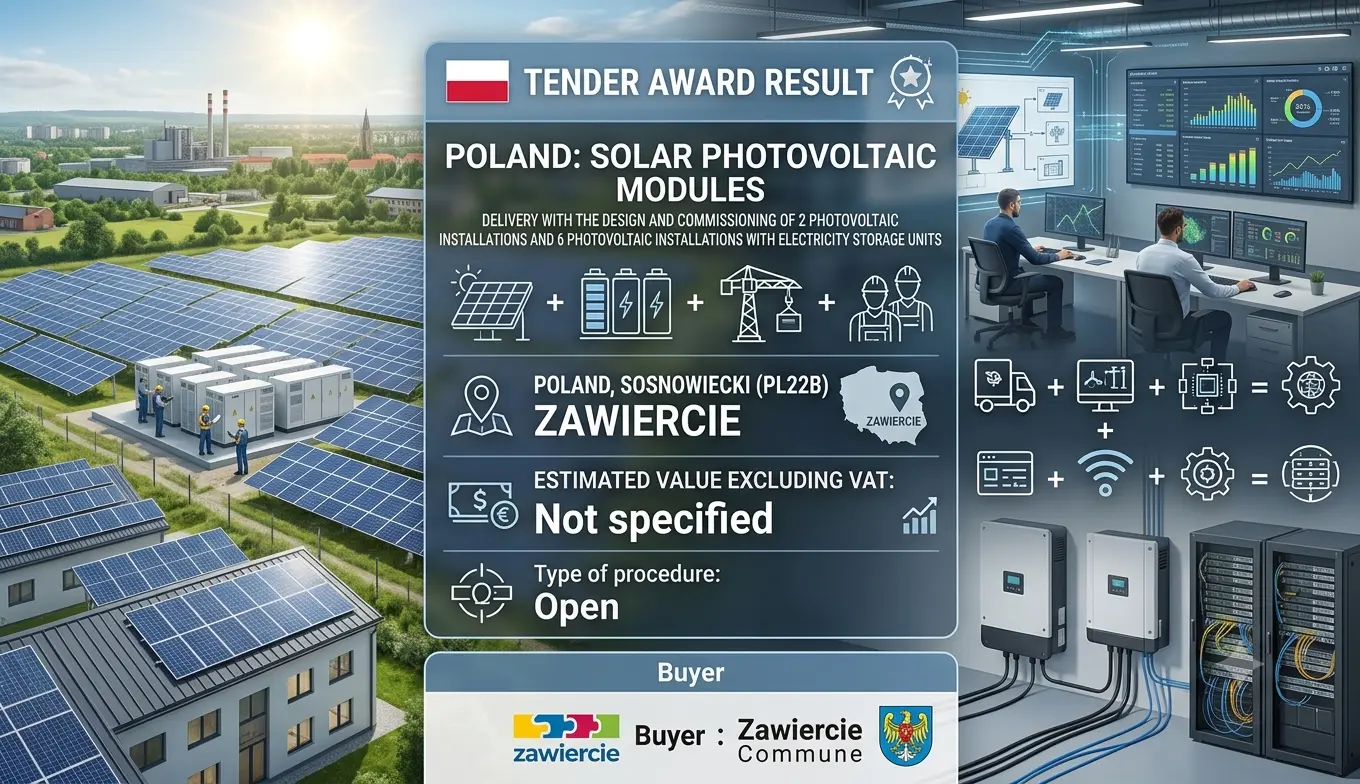
The Polish municipality of Zawiercie has awarded a contract to design, supply, install and commission eight solar photovoltaic installations, six of which include battery energy storage. The contract went to EkoEnergia Polska sp. z o.o., a small Warsaw-based company, at a tender value of PLN 2,655,619.06. Ten bids were received, all from SMEs, making this one of the more competitive renewable energy procurements. The installations will power a town hall, three primary schools, a fire station, a heritage building, a cemetery and a municipal housing management office.
Introduction
Municipalities across Europe are under pressure to cut energy costs and reduce carbon emissions at the same time. For many, the most practical route is to generate their own electricity on the buildings they already own. Schools, town halls, fire stations and maintenance depots all have roofs or land that can host solar panels. Adding battery storage lets a municipality use that electricity when it needs it rather than only when the sun shines.
The Gmina Zawiercie, a municipality in southern Poland, has taken that approach at scale. It has awarded a contract to design, build and commission eight separate photovoltaic installations across publicly owned buildings, six of which will be paired with battery energy storage systems. The total installed capacity is at least 297.12 kWp. The project is being carried out under the banner of developing distributed renewable energy for public buildings in the municipality.
The contract is funded in part by EU funds, which is significant. It shows how EU cohesion and energy transition funding is being channelled into practical, locally visible projects rather than only large-scale infrastructure. It also shows that Poland's small and medium-sized renewable energy contractors are actively competing for this work.
Why This Contract Matters
This contract matters because it is a template for how small and medium-sized municipalities can decarbonise their building stock. Rather than procuring one large installation, Zawiercie has bundled eight smaller installations into a single contract, each tailored to the building it serves. That approach spreads the benefit across the community and gives the municipality a single point of accountability for design, installation and commissioning.
It also matters because of the storage component. Six of the eight installations include battery energy storage, with capacities ranging from 30 kWh at the municipal cemetery to between 290 kWh and 300 kWh at the town hall. Storage changes the economics of solar for a municipality. It allows excess generation to be used in the evening or during peak demand, reducing reliance on grid electricity and improving the resilience of the buildings concerned.
The competition is notable. Ten bids were received, all from micro, small or medium-sized enterprises. That is a healthy outcome. It suggests that the contract was attractive to the Polish SME market and that the requirements were not drawn so tightly that only one or two suppliers could respond. The winning tender, however, came in above the value recorded for all contracts awarded in the notice, a discrepancy that the notice does not explain.
Contract Timeline
- Previous notice: 112824-2026
- Contract concluded: 25 September 2026
- Notice dispatched: 2 October 2026
- Notice published: 5 October 2026
- Estimated duration: 3 months
Contract Overview
The contract covers the design, supply, installation and commissioning of two photovoltaic installations without storage and six photovoltaic installations with battery energy storage. It is a single-lot procurement, identified as LOT-0001, with the internal identifier ZP.271.89.2025.AS.
The main nature of the contract is supplies, classified under CPV 09331200 (solar photovoltaic modules). Additional classifications cover building installation work, electrical installation work, installation services, engineering design services, site preparation work, solar installation, electrical machinery and apparatus, architectural services, building construction work and dismantling works. This is a broad scope that reflects the fact that the contractor must handle everything from design and permitting through to commissioning and handover.
The place of performance is the municipality of Zawiercie, postcode 42-400, in the Sosnowiecki NUTS region (PL22B). The procurement was conducted as an open procedure under Directive 2014/24/EU. It is not a framework agreement and does not use a dynamic purchasing system. It is covered by the Government Procurement Agreement and is fully or partially financed with EU funds.
Key Contract Details
| Notice ID | 683932-2026 |
| OJ S issue | 192/2026 |
| Publication date | 5 October 2026 |
| Contracting authority | Gmina Zawiercie |
| Contract type | Supplies |
| Main CPV code | 09331200 – Solar photovoltaic modules |
| Procedure type | Open procedure |
| Legal basis | Directive 2014/24/EU |
| Lot | LOT-0001 |
| Winner | EkoEnergia Polska sp. z o.o. |
| Value of the tender | PLN 2,655,619.06 |
| Value of all contracts awarded in this notice | PLN 2,174,503.47 |
| Number of bids | 10 |
| Award criteria | Gross offer price – 60 points; warranty period – 20 points; fault removal time – 20 points |
| Estimated duration | 3 months |
| Framework agreement | No |
| Dynamic purchasing system | No |
| EU funding | Yes – fully or partially financed with EU funds |
| GPA covered | Yes |
| Subcontracting | No |
| SME participation | 10 SME tenders received |
| Contract identifier | 669/2026 |
Project Scope
The scope is unusually detailed and site-specific. The contractor must design, supply, install and commission eight photovoltaic installations across municipal buildings, with battery storage at six of them. The total minimum capacity is 297.12 kWp, distributed across the sites as follows.
- OSP w Skarżycach (fire station), ul. Skarżycka 4: minimum 2.40 kWp on the roof, no storage.
- Pałacyk nad Wartą (heritage building), ul. Filaretów 1: minimum 6.24 kWp on the roof, no storage.
- Urząd Miejski w Zawierciu (town hall), ul. Leśna 2: minimum 99.84 kWp on the roof, with storage of not less than 290 kWh and not more than 300 kWh, mounted externally. Maximum capacity not greater than 100 kW.
- Szkoła Podstawowa nr 3 (primary school), ul. M. Skłodowskiej-Curie 16: minimum 41.28 kWp on the roof, with 80 kWh storage inside the building.
- Szkoła Podstawowa nr 6 (primary school), ul. Wierzbowa 4: minimum 31.68 kWp on the roof, with 60 kWh storage inside the building.
- Szkoła Podstawowa nr 7 (primary school), ul. Oświatowa 55: minimum 55.68 kWp on the roof, with 110 kWh storage inside the building.
- Cmentarz Komunalny (municipal cemetery), ul. Przyjaźni 184: minimum 17.28 kWp on the ground, with 30 kWh storage inside the building.
- ZGM w Zawierciu (municipal housing management), ul. Towarowa 30: minimum 42.72 kWp on the roof, with 90 kWh storage in an internal technical room.
The work includes a wide range of tasks. The contractor must inventory the existing electrical installations, obtain all necessary permits and decisions, including grid connection conditions and building permits, and prepare and agree the design documentation with the municipality. It must modernise and equip the main distribution boards, install mounting structures and PV modules, install inverters and battery storage, lay DC and AC cabling, connect the PV installation to the building's main distribution board, provide lightning protection, and for ground-mounted installations, build a fence with a technical entrance.
Additional tasks include sealing and post-installation repairs, commissioning and adjustment, labelling of distribution boards and cable joints, electrical measurements, training for the municipality's staff and users, notification of the micro-installation to the energy company, submission of the fire-safety-approved design to the relevant fire service unit, and preparation of as-built documentation.
The notice does not disclose the specific PV module brands, inverter models or battery storage products to be used. The contracting authority has not disclosed this information.
About the Contracting Authority
The buyer is the Gmina Zawiercie, a municipality in the Silesian Voivodeship of southern Poland. It is classified as a local authority with general public services activity. Its registration number is 276258871, and its procurement department is the Wydział Zamówień Publicznych (Public Procurement Department).
The municipality's contact points for this procurement are Jarosław Felczuk and Anna Siejka. Its email address is zamowieniapubliczne@zawiercie.eu, and its telephone number is +48 32 494 12 52. Its website is hosted at zawiercie.bip.net.pl, and it uses the Logintrade platform for electronic procurement at zawiercie.logintrade.net.
The Gmina Zawiercie is both the buyer and the entity responsible for the project. It is the beneficiary of the EU funding that supports the installations. Its role is to define the requirements, run the procurement, evaluate the ten bids and conclude the contract with the winner. It will also manage the project during construction and operate the installations afterwards.
About the Organisations Involved
Gmina Zawiercie
The Gmina Zawiercie is the contracting authority. It is a Polish municipality responsible for local public services, including schools, municipal buildings, cemeteries and housing management. Its role in this procurement is as buyer and beneficiary of the EU funding.
It is registered in Zawiercie, postcode 42-400, with registration number 276258871. Its procurement department handles public tenders on its behalf. The municipality has chosen to bundle eight separate installations into a single contract, which simplifies management but places a significant coordination burden on the winning contractor.
EkoEnergia Polska sp. z o.o.
EkoEnergia Polska sp. z o.o. is the winning bidder. It is classified as a small economic operator. Its registration number is 9591953988, and its registered office is in Warszawa, postcode 00-133, in the Miasto Warszawa NUTS region (PL911).
The company submitted the winning tender for LOT-0001. The value of the tender is recorded as PLN 2,655,619.06. The notice records that the company declared no subcontracting, meaning it will deliver the full scope itself. The notice does not disclose the company's technical approach, the products it proposed, or how it will manage eight simultaneous installations across the municipality. The contracting authority has not disclosed this information.
It is worth noting that the company is based in Warsaw, not in Zawiercie or the surrounding region. That is not unusual in Polish public procurement, but it does mean the municipality will be relying on a contractor from outside the local area.
Krajowa Izba Odwoławcza
The Krajowa Izba Odwoławcza (National Appeal Chamber) is Poland's central review body for public procurement disputes. It is listed as the review organisation and the organisation providing more information on review procedures. Its registration number is 5262239325, and its address is ul. Postępu 17a, Warszawa, postcode 02-676.
Its role is to hear appeals from bidders who believe a procurement has been conducted improperly. The notice sets out the review rules in considerable detail, referring to the Polish Public Procurement Law and specifying the deadlines for filing an appeal depending on the value of the contract and the nature of the challenge.
Publications Office of the European Union
The Publications Office of the European Union is listed as the TED eSender. Its role is administrative: it operates Tenders Electronic Daily, the official journal supplement where EU procurement notices are published. It is based in Luxembourg and is not involved in the procurement itself.
Other organisations
The notice does not identify the other nine bidders by name. It records that ten tenders were received, all from SMEs, but it does not list them. No consortium members, framework participants or subcontractors are disclosed. No other organisation materially affects the understanding of this award.
Procurement Analysis
The procurement was conducted as an open procedure under Directive 2014/24/EU. The open procedure is the standard route for a contract of this size and allows any qualifying supplier to bid.
The evaluation was structured around three criteria. Price carried 60 points out of 100. Two quality criteria accounted for the remaining 40 points: warranty period (20 points) and fault removal time (20 points). This is a moderately quality-sensitive evaluation. With 60% of the score determined by price, cost remains the primary consideration, but a bidder offering a longer warranty and faster fault response could close a meaningful gap.
The quality criteria are revealing. Both relate to the post-installation phase of the project: how long the installation is guaranteed and how quickly faults are fixed. That suggests the municipality is not just buying hardware. It is buying long-term reliability and service. A solar installation with storage is a long-lived asset, and the municipality wants assurance that problems will be addressed quickly and that the equipment will be covered for an extended period.
Ten bids were received. All were submitted electronically. All ten came from micro, small or medium-sized enterprises. None came from other EEA countries or from outside the EEA. The competition was therefore domestic but genuinely contested, with a broad field of SME bidders.
There is a discrepancy in the notice regarding the contract value. The value of all contracts awarded in this notice is recorded as PLN 2,174,503.47, but the value of the winning tender is recorded as PLN 2,655,619.06. These figures do not match. The notice does not explain the difference. It is possible that the first figure represents the awarded value after evaluation or that the second figure includes an element such as VAT, but the notice does not clarify this. The contracting authority has not explained the discrepancy.
The contract is covered by the Government Procurement Agreement, which means it is open to suppliers from GPA member countries on the same terms as EU suppliers. That is notable for a municipal-level contract. The contract is also fully or partially financed with EU funds, which is consistent with its inclusion under the GPA.
The contract has an estimated duration of three months. That is a short implementation window for eight installations, including design, permitting, installation and commissioning. It suggests that the municipality expects the contractor to move quickly and that the sites are already prepared for the work.
The contract is not a framework agreement and does not use a dynamic purchasing system. It is a direct contract with a single supplier.
The notice does not disclose the estimated contract value, so it is not possible to compare the awarded value to the municipality's pre-tender estimate. The contracting authority has not disclosed this information.
Additional Procurement Facts
- Legal basis: Directive 2014/24/EU.
- Procedure: Open procedure, not accelerated.
- Award criteria: Gross offer price (60 points); warranty period (20 points); fault removal time (20 points).
- Number of bids: 10, all from SMEs.
- EU funding: The procurement project is fully or partially financed with EU funds.
- GPA: Covered by the Government Procurement Agreement.
- Framework agreement: None.
- Dynamic purchasing system: None.
- Subcontracting: The winning tenderer declared no subcontracting.
- Estimated duration: 3 months.
- Total minimum capacity: 297.12 kWp across eight sites.
- Storage: Six of the eight installations include battery energy storage, ranging from 30 kWh to between 290 and 300 kWh.
- Review body: Krajowa Izba Odwoławcza (National Appeal Chamber).
- Value discrepancy: The value of all contracts awarded is recorded as PLN 2,174,503.47, while the winning tender is recorded as PLN 2,655,619.06. The notice does not explain the difference.
Market & Industry Perspective
The Polish solar market has grown rapidly over the past decade, driven by falling technology costs, rising electricity prices and generous support schemes. Municipalities have become significant buyers, using EU funds and national programmes to install solar on public buildings. The market includes a large number of small and medium-sized installation companies, which compete for local and regional contracts.
This procurement reflects that market structure. Ten SMEs bid for the contract, which suggests a healthy level of competition in the segment. The winner, EkoEnergia Polska, is a small company based in Warsaw. Its victory over nine other SMEs indicates that the evaluation criteria — price, warranty and fault response — were decisive.
The inclusion of battery energy storage is significant. Storage is still a relatively new component in Polish municipal solar projects. It adds cost and complexity, but it also adds value: stored electricity can be used when the sun is not shining, reducing the building's reliance on the grid. The town hall's 290 to 300 kWh storage system is large by municipal standards and suggests the municipality is treating the town hall as a flagship installation.
The three-month implementation window is tight. Delivering eight installations, including design, permitting, installation and commissioning, in three months requires careful planning and coordination. It also requires the contractor to have established relationships with equipment suppliers and subcontractors, even though the winner declared no subcontracting.
The EU funding is central to the project's viability. Municipalities in Poland often rely on EU cohesion and recovery funds to finance renewable energy investments. The fact that this project is funded in part by the EU explains its inclusion under the GPA and its publication in TED.
Economic Significance
A contract worth roughly PLN 2.66 million is modest in absolute terms, but it has a disproportionately large local impact. It creates work for the winning contractor and its supply chain, and it delivers long-term energy savings for the municipality. The installations will reduce the electricity bills of eight public buildings, freeing up resources for other services.
The contract also has an environmental dimension. By generating electricity from solar rather than fossil fuels, the installations will reduce the municipality's carbon footprint. That contributes to Poland's national climate targets and to the EU's broader energy transition objectives.
The economic significance extends to the local labour market. Installation work will be carried out in Zawiercie, and the contractor will need to engage local labour and possibly local subcontractors, even if it has not formally declared subcontracting. The three-month duration means the work will be concentrated in a short period, providing a burst of local economic activity.
The storage component has an economic dimension too. Battery storage allows the municipality to shift solar generation to times of higher demand or higher prices, improving the return on investment. Over the lifetime of the installations, that can translate into meaningful savings.
Future Procurement Opportunities
The most immediate future opportunity is the maintenance and servicing of the eight installations. The contract includes a warranty period and a fault removal time, both of which were scored at the award stage. Once the warranty expires, the municipality will need to procure ongoing maintenance, either from the original installer or from a third party.
There may also be opportunities to extend the project. If the eight installations perform well, the municipality may wish to add solar and storage to other public buildings. That would create a follow-on procurement, possibly structured similarly to this one.
More broadly, municipalities across Poland are pursuing similar projects, supported by EU funds. Suppliers with a proven track record in municipal solar and storage installations will be well positioned to bid for that pipeline. The fact that ten SMEs competed for this contract suggests that the market is active and that there is no shortage of capable bidders.
Suppliers should monitor the Gmina Zawiercie's procurement platform at zawiercie.logintrade.net and its BIP page for future notices. They should also monitor national and EU funding programmes for municipal renewable energy projects, as these often signal upcoming procurements.
Opportunities for Suppliers
- Solar installation contractors: The market for municipal solar installations in Poland is active, with EU funding supporting a steady pipeline of projects.
- Battery storage specialists: Storage is becoming a standard component of municipal solar projects. Suppliers with storage expertise will be better positioned.
- Maintenance providers: Once the warranty period expires, the municipality will need ongoing maintenance. Suppliers should watch for that opportunity.
- Local subcontractors: Although the winner declared no subcontracting, installation work in Zawiercie may still generate opportunities for local trades and suppliers.
- Design and permitting specialists: The contract requires design documentation, permits and grid connection approvals. Suppliers with these capabilities can differentiate themselves.
- Monitoring the buyer: Suppliers should monitor the municipality's procurement platform and BIP page for future opportunities.
What Businesses Should Watch
- How the implementation proceeds: Eight installations in three months is ambitious. Suppliers should watch for any delays or changes that might indicate follow-on work.
- Whether the value discrepancy is explained: The notice records two different values for the contract. Suppliers should watch for clarification.
- Whether the municipality expands the project: If the installations perform well, the municipality may add solar and storage to other buildings.
- Whether maintenance is procured separately: Once the warranty expires, a maintenance contract is likely. Suppliers should prepare for that opportunity.
- Whether other municipalities follow suit: Zawiercie's approach — bundling multiple installations into one contract — could be replicated by other Polish municipalities.
- Whether EU funding continues: The project depends in part on EU funds. Changes to funding programmes could affect the pipeline of similar projects.
PolandTenders.com Procurement Intelligence
This contract represents a broader procurement trend in Central and Eastern Europe: municipalities are bundling multiple small renewable energy installations into single contracts to achieve scale, simplify management and attract competitive bids. That approach is becoming more common as EU funding for local energy transition projects expands. It favours contractors that can manage multi-site delivery, coordinate permitting and design across different buildings, and offer long-term warranty and service commitments.
The award is strategically important because it shows how a mid-sized Polish municipality is approaching its energy transition. Zawiercie did not simply install solar on one building. It designed a distributed network of eight installations, six with storage, spread across the community. That creates visible, local benefits and gives the municipality direct control over its energy generation. It also gives the winning contractor a portfolio of reference sites that could support future bids elsewhere in Poland.
Suppliers can learn several things from this procurement. First, multi-site delivery capability matters. The contract covers eight locations with different characteristics, including roof-mounted and ground-mounted systems, and different storage configurations. Contractors that can manage that complexity will be better positioned. Second, post-installation service matters. The two quality criteria — warranty period and fault removal time — account for 40% of the score. That means the municipality is buying reliability, not just hardware. Third, price still matters most. At 60 points, price is the single largest factor, and with ten bidders competing, price pressure was real. Fourth, SME participation is strong. All ten bidders were SMEs, which shows that the Polish municipal solar market is accessible to smaller companies.
Suppliers should position themselves accordingly. They should build multi-site project management capability. They should be able to offer competitive warranty and fault response terms. They should develop relationships with storage equipment suppliers, since storage is now a standard requirement in many municipal projects. And they should monitor EU and national funding programmes, because these drive the pipeline of municipal renewable energy procurements.
Future contracts in this market are likely to evolve in two directions. First, more municipalities will bundle multiple installations into single contracts, following Zawiercie's model. Second, storage will become a standard component rather than an optional extra, as municipalities seek to maximise self-consumption and reduce grid reliance. Suppliers that can deliver integrated solar-plus-storage solutions at competitive prices, with strong warranty and service commitments, will be well positioned. Suppliers that cannot will find themselves squeezed out of a market that is growing but increasingly demanding.
Supplier Takeaways
- Multi-site delivery capability is essential. The contract covers eight locations with different mounting types and storage configurations.
- Battery storage is now a standard component of municipal solar projects in Poland. Suppliers should develop storage expertise.
- Post-installation service matters. Warranty period and fault removal time account for 40% of the evaluation.
- Price dominates at 60 points out of 100. Suppliers must be price-competitive.
- Ten bids were received, all from SMEs. The market is competitive and accessible to smaller companies.
- The winner, EkoEnergia Polska sp. z o.o., is a small company based in Warsaw, not in Zawiercie. Regional presence is not a barrier.
- The winner declared no subcontracting. Suppliers should be prepared to deliver the full scope themselves.
- The contract is EU-funded and GPA-covered. That means it is open to suppliers from GPA member countries.
- The implementation window is only three months. Contractors must be able to mobilise quickly.
- The notice contains a value discrepancy: PLN 2,174,503.47 for all contracts awarded versus PLN 2,655,619.06 for the winning tender. Suppliers should seek clarification.
Key Takeaways
- The Gmina Zawiercie awarded a contract for the design, supply, installation and commissioning of eight solar photovoltaic installations to EkoEnergia Polska sp. z o.o.
- The contract covers two installations without storage and six with battery energy storage, with a total minimum capacity of 297.12 kWp.
- The winning tender is valued at PLN 2,655,619.06, while the value of all contracts awarded in the notice is recorded as PLN 2,174,503.47 — a discrepancy the notice does not explain.
- Ten bids were received, all from micro, small or medium-sized enterprises.
- Award criteria were gross offer price (60 points), warranty period (20 points) and fault removal time (20 points).
- The procurement was an open procedure under Directive 2014/24/EU.
- The contract is fully or partially financed with EU funds and is covered by the Government Procurement Agreement.
- The contract has an estimated duration of three months and is not a framework agreement.
- Installations will be located at a fire station, a heritage building, the town hall, three primary schools, a municipal cemetery and a municipal housing management office.
- The review body is the Krajowa Izba Odwoławcza (National Appeal Chamber).
Conclusion
The Gmina Zawiercie has taken a practical and ambitious step towards local energy transition. By bundling eight solar installations into a single contract, six of them with battery storage, the municipality has created a distributed renewable energy network across its public buildings. The contract, worth PLN 2,655,619.06, went to EkoEnergia Polska sp. z o.o., a small Warsaw-based company, after competition from ten SME bidders.
The procurement was well contested, which is a positive sign for the Polish municipal solar market. The evaluation balanced price against warranty and fault response, reflecting the municipality's interest in long-term reliability as well as upfront cost. The inclusion of storage at six sites shows that battery technology is becoming a standard part of municipal renewable energy projects.
For suppliers, the contract reinforces the importance of multi-site delivery capability, storage expertise, competitive pricing and strong post-installation service. For the municipality, the challenge will be to manage the three-month implementation window and to ensure that the installations deliver the expected energy and cost savings. The notice leaves one notable question unanswered — the discrepancy between the two recorded contract values — but the core award is clear: Zawiercie is investing in its own energy future, one building at a time.
Source: Tenders Electronic Daily (TED), Contract Award Notice 683932-2026, Official Journal of the European Union, OJ S 192/2026, published on 5 October 2026.
Frequently Asked Questions (FAQs)

Fresh and verified Tenders from Poland. Find, search and filter Tenders/Call for bids/RFIs/RFPs/RFQs/Auctions published by the government, public sector undertakings (PSUs) and private entities.
- 1,000+ Tenders
- Verified Tenders Only
- New Tenders Every Day
- Tenders Result Data
- Archive & Historical Tenders Access
- Consultants for RFI/RFP/RFQ
- Tender Notifications & Alerts
- Search, Sort, and Filter Tenders
- Bidding Assistance & Consulting
- Customer Support
- Publish your Tenders
- Export data to Excel
- API for Tender Data
- Tender Documents

Fill out the form below and you will receive a call from us within 24 hours.
Get FREE SAMPLE TENDERS from Poland in your email inbox.
Copyright © 2014-2026 PolandTenders.com. All Rights Reserved.