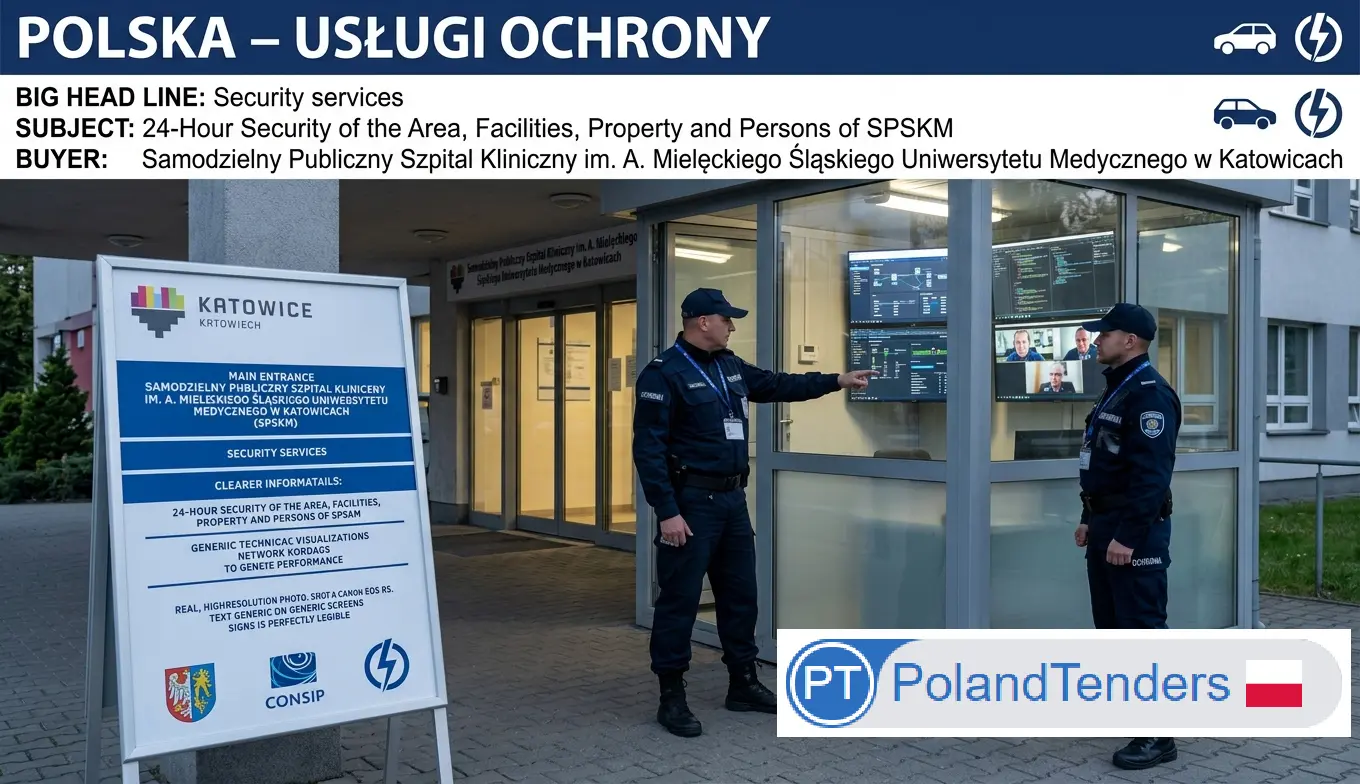
Local Security Firm Secures 28-Month Katowice Hospital Protection Contract in Competitive Three-Bidder Race
27 Aug 2026
Introduction Protecting healthcare infrastructure requires a delicate balance of patient safety, asset security and operational continuity. A regional Polish security provider has won a 28-month contract to safeguard a major clinical hospital in Katowice. This award demonstrates the viability of local small and medium enterprises in public sector security procurement. It also highlights the healthcare sector's ongoing effort to secure sensitive environments through standardized, cost-effective service agreements. Why This Contract Matters Hospital security extends far beyond guarding main entrances. It involves managing complex environments where public access intersects with sensitive medical operations and valuable pharmaceutical inventories. This contract ensures continuous, professional oversight of the hospital’s perimeter, facilities and personnel. It mitigates risks associated with theft, vandalism and unauthorized access, allowing medical staff to focus entirely on patient care. Contract Timeline The contracting authority selected the winning bidder on 10 August 2026. The formal contract was concluded shortly thereafter on 26 August 2026. The official notice was published in the Tenders Electronic Daily on 27 August 2026. The 28-month service period is scheduled to commence on 1 September 2026. Contract Overview This is a single-lot service contract for the 24-hour protection of the hospital's area, facilities, property and persons. The agreement covers the entire campus of the Independent Public Clinical Hospital of the Medical University of Silesia in Katowice. The procurement was conducted under specific provisions of Polish public procurement law governing social and other specific services. This indicates a tailored approach designed to balance competitive pricing with the unique social responsibilities of healthcare security. Key Contract Details Contracting Authority Samodzielny Publiczny Szpital Kliniczny im. A.Mielęckiego Śląskiego Uniwersytetu Medycznego w Katowicach Procedure Type Open Procedure Contract Type Services (Security services) CPV Code 79710000 (Security services) Contract Duration 28 Months (Starting 01/09/2026) Contract Value 5,025,587.43 PLN (excluding VAT) Award Criterion Price (100%) Number of Bids Received 3 (all from micro, small, or medium enterprises) Project Scope The supplier is responsible for providing round-the-clock physical security across the hospital campus. This includes monitoring the perimeter, securing internal facilities, protecting medical and administrative property and ensuring the safety of patients, visitors and staff. The scope is strictly limited to physical security services. The notice does not mention the supply or maintenance of electronic security infrastructure, such as CCTV or access control systems, under this specific agreement. About the Contracting Authority Samodzielny Publiczny Szpital Kliniczny im. A.Mielęckiego Śląskiego Uniwersytetu Medycznego w Katowicach This is a major independent public clinical hospital affiliated with the Medical University of Silesia. It serves as a key healthcare provider in the region, requiring robust operational support to maintain a safe environment for complex medical treatments. About the Organisations Involved Samodzielny Publiczny Szpital Kliniczny im. A.Mielęckiego Śląskiego Uniwersytetu Medycznego w Katowicach The contracting authority and buyer. It initiated the procurement to secure its facilities and will execute payments under the resulting contract. Sky One sp. z o.o. The successful bidder. Classified as a micro, small, or medium enterprise, this security services company is based in Mysłowice, within the same regional subdivision as the hospital. Its local presence likely contributed to its operational competitiveness. Krajowa Izba Odwoławcza The National Chamber of Appeal. This is the official review organisation responsible for handling legal disputes and complaints related to public procurement procedures in Poland. Procurement Analysis The open procedure attracted three tender submissions. Notably, all three bids were submitted by micro, small, or medium-sized enterprises. This indicates a healthy, localized competitive landscape for regional healthcare security contracts. The award was determined solely on the lowest price, with a 100% weighting. The contracting authority justified this by treating the technical requirements for physical security as fully standardized, making cost the only differentiating factor. The price competition was significant. The lowest admissible tender was valued at 5,025,587.43 PLN, while the highest admissible tender reached 7,548,764.81 PLN. This 33 percent variance highlights the importance of lean operational models in winning price-driven public security contracts. Additional Procurement Facts The procurement is not financed by EU funds. The agreement is not covered by the Government Procurement Agreement (GPA). Subcontracting is not permitted or disclosed for this contract. The procedure explicitly references Articles 359 to 361 of the Polish Public Procurement Law (Pzp), which govern the specific rules for awarding social and other specific services. Market & Industry Perspective The Polish private security market is highly fragmented. While national giants dominate large-scale corporate contracts, regional SMEs frequently win public sector healthcare and municipal contracts. Success in this niche depends on local operational capacity, familiarity with healthcare-specific protocols and the ability to maintain tight cost controls. The victory of a Mysłowice-based firm for a Katowice hospital underscores the advantage of geographic proximity in labor-intensive security services. Economic Significance For the hospital, securing a fixed-price, 28-month contract provides budget predictability. It shields the institution from short-term wage inflation in the security sector while guaranteeing continuous service. For the local economy, the award channels public healthcare spending directly into a regional business. This supports local employment and reinforces the economic ecosystem of the Silesian region. Future Procurement Opportunities As this 28-month term progresses, the hospital may issue separate tenders for complementary security technologies. Opportunities will likely arise for upgraded CCTV systems, electronic access control and cybersecurity for connected medical devices. Furthermore, upon the expiration of this contract, a follow-on procurement will be required. Suppliers should begin monitoring the hospital’s procurement profile for preliminary market engagement or prior information notices well before the 28-month term concludes. Opportunities for Suppliers Security firms targeting public healthcare contracts should emphasize their SME status and local operational capacity. Demonstrating specific experience in medical facility management, including patient de-escalation training, is a strong competitive differentiator. Suppliers must also ensure full compliance with the specific Polish legal frameworks governing social and healthcare-related services, as these often carry distinct procedural requirements compared to standard supply tenders. What Businesses Should Watch Market participants should monitor how Polish public hospitals integrate physical security with emerging digital health infrastructure. Changes in national healthcare security regulations could trigger new compliance-driven procurement waves. Observers should also track wage developments in the Polish security sector. Significant increases in the statutory minimum wage for security guards will directly impact the pricing dynamics of future hospital security tenders. PolandTenders.com Procurement Intelligence This award reflects a broader European trend where public healthcare entities prioritize localized, agile service providers over monolithic national contractors. Decentralized, region-specific procurement allows hospitals to secure vendors who understand their unique operational culture. Strategically, the 100% price weighting indicates that the contracting authority views basic physical security as a commoditized service. Suppliers must learn that in such environments, operational efficiency and lean cost structures are the primary competitive advantages, not value-added proposals. Relevant suppliers should position themselves by optimizing their labor scheduling and local logistics to submit aggressively competitive bids. However, they must balance this with the risk of underpricing, which can lead to service degradation and contractual penalties. Future contracts in this sector will likely evolve to demand hybrid physical-digital security solutions. Authorities will increasingly reward suppliers who can seamlessly integrate traditional guarding with smart facility management and real-time threat detection systems. Supplier Takeaways Local proximity and regional operational capacity are decisive advantages in labor-intensive public security contracts. When technical specifications are standardized, 100% price weighting makes lean cost structures the primary path to victory. Understanding the specific legal frameworks for social and healthcare services (such as Polish Pzp Articles 359-361) is mandatory for compliance. Future opportunities will increasingly blend physical guarding with electronic security system management. Key Takeaways Sky One sp. z o.o. secured a 28-month, 5.02 million PLN contract to protect a major clinical hospital in Katowice. The open procedure attracted three bids, all from micro, small, or medium-sized enterprises. The award was based entirely on the lowest price, with a significant 33 percent variance between the lowest and highest admissible bids. The contract covers 24-hour physical security of the hospital's area, facilities, property and persons. No subcontracting is permitted, ensuring the winning SME retains full operational control and liability. Conclusion This procurement successfully secures a vital operational function for a major Polish healthcare institution. By awarding the contract to a regional SME, the hospital balances cost efficiency with localized service delivery. As the healthcare sector continues to modernize, the baseline requirement for reliable, professional physical security remains unchanged. This contract establishes a stable foundation for the hospital’s operations over the next 28 months. Source: Tenders Electronic Daily (TED), Contract Award Notice 593247-2026, Official Journal of the European Union, published on 27/08/2026.
View Details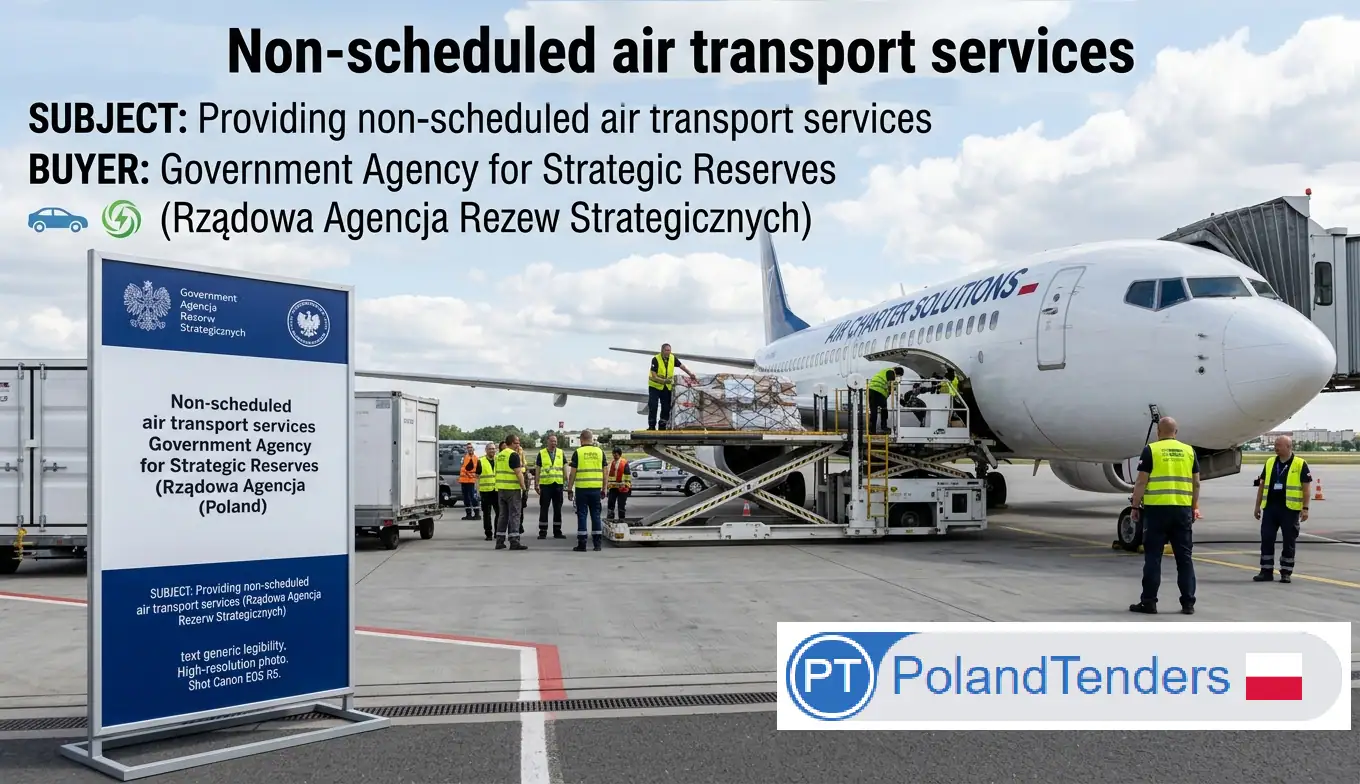
LOT Polish Airlines Secures Strategic rescEU Air Transport Contract as Poland Bolsters Civil Protection Capabilities
26 Aug 2026
Introduction Rapid humanitarian response and medical evacuation capabilities have become critical national security priorities across Europe. Escalating regional conflicts and climate driven emergencies demand immediate, reliable air transport infrastructure that can be activated at a moment’s notice. Poland’s Government Agency for Strategic Reserves has awarded a 36-month contract to LOT Polish Airlines to provide constant-readiness non-scheduled air transport and medical evacuation services. Funded through the European Union’s rescEU mechanism, the agreement ensures Warsaw maintains dedicated humanitarian logistics capacity amid growing geopolitical and environmental instability. Why This Contract Matters This procurement extends far beyond a standard commercial aviation charter. It establishes a dedicated, 24/7/365 standby capability for the Polish state, integrating passenger and cargo transport with specialized medical evacuation operations. By securing these services through the EU Civil Protection Mechanism, Poland not only enhances its domestic resilience but also contributes to a broader European network of emergency response assets. The contract guarantees that aircraft and associated medical storage infrastructure remain immediately available for deployment during natural disasters or humanitarian crises. Contract Timeline The contracting authority utilized an accelerated open procedure, selecting the winning bidder on 21 August 2026. The contract was formally concluded on 25 August 2026, with the official notice published in the Tenders Electronic Daily on 26 August 2026. The 36-month service period is scheduled to commence on 1 September 2026. Contract Overview The agreement covers the provision of non-scheduled air transport services under a constant state of readiness. The scope requires the supplier to maintain two multi-purpose aircraft for passenger and cargo transport, alongside one specialized medical aircraft configured for MEDEVAC operations. In addition to flight readiness, the contract includes the lease of dedicated warehouse space at Warsaw Chopin Airport. This facility will store professional medical equipment and supplies necessary for emergency operations. The procurement is fully financed by the EU’s Union Civil Protection Mechanism for the 2021-2027 period. Key Contract Details Contracting Authority Rządowa Agencja Rezerw Strategicznych (Government Agency for Strategic Reserves) Procedure Type Open Procedure (Accelerated) Contract Type Services CPV Codes 60420000 (Non-scheduled air transport services), 70220000 (Non-residential property renting or leasing services) Contract Duration 36 Months (Starting 01/09/2026) Award Criteria Price (Aircraft): 50%, Price (Warehouse): 10%, Quality (Readiness time): 40% Number of Bids Received 1 Contract Value Discrepancy The notice presents conflicting financial figures. The total value of contracts awarded is listed as 885,626,075.00 PLN, while the specific tender value for the winning bidder is recorded as 1,611,634,686.37 PLN. This discrepancy is presented exactly as it appears in the official notice and the contracting authority has not disclosed the reason for this variance. Project Scope The supplier must maintain a constant state of readiness to execute air transport operations upon request. The multi purpose aircraft must be available for passenger and cargo movement, while the medical aircraft must be permanently stationed at Warsaw Chopin Airport, equipped for emergency medical interventions. The contracting authority retains an option to increase the allocated block hours by 100 hours per aircraft, per calendar year. This option can be exercised if the initial hours are exhausted during active rescue or MEDEVAC operations under the Civil Protection Mechanism. About the Contracting Authority Rządowa Agencja Rezerw Strategicznych (RARS) The Government Agency for Strategic Reserves is a central government authority in Poland. It is responsible for managing state strategic reserves, ensuring public order and safety and coordinating logistics for civil protection and emergency response initiatives. About the Organisations Involved Polskie Linie Lotnicze LOT S.A. The successful bidder. LOT Polish Airlines is the flag carrier of Poland and a large enterprise. The airline possesses the necessary Air Operator Certificate (AOC) and specialized operational experience required for complex humanitarian and medical transport missions. Krajowa Izba Odwoławcza The National Chamber of Appeal. This is the official review organisation responsible for handling legal disputes and complaints related to public procurement procedures in Poland. Sąd Polubowny przy Prokuratorii Generalnej Rzeczypospolitej Polskiej The Arbitration Court at the Prosecutor General’s Office of the Republic of Poland. This body serves as the designated mediation organisation for resolving contractual disputes arising from this agreement. Procurement Analysis The contracting authority invoked an accelerated open procedure, reducing the standard tender submission deadline to 15 days. The justification cited an urgent need to establish rescEU transport capacities due to escalating regional threats, including increased wildfire activity across Europe, conflict escalation in the Middle East and the ongoing security situation in Ukraine. Despite the accelerated timeline, the procedure attracted only one electronic tender submission. The evaluation utilized a reverse procedure, meaning the authority evaluated the commercial and technical merits of the offer first, before verifying the sole bidder’s formal qualifications and exclusion grounds. The award criteria heavily weighted operational responsiveness. While price accounted for 60 percent of the score, 40 percent was allocated to quality, specifically rewarding bidders who could shorten the mandatory readiness notification period. Bidders could earn up to 20 points for committing to reduce the readiness declaration time for the aircraft by seven days. Additional Procurement Facts The procurement is fully financed by the European Union under the Union Civil Protection Mechanism (rescEU) 2021-2027. The agreement is covered by the Government Procurement Agreement (GPA). Subcontracting is not permitted for this contract. Bidders were required to hold a valid Air Operator Certificate and demonstrate prior experience in disaster relief or humanitarian air transport within the last six years. Market & Industry Perspective The specialized air logistics market for humanitarian and medical response is characterized by high barriers to entry. Operators must maintain specific regulatory certifications, specialized aircraft modifications and trained crews capable of rapid deployment. By securing this contract, LOT Polish Airlines reinforces its position not only as a commercial carrier but as a critical national infrastructure provider. The requirement for a dedicated warehouse at Warsaw Chopin Airport further integrates the airline’s operations with the state’s emergency supply chain. Economic Significance For the Polish government, this contract converts variable emergency response costs into a predictable, fixed readiness fee, ensuring immediate capability without the delays of ad hoc chartering during a crisis. For the winning airline, the agreement provides a stable, long-term revenue stream backed by EU funding. The inclusion of optional block hour extensions offers additional upside potential if regional emergencies intensify during the contract period. Future Procurement Opportunities As the EU continues to expand the rescEU stockpile and logistical network, similar procurement opportunities will likely emerge in other member states. Authorities will seek to establish regional hubs for medical evacuation, firefighting aircraft and strategic cargo transport. Within Poland, follow-on contracts may arise for the actual execution of transport missions once the standby period concludes, or for the maintenance and certification of the specialized medical equipment stored at the designated warehouse. Opportunities for Suppliers Aviation suppliers, maintenance providers and medical equipment manufacturers should monitor the implementation of this contract. The requirement to store and maintain professional medical supplies at Warsaw Chopin Airport creates downstream opportunities for specialized logistics and cold-chain management providers. Aerospace firms capable of rapidly certifying aircraft for medical evacuation roles will find growing demand as public authorities seek to upgrade their civil protection fleets. What Businesses Should Watch Market participants should track the utilization rate of the reserved block hours. High utilization would indicate escalating regional emergencies and could trigger the contracting authority’s option to extend operational hours, signaling sustained demand in the humanitarian aviation sector. Observers should also monitor how the EU Civil Protection Mechanism evolves its funding allocations for transport logistics, as this will dictate the volume of similar tenders across the bloc in the coming years. PolandTenders.com Procurement Intelligence This contract represents a broader European trend: the formalization and centralization of civil protection logistics under the EU’s rescEU framework. Member states are moving away from ad-hoc emergency charters toward dedicated, pre-funded standby agreements that guarantee immediate availability. Strategically, the award highlights the dual-use nature of modern aviation infrastructure. Commercial airlines are increasingly viewed as essential components of national security and humanitarian response architectures. The 40 percent weighting on readiness time demonstrates that, in emergency procurement, speed of deployment is valued almost as highly as cost efficiency. Suppliers can learn that success in this niche requires more than competitive pricing. Demonstrating verifiable experience in humanitarian operations and the regulatory agility to shorten readiness timelines are decisive competitive advantages. Relevant suppliers should position themselves by obtaining specialized aviation certifications, such as medical evacuation approvals and by building relationships with national civil protection agencies. Future contracts in this market will likely incorporate stricter environmental standards for emergency fleets and deeper integration with cross-border EU response networks. Supplier Takeaways Specialized regulatory certifications, such as Air Operator Certificates and medical evacuation approvals, are mandatory barriers to entry in humanitarian aviation procurement. In emergency response tenders, award criteria increasingly reward operational speed and readiness over pure cost minimization. EU funding mechanisms like rescEU are driving sustained, long-term demand for dedicated civil protection logistics across member states. Downstream opportunities exist for ground logistics, warehouse management and specialized aircraft maintenance providers supporting these primary contracts. Key Takeaways LOT Polish Airlines secured a 36-month contract to provide constant-readiness air transport and MEDEVAC services for Poland. The procurement was executed under an accelerated open procedure due to urgent regional security and climate-related threats. The contract includes the lease of dedicated medical supply warehouse space at Warsaw Chopin Airport. The notice contains a financial discrepancy, listing the total awarded value at 885.6 million PLN and the winner's tender value at 1.61 billion PLN. The agreement is fully funded by the EU’s Union Civil Protection Mechanism, with no subcontracting permitted. Conclusion This procurement successfully secures a vital component of Poland’s civil protection infrastructure for the next three years. By partnering with its national flag carrier, the Government Agency for Strategic Reserves ensures that humanitarian and medical air transport capabilities remain immediately available, backed by European Union funding. The contract underscores a strategic shift toward proactive, pre-positioned emergency logistics. As geopolitical and environmental uncertainties persist, the model established here will likely serve as a blueprint for civil protection procurement across the broader European Union. Source: Tenders Electronic Daily (TED), Contract Award Notice 588382-2026, Official Journal of the European Union, published on 26/08/2026.
View Details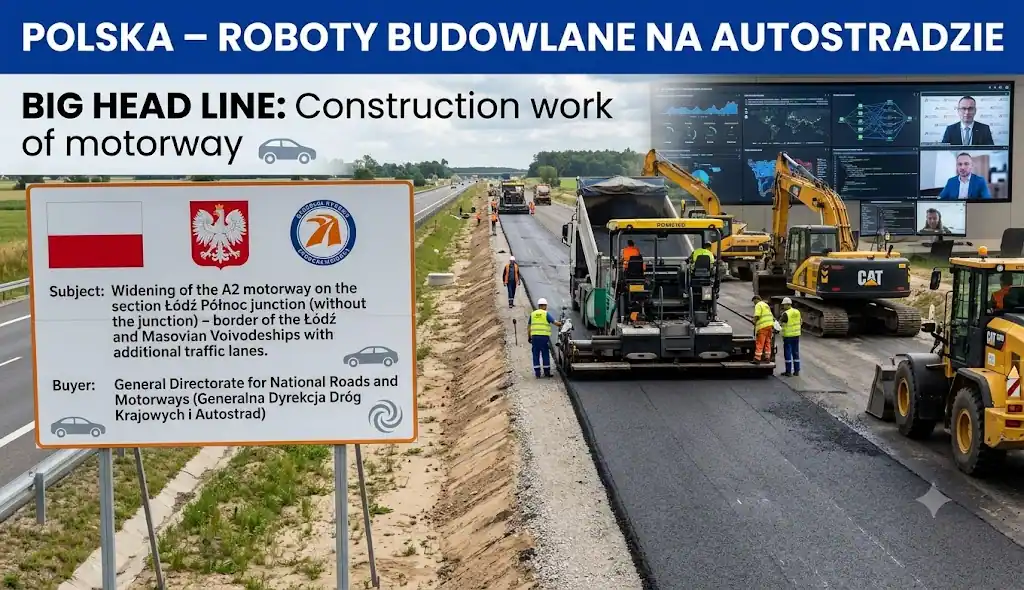
Strabag Wins PLN 261 Million Contract to Widen a 22km Stretch of Poland's A2 Motorway
25 Aug 2026
Standfirst Poland's national roads authority has awarded Strabag Sp. z o.o. a PLN 261 288 584.84 contract to widen a roughly 22 kilometre section of the A2 motorway between Łódź and the Mazowieckie border from two lanes to three in each direction. Six contractors competed for the work, evaluated on an 80 percent price and 20 percent recycled asphalt use basis. Introduction The A2 motorway is one of Poland's principal east-west arteries, part of the European route linking Berlin to Warsaw and beyond. A stretch of it running through Łódzkie voivodeship is about to get considerably wider, as the national roads authority moves forward with a long planned project to add a third lane in each direction along a corridor already carrying heavy traffic. Strabag Sp. z o.o., the Polish arm of one of Europe's largest construction groups, has won the contract to build this specific section, known as Section B, running roughly 22 kilometres between the Łódź Północ junction area and the border with Mazowieckie voivodeship. Six companies competed for the work. Why This Contract Matters Widening a motorway from two lanes to three per direction is a substantial capacity upgrade, directly addressing congestion on one of Poland's busiest long distance road corridors. The project's technical approach, widening each carriageway by 3 metres on the inner side using the motorway's existing wide central median, is a relatively efficient way to add capacity without needing to acquire significant new land along the route. The contract also carries a notable environmental dimension: bidders were scored specifically on their planned use of reclaimed asphalt pavement, recycled material from old road surfaces, incorporated using "hot recycling" technology into new wearing, binder and base courses. That criterion rewards contractors who can demonstrate genuine sustainable materials practice, not just price competitiveness. Contract Timeline Original tender notice referenced by this procedure: 780620-2025 Contract concluded: 21 August 2026 Notice dispatched to the Publications Office: 24 August 2026 Published in the Official Journal, OJ S 163/2026: 25 August 2026 Completion time: 13 months from the start date if no options are exercised, extending to 14 or 17 months depending on which options are activated Contract Overview GDDKiA's Łódź branch ran an open procedure, using Poland's reversed procedure evaluation method, for reconstruction and widening of the A2 motorway's Section B, from kilometre marker 389+678 to 411+466. Six tenders were received, all submitted electronically and Strabag Sp. z o.o. was awarded the contract, ranked first, with a winning bid of PLN 261 288 584.84, matching the notice's total awarded value exactly. The contract includes two optional scope elements the buyer may activate: traffic organisation adjustments at 15 named intersections and junctions across a wider surrounding area and implementation and maintenance of a temporary traffic diversion scheme during construction, with a minimum 24-month maintenance obligation for the temporary signage involved. Key Contract Details Contracting authorityGeneralna Dyrekcja Dróg Krajowych i Autostrad, Łódź branch Contract titleA2 motorway widening, Section B, km 389+678 to km 411+466 CPV code45000000, Construction work, plus extensive additional codes covering road, engineering and building works Procedure typeOpen procedure, using Poland's reversed procedure evaluation method Legal basisDirective 2014/24/EU Awarded valuePLN 261 288 584.84, excluding VAT Completion time13 months (no options), 14 months (Option 1), or 17 months (Option 2, or both options) Award criteriaPrice 80 percent; use of reclaimed asphalt material 20 percent Tenders received6, all electronic, none from SMEs, none from outside Poland WinnerStrabag Sp. z o.o. Winner size classificationLarge enterprise SubcontractingYes, covering works, services and material supply except key tasks reserved for personal execution Contract signed21 August 2026 GPA coverageYes Framework structureNo framework agreement, direct works contract Performance security10 percent of the gross bid price Review bodyGDDKiA - Krajowa Izba Odwoławcza (National Appeals Chamber) Notice reference584823 2026, OJ S 163/2026, published 25 August 2026 Project Scope The core works widen each carriageway of the A2 motorway by 3 metres on the inner side along Section B, using the motorway's existing wide central median, changing the road's cross-section from two lanes in each direction to a target of three. The section runs through Łódzkie voivodeship, spanning the Łowicki and Skierniewicki counties, across the municipalities of Łyszkowice, Nieborów and Bolimów. Two option rights sit alongside the core widening works. Option 2 covers traffic organisation adjustments at 15 named intersections and junctions spread across a considerably wider area than the immediate construction section, including crossings in Brzeziny, Łowicz, Sochaczew and Błonie, plus the Warszawa Zachód, Opacz, Mszczonów Północ and Wiskitki motorway junctions, suggesting coordinated traffic management across the broader corridor affected by the wider A2 widening programme. Option 1 covers implementing and maintaining a temporary traffic diversion scheme during construction, following a specific detour strategy document, with the contractor required to maintain the temporary signage for at least 24 months, with additional compensation available if that period is extended. A distinctive technical requirement applies to bidders proposing to use "hot recycling" technology for reclaimed asphalt pavement in the wearing course, binder course and base layers: they must submit evidence confirming they will use an asphalt mixing plant equipped with hot recycling capability and a parallel drum for dosing asphalt granulate, specifying its location, capacity and type. About the Contracting Authority Generalna Dyrekcja Dróg Krajowych i Autostrad is a central government authority active in general public services, procuring through its Łódź branch office. GDDKiA is Poland's national roads authority, responsible for planning, constructing and maintaining the country's national road and motorway network, including the ongoing capacity expansion of the A2 corridor. About the Organisations Involved Generalna Dyrekcja Dróg Krajowych i Autostrad As covered above, GDDKiA's Łódź branch is the buyer for this contract and the authority also serves, alongside the National Appeals Chamber, as the review body for procurement disputes. Krajowa Izba Odwoławcza Poland's National Appeals Chamber is named alongside GDDKiA in the review process for this contract, with detailed statutory appeal deadlines ranging from 10 to 30 days depending on the specific circumstances and a further route to the Warsaw Regional Court and ultimately the Supreme Court for cassation appeals. Strabag Sp. z o.o. Strabag Sp. z o.o., based in Pruszków near Warsaw and classified as a large enterprise, is the winning contractor. Strabag is part of one of Europe's largest construction groups, headquartered in Austria, with an extensive track record delivering major road, rail and civil engineering projects across Central and Eastern Europe, including substantial prior experience on Poland's national motorway network. Procurement Analysis GDDKiA ran an open procedure using Poland's reversed procedure method, under which tenders are evaluated before the winning bidder's qualification documents are formally checked, a standard efficiency mechanism in Polish public works procurement. Award criteria weighted price heavily at 80 percent, with the remaining 20 percent tied specifically to reclaimed asphalt material use, a criterion that rewards genuine environmental practice in road resurfacing rather than defaulting purely to lowest cost. Six tenders competed for the contract, none from SMEs and none from outside Poland, reflecting the scale and capital intensity of a project this size, which realistically only large, well capitalised national and international contractors can credibly bid for. Strabag's winning bid was ranked first among the six, though the notice does not disclose the values of the competing bids, so the margin of victory cannot be assessed from this notice alone. The contract's variable completion timeline, ranging from 13 to 17 months depending on which options GDDKiA ultimately exercises, gives the authority flexibility to scope the project's full extent, including the wider traffic coordination work at 15 separate intersections, without committing to that scope upfront. Additional Procurement Facts The tender's exclusion grounds explicitly reference Article 5k of EU Council Regulation 833/2014, the Russia sanctions regime. Eligibility was restricted to bidders based in the EU, a GPA signatory state, or a state with a relevant bilateral or regional agreement with the EU on public procurement. GDDKiA may offer an advance payment of between 1 and 10 percent of the gross contract value, subject to the contractor providing corresponding security. The contracting authority did not conduct preliminary market consultations ahead of this tender. GDDKiA maintains an internal whistleblower reporting procedure under Poland's 2024 law on whistleblower protection, referenced in the tender's general information. Market and Industry Perspective Major Polish motorway capacity expansion work of this kind continues to draw a concentrated field of large national and international contractors, reflected in the six bidder, all-large-enterprise field here. Strabag's win reinforces its established position within Poland's road construction market, competing alongside other major players active in the country's ongoing national road investment programme. Economic Significance At PLN 261 288 584.84 for roughly 22 kilometres of motorway widening, this is a substantial single contract within Poland's broader, multi-billion złoty national road investment programme, reflecting continued government commitment to expanding capacity on key freight and passenger corridors like the A2. Future Procurement Opportunities The broader A2 widening project between the Łódź Północ junction and the Łódzkie-Mazowieckie border extends beyond this single Section B contract, meaning further sections of the same overall widening programme are likely to be tendered separately, offering additional opportunities for contractors active in this market. Opportunities for Suppliers Large scale civil engineering and road construction contractors should note GDDKiA's continued investment in the A2 corridor as a signal of further upcoming tenders along the same route. Suppliers of asphalt recycling technology and reclaimed pavement material may also find growing demand given this contract's explicit scoring incentive for hot recycling technology adoption. What Businesses Should Watch Further sections of the broader A2 Łódź Północ to Mazowieckie border widening project as they come to tender. Whether GDDKiA exercises Option 1, Option 2, or both, affecting the project's final completion timeline and scope. Broader GDDKiA national road investment activity across other corridors as Poland continues expanding motorway capacity. PolandTenders.com Procurement Intelligence This contract illustrates how Poland continues to expand its national motorway network's capacity through targeted widening projects rather than solely new build construction, a generally more land and cost efficient approach where existing medians and rights of way can be reused. The explicit scoring credit for reclaimed asphalt material use also reflects a broader shift in European road construction toward rewarding demonstrable sustainability practice within otherwise price dominated evaluation frameworks. For contractors competing in this market, the six bidder field, entirely composed of large enterprises with no SME or international participation, confirms that motorway widening work at this scale remains realistically accessible only to well capitalised firms with substantial prior road construction experience in Poland. Firms considering entry into this market should expect to compete against an established roster of major national and international contractors rather than a broad, open field. Looking ahead, the wider A2 widening programme this section belongs to suggests further contract opportunities will follow along the same corridor, giving contractors positioned here a reasonable basis to plan for continued work in the same geographic area over the coming years. Supplier Takeaways This contract was decided 80 percent on price and 20 percent on reclaimed asphalt material use, rewarding genuine environmental practice alongside cost competitiveness. All six competing bidders were large enterprises, confirming this category of work remains concentrated among well capitalised contractors. The project's completion timeline varies from 13 to 17 months depending on which of two option rights the buyer exercises. A specific technical evidence requirement applies to bidders proposing hot recycling asphalt technology, a detail worth preparing for in similar future Polish road tenders. This section is part of a larger A2 widening programme, suggesting further related tenders are likely to follow along the same corridor. Key Takeaways GDDKiA awarded Strabag Sp. z o.o. a PLN 261 288 584.84 contract to widen roughly 22 kilometres of the A2 motorway in Łódzkie voivodeship. Six tenders competed, all from large Polish based enterprises, none from SMEs or international bidders. Award criteria weighted price at 80 percent and reclaimed asphalt material use at 20 percent. The project includes two optional scope elements affecting traffic management at 15 intersections and temporary traffic diversion during construction. Completion is scheduled for 13 to 17 months depending on which options are exercised. The contract is not covered by a framework agreement and requires a 10 percent performance security. Conclusion Adding a third lane to 22 kilometres of one of Poland's busiest motorways is the kind of infrastructure work that rarely makes headlines but directly shapes how efficiently people and freight move across the country. Strabag now carries that responsibility for Section B of the A2, in a contract that rewards recycled materials alongside competitive pricing and that likely marks just one stretch in a longer, ongoing programme to widen this key European transport corridor. Source: Tenders Electronic Daily (TED), Contract Award Notice 584823-2026, Official Journal of the European Union, OJ S 163/2026, published on 25 August 2026.
View Details