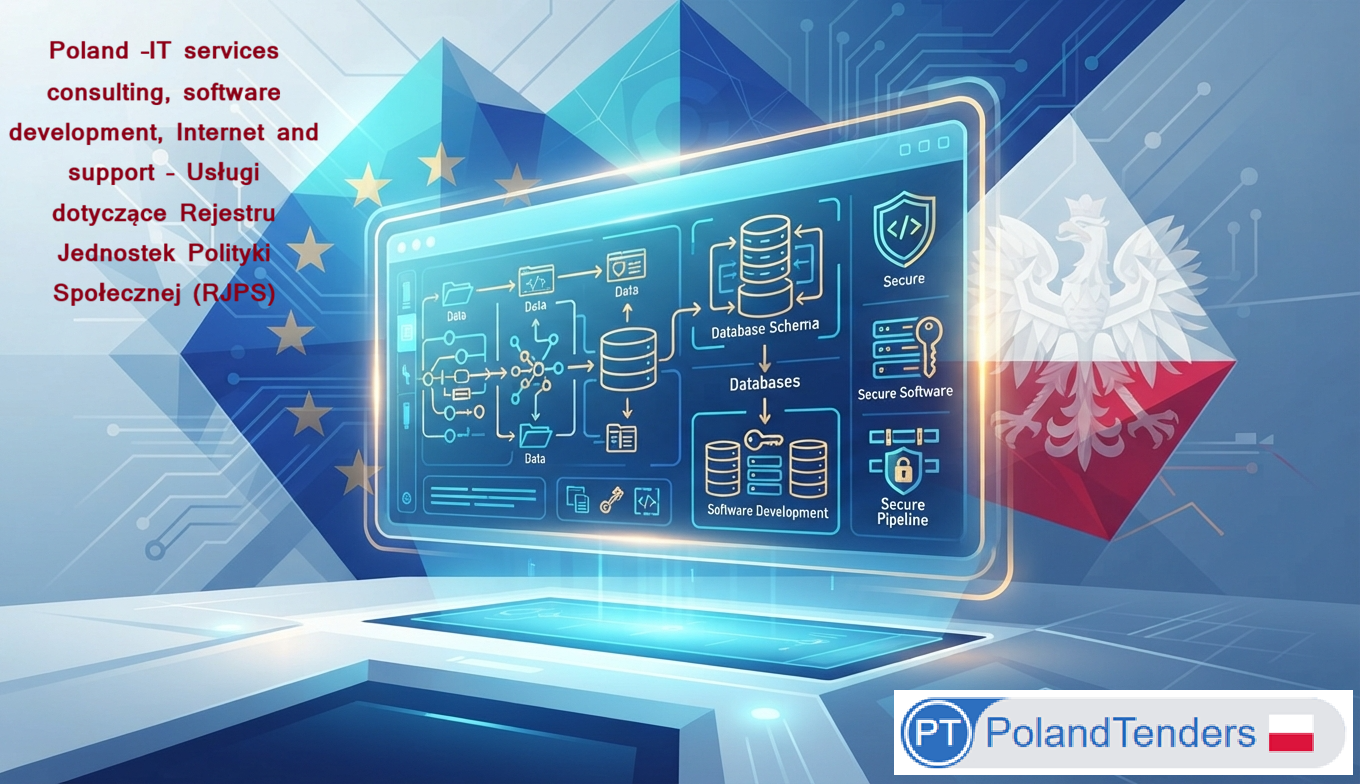
Poland Awards PLN 11.24 Million Contract for Social Policy Register (RJPS) IT Services
24 Jul 2026
Introduction: Poland's Ministry of Family, Labour and Social Policy (Ministerstwo Rodziny, Pracy i Polityki Społecznej) has awarded a major information technology services contract for the continued development, administration and technical support of the Register of Social Policy Units (Rejestr Jednostek Polityki Społecznej - RJPS). The contract, published in the Official Journal of the European Union (OJ S 141/2026), covers software development, system administration, technical maintenance, user support and operational services for one of the country's key digital public administration platforms. The contract has been awarded to Sygnity Spółka Akcyjna through an open procurement procedure for a total value of PLN 11,235,300.00. The project will be delivered over a period of 48 months, supporting the long term operation and enhancement of the RJPS platform used within Poland's social policy administration. Beyond routine software maintenance, the procurement focuses on continuous development of the information system, administration services, incident resolution, hotline support for users and coordination of meetings of the RJPS User Council. The contract demonstrates the Ministry's continued investment in strengthening digital public services through modern software management and long term application support. The project also reflects the growing importance of digital transformation across public administration. By investing in the continuous evolution of the RJPS platform, the Ministry aims to improve operational efficiency, maintain system reliability and support the delivery of social policy services through secure and well maintained digital infrastructure. Why This Contract Matters Governments across Europe continue to modernise digital public services through long term IT service contracts covering software development, application maintenance and technical support. Rather than replacing existing systems, many public authorities are investing in continuous improvement programmes that ensure critical government platforms remain secure, reliable and capable of adapting to changing policy requirements. The Register of Social Policy Units (RJPS) is an important digital platform supporting Poland's social policy administration. Maintaining such a system requires ongoing software development, operational support and user assistance to ensure uninterrupted service delivery across public institutions that depend on the platform. The procurement is also significant because it combines several specialised IT services within a single contract. The successful contractor will not only maintain and develop the application but will also administer the system, resolve incidents and software defects, operate a user hotline and organise meetings for the RJPS User Council, ensuring comprehensive lifecycle support. By selecting a single contractor through an open procurement procedure, the Ministry aims to secure long term technical expertise while maintaining continuity of service for an important government information system used within Poland's public administration. Contract Timeline Milestone Details Country Poland Notice Type Contract Award Notice - Standard Regime Publication OJ S 141/2026 - 24 July 2026 Contracting Authority Ministry of Family, Labour and Social Policy Procedure Open Procedure Contract Type Services Main CPV 72000000 - IT services: consulting, software development, Internet and support Estimated Contract Value PLN 9,146,214.43 excluding VAT Winning Contract Value PLN 11,235,300.00 Contract Duration 48 Months Winner Selected 2 June 2026 Contract Signed 6 July 2026 Contract Overview The procurement covers comprehensive IT services relating to the Register of Social Policy Units (RJPS). According to the procurement notice, the successful contractor will be responsible for the continued development of the platform, administration of the system, removal of software failures and defects, user support services, hotline operations and the organisation of meetings for the RJPS User Council. The contract forms part of the Ministry's broader strategy to ensure the continuous operation and improvement of digital systems supporting public administration. The services include both technical maintenance and functional development, allowing the system to evolve alongside future legislative, operational and organisational requirements. The procurement was conducted through an open procedure under Directive 2014/24/EU, encouraging competition among qualified IT service providers. Interested suppliers were required to submit electronic tenders together with extensive technical documentation, including a development concept relating to data pseudonymisation and removal functionality within the Central Foster Care Register (CRPZ), which formed part of the quality evaluation process. The contract will commence no earlier than 3 September 2026 and will remain in force for 48 months. According to the published notice, the procurement is not financed through European Union funds. Key Contract Details Item Information Project Title IT Services for the Register of Social Policy Units (RJPS) Contracting Authority Ministry of Family, Labour and Social Policy Country Poland Main CPV 72000000 - IT services: consulting, software development, Internet and support Estimated Value PLN 9,146,214.43 excluding VAT Winning Contract Value PLN 11,235,300.00 Procurement Procedure Open Procedure Contract Duration 48 Months Framework Agreement No Dynamic Purchasing System No EU Funding Not financed through European Union funds Project Scope The contract covers comprehensive IT services for the Register of Social Policy Units (Rejestr Jednostek Polityki Społecznej - RJPS), one of the Ministry's key digital information systems supporting Poland's social policy administration. The procurement combines software development, system administration, technical support and user assistance under a single long term service agreement. According to the procurement notice, the successful contractor will be responsible for the continuous development of the RJPS platform, ensuring that the application evolves in line with operational requirements and future legislative or organisational changes. The scope also includes administration of the production environment, removal of software failures and defects, user support services and operation of a dedicated hotline. In addition to technical services, the contractor will organise and conduct meetings of the RJPS User Council, providing structured collaboration between the Ministry and system users. The procurement documentation states that detailed technical requirements, implementation conditions and service obligations are defined within the draft contractual provisions accompanying the tender documentation. To enable suppliers to prepare technically robust proposals, the Ministry provided controlled access to RJPS documentation and a test environment. Bidders could review system documentation and access a test instance of the Central Foster Care Register (CRPZ) to prepare their technical development concepts, particularly regarding pseudonymisation and secure removal of processed data. Development and enhancement of the RJPS platform. Administration and operational management of the information system. Correction of software defects and system failures. User support services and operation of a technical hotline. Organisation and coordination of RJPS User Council meetings. Long term application maintenance and technical support. Delivery of IT services throughout the 48 month contract period. About the Contracting Authority The procurement was conducted by the Ministry of Family, Labour and Social Policy (Ministerstwo Rodziny, Pracy i Polityki Społecznej), a central government authority responsible for developing and implementing national policies relating to family affairs, employment, labour markets and social welfare. As part of its digital transformation strategy, the Ministry continues to invest in information systems that improve public administration, strengthen service delivery and support efficient management of social policy programmes. The RJPS platform represents one of the Ministry's important digital assets requiring continuous technical maintenance and development. The Ministry managed the procurement through an open procedure using an electronic procurement platform, requiring bidders to submit fully electronic tenders together with technical documentation and supporting evidence demonstrating their capability to deliver the required IT services. Organisations Involved The Ministry of Family, Labour and Social Policy acted as the contracting authority responsible for preparing the procurement documentation, evaluating tenders and awarding the contract. The procurement notice identifies the Krajowa Izba Odwoławcza (National Appeals Chamber) as the review body responsible for handling procurement appeals and providing information regarding review procedures under Polish public procurement legislation. The successful contractor, Sygnity Spółka Akcyjna, will deliver all contracted IT services associated with the development, administration and long term support of the Register of Social Policy Units. Winning Contractor The contract was awarded to Sygnity Spółka Akcyjna, a major Polish information technology company with extensive experience in delivering software development and digital transformation projects for public sector organisations. The company secured first place following evaluation of the submitted tenders, with a winning offer valued at PLN 11,235,300.00. According to the procurement notice, the contract does not include subcontracting arrangements and the successful tender was ranked first among participating bidders. The winner was selected on 2 June 2026 and the contract was formally concluded on 6 July 2026. Implementation of the services is scheduled to begin no earlier than 3 September 2026. Contract Award Details Item Details Winning Contractor Sygnity Spółka Akcyjna Winning Contract Value PLN 11,235,300.00 Estimated Contract Value PLN 9,146,214.43 excluding VAT Total Tenders Received 2 Winning Rank 1 Contract Award Date 2 June 2026 Contract Conclusion Date 6 July 2026 Subcontracting No subcontracting indicated in the published notice. Procurement Analysis The procurement demonstrates Poland's continued investment in maintaining and enhancing critical government information systems through long term service contracts. Rather than procuring a completely new platform, the Ministry selected a contractor capable of delivering continuous software development, operational administration, technical maintenance and user support for the Register of Social Policy Units (RJPS). The contract was awarded through an open procurement procedure under Directive 2014/24/EU, encouraging competition among qualified IT service providers. Two tenders were submitted during the competition, with Sygnity Spółka Akcyjna securing the highest ranked offer and being awarded the contract valued at PLN 11,235,300.00. A notable aspect of the procurement is the balanced evaluation methodology. The contracting authority allocated equal weighting to price (50%) and quality (50%), indicating that technical capability was considered just as important as commercial competitiveness. Suppliers were required to submit a detailed development concept addressing pseudonymisation and secure removal of processed data within the Central Foster Care Register (CRPZ), demonstrating their technical expertise in developing secure government information systems. The procurement also required bidders to review system documentation and work with a controlled test environment before preparing their proposals. This approach enabled suppliers to develop realistic implementation strategies while giving the Ministry greater confidence in the technical quality of submitted solutions. Technical Highlights The awarded contract combines software engineering, application management and operational support into a single integrated IT services programme designed to ensure the long term reliability of the RJPS platform. Continuous software development and functional enhancement of the RJPS system. Administration and operational management of the production environment. Identification and resolution of software defects and technical incidents. User support services together with a dedicated technical hotline. Organisation of meetings for the RJPS User Council. Support for secure data processing and application maintenance. Long term technical services delivered over a 48 month implementation period. The procurement documentation also required suppliers to demonstrate their capability to develop functionality supporting pseudonymisation and secure removal of processed information, reflecting the increasing importance of privacy protection and secure information management within government digital platforms. Market & Industry Perspective Governments throughout Europe continue to increase investment in maintaining mission critical digital platforms rather than replacing them entirely. Long term software support contracts allow public authorities to modernise existing systems while ensuring uninterrupted delivery of public services. The RJPS procurement reflects this broader trend by combining software development, maintenance and operational support within a single contract. Integrated service agreements enable contracting authorities to establish long term partnerships with experienced technology providers capable of delivering continuous improvements while maintaining platform stability. The project also illustrates the growing demand for specialised public sector IT suppliers with expertise in government applications, secure information management, regulatory compliance and digital transformation. As public administration becomes increasingly dependent on digital platforms, contracts covering application lifecycle management are expected to remain a significant segment of the European public procurement market. Economic Significance The contract, valued at PLN 11,235,300.00, represents a significant investment in Poland's digital public administration infrastructure. Rather than funding physical assets, the procurement supports specialised software engineering, technical maintenance, user services and long term operational continuity for an important government information system. The project contributes to sustained demand within Poland's information technology sector, particularly for companies specialising in software development, application management and government digital services. Long term contracts of this nature help create predictable investment opportunities while supporting innovation within the country's public sector technology market. Although the procurement is not financed by European Union funds, it aligns with broader public sector digitalisation initiatives focused on improving service quality, operational efficiency and secure management of government information systems. Additional Procurement Facts Winning contract value: PLN 11,235,300.00. Estimated procurement value: PLN 9,146,214.43 excluding VAT. Contract duration: 48 months. Main CPV: 72000000 - IT services: consulting, software development, Internet and support. The procurement was conducted through an open procedure. The project is not financed by European Union funds. The procurement is covered by the Government Procurement Agreement (GPA). Two tenders were received during the competition. The winning contractor was selected on 2 June 2026 and the contract was signed on 6 July 2026. No subcontracting arrangements were disclosed in the published contract award notice. Future Procurement Opportunities The award of this contract reflects the Ministry's long term commitment to maintaining and continuously improving critical digital infrastructure supporting Poland's social policy administration. During the 48 month implementation period, additional procurement opportunities may arise for complementary services such as cybersecurity, cloud infrastructure, software integration, data migration, application testing, user training and specialised IT consultancy. As governments continue expanding digital public services, future procurements are likely to focus on application modernisation, secure data management, interoperability between public information systems and advanced digital services. Technology providers with expertise in government software development, application maintenance and digital transformation will remain well positioned to participate in similar public sector projects. Opportunities for Suppliers This procurement highlights growing demand for contractors capable of delivering end to end application lifecycle management rather than standalone software development projects. Suppliers offering software engineering, system administration, technical support, managed services and user assistance can expect continued opportunities across the public sector. The equal weighting assigned to price and quality also demonstrates that contracting authorities increasingly value technical innovation, implementation methodology and long term service capability. Companies participating in future competitions should therefore invest in solution architecture, information security, user experience and operational support alongside competitive pricing. Suppliers specialising in digital government platforms, secure software development, application maintenance, privacy enhancing technologies and public sector IT consulting are likely to benefit from increasing investment in national digital infrastructure programmes. What Businesses Should Watch Future procurements for government application development and maintenance services. Digital transformation programmes within Poland's public administration. Software modernisation and long term application support contracts. Cybersecurity, system administration and managed IT service opportunities. Projects involving secure data processing, privacy protection and regulatory compliance. Public sector procurements requiring integrated software development and operational support. PolandTenders.com Procurement Intelligence The RJPS contract illustrates how public authorities are shifting from one time software implementation projects towards continuous digital service management. Instead of procuring isolated development activities, the Ministry has established a long term partnership that combines software enhancement, operational administration, technical maintenance and user support under a single contract. The procurement also demonstrates the increasing importance of quality based evaluation in public sector IT purchasing. By assigning equal weight to price and technical quality, the Ministry recognised that successful digital transformation depends not only on competitive pricing but also on the contractor's ability to deliver secure, scalable and sustainable technology solutions. Another notable feature is the emphasis placed on data protection and secure information management. Requiring bidders to prepare a technical concept addressing pseudonymisation and secure data removal reflects growing regulatory expectations surrounding government information systems and digital public services. As governments continue investing in digital administration, contracts covering long term software lifecycle management, operational resilience and continuous platform improvement are expected to become increasingly common throughout the European public procurement market. Supplier Takeaways The contract has been awarded to Sygnity Spółka Akcyjna. Total contract value amounts to PLN 11,235,300.00. The implementation period extends over 48 months. The procurement covered software development, administration, maintenance and user support services. Quality and price each represented 50% of the evaluation criteria. The project supports the long term operation of Poland's Register of Social Policy Units (RJPS). Key Takeaways The Ministry of Family, Labour and Social Policy has invested in the long term development and maintenance of the RJPS digital platform. The contract was awarded through an open procurement procedure with two competing tenders. Sygnity Spółka Akcyjna secured the contract valued at PLN 11.24 million. The procurement combines software development, application management, technical support and operational services within a single agreement. The project highlights increasing investment in secure, resilient and continuously evolving government digital infrastructure. Long term IT service contracts remain an important opportunity for technology providers serving the European public sector. Conclusion The award of the RJPS IT services contract represents an important step in strengthening Poland's digital public administration capabilities. By securing a long term technology partner responsible for software development, system administration and operational support, the Ministry aims to ensure that the Register of Social Policy Units continues to operate efficiently while adapting to future policy and technological requirements. The procurement reflects wider European trends towards integrated application lifecycle management, balanced quality based procurement and sustained investment in digital government infrastructure. As public sector organisations continue modernising critical information systems, similar contracts are expected to generate significant opportunities for software developers, managed service providers and digital transformation specialists. Source: TED European Union, Contract Award Notice, OJ S 141/2026, Notice 514421-2026. published 24/07/2026. Contracting Authority : Ministry of Family, Labour and Social Policy (Ministerstwo Rodziny, Pracy i Polityki Społecznej)
View Details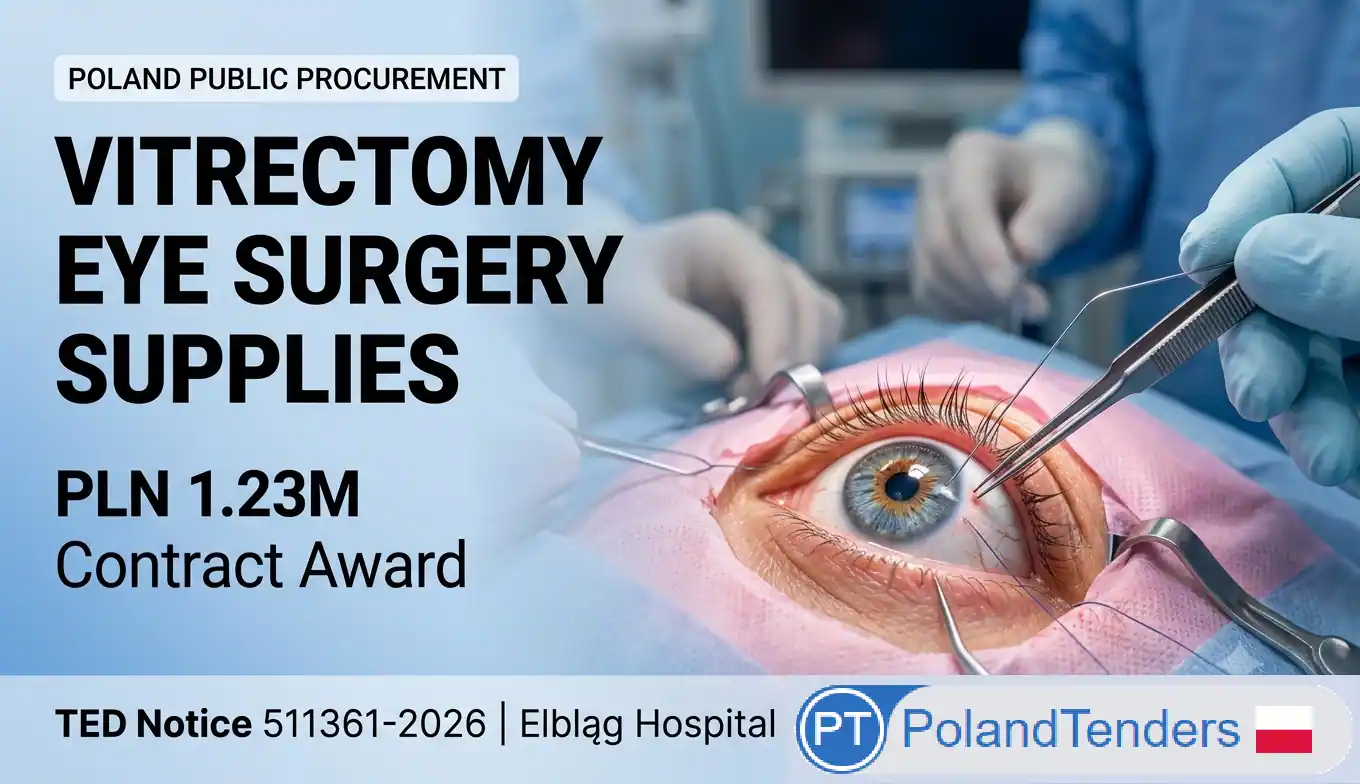
Saving Sight in Elbląg: A Polish Hospital's Eye Surgery Supply Contract, Five Packages and One Very Large Decimal Error
23 Jul 2026
StandfirstThe Provincial Combined Hospital in Elbląg has secured a two year supply of specialised accessories for vitrectomy, the delicate eye surgery used to repair detached retinas and treat severe diabetic eye disease, splitting the contract across five packages won by three different suppliers, including Polish micro enterprise Inov8 and global eye care giant Alcon. Every single package drew exactly one bidder and the notice's own headline total value is out by a factor of 100, a tidy illustration of how easily a decimal point can distort a procurement record.IntroductionVitrectomy is one of ophthalmology's more delicate interventions: a surgeon removes the vitreous gel that fills the eye, works directly on the retina to repair a detachment, close a macular hole or clear blood and scar tissue caused by advanced diabetic retinopathy and then often needs to fill the eye with gas or silicone oil to hold the repaired retina in place while it heals. None of that is possible without a specific, unglamorous supporting cast of consumables, surgical dyes that let the surgeon see delicate membranes otherwise invisible against the retina, ophthalmic gases and oils for tamponade, fine needles and instruments and sterile filters.The Provincial Combined Hospital in Elbląg, in northern Poland, has just secured its next two years of exactly that supply chain, splitting the contract into five separate packages tendered together and won across three different companies: Inov8 I. Żebrowska, a Warsaw based micro enterprise, took three of the five packages; ABJ-Vision, a small firm from Łódzkie province, took a fourth; and Alcon Polska, the Polish arm of the global eye care manufacturer, won the fifth and by far the largest package.Why This Contract MattersRetinal detachment and severe diabetic eye complications are emergencies in every meaningful sense: left untreated, they cause permanent vision loss, often within days. A regional hospital's ophthalmology department can only perform vitrectomy surgery reliably if its supply chain for these specific consumables is secured well in advance, there is no substituting a generic alternative mid procedure when a surgeon needs a specific ophthalmic dye or tamponade gas already loaded into the operating theatre.This contract is a clean, if modest, example of how a mid sized regional hospital manages that requirement: rather than one supplier for everything, the tender split highly specific categories of consumable, dyes, gas, oils, filters, needles and instruments, into separate packages, allowing different specialised suppliers to compete for the specific product category each is best positioned to provide. It is exactly the kind of unglamorous procurement that keeps a regional eye department capable of treating sight threatening emergencies without interruption.Contract Timeline Date Milestone ---- Open procedure launched (referenced prior notice 325881-2026) 30 June 2026 Winners selected across all five packages 7 July 2026 Contracts concluded with all three winning suppliers 22 July 2026 Award notice dispatched to the EU Publications Office 23 July 2026 Notice published in OJ S 140/2026 Contract OverviewWojewódzki Szpital Zespolony w Elblągu (the Provincial Combined Hospital in Elbląg) ran an open procedure to secure a 24 month supply of accessories necessary for performing posterior vitrectomy surgery for its Ophthalmology Department, splitting the requirement into five packages. Each package was evaluated identically: price counted for 60% of the score, with delivery time and complaint resolution time each weighted 20%, a structure that rewards not just cost but responsiveness, reflecting how critical timely delivery and prompt fault resolution are for consumables tied directly to scheduled or emergency eye surgery.Every one of the five packages attracted exactly one tender and in each case that single tender was declared the winner. Inov8 I. Żebrowska won Packages 1, 2 and 3 (dyes, ophthalmic gas and silicone oils/decaline respectively); ABJ Vision won Package 4 (microporous and microbiological filters, syringes); and Alcon Polska won Package 5 (needles and vitrectomy instruments), the largest package by a wide margin.Key Contract Details Field Detail Contracting authority Wojewódzki Szpital Zespolony w Elblągu Title Dostawa w 5 pakietach akcesoriów niezbędnych do wykonywania zabiegów operacyjnych witrektomii tylnej dla potrzeb Oddziału Okulistyki WSZ w Elblągu CPV code 33100000 – Medical equipments Procedure type Open Legal basis Directive 2014/24/EU; Polish Public Procurement Law, Article 132 Estimated value (all 5 packages, excl. VAT) PLN 947,815.20 Award criteria (all packages) Price (60%); Delivery time (20%); Complaint resolution time (20%) Contract duration (all packages) 24 months Framework agreement None EU funding None, not financed with EU funds GPA coverage No Mediation / Review body Krajowa Izba Odwoławcza (National Appeals Chamber) Place of performance Elbląg, Elbląski, Poland Package by package results Package Contents Estimated Value (PLN) Winner Winning Tender (PLN) Tenders Received 1 Vitrectomy dyes 112,500.00 Inov8 I. Żebrowska Sp. z o.o. 103,200.00 1 2 Ophthalmic gas 91,800.00 Inov8 I. Żebrowska Sp. z o.o. 91,800.00 1 3 Silicone oils, decaline 82,050.00 Inov8 I. Żebrowska Sp. z o.o. 99,500.00 1 4 Microporous/microbiological filters, syringes 21,300.00 ABJ-Vision Sp. z o.o. 24,500.00 1 5 Needles, vitrectomy instruments 640,165.20 ALCON Polska Sp. z o.o. 915,720.52 1 Project ScopeThe five packages together cover the full range of disposable and near disposable materials a vitrectomy procedure requires. Package 1 covers surgical dyes used to stain the internal limiting membrane and other delicate ocular tissues, making structures that are otherwise nearly transparent visible to the surgeon during the procedure, a critical visual aid for precision work on the retina. Package 2 covers ophthalmic gases used for tamponade, holding a repaired retina in place against the back of the eye while it heals. Package 3 covers silicone oils and decaline, used for longer term tamponade in more complex or recurrent detachment cases. Package 4 covers microporous and microbiological filters and syringes, essential for maintaining sterility during the procedure. Package 5, the largest package, covers the specialised needles and instruments used to actually perform the vitrectomy itself, the cutting, aspiration and illumination tools at the centre of the surgery.About the Contracting AuthorityWojewódzki Szpital Zespolony w Elblągu, the Provincial Combined Hospital in Elbląg, is a public hospital in northern Poland's Warmian Masurian region, structured as a body governed by public law under the country's public health sector classification. Its Ophthalmology Department performs vitrectomy and other retinal surgery for patients across the region, making a secure, uninterrupted supply of the specific consumables this contract covers directly relevant to the department's capacity to treat sight threatening conditions without delay.About the Organisations InvolvedInov8 I. Żebrowska Sp. z o.o., Winning Tenderer (Packages 1, 2 & 3)Inov8, based in Warsaw and classified as a micro enterprise, won three of the five packages in this tender, dyes, ophthalmic gas and silicone oils, reflecting a specialised focus on the consumable, non instrument side of vitrectomy supply. Winning three separate, distinct product categories within a single tender is a notable outcome for a firm of micro enterprise scale and reflects the kind of focused, niche distribution specialism common among smaller suppliers competing in specific ophthalmic consumable categories.ABJ-Vision Sp. z o.o., Winning Tenderer (Package 4)ABJ-Vision, based in Gałków Duży in Łódzkie province and classified as a small enterprise, won the sterility related consumables package covering filters and syringes, the smallest single package in the tender by value.ALCON Polska Sp. z o.o., Winning Tenderer (Package 5)Alcon Polska, based in Warsaw and classified as a large economic operator, is the Polish subsidiary of Alcon, one of the world's largest eye care device and consumables manufacturers, spun off from Novartis in 2019 and now an independent, globally listed company. Alcon's win of Package 5, needles and vitrectomy instruments, the core surgical hardware of the procedure and, at PLN 915,720.52, by far the largest single award in this notice, reflects the company's established position as a leading global manufacturer of vitreoretinal surgical equipment.Krajowa Izba Odwoławcza, Review and Mediation OrganisationPoland's National Appeals Chamber, based in Warsaw, serves as both the review and mediation body for this procurement, providing the formal legal channel through which any party could contest aspects of the award across any of the five packages.Procurement AnalysisThe single most notable pattern in this notice is that every one of the five packages attracted exactly one tender. Across highly specific, narrowly defined product categories, a particular type of surgical dye, a specific tamponade gas, a specific instrument set, this is not necessarily a sign of weak market interest so much as a reflection of how specialised and manufacturer concentrated the global ophthalmic surgical consumables market genuinely is. Few companies manufacture or distribute vitrectomy specific dyes, gases or instrument sets and a regional Polish hospital's specific technical requirements for each package may align closely with only one supplier's available product line in each category.The 60/20/20 award criteria structure, price, delivery time and complaint resolution time, is worth noting as a deliberately service oriented evaluation model rather than a purely cost driven one. For consumables tied to scheduled and emergency eye surgery, a supplier's ability to deliver quickly and resolve any product issue promptly is not a secondary consideration; a delayed delivery or slow resolved complaint can directly translate into a postponed or compromised surgical procedure. Weighting these service factors at 40% combined, against 60% for price, reflects that priority directly in the evaluation methodology.One clear data quality issue is worth flagging plainly. The notice's own recorded "value of all contracts awarded in this notice" is stated as PLN 123,472,052.00. Summing the five individual winning tender values disclosed in the same notice (PLN 103,200 + 91,800 + 99,500 + 24,500 + 915,720.52) produces a total of PLN 1,234,720.52, almost precisely one hundred times smaller than the notice's own headline aggregate figure. This is consistent with a decimal point or scaling error in how the aggregate value field was populated, rather than any genuine indication that this tender's real value is over PLN 123 million; a hospital ophthalmology department's two year consumables contract of that scale would be entirely disproportionate to the actual package values disclosed elsewhere in the same notice. PolandTenders.com treats the correctly summed figure of approximately PLN 1.23 million as the accurate total contract value.Additional Procurement FactsEvery tender received across all five packages was submitted electronically and every winning tenderer was classified as a micro, small or medium sized enterprise except Alcon Polska, which is classified as large. No tenders were received from bidders registered outside Poland in any package. No subcontracting was disclosed for any of the five winning tenders. None of the five packages carry EU funding and the tender as a whole is not covered by the WTO Government Procurement Agreement.Market & Industry PerspectiveThe global market for vitreoretinal surgical consumables and instrumentation is served by a mix of large, specialised ophthalmic device manufacturers, Alcon prominent among them, alongside competitors such as Bausch + Lomb and Carl Zeiss Meditec, and smaller, more narrowly focused distributors handling specific consumable categories like surgical dyes and tamponade agents. This tender's outcome reflects that structure clearly: the core surgical hardware package went to a major global manufacturer, while the more specialised consumable categories were won by smaller Polish distribution specialists.That every package drew only a single bidder is broadly consistent with how narrowly specified medical device and consumable tenders often play out at the regional hospital level across Europe, genuine competition tends to concentrate at the national or EU wide framework level, while individual regional hospital tenders for highly specific product categories frequently attract only the one supplier whose product precisely matches the technical specification.Economic SignificanceAt a corrected total of approximately PLN 1.23 million over 24 months, this is a modest but essential contract for a regional hospital's ophthalmology department, ensuring continuity of supply for a category of surgery with no acceptable substitute when materials are unavailable. For the three winning suppliers, the contract represents a secure, multi year revenue stream from a public health institution, with Alcon's Package 5 award representing the clear majority of the contract's real value.Future Procurement OpportunitiesWith a 24 month contract term now in place across all five packages, the hospital's next open competition for this category of surgical consumables is unlikely to reach the market again until 2028. Suppliers of ophthalmic surgical dyes, tamponade agents, sterility consumables and vitrectomy instrumentation not currently represented in this award should watch for the hospital's next tender cycle and should also note the apparent single bidder pattern across every package in this round as a signal that genuine competitive tension in these specific product categories may be limited at this particular hospital.Opportunities for SuppliersManufacturers and distributors of ophthalmic surgical consumables, particularly those not currently supplying Polish regional hospitals directly, should note that this tender's package based structure allows a supplier to compete for a single, narrow product category rather than needing to offer the full range of vitrectomy supplies. Given that every package in this round drew only one bidder, a supplier with a genuinely competitive product in any of these categories may find a comparatively open field when this or similar regional Polish hospital tenders next return to market.What Businesses Should WatchThree things are worth tracking from this contract. First, whether the correctly calculated total contract value (approximately PLN 1.23 million) is reflected accurately in any future related notice or corrigendum, given the apparent decimal scale discrepancy in this notice's own aggregate figure. Second, whether other Polish regional hospitals running comparable vitrectomy consumables tenders see a similarly narrow, single bidder field per package, which would confirm this as a broader pattern in the Polish ophthalmic supplies market rather than a result specific to Elbląg. Third, how Alcon's continued dominance of the core surgical instrument category in tenders of this kind compares with smaller distributors' hold on more specialised consumable niches, as a signal of where competitive opportunities remain most open for smaller suppliers.PolandTenders.com Procurement IntelligenceThis notice is a useful, small scale illustration of two recurring themes in European public procurement: genuinely narrow, specialised medical consumables markets that often produce single bidder outcomes at the level of individual regional hospitals and the ease with which a simple data entry or scaling error can distort a procurement notice's headline figures by orders of magnitude. Both patterns are worth recognising and neither should be mistaken for the other, a single bidder per package here reflects a genuinely narrow supplier base for highly specific surgical consumables, not a flawed procurement process, while the PLN 123.47 million aggregate figure is very clearly a data artefact rather than a real number, given it exceeds the sum of the notice's own disclosed package values by a factor of one hundred.For hospital procurement teams and market analysts alike, this notice is a small but clear reminder to verify headline aggregate figures against a notice's own itemised lot level detail before treating them as reliable, a discipline that matters just as much for a modest regional hospital consumables tender as it does for the largest national infrastructure contracts.Supplier Takeaways Highly specialised medical consumable categories, such as vitrectomy specific dyes, gases and instrumentation, often produce single bidder outcomes at the individual hospital level, reflecting genuine market concentration rather than a flawed tender process. Package based tender structures, as used here, allow smaller, specialised distributors to compete successfully for narrow product categories alongside large global manufacturers who typically win the core instrumentation package. Service oriented award criteria (delivery time, complaint resolution time), weighted here at 40% combined against 60% price, reflect how critical responsiveness is for consumables tied to scheduled and emergency surgery. Always cross check a notice's own headline aggregate contract value against the sum of its individual lot level figures, discrepancies of an order of magnitude, as seen in this notice, do occur and should not be taken at face value. This hospital's next open competition for these consumable categories is expected around 2028, given the 24 month contract term now in place. Key Takeaways Wojewódzki Szpital Zespolony w Elblągu awarded a five package, 24 month contract for vitrectomy surgical consumables, split across three suppliers: Inov8 I. Żebrowska (three packages), ABJ Vision (one package) and Alcon Polska (one package). Every one of the five packages attracted exactly one tender. Alcon Polska's Package 5 award (needles and vitrectomy instruments), valued at PLN 915,720.52, accounts for the clear majority of the contract's real total value. The notice's own recorded aggregate value (PLN 123,472,052.00) is approximately 100 times larger than the sum of its five disclosed package values (approximately PLN 1,234,720.52), PolandTenders.com treats the latter, corrected figure as accurate. The contract carries no EU funding and is not covered by the WTO Government Procurement Agreement. ConclusionA regional hospital's eye surgery supply contract will never make national headlines, but it is exactly the kind of unglamorous procurement that keeps a sight saving surgical department functioning. Five packages, three suppliers and a single bidder for each, this contract is a small, clean window into how narrow and specialised medical device supply chains actually are and a reminder that even the simplest looking number in a procurement notice is worth checking against its own underlying detail before taking it at face value.Source: EU Official Journal, Contract Award Notice 511361-2026, OJ S 140/2026, published 23/07/2026. Contracting authority: Wojewódzki Szpital Zespolony w Elblągu.
View Details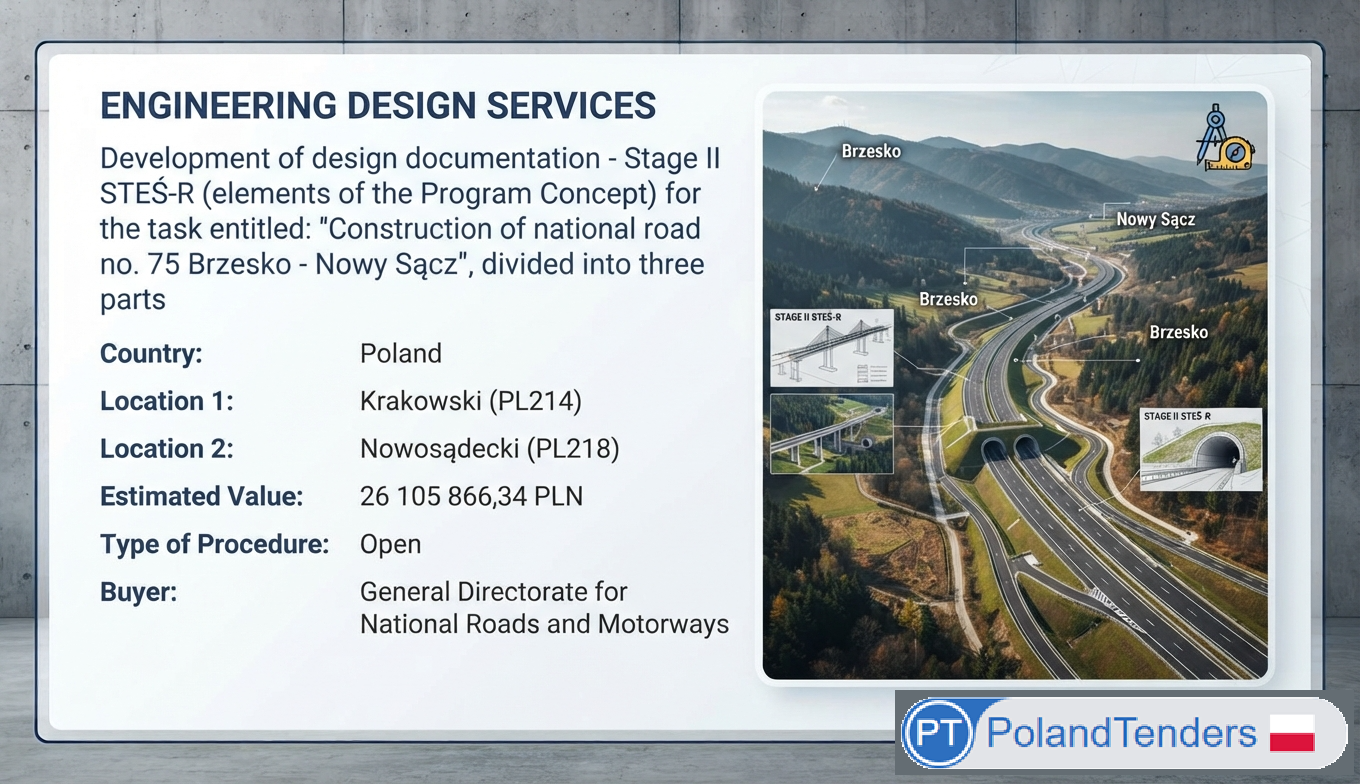
298 Accidents, 34 Deaths, One Overloaded Road: Poland Starts Designing the Replacement for the DK75
22 Jul 2026
StandfirstBetween 2017 and 2024, the DK75 national road connecting Brzesko and Nowy Sącz in southern Poland recorded 298 accidents and 34 deaths, a quarter of them pedestrians, on a route now carrying up to 21,500 vehicles a day through terrain it was never built to handle at this volume. Poland's national roads authority has awarded the design contracts for two of the first three sections of its replacement, a new dual carriageway road known locally as the "Sądeczanka", to specialist engineering firms DATABOUT and a Transprojekt Warszawa led consortium.IntroductionSome roads earn a nickname because people love them. The DK75 between Brzesko and Nowy Sącz has earned one, "Sądeczanka", after the Sądecki region it eventually reaches, because people are waiting with growing impatience for its replacement. The existing route winds through Małopolska's hill country carrying traffic volumes it was never designed for and the safety statistics attached to it are stark enough that Poland's Ministry of Infrastructure has folded its reconstruction into an approximately PLN 8 billion regional investment programme.Before a single metre of new carriageway can be built, however, the road has to be designed and designing a nearly 47 kilometre dual carriageway route through varied and difficult terrain is itself a substantial undertaking. The General Directorate for National Roads and Motorways (GDDKiA), through its Kraków branch, has now awarded design contracts for two of the project's three initial sections, covering the technical, economic and environmental feasibility study stage, plus supporting geological and geotechnical work, to DATABOUT Sp. z o.o. and a consortium led by Biuro Projektowo Badawcze Dróg i Mostów TRANSPROJEKT WARSZAWA.Why This Contract MattersThe case for rebuilding this stretch of road is written in its accident record. Between 2017 and 2024, the existing DK75 recorded 298 crashes along its roughly 47 kilometre length, resulting in 34 deaths and 439 injuries, 127 of them serious and roughly one in four fatalities was a pedestrian. Traffic near Nowy Sącz, Małopolska's third largest city, now reaches up to 21,500 vehicles a day on a route that was never engineered for this level of demand with quieter sections still carrying around 12,000 vehicles daily.The planned new route, a genuine dual carriageway "GP class" road (Poland's classification for a main road built for accelerated traffic flow, broadly comparable to a grade separated expressway), is projected to cut travel time between Brzesko and Nowy Sącz from roughly 60 minutes to about 30, while providing a safer, grade separated connection to the A4 motorway and, through it, to Kraków and Tarnów. This design contract is the first concrete step toward that outcome for two of the route's three initial sections; without it, none of the safety, economic or connectivity benefits the project promises can begin to materialise.Contract Timeline Date Milestone 27 September 2021 GDDKiA formally initiates the environmental decision process for the Brzesko-Nowy Sącz route March 2026 Tenders for the programme concept and geological studies for the first three sections publicly announced 14 July 2026 Contracts concluded with DATABOUT (Section III / Part 2) and the Transprojekt Warszawa-Infra consortium (Section V / Part 3) 21 July 2026 Award notice dispatched to the EU Publications Office 22 July 2026 Notice published in OJ S 139/2026 2027–2028 Further tenders planned for detailed design and construction of the route 2030–2031 Construction works expected to begin, per GDDKiA's public statements Contract OverviewGDDKiA's Kraków branch ran an open procedure, split into three parts, to procure Stage II STEŚ R design documentation, a Polish technical economic environmental feasibility study incorporating elements of a formal programme concept, for the new DK75 road between Brzesko and Nowy Sącz. This notice reports results for two of the three parts: Part 2 (Section III, from Wytrzyszczka to Łososina Dolna) and Part 3 (Section V, from Tęgoborze to Nowy Sącz). Part 1, covering Section I from Okocim to Uszew, does not appear in this notice's results and its outcome is not disclosed here.DATABOUT Sp. z o.o., a Warsaw based medium sized engineering firm, won Part 2 with a tender of PLN 5,342,000, from a field of five bidders, four of them SMEs. A consortium led by Biuro Projektowo Badawcze Dróg i Mostów TRANSPROJEKT WARSZAWA, alongside partner Infra - Centrum Doradztwa, won Part 3 with a tender of PLN 10,176,900, from a field of two bidders, both SMEs. Both contracts require the winning designers to remain available to answer technical questions during the subsequent tender procedure for the construction contractor, a structural link between the design and construction phases common in major Polish road projects.Key Contract Details Field Detail Contracting authority Generalna Dyrekcja Dróg Krajowych i Autostrad (GDDKiA), Kraków Branch Winning contractors DATABOUT Sp. z o.o. (Part 2 / Section III); Konsorcjum Biuro Projektowo Badawcze Dróg i Mostów TRANSPROJEKT WARSZAWA (leader) Infra Centrum Doradztwa (Part 3 / Section V) Title Opracowanie dokumentacji projektowej -Etap II STEŚ R dla zadania "Budowa DK nr 75 Brzesko -Nowy Sącz" CPV code 71320000 -Engineering design services (plus geology, geotechnical, architectural and surveying classifications) Procedure type Open (using Poland's "reversed procedure" under Article 139(1) of the Public Procurement Law) Legal basis Directive 2014/24/EU Estimated value (full three part procurement) PLN 26,105,866.34 Value of contracts awarded in this notice PLN 15,518,900.00 Part 2 (Section III) estimated value / awarded value PLN 6,010,570.00 estimated / PLN 5,342,000.00 awarded Part 3 (Section V) estimated value / awarded value PLN 9,678,260.34 estimated / PLN 10,176,900.00 awarded Award criteria Price (60%); Road Designer Experience (20%); Geological Team Experience (20%) Contract duration Part 2: 30 months; Part 3: 27 months, extendable to a maximum 36 months if the contract option is exercised Tenders received Part 2: 5 (4 from SMEs); Part 3: 2 (both SMEs) EU funding None disclosed GPA coverage Yes Framework agreement None Review body Krajowa Izba Odwoławcza (National Appeals Chamber) Place of performance Krakowski and Nowosądecki sub regions, Małopolskie voivodeship, Poland Project ScopeEach part of this contract covers preparation of Stage II STEŚ R documentation, a combined technical, economic and environmental feasibility study with elements of a formal "Programme Concept", the stage of Polish road planning that follows initial corridor selection and precedes detailed engineering design. The work includes design mapping, traffic analysis and forecasting, geophysical surveys and geological engineering documentation, together with an obligation to respond to technical questions raised during the subsequent tender for the construction contractor.Part 3 (Section V, Tęgoborze to Nowy Sącz) carries an additional contract option covering the stretch from roughly design kilometre 42+500 to the end of the section within the city of Nowy Sącz itself, the most technically and socially sensitive portion of the route, running through built up urban terrain. If GDDKiA exercises this option, the contractor's obligations expand to include design mapping, traffic forecasting, geophysical testing and geological engineering documentation specifically for this urban stretch, extending the maximum contract term to 36 months.Across the wider, three part programme, the new road is planned as a roughly 47 kilometre, dual carriageway GP class route with two lanes in each direction and grade separated junctions eliminating direct property access points, a substantially different design standard from the existing single carriageway DK75 it will eventually replace.About the Contracting AuthorityGeneralna Dyrekcja Dróg Krajowych i Autostrad (GDDKiA), Poland's General Directorate for National Roads and Motorways, is the central government authority responsible for planning, procuring and maintaining Poland's national road and motorway network. Its Kraków branch is managing this project given the route's location entirely within Małopolskie voivodeship and this design procurement sits within a broader, approximately PLN 8 billion investment programme covering the full Brzesko - Nowy Sącz corridor, part of Poland's National Road Construction Programme running to 2030, with a further planning horizon to 2033.About the Organisations InvolvedDATABOUT Sp. z o.o., Winning Tenderer (Part 2 / Section III)DATABOUT, headquartered in Warsaw and classified as a medium sized enterprise, won the design contract for Section III, running from Wytrzyszczka to Łososina Dolna, with the winning tender disclosing planned subcontracting in geology and geotechnics, geodesy and traffic analysis and forecasting, indicating the firm will bring in specialist partners for specific technical disciplines while retaining overall project leadership.Biuro Projektowo-Badawcze Dróg i Mostów TRANSPROJEKT-WARSZAWA Sp. z o.o., Winning Tenderer (Part 3 / Section V, Consortium Leader)TRANSPROJEKT-WARSZAWA, a Warsaw based medium sized road and bridge design and research bureau, led the winning consortium for Section V, the segment running from Tęgoborze into Nowy Sącz itself, the most complex portion of the route given its urban terminus. The firm's specific focus on road and bridge engineering design and research reflects the kind of specialist technical pedigree that Polish national road procurement typically requires for the most technically demanding project segments.Infra - Centrum Doradztwa Sp. z o.o., Winning Tenderer (Part 3 / Section V, Consortium Partner)Infra -Centrum Doradztwa, also based in Warsaw and classified as a medium sized enterprise, joined TRANSPROJEKT WARSZAWA as consortium partner for Section V. As with DATABOUT's Section III award, the consortium's winning tender discloses planned subcontracting in geology, traffic analysis and forecasting and geodesy, again reflecting how these complex feasibility studies typically draw on a network of specialist subcontractors beyond the lead consortium members themselves.Krajowa Izba Odwoławcza, Review OrganisationPoland's National Appeals Chamber, based in Warsaw, is the designated review body for this procurement, providing the formal legal channel through which unsuccessful bidders across either part could challenge the award, with further appeal possible to the Warsaw Regional Court's dedicated public procurement division.Procurement AnalysisGDDKiA structured the evaluation for both parts identically: price counted for 60% of the score, with the remaining 40% split evenly between two quality criteria assessing the specific, named individuals a bidder proposes to lead the work, a "Road Designer Experience" criterion and a "Geological Team Experience" criterion, each further subdivided by specific expertise (a geologist and a geophysicist evaluated separately within the geological criterion). This individual expertise based scoring, common in Polish infrastructure design procurement, ties the evaluation directly to the track record of specific named professionals rather than the bidding firm's institutional credentials alone, a bidder proposing a road designer or geologist with a stronger personal history of comparable projects scores measurably higher, regardless of the firm's overall size or reputation.The contrast in competitive intensity between the two awarded parts is worth noting. Section III (Part 2) drew five tenders, four from SMEs, a genuinely competitive field for a specialised engineering design contract. Section V (Part 3), arguably the more complex segment, given its urban terminus in Nowy Sącz and its attached contract option, drew only two tenders, both from SMEs, a narrower field consistent with the additional technical complexity and risk that section's scope likely represented to prospective bidders.The absence of Section I (Part 1, Okocim–Uszew) from this notice's results is worth flagging plainly. Summing the two disclosed parts' estimated values (PLN 6,010,570 + PLN 9,678,260.34) against the overall three part estimated value of PLN 26,105,866.34 leaves a residual of approximately PLN 10.4 million implicitly attributable to Part 1, a section evidently included in the original tender but whose specific award outcome is not reported in this particular notice.Additional Procurement FactsAcross the two disclosed parts, seven tenders were received in total (five for Part 2, two for Part 3), all submitted electronically, with six of the seven coming from micro, small or medium sized enterprises. No tenders were received from bidders registered in other EEA countries or outside the EEA for either part. Both winning tenderers disclosed planned subcontracting, though neither the specific value nor percentage of subcontracted work is disclosed in the notice. GDDKiA's procedure explicitly excludes contractors subject to EU Regulation 833/2014 sanctions connected to Russia's actions in Ukraine, a standard exclusion clause now embedded in Polish public procurement documentation. The project carries no EU funding and is confirmed as covered by the WTO Government Procurement Agreement.Market & Industry PerspectivePolish road design and feasibility study work of this kind is served by a specialist field of domestic engineering and planning firms, DATABOUT, TRANSPROJEKT WARSZAWA and Infra - Centrum Doradztwa among them, many of which have long established track records delivering GDDKiA's STEŚ and STEŚ R studies across the country's national road network. Unlike the later construction phase, where large international contractors with heavy civil engineering capacity typically dominate, the design and feasibility stage tends to favour specialist Polish engineering consultancies with deep familiarity with national environmental impact assessment procedures, traffic modelling requirements and the specific documentation standards GDDKiA requires before a project can proceed to construction tender.That both winning parties in this notice are Warsaw based firms, despite the project itself being located entirely within Małopolskie voivodeship in southern Poland, reflects how concentrated Poland's specialist road design engineering sector remains around the capital, even for projects located well outside it.Economic SignificanceAt a combined awarded value of PLN 15.5 million across these two design contracts and an estimated PLN 26.1 million across the full three part design programme, this is a modest fraction of the roughly PLN 8 billion the wider Brzesko–Nowy Sącz road project is projected to cost when construction eventually proceeds, but it is an essential and unavoidable one. No construction tender and no construction funding commitment, can meaningfully proceed until this design and feasibility stage is complete, environmental approvals are secured and a preferred route corridor is finalised.For the Małopolska region, the broader economic case rests on substantially improved connectivity between Nowy Sącz, the region's third largest city and the A4 motorway corridor linking Kraków and Tarnów, a connection expected to support both freight logistics and tourism access to southern Małopolska's mountain and lake districts.Future Procurement OpportunitiesWith this design stage now under way for two of the project's three initial sections, GDDKiA's own public statements indicate further tenders covering detailed design and construction are planned for 2027 and 2028, with physical construction works expected to begin in 2030 and 2031. Section I (Okocim–Uszew), whose design contract result is not included in this notice, should also be watched for separate publication, either through a corrigendum to this notice or a standalone award notice.Suppliers of traffic modelling, environmental impact assessment and geological survey services should watch for continued procurement activity as this project and comparable Małopolska road schemes, including the parallel S52 Bielsko Biała-Głogoczów expressway project referenced in GDDKiA's own regional investment planning, progress through their respective design stages over the coming two to three years.Opportunities for SuppliersSpecialist geological, geophysical, traffic modelling and geodetic subcontractors should note that both winning consortia in this notice disclosed plans to bring in subcontractors for exactly these disciplines, suggesting genuine subcontracting opportunities beneath the two lead design contracts as work proceeds. Construction contractors with heavy civil engineering and mountainous terrain road building experience should begin tracking this project now, well ahead of the 2027-2028 construction tenders GDDKiA has publicly flagged, given the multi year lead time typical of major Polish national road procurement.What Businesses Should WatchThree developments are worth tracking as this project progresses. First, the outcome of Section I's design contract (Part 1, Okocim–Uszew), not disclosed in this notice, which would complete the picture of all three initial design awards. Second, whether GDDKiA exercises the contract option attached to Section V, extending the Transprojekt Warszawa–Infra consortium's scope to cover the technically demanding urban terminus within Nowy Sącz itself. Third, the timing and structure of the subsequent detailed design and construction tenders GDDKiA has indicated for 2027 and 2028, since these will represent substantially larger contract opportunities than the design stage awards covered in this notice.PolandTenders.com Procurement IntelligenceThis notice captures an early, unglamorous but essential stage in how major road infrastructure gets built in Poland: years of feasibility studies, environmental assessments and route corridor analysis precede a single construction contract and the specialist engineering firms who win these design stage contracts quietly shape decisions, route corridor, junction placement, environmental mitigation measures, that will determine the character of the eventual road for decades. The road safety statistics driving this specific project (298 accidents, 34 deaths, disproportionate pedestrian fatalities) illustrate why GDDKiA and Poland's Ministry of Infrastructure have prioritised this corridor within the broader national road programme, but the actual mechanism for delivering that safety improvement runs first through exactly this kind of specialist design procurement, years before any visible construction begins.The individual expertise weighted evaluation criteria used here, scoring bidders on the specific named road designer and geological team members they propose, rather than institutional credentials alone, is a notable and replicable feature of Polish infrastructure design procurement, one that rewards firms able to demonstrate a genuinely experienced technical team rather than simply a strong corporate track record. Suppliers competing for comparable Polish road design contracts should recognise that assembling the right named personnel, with directly comparable prior project experience, can be as decisive to winning as price itself, given the 40% combined weighting attached to these criteria across both parts of this contract.Looking ahead, the gap in this notice around Section I's award outcome is a reminder that complex, multi part infrastructure procurement does not always publish complete results in a single notice, tracking a major road corridor project of this kind properly requires following multiple related notices across its full design and construction lifecycle, not just the first one to appear.Supplier Takeaways Polish national road design procurement rewards bidders who propose specific, individually experienced personnel (road designers, geologists, geophysicists), assembling the right named team can be as decisive as price given the substantial combined weighting these criteria typically carry. Specialist subcontracting opportunities in geology, geotechnics, traffic modelling and geodesy exist beneath major design consortia, as both winning bids in this notice demonstrate. Design stage contracts of this kind are the essential precursor to much larger detailed design and construction tenders, GDDKiA has publicly flagged 2027–2028 for the next tender wave on this specific project. Warsaw based specialist engineering consultancies continue to dominate Polish road design procurement even for projects located well outside the capital region. Watch for related notices covering any project section whose results are not disclosed in a given notice, since multi part infrastructure procurement often publishes results incrementally across several separate publications. Key Takeaways GDDKiA's Kraków branch awarded design contracts for two of three initial sections of the new DK75 Brzesko–Nowy Sącz road ("Sądeczanka") to DATABOUT Sp. z o.o. (Section III, PLN 5,342,000) and a Transprojekt Warszawa led consortium (Section V, PLN 10,176,900). The wider road project responds to a serious safety record, 298 accidents and 34 deaths on the existing route between 2017 and 2024 and is projected to cost roughly PLN 8 billion when construction eventually proceeds. These design contracts cover Stage II STEŚ R feasibility and environmental study documentation, evaluated 60% on price and 40% on the named technical team's individual experience. Section I's design contract result is not disclosed in this notice. Construction on the wider project is expected to begin in 2030-2031, following further detailed design and construction tenders planned for 2027–2028. ConclusionNo driver will ever see this contract reflected directly in the road they eventually use, feasibility studies and environmental documentation are, by design, invisible to the public they ultimately serve. But this unglamorous design work is precisely what stands between a stretch of road with a documented, tragic accident record and a safer, faster replacement more than a decade in the planning. For Małopolska's Sądecki region, this contract is a genuine, if quiet, first step toward that outcome. Source: EU Official Journal, Contract Award Notice 504992-2026, OJ S 139/2026, published 22/07/2026. Contracting authority: Generalna Dyrekcja Dróg Krajowych i Autostrad.
View Details