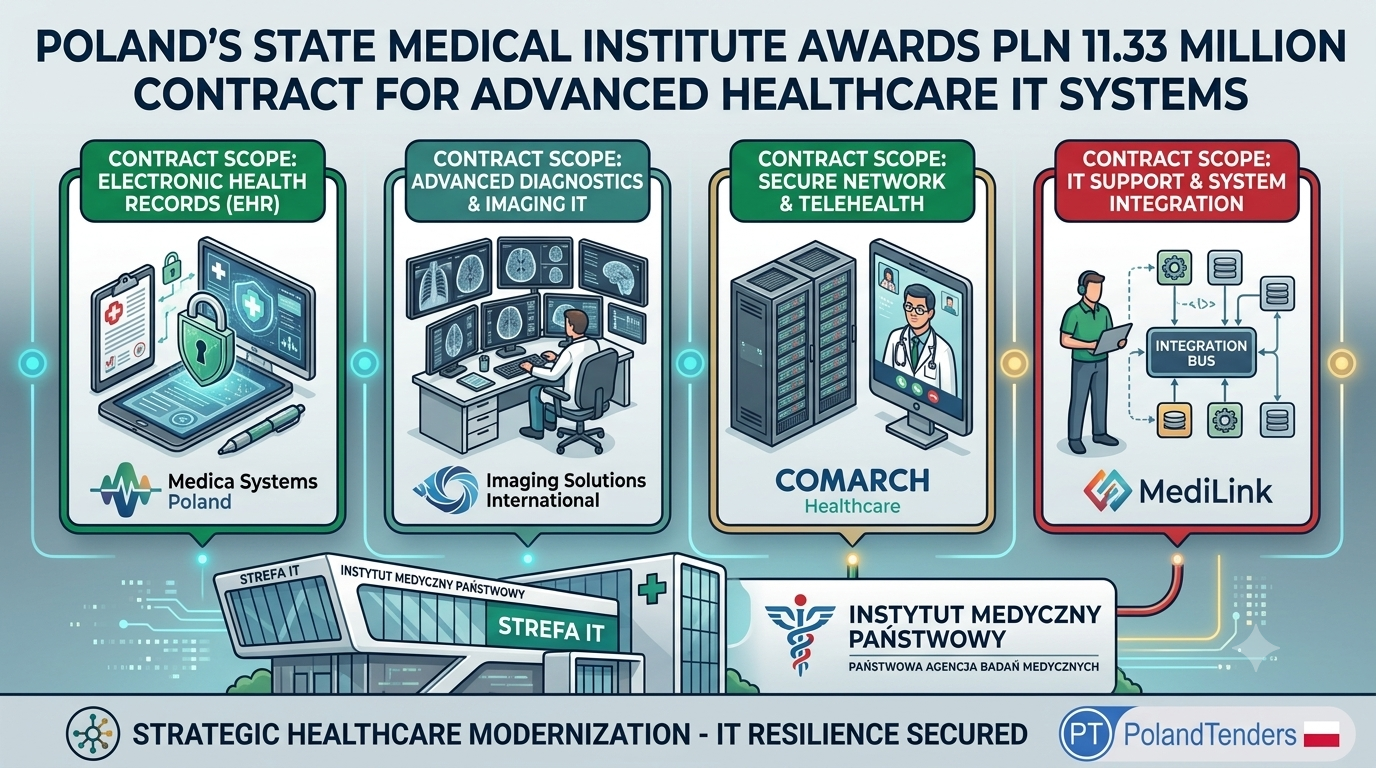
Poland's State Medical Institute Awards PLN 11.33 Million Contract for Advanced Healthcare IT Systems
10 Jul 2026
Standfirst Poland's State Medical Institute of the Ministry of the Interior and Administration has awarded a PLN 11.33 million contract to MEDICMIND Sp. z o.o. for advanced IT systems designed to support specialist outpatient clinics in Warsaw. The award offers a window into a broader shift in healthcare procurement: hospitals are increasingly investing not simply in software, but in digital infrastructure intended to improve how specialist services are managed and delivered. Introduction A modern specialist clinic depends on more than doctors, diagnostic equipment and treatment rooms. Behind every consultation sits an increasingly complex digital infrastructure that helps medical professionals manage information, coordinate services and support day-to-day clinical operations. In Warsaw, one of Poland's major state medical institutions is investing PLN 11.33 million in that less visible part of healthcare delivery. The Państwowy Instytut Medyczny Ministerstwa Spraw Wewnętrznych i Administracji, or State Medical Institute of the Ministry of the Interior and Administration, has selected Warsaw-based MEDICMIND Sp. z o.o. to supply and implement advanced IT systems supporting its specialist outpatient clinics. The contract is significant not only because of its value. It shows how digital healthcare procurement is moving beyond basic software acquisition towards implementation-heavy projects where technical capability and the experience of the people delivering the system can directly influence the outcome. Why This Contract Matters Healthcare digitalisation succeeds or fails at the point where technology meets clinical reality. A sophisticated IT system has limited value if doctors struggle to use it, if information cannot move efficiently through an institution, or if implementation disrupts rather than improves existing workflows. That is why this procurement deserves attention beyond its PLN 11.33 million price tag. The tender was evaluated using two criteria: price accounted for 60% of the score, while the experience of the contractor's personnel carried a substantial 40% weighting. That balance suggests the buyer was not simply looking for the cheapest software provider. It placed significant importance on the human expertise required to implement the technology. For healthcare IT suppliers, that is an important procurement signal. Proven implementation teams, demonstrable staff experience and sector-specific delivery capability can be nearly as important as pricing when competing for complex public-sector digital health contracts. Contract Timeline Previous TED Notice: 217991-2026 Contract Concluded: 26 June 2026 Award Notice Published: 10 July 2026 TED Notice ID: 477836-2026 Contract Overview The procurement covers the purchase and implementation of advanced IT systems supporting specialist outpatient clinics operated by the State Medical Institute of the Ministry of the Interior and Administration in Warsaw. The estimated contract value was PLN 11,699,187 excluding VAT. The notice records the value of the awarded contract at PLN 11,330,000. MEDICMIND Sp. z o.o., classified in the notice as a small enterprise, was selected as the winner. Two electronic tenders were received in total. The other identified participant was PLOMOTO Sp. z o.o., a micro-enterprise whose tender was not ranked and was recorded as inadmissible. Key Contract Details Detail Information Contracting Authority Państwowy Instytut Medyczny Ministerstwa Spraw Wewnętrznych i Administracji Winning Company MEDICMIND Sp. z o.o. Non-Winning Tenderer PLOMOTO Sp. z o.o. Country Poland Location Warsaw Sector Healthcare IT and software implementation Procedure Type Open procedure Estimated Value PLN 11,699,187 excluding VAT Awarded Contract Value PLN 11,330,000 Contract Date 26 June 2026 Tenders Received 2 Main CPV Code 72000000 - IT services: consulting, software development, Internet and support Additional CPV Codes 72200000 and 72500000 TED Notice ID 477836-2026 Project Scope The contract concerns the purchase and implementation of advanced IT systems intended to support the activities of the institute's specialist outpatient clinics. The TED notice does not disclose detailed technical specifications for individual software modules, integrations or clinical functionalities. Those requirements are referenced in the procurement specifications and description of the subject matter. What the notice does establish is that this is not merely a software licence purchase. Implementation forms an explicit part of the procurement, making the contractor responsible for helping translate the acquired technology into an operational system within a functioning healthcare environment. That distinction matters. In healthcare IT, the challenge is often not buying technology but integrating it into existing clinical and administrative workflows without creating new operational bottlenecks. About the Contracting Authority The Państwowy Instytut Medyczny Ministerstwa Spraw Wewnętrznych i Administracji is a public-law healthcare institution based in Warsaw. The procurement notice identifies health as its principal activity. As the buyer, the institute is responsible for procuring the advanced IT systems and implementation services covered by this contract. The project is to be performed in Warsaw, including at the institute's address on Wołoska Street. About the Organisations Involved MEDICMIND Sp. z o.o. - Winning Tenderer MEDICMIND Sp. z o.o., based in Warsaw, was selected as the winner of LOT-0001. The TED notice classifies the company as a small enterprise. Its tender was ranked first, and the awarded contract has a recorded value of PLN 11.33 million. The notice states that no subcontracting is involved. For procurement observers, the company's size is noteworthy. The award demonstrates that smaller technology companies can compete successfully for multimillion-zloty public healthcare IT contracts when they meet the required technical, commercial and personnel criteria. PLOMOTO Sp. z o.o. - Non-Winning Tenderer PLOMOTO Sp. z o.o., also based in Warsaw, participated in the competition and is classified as a micro-enterprise in the TED notice. Its tender was valued at PLN 900,000 but was not ranked. The procurement statistics show that one of the two tenders received was verified as inadmissible. However, the notice does not explicitly provide a detailed explanation linking the inadmissibility decision to a specific technical or legal deficiency, so no further conclusion should be drawn beyond the published information. This is exactly the kind of organisation that could easily disappear from a conventional award summary. From a procurement-intelligence perspective, however, identifying all disclosed bidders helps businesses understand the competitive landscape surrounding a public contract. Krajowa Izba Odwoławcza - Review and Mediation Organisation The Krajowa Izba Odwoławcza, Poland's National Appeals Chamber, is identified as both the review and mediation organisation for this procurement. Its role is not commercial and it did not participate in bidding. It provides the institutional mechanism through which eligible parties can challenge procurement decisions under Polish public procurement law. Urząd Zamówień Publicznych Departament Odwołań - Review Information Body The Appeals Department of Poland's Public Procurement Office is identified as the organisation providing additional information about review procedures. It plays an administrative role in the procurement system rather than participating in the commercial competition for the contract. Procurement Analysis The contract was awarded through an open procedure under Directive 2014/24/EU and Poland's Public Procurement Law of 11 September 2019. Competition was limited. Two tenders were submitted electronically, one from a small enterprise and one from a micro-enterprise. One tender was verified as inadmissible, leaving only one admissible offer in the competition. The evaluation model is particularly revealing. Price carried a 60% weighting, while the experience of the contractor's personnel accounted for the remaining 40%. For a technology implementation contract, that weighting recognises a practical reality: software alone does not deliver transformation. The expertise of the people configuring, implementing and adapting the system can materially affect whether the project works in practice. Additional Procurement Facts Legal Basis: Directive 2014/24/EU and Polish Public Procurement Law Nature of Contract: Services Framework Agreement: No Dynamic Purchasing System: No EU Funding: No EU funds involved GPA Coverage: No Price Weighting: 60% Personnel Experience Weighting: 40% Subcontracting by Winner: No Number of Complaints Recorded: 0 SME Participation: One tender was received from a micro, small or medium-sized enterprise Market & Industry Perspective Healthcare institutions across Europe are under pressure to modernise ageing digital infrastructure while managing growing patient volumes, more complex care pathways and rising expectations for connected health services. Contracts such as this sit at the intersection of healthcare delivery and digital transformation. They create opportunities not only for major global technology groups but also for specialised domestic software companies with deep knowledge of healthcare workflows and public-sector implementation requirements. The 40% weighting given to personnel experience is particularly relevant to the market. It suggests that future suppliers cannot rely solely on competitive pricing or technical product features. Buyers may increasingly demand evidence that the actual people assigned to a project have the experience needed to deliver in complex healthcare environments. Economic Significance At PLN 11.33 million, this is a substantial digital investment by a single Polish public healthcare institution. The awarded value is approximately PLN 369,187 below the estimated procurement value, a difference of about 3.2%. Yet the competitive picture is more complicated than that figure alone suggests, because only one of the two received tenders was admissible. The broader economic significance lies in the growing demand for healthcare software, implementation expertise, systems integration and specialist technical personnel. Each major hospital IT project can create a wider commercial ecosystem involving software developers, consultants, cybersecurity specialists, data experts, infrastructure providers and long-term support services. Future Procurement Opportunities The immediate notice does not disclose a future renewal timetable or confirm follow-on contracts. However, healthcare IT systems rarely operate as one-off purchases. Once deployed, they can generate future requirements involving maintenance, upgrades, integrations, cybersecurity, user support, additional modules and compatibility with new digital health infrastructure. Suppliers should therefore watch future procurement activity from the State Medical Institute as well as similar Polish healthcare authorities investing in specialist clinic systems, hospital information technology and digital patient services. Opportunities for Suppliers For healthcare software companies, this award highlights several areas of potential opportunity. Specialist clinical software providers can position themselves for future hospital digitalisation projects, while systems integrators may find demand for connecting new platforms with existing healthcare infrastructure. Cybersecurity companies, data specialists, cloud providers and technical support firms should also watch this market closely. Even when such services are not separately procured in the initial contract, complex healthcare IT systems often create downstream requirements during their operational life. The procurement also carries a practical lesson for smaller companies: size alone is not necessarily a barrier. The winner itself is classified as a small enterprise. What Businesses Should Watch Future healthcare IT procurements from PIM MSWiA and other Polish public hospitals. Tenders requiring proven experience from named implementation personnel. Software integration, cybersecurity and maintenance opportunities following major system deployments. Procurement notices involving CPV codes 72000000, 72200000 and 72500000. Whether public healthcare buyers continue giving significant evaluation weight to delivery-team experience rather than relying predominantly on price. Polandtenders.com Procurement Intelligence The most revealing feature of this contract is not the PLN 11.33 million award. It is the structure of the competition. Two companies entered. One tender was inadmissible. The remaining bidder secured the contract in a procurement where 40% of the evaluation depended on personnel experience. For suppliers, the lesson is clear: in specialist healthcare IT procurement, eligibility and delivery credentials can matter before price competition even begins. A low-priced offer has little commercial value if it fails admissibility requirements, while experienced implementation personnel can materially strengthen a bidder's competitive position. The award also illustrates an opening for specialised SMEs. Large technology groups do not automatically dominate every public-sector digital transformation contract. Smaller providers can compete where they combine technical capability, sector knowledge and demonstrable implementation experience. Future contracts may increasingly extend beyond initial system deployment into integration, cybersecurity, upgrades, support and data interoperability. Suppliers that track the original technology awards can position themselves earlier for these downstream opportunities rather than waiting until follow-on tenders are published. Supplier Takeaways Build verifiable healthcare IT implementation references before pursuing major public contracts. Pay close attention to admissibility requirements; failure at this stage can eliminate even a commercially aggressive bid. Develop experienced project teams whose credentials can be directly scored in procurement evaluations. Monitor healthcare IT awards for later integration, maintenance, cybersecurity and upgrade opportunities. Smaller technology companies should not assume that multimillion-zloty public contracts are reserved for large corporations. Key Takeaways Poland's State Medical Institute awarded a PLN 11.33 million healthcare IT contract to MEDICMIND Sp. z o.o. The project covers the purchase and implementation of advanced IT systems supporting specialist outpatient clinics. Two electronic tenders were received, but one was verified as inadmissible. MEDICMIND is classified as a small enterprise, demonstrating SME participation at a significant contract value. Price accounted for 60% of the evaluation and personnel experience for 40%. PLOMOTO Sp. z o.o., a micro-enterprise, was identified as the non-winning tenderer. The project is not financed by EU funds and is not covered by the Government Procurement Agreement. Conclusion The most important story behind this Polish healthcare IT award is not simply that a hospital bought software. It is that a public medical institution placed nearly as much emphasis on the experience of the people implementing the technology as it did on price. That reflects the reality of healthcare digitalisation: systems only create value when they work inside complex clinical environments. For technology suppliers, the contract offers another lesson. Smaller companies can win significant public-sector work, but success depends on more than offering software at the right price. Eligibility, implementation expertise and credible delivery teams can determine who remains in the competition long enough to win it. Frequently Asked Questions What is the value of the healthcare IT contract awarded by PIM MSWiA? The awarded contract value recorded in the TED notice is PLN 11.33 million. Who won the contract? MEDICMIND Sp. z o.o., a Warsaw-based company classified as a small enterprise, was selected as the winner. What will the contract deliver? The procurement covers the purchase and implementation of advanced IT systems supporting specialist outpatient clinics operated by the State Medical Institute of the Ministry of the Interior and Administration. How many companies submitted tenders? Two electronic tenders were received. MEDICMIND won the contract, while PLOMOTO Sp. z o.o. was identified as the non-winning tenderer. How was the winner evaluated? Price accounted for 60% of the evaluation, while the experience of the contractor's personnel accounted for 40%. Was the project financed by EU funds? No. The TED notice states that the procurement project is not financed with EU funds. What procurement rules governed the contract? The procurement was conducted under Directive 2014/24/EU and Poland's national Public Procurement Law. Why is this contract important for suppliers? It demonstrates that specialised SMEs can win substantial healthcare IT contracts and that implementation-team experience can carry significant weight in public procurement evaluations. Source: TED (Tenders Electronic Daily) - Official Contract Award Notice, Notice ID: 477836-2026.
View Details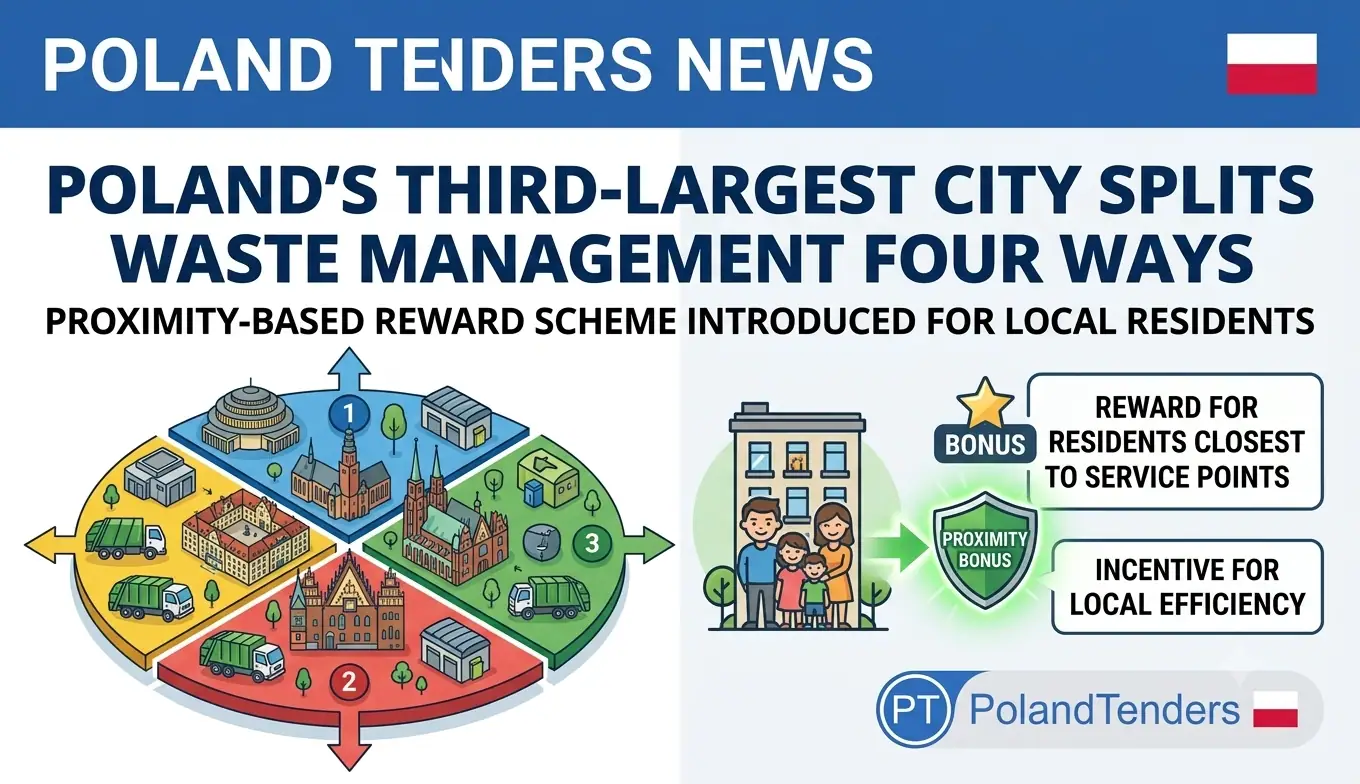
Poland's Third Largest City Just Split Its Entire Waste Problem Four Ways And Rewarded Whoever Lives Closest
09 Jul 2026
Łódź has locked in two years of waste processing worth over 258 million złoty across four companies, using a scoring system that pays contractors extra for staying close to the city, recycling more and burying less.StandfirstThe city of Łódź has awarded ten separate contracts, together worth more than 258 million złoty, to process the mixed household waste and biodegradable kitchen scraps its residents produce between February 2027 and January 2029. German waste giant Remondis took the largest share, followed by a Polish consortium, the Schwarz Group's PreZero and a small specialist biowaste firm that beat larger rivals for the city's food waste. The contract's scoring system rewards contractors for operating close to Łódź, recycling more and sending less to landfill, a live example of the EU's circular economy targets shaping how a city actually buys waste disposal services.IntroductionEvery city produces waste faster than most residents ever think about it and someone has to be paid, continuously, to make it disappear responsibly. Łódź, Poland's third largest city, just finished deciding who that someone will be for the next two years, splitting the job into ten pieces and handing them to four different companies.The details of how it made that decision and what it chose to reward say more about where European waste policy is heading than the tonnage figures alone ever could.Why This Contract MattersWaste processing contracts of this scale are essential, recurring infrastructure decisions: get them wrong and a city's rubbish either piles up or gets shipped further than it needs to travel, at greater cost and environmental impact. Get them right and a city can meaningfully improve its recycling performance and cut landfill use without residents noticing any change in their weekly collection.This contract also matters as a live illustration of EU environmental policy reaching into the fine print of a municipal tender. Łódź built financial rewards directly into its scoring system for contractors who recycle more, landfill less and process waste close to the city rather than trucking it across the country, exactly the outcomes the EU's waste and landfill rules are designed to encourage.Contract Timeline 22 June 2026, The earliest recorded contract conclusion date across the ten lots (Remondis' three contracts, parts I - III). 1 February 2027, The contracts' service period begins. 31 January 2029, All ten contracts are scheduled to end, marking a two year term. 8 July 2026, The result notice was dispatched for publication. 9 July 2026, The notice was published in the Official Journal of the EU (OJ S 130/2026). The notice references an earlier related notice, confirming this result follows an original tender announcement published separately.Contract OverviewŁódź ran a single open procedure, split into ten separately awarded lots, to secure processing capacity for two waste streams: unsegregated (mixed) municipal household waste and biodegradable kitchen waste. Bidders were free to tender for any single lot or any combination of lots, with each lot evaluated and awarded independently.Eight of the ten lots cover mixed municipal waste, split into differently sized batches, three lots of 45,000 tonnes each, four lots of 30,000 tonnes each and one lot of 21,000 tonnes, while the remaining two lots each cover 14,000 tonnes of biodegradable kitchen waste. Across the full two year contract term, that adds up to 276,000 tonnes of mixed waste and 28,000 tonnes of kitchen waste passing through the winning contractors' facilities.Key Contract Details Detail Information Contracting authority City of Łódź - Łódź City Hall (Miasto Łódź - Urząd Miasta Łodzi) Procedure title Processing of mixed municipal waste and biodegradable kitchen waste from Łódź, 1 February 2027 - 31 January 2029 Main CPV code 90500000 - Refuse and waste related services Additional CPV codes 90510000 - Refuse disposal and treatment; 90514000 - Refuse recycling services; 90533000 - Waste tip management services Procedure type Open procedure (not accelerated), 10 lots Total waste volume covered 276,000 tonnes mixed municipal waste; 28,000 tonnes biodegradable kitchen waste Contract duration 1 February 2027 - 31 January 2029 (2 years), all lots Award criteria (Lots I–VIII) Price (50 pts); recycling rate bonus (15 pts); reduced landfilling bonus (10 pts); proximity to Łódź (25 pts) Award criteria (Lots IX–X) Price (60 pts); R3 biowaste recovery rate bonus (15 pts); proximity to Łódź (25 pts) Total value of contracts awarded 258,133,000 PLN (excl. VAT) EU funding Not financed with EU funds GPA coverage Yes (all lots) Legal basis Directive 2014/24/EU Review body Krajowa Izba Odwoławcza (Poland's National Appeal Chamber) Distinct winning companies 4 Project ScopeContractors under this agreement take responsibility for processing waste collected across Łódź: unsegregated household waste under Polish waste code 20 03 01 and biodegradable kitchen waste under code 20 01 08. All facilities used to process the waste must belong to the winning contractor and the city explicitly evaluated how far each contractor's processing facility sits from Łódź's city boundary as part of its scoring.Beyond simple processing, the tender's technical requirements pushed contractors to commit to specific performance levels: for mixed waste, a minimum recycling and reuse preparation rate, plus a target for how much biodegradable material within that mixed waste avoids landfill altogether; for kitchen waste specifically, a minimum rate of material recovered through what waste engineers call the "R3" process, essentially recycling organic material back into usable resources such as compost or biogas rather than simply disposing of it.About the Contracting AuthorityThe City of Łódź, acting through Łódź City Hall's Public Procurement Department, is Poland's third largest city and the contracting authority for this tender. It is classified in the notice as a local authority with general public services as its main activity, consistent with a municipal government managing essential services on behalf of its residents.As the body legally responsible for managing the city's municipal waste under Polish and EU law, Łódź designed this tender's scoring system specifically to advance national and EU waste policy goals, higher recycling rates, less landfilling and shorter transport distances, rather than treating price as the only meaningful factor in choosing a contractor.About the Organisations InvolvedCity of Łódź - Łódź City Hall, BuyerBased on Piotrkowska Street in central Łódź, the city's Public Procurement Department structured this ten lot tender, evaluated all bids received and signed the resulting contracts with four separate winning companies.Krajowa Izba Odwoławcza, Review OrganisationPoland's National Appeal Chamber, based in Warsaw, is the designated review body for every lot in this tender, available to hear any formal challenge from an unsuccessful bidder under Poland's Public Procurement Law.Remondis Sp. z o.o., Winner of Lots I, II and IIIRemondis is based in Warsaw and classified as a large economic operator. It is the Polish arm of Remondis, one of Germany's largest waste management and recycling groups, with an international presence spanning dozens of countries. Remondis won all three of the largest individual lots in this tender, parts I, II and III, each covering 45,000 tonnes of mixed municipal waste, at 39,105,000 złoty per lot, facing two other bidders in each case. Its clean sweep of the tender's biggest lots reflects the scale of processing capacity a company of Remondis' size can bring to bear.Konsorcjum firm: FBSerwis Zielony Kamieńsk Sp. z o.o. / FBSerwis Zielony Wrocław Sp. z o.o., Winner of Lots IV, V and VIIIThis is a joint bidding consortium of two regional subsidiaries within the FBSerwis group, both registered at Kamieńsk in the Łódź region and classified together as a large economic operator. The consortium won three lots: parts IV and V, each covering 30,000 tonnes of mixed waste at 26,340,000 złoty per lot and part VIII, covering 21,000 tonnes at 18,438,000 złoty, facing a single competing bidder in each case.PreZero Service Centrum Sp. z o.o., Winner of Lots VI and VIIPreZero Service Centrum is based in Kutno, in the Łódź region and classified as a large economic operator. It is part of PreZero, the international waste management and recycling arm of Germany's Schwarz Group, the parent company of the Lidl and Kaufland retail chains, which operates hundreds of waste processing locations across Europe and North America. PreZero won two lots, parts VI and VII, each covering 30,000 tonnes of mixed waste at 25,890,000 złoty per lot, against two other bidders in each case.Bioodpady.pl Sp. z o.o., Winner of Lots IX and XBioodpady.pl is based in Warsaw and classified as a small economic operator, the only winner in this tender not designated large. It won both of the biodegradable kitchen waste lots, parts IX and X, each covering 14,000 tonnes at 8,960,000 złoty per lot. Notably, one of the two bids received for these lots came from a micro, small or medium enterprise, likely Bioodpady.pl itself, meaning a specialist smaller firm outcompeted the field for the tender's most specifically technical waste stream.Procurement AnalysisŁódź structured its award criteria to reward far more than the lowest price. For the eight mixed waste lots, price counted for half the available score, with the remaining half split between three technical bonuses: an extra 15 points for exceeding the minimum recycling and reuse preparation rate, up to 10 points for reducing how much biodegradable waste within the mixed stream ends up at landfill and up to 25 points, a full quarter of the total score, for operating a processing facility within 65 kilometres of the city's boundary. For the two biowaste lots, price counted for 60% of the score, with 15 points for exceeding a minimum organic recovery rate and 25 points again reserved for proximity.That proximity criterion carrying as much weight as price's largest single competitor is a clear policy signal: Łódź is willing to pay a premium, within limits, to keep its waste processed nearby rather than trucked long distances, reducing transport emissions and keeping the city less dependent on distant capacity.Competition varied sharply by lot type. The mixed waste lots each attracted two or three bidders, uniformly from large operators with no small or medium enterprise interest recorded. The two biowaste lots, by contrast, drew interest from a smaller specialist alongside a larger competitor and the smaller firm won both, evidence that niche organic waste processing remains a viable market for focused, smaller operators even where the broader mixed waste segment is dominated by scale players.All ten lots are confirmed covered by the WTO Government Procurement Agreement and not financed by EU funds and none of the lots involve a framework agreement or dynamic purchasing system, each is a standalone, directly awarded service contract for the full two year term.Additional Procurement FactsThe notice's overall stated value, 258,133,000 złoty, reconciles exactly with the sum of the ten individual lot values disclosed in the same document, a reassuring contrast to some other large multi lot notices, where headline totals and itemised figures do not always agree.One smaller inconsistency is worth flagging: the tender's own descriptive text states in one place that the contract covers 21,000 tonnes of biodegradable kitchen waste in total, while a separate passage in the same description states that the final two lots together cover 28,000 tonnes of kitchen waste, a figure that matches the two lots' individually disclosed volumes of 14,000 tonnes each. The 28,000 tonne figure appears to be the accurate one, consistent with the lot level detail; the 21,000 tonne reference elsewhere in the same procedure description appears to be a drafting inconsistency in the underlying Polish tender documentation.Market & Industry PerspectiveThis award is a snapshot of the waste management competitive landscape now active in Poland: German multinational Remondis and the Schwarz Group's PreZero, both established international players with deep processing capacity, sit alongside a Polish regional consortium and a small, focused domestic specialist and all four found a place to compete and win.For the broader European waste sector, the emphasis on proximity and recycling performance in the scoring formula reflects a wider trend among municipal buyers translating EU circular economy and landfill reduction policy directly into competitive scoring criteria, rather than treating environmental performance as a compliance checkbox separate from the commercial award decision.Economic SignificanceAt over 258 million złoty for two years of service, this is a substantial recurring cost for the city of Łódź and a meaningful, multi year revenue base for the four winning companies. Splitting the volume across ten lots and four different contractors also reduces the city's dependency on any single operator, a resilience consideration for a service residents rely on every week without exception.For Remondis, PreZero and the FBSerwis consortium, securing multiple lots each provides steady, contracted throughput for processing facilities that require continuous volume to operate efficiently. For Bioodpady.pl, winning both biowaste lots represents a significant win relative to its smaller scale, underscoring that specialised processing niches can support smaller operators even within a market otherwise dominated by large, diversified waste companies.Future Procurement OpportunitiesBecause all ten contracts run for a fixed two year term ending 31 January 2029, Łódź will need to retender this entire waste processing requirement again before that date, giving both incumbent winners and companies that did not win this round a clear future opportunity to compete again.Other Polish cities managing similar mixed waste and biowaste processing needs are likely to structure comparable multi lot tenders on similar cycles and the scoring formula used here, rewarding recycling performance, reduced landfilling and proximity, may increasingly become a template other Polish municipalities adopt as they align local waste tenders with national and EU recycling targets.Opportunities for Suppliers Specialist biowaste processors have a proven route to compete. Bioodpady.pl's win against a larger rival shows that focused organic waste expertise, rather than broad scale, can be decisive for kitchen waste specific lots. Facility location matters as much as price for a meaningful share of the score. Companies investing in processing capacity within Łódź's surrounding region gain a structural scoring advantage worth up to a quarter of the available points. Recycling and landfill diversion performance is directly monetised, not just regulatory box ticking; contractors that can credibly commit to higher recycling and lower landfill rates gain real points against competitors relying on price alone. Track the 2029 retender cycle now; with all ten contracts expiring simultaneously, early engagement with Łódź's procurement department ahead of the next tender could offer a meaningful head start. What Businesses Should WatchWatch how the four winning contractors perform against their declared recycling, landfill reduction and R3 recovery rate commitments over the two year term, since underperformance against declared targets could affect future competitiveness or trigger contractual consequences.Watch for Łódź's approach to retendering as the 2029 expiry approaches, particularly whether the city adjusts its scoring weights, especially the strong proximity criterion, in light of how this round's competitive dynamics played out.Watch the broader Polish municipal waste sector for similar tenders adopting comparable recycling and proximity weighted scoring formulas, particularly as national recycling targets under EU law continue to tighten.Polandtenders.com Procurement IntelligenceThis tender is a clear, well documented example of environmental policy being built directly into the mechanics of a public procurement scoring formula, rather than sitting alongside it as a separate compliance requirement. Rewarding proximity with up to a quarter of the total score and offering meaningful points for recycling performance and reduced landfilling, means a contractor cannot simply undercut competitors on price alone, it has to also commit credibly to environmental outcomes the city can hold it to over the following two years.The result, four different winners, ranging from a German multinational to a small Polish specialist, suggests this approach worked as intended, producing genuine competition rather than a single dominant winner sweeping every lot. That outcome is worth watching as other European cities design or redesign their own municipal waste tenders: a scoring formula that rewards specific measurable outcomes, rather than price and generic quality criteria, appears capable of supporting a genuinely diverse supplier base, including smaller specialists in niche categories like biowaste, alongside the large multinational operators that typically dominate this sector.For suppliers, the lesson is that environmental performance criteria in municipal waste tenders are no longer a minor tie breaker. In this tender, they represented as much or more of the available score as price itself and companies that can substantiate strong environmental commitments, not just competitive rates, are increasingly the ones taking home the largest lots.Supplier Takeaways Invest in facilities within the geographic radius municipal buyers are likely to reward; this tender's 65 kilometre proximity threshold for full points is a concrete benchmark worth benchmarking against. Build a credible, verifiable track record on recycling rates and reduced landfilling; these were worth a substantial share of the available score and are likely to recur in future Polish municipal waste tenders. Smaller, specialist operators should target niche waste streams, such as biodegradable kitchen waste, where scale advantages matter less and technical focus can be decisive. Prepare early for Łódź's 2029 retender, since all ten current contracts expire simultaneously, creating a single, large, predictable future competitive event. Key Takeaways Łódź awarded ten separate waste processing contracts worth a combined 258.1 million złoty, running from February 2027 to January 2029. Four companies won: Remondis (three lots), an FBSerwis consortium (three lots), PreZero Service Centrum (two lots) and small specialist firm Bioodpady.pl (two biowaste lots). The award formula gave up to a quarter of the total score to contractors operating close to Łódź, alongside meaningful points for recycling performance and reduced landfilling. The notice's total value reconciles exactly with its individual lot figures, though a minor inconsistency exists in the tender's own descriptive text regarding total kitchen waste volume. The mixed waste lots attracted competition exclusively from large operators, while the biowaste lots saw a smaller specialist firm win against larger competition. ConclusionŁódź did not simply buy the cheapest available waste disposal capacity for the next two years. It built a scoring system that pays for proximity, recycling performance and reduced landfilling and the result was a genuinely mixed field of winners, from a German multinational to a small Polish biowaste specialist. For a city managing an essential, unglamorous service that residents notice only when it fails, that is arguably the more interesting story than the tonnage or the total price alone.Frequently Asked QuestionsQ1. Why did Łódź split this tender into ten separate lots? Splitting the requirement by waste type and volume allowed different companies, including smaller specialists, to compete for individual portions rather than requiring one contractor to handle the city's entire waste stream.Q2. Why did proximity to the city carry so much weight in the scoring? Awarding up to 25 of 100 points for operating within a defined distance of Łódź reduces the environmental and logistical cost of transporting waste long distances, aligning the award criteria directly with sustainability goals rather than treating them as separate from the commercial decision.Q3. What is the "R3" process mentioned for biodegradable waste? R3 refers to a recognised waste recovery process, effectively recycling organic material back into usable resources, such as compost or biogas, rather than sending it to landfill or incineration without recovery.Q4. Why did a small company win the biowaste lots against larger competition? Bioodpady.pl, classified as a small economic operator, won both biodegradable kitchen waste lots, suggesting specialist expertise in this narrower waste category outweighed the scale advantages that larger operators held in the broader mixed waste segment.Q5. Is this contract financed by the EU? No. All ten lots are confirmed as not financed with EU funds, though all are covered by the WTO Government Procurement Agreement.Q6. How much waste does this contract actually cover? Across the full two year term, the contracts cover 276,000 tonnes of mixed municipal waste and 28,000 tonnes of biodegradable kitchen waste, according to the individual lot volumes disclosed in the notice.Q7. When will Łódź need to retender this waste processing requirement? All ten contracts are scheduled to run until 31 January 2029, meaning the city will need to run a new competitive process before that date to secure processing capacity beyond the current term. Source: EU Official Journal, Contract Award Notice 473062-2026, OJ S 130/2026, published 9 July 2026. Contracting authority: Miasto Łódź - Urząd Miasta Łodzi.
View Details
Poland Expands Hospital Medical Equipment Procurement to Strengthen Patient Care
08 Jul 2026
SP ZZOZ Kozienice split its single use medical equipment tender into dozens of small contracts, drawing in everyone from Polish family distributors to Olympus and Baxter and along the way cancelled one lot for lack of money and left at least one winner unnamed.StandfirstA public hospital in the Polish town of Kozienice has published the results of 42 separate contracts for single use medical equipment and consumables, part of a wider tender split into as many as 59 individual lots. The winners range from small Polish medical distributors to global names like Olympus, Baxter and GE Healthcare. One lot was cancelled outright because the hospital ran short of budget and the notice itself contains a striking, unexplained gap between its headline total value and the sum of the individual contracts it lists.IntroductionHospitals do not buy disposable medical supplies the way most people imagine government procurement working, as one giant contract signed with one big supplier. They often buy it item category by item category, sometimes dozens of separate contracts within a single tender, each covering one narrow slice of the products a hospital ward needs every day.This notice from SP ZZOZ Kozienice, a public healthcare provider in central Poland, is a clear illustration of that fragmented approach and a useful case study in exactly how granular hospital procurement can get.Why This Contract MattersDisposable medical supplies rarely make headlines. But they are what keep a hospital's daily operations running: syringes, dressings, catheters, surgical consumables, monitoring accessories and the dozens of other single use items clinical staff use every shift. Interruptions in this supply chain are felt immediately on hospital wards.Splitting a tender into dozens of narrow lots is a deliberate procurement strategy: it lets smaller, specialised suppliers compete for individual product categories rather than requiring one company to supply everything, widening the field of eligible bidders. This notice shows both the benefits of that approach, in the range of companies that won contracts and its limits, in the lot that had to be cancelled and the one whose winner was never clearly recorded.Contract Timeline 26 May 2026, The earliest recorded date on which a winner was chosen across the lots in this notice (Lot 1). 8 June 2026, The earliest recorded contract conclusion date (Lot 1). 7 July 2026, The result notice was dispatched for publication. 8 July 2026, The notice was published in the Official Journal of the EU (OJ S 129/2026). This notice references an earlier related notice (216126-2026), indicating it is a follow on publication reporting further results from the same wider tender, rather than the tender's original announcement.Contract OverviewSP ZZOZ Kozienice ran an open procedure to buy single use medical equipment and consumables, splitting the requirement into numbered lots, referred to in the Polish language notice as "Zadanie" (Task) 1 through at least 59. Each lot covers a distinct basket of disposable medical products, though the notice does not break out the specific items within each lot beyond a shared classification as medical equipment and consumables.This particular notice reports results for 42 of those lots. Of those, 41 have a named winner, one (Lot 2) was cancelled outright and one (Lot 48) confirms a winner was chosen but does not name the company in the notice's structured winner field. The remaining lot numbers within the 1–59 range not covered here were most likely addressed in the earlier linked notice or remain to be reported separately.Key Contract Details Detail Information Contracting authority Samodzielny Publiczny Zespół Zakładów Opieki Zdrowotnej w Kozienicach (SP ZZOZ Kozienice) Procedure title Supply of single use medical equipment for SP ZZOZ Kozienice Procedure type Open procedure (not accelerated) Main CPV code 33100000 - Medical equipments Additional CPV code 33140000 - Medical consumables Number of lots covered by this notice 42 (out of a wider tender split into numbered lots up to at least 59) Lot duration 24 months each Award criteria (per lot) Price (typically weighted 60%) and delivery time for partial deliveries (typically weighted 40%) Framework agreement None EU funding Not financed with EU funds GPA coverage Yes Legal basis Directive 2014/24/EU Review body Krajowa Izba Odwoławcza (Poland's National Appeal Chamber) Lots with no winner 1 (Lot 2, cancelled due to insufficient buyer funds) Lots with an unnamed winner 1 (Lot 48, winner selected but not identified in the notice) Distinct winning companies identified 26 Project ScopeEvery lot in this tender covers single use medical equipment and consumables, the disposable products hospitals purchase on an ongoing basis rather than durable capital equipment. Each lot runs for a 24 month supply period and is awarded on a mix of price and delivery reliability for partial, staggered deliveries, reflecting how hospitals typically draw down disposable supplies gradually against an agreed contract rather than taking one bulk delivery upfront.The lots vary enormously in scale. The smallest recorded winning tender in this notice, Lot 30, was worth just 534.60 złoty, a few hundred euros, while the largest, Lot 16, won by Olympus Polska, was valued at over 2.25 million złoty, suggesting a specialised or higher value product category such as endoscopic or optical medical equipment, an area where Olympus is a globally recognised manufacturer.About the Contracting AuthoritySP ZZOZ Kozienice, the Independent Public Complex of Healthcare Facilities in Kozienice, is a public hospital and healthcare provider based in Kozienice, a town in Poland's Mazovian region. It is classified in the notice as a body governed by public law with health as its main activity, the standard designation for a Polish public hospital.The hospital ran this tender through its own public procurement and supply department and this notice represents one instalment in what appears to be an ongoing, staggered publication of results across a large, multi lot tender rather than a single, one off award event.About the Organisations InvolvedGiven the scale of this tender, 42 separate lot results involving 26 distinct winning companies, this section profiles the buyer, the review body and the suppliers that won multiple lots, then summarises the remaining single lot winners in a consolidated table.SP ZZOZ Kozienice, BuyerBased in Kozienice, this public hospital structured the tender, evaluated bids lot by lot and signed the resulting supply contracts. Running a single tender split into dozens of lots, rather than one aggregated contract, reflects a deliberate choice to widen competition across many niche categories of disposable medical products.Krajowa Izba Odwoławcza, Review OrganisationPoland's National Appeal Chamber, based in Warsaw, is named as the review body for every lot in this tender. It did not participate in the award decisions; its role is to hear any formal appeal a bidder might file under Poland's Public Procurement Law, should it believe a specific lot award was handled unlawfully.ZARYS INTERNATIONAL Sp. z o.o., Winner of Seven LotsBased in Zabrze and classified as a large economic operator, Zarys International was the most successful bidder in this notice by lot count, winning seven separate lots (Lots 17, 18, 25, 36, 39, 49 and 59) at a range of contract values from just over 500 złoty to nearly 11,000 złoty per lot. Its breadth of wins across many small, distinct lots suggests a supplier with a wide product catalogue spanning multiple categories of disposable medical consumables.SKAMEX Spółka Akcyjna, Winner of Four LotsBased in Łódź and also classified as large, Skamex won four lots (27, 28, 33 and 40), including one of the notice's higher value awards, Lot 28, worth over 344,000 złoty. Like Zarys, its multi lot success points to a diversified disposable products portfolio capable of competing across several distinct procurement categories within the same tender.BIALMED Sp. z o.o., Winner of Three LotsBased in Warsaw and classified as large, Bialmed won three lots (11, 30 and 34), at values ranging from just over 500 złoty to around 12,000 złoty, indicating participation in relatively low value, high frequency consumable categories.SUN-MED SPÓŁKA CYWILNA, Winner of Three LotsBased in Łódź and classified as a micro enterprise despite winning three separate lots (14, 26 and 55), Sun-Med's contracts ranged up to roughly 219,000 złoty for its largest award, Lot 14, a reminder that smaller Polish suppliers can and do compete successfully for meaningful contract values in this fragmented lot structure.COOK MEDICAL Sp. z o.o., Winner of Two LotsBased in Warsaw, Cook Medical, the Polish arm of the globally recognised medical device manufacturer, won two lots (29 and 50), including one of the larger individual awards in the notice, Lot 29, valued at 621,540 złoty.Other Winning Suppliers (One Lot Each)The remaining 20 lots with a named winner went to single lot winners, a mix of Polish distributors and Polish subsidiaries of international medical device manufacturers: Winning Company Lot Value (PLN) PROMED S.A. 1 191,294.02 MEDIA MED Sp. z o.o. 4 8,856.00 ERMED MEDICAL EQUIPMENT SERVICE PUH 5 196,199.28 Lubmedical Sp. z o.o. Sp. k. 10 122,141.52 CEDICAL Sp. z o.o. 15 43,416.00 OLYMPUS POLSKA Sp. z o.o. 16 2,253,506.40 BAXTER POLSKA Sp. z o.o. 19 19,440.00 ADVANCE EUROPE Biuro Techniczno Handlowe Sp. z o.o. 21 8,029.80 Pajunk Medical Produkte GmbH 22 5,602.61 EUMed Sp. z o.o. 24 24,211.24 Corza Medical GmbH 31 37,680.00 BERYL MED POLAND Sp. z o.o. 32 29,044.05 GE Medical Systems Polska Sp. z o.o. 38 36,487.80 SALUS INTERNATIONAL Sp. z o.o. 41 351,392.04 FRESENIUS MEDICAL CARE POLSKA S.A. 42 68,067.00 Edwards Lifesciences Poland Sp. z o.o. 43 127,116.00 Varimed Sp. z o.o. 45 84,240.00 BALTON Sp. z o.o. 46 3,591.00 POL-MED Paweł Jabłonka 47 29,376.00 ANMAR Sp. z o.o. 53 263,477.67 Arthrex Polska Sp. z o.o. 58 157,865.04 Several of these, Baxter, GE Medical Systems, Edwards Lifesciences, Arthrex and the German suppliers Pajunk Medical Produkte and Corza Medical, are Polish subsidiaries or direct suppliers for internationally known medical device manufacturers, indicating that even narrowly scoped lots in a mid sized Polish hospital tender attract global manufacturers alongside domestic distributors.Procurement AnalysisThe open procedure, split into dozens of narrow lots, is a common approach for hospitals buying disposable supplies precisely because it lowers the barrier to competition: a small, specialised distributor can realistically win a single lot worth a few thousand złoty without needing the scale to supply a hospital's entire consumables catalogue.Lot 2 was cancelled, with the stated reason recorded as the buyer's decision due to insufficient funds, despite receiving two tenders. This is a meaningful data point: it confirms the hospital received competitive interest but ultimately judged the bids unaffordable within its budget, rather than the lot failing for lack of supplier interest, a distinct and more common scenario in fragmented hospital tenders than the zero bid outcomes seen elsewhere in public procurement.Lot 48's winner is not named in the notice's structured data. The record confirms a winner was chosen and shows a tender value of 145,800 złoty and lists a non winning bidder, Meden Inmed Sp. z o.o., but the field identifying the successful company is absent. The contracting authority has not disclosed this information in the published notice.Across the lots with statistical detail, the overwhelming majority received only a single tender, with a handful attracting two or three bids. That pattern is typical of highly specific, low value consumable lots, where often only one or two suppliers stock the precise product specified.Additional Procurement FactsThe notice states that the total value of all contracts awarded in this notice is 601,618,443.43 złoty. That figure is dramatically higher, by more than a hundredfold, than the combined value of the individual lot tenders disclosed elsewhere in the same notice, which sum to approximately 5.84 million złoty. The notice does not explain this discrepancy and readers should treat the headline aggregate figure with caution pending clarification from the contracting authority; the lot by lot figures, which are individually itemised and consistent with the scale of a single use consumables tender, appear the more reliable guide to this notice's actual scope.All 42 lots covered in this notice share the same procedural backbone: 24 month contract terms, no framework agreement, no dynamic purchasing system and Poland's National Appeal Chamber as the designated review body, confirming this is one coordinated tender exercise reported across multiple result notices rather than unrelated, separately run competitions.Market & Industry PerspectiveFor Poland's medical consumables distribution sector, this tender illustrates how hospital procurement at this scale supports a genuinely mixed market: large, diversified Polish distributors like Zarys International and Skamex sit alongside micro enterprises like Sun Med and both compete directly against the Polish arms of global manufacturers such as Baxter, GE Healthcare, Edwards Lifesciences and Arthrex.That diversity is a direct product of the lot splitting strategy. A single combined tender covering all these product categories would likely favour only the largest, most diversified distributors capable of supplying everything at once. Splitting the requirement into dozens of narrow lots instead allows specialist and small suppliers a genuine route to winning public hospital business.Economic SignificanceIndividually, most of these lots are modest, several are worth just a few hundred or a few thousand złoty. Collectively, however, they represent a hospital's entire disposable supply chain for a two year period, spanning dozens of distinct product categories essential to daily clinical operations. The cancellation of Lot 2 for lack of funds is a reminder that even routine, unglamorous consumable contracts are subject to real budget constraints inside Polish public hospitals.For the winning suppliers, particularly the smaller, single lot winners, contracts of this kind, even at modest individual value, provide a meaningful and recurring revenue stream from the public hospital sector over a 24 month term.Future Procurement OpportunitiesWith lot numbers extending to at least 59 and only 42 covered here, further result notices from this same tender are likely to follow, covering the remaining lots not yet reported. Suppliers active in Polish hospital consumables procurement should watch for those follow on notices.Because each lot runs for 24 months, the next competitive opportunity for any given product category will emerge as that term approaches expiry, giving suppliers a predictable, recurring window to compete again, including the now cancelled Lot 2, which the hospital will likely need to retender once its budget position allows.Opportunities for Suppliers Specialise rather than generalise. The tender's lot structure rewards suppliers who can win narrowly defined categories rather than requiring a full catalogue offering, a genuine opening for small and micro distributors. Watch for the cancelled Lot 2 to reappear. A retender is likely once the hospital's budget position improves and suppliers who bid previously already have a documented track record with this buyer. Track the remaining, unreported lots. With the tender extending to at least 59 lots and only 42 addressed here, further award notices covering the outstanding lots should be expected. Approach multi lot winners as potential subcontracting or distribution partners if direct competition for specific lots is not viable, particularly firms like Zarys International and Skamex that appear to supply across a wide range of consumable categories. What Businesses Should WatchWatch for the hospital's response to Lot 2's cancellation; whether it retenders quickly, revises the specification or delays the category entirely will signal how tightly its 2026 procurement budget is constrained.Watch for a correction or clarification regarding Lot 48's unnamed winner and the notice's unexplained total value discrepancy; either could prompt a corrigendum notice from the contracting authority.Watch for the remaining unreported lots in the 1–59 range; their eventual publication will complete the picture of this hospital's full disposables procurement for the current contract cycle.PolandTenders.com Procurement IntelligenceThis notice is a useful reminder that not every public procurement story is about a single large winner. Fragmented, many lot tenders like this one are how a meaningful share of Europe's hospital supply chain is actually procured, category by narrow category and they function as a deliberate mechanism for keeping smaller and specialised suppliers competitive against larger, more diversified distributors.The data irregularities in this notice, a headline total value that bears no obvious relationship to its own itemised lot figures and a winner left unnamed on a lot the buyer confirms was awarded, are also worth flagging as a broader point about procurement transparency. Large multi lot tenders generate correspondingly large volumes of structured data and errors or omissions of this kind, whatever their cause, make it harder for suppliers, auditors and researchers to verify exactly how public money moved. A hospital cancelling a lot for lack of funds is normal and disclosed; a nine figure discrepancy in a notice's own summary total is not something suppliers should simply wave away.For businesses in this space, the lesson is to engage with these tenders at the lot level, not the headline level: the real competitive intelligence sits in which specific categories a given supplier won, at what price and against how many competing bids, not in an aggregate figure that this notice itself does not appear to support.Supplier Takeaways Treat each lot as its own competitive opportunity; success in this tender clearly does not require supplying every product category the hospital buys. Prepare for a likely retender of Lot 2 once the hospital's budget allows and consider that insufficient funds, not lack of competition, was the stated reason for its cancellation. Watch for further result notices from the same tender covering lots beyond the 42 addressed here. Where notice data looks inconsistent, such as the aggregate value discrepancy or an unnamed winner, consider raising a clarification request with the contracting authority rather than assuming the published figures are complete. Key Takeaways SP ZZOZ Kozienice published results for 42 lots of single use medical equipment and consumables, part of a wider tender extending to at least 59 lots. 26 distinct companies won contracts, ranging from large Polish distributors like Zarys International and Skamex to global manufacturers' Polish arms such as Baxter, Olympus and GE Healthcare. One lot (Lot 2) was cancelled due to the buyer's insufficient funds despite receiving two tenders. One lot (Lot 48) confirms a winner was chosen but does not name the company in the notice. The notice's stated total contract value, 601.6 million złoty, is dramatically inconsistent with the sum of its own itemised lot values, roughly 5.84 million złoty, a discrepancy the notice does not explain. ConclusionHospital procurement rarely looks like a single dramatic contract signing. More often, as this notice shows, it looks like dozens of small, specific decisions made lot by lot, category by category, spread across a wide field of Polish and international suppliers. The story here is not one company's big win, but a functioning, fragmented market for hospital consumables, with all the ordinary friction, budget limits and paperwork gaps that come with running dozens of contracts at once.Frequently Asked QuestionsQ1. Why did the hospital split this tender into so many separate lots? Splitting large procurement requirements into narrow lots lets smaller, specialised suppliers compete for individual product categories, rather than requiring one company to supply the hospital's entire range of disposable medical products.Q2. Why was one lot cancelled? Lot 2 was cancelled because the buyer decided it had insufficient funds to proceed, even though two tenders were received. The contracting authority has not disclosed further detail on its budget position.Q3. Why doesn't the notice name the winner of Lot 48? The notice confirms a winner was chosen for this lot and records a tender value, but the field identifying the winning company is not populated. The contracting authority has not disclosed this information.Q4. Why is the notice's total contract value so much higher than the sum of its individual lots? This is not explained in the notice. The stated total of 601.6 million złoty is far higher than the roughly 5.84 million złoty that results from adding up the individual lot values disclosed in the same document and represents an unresolved discrepancy in the published data.Q5. Are these contracts open to suppliers outside Poland? Yes. The lots are confirmed as covered by the WTO Government Procurement Agreement and several winners are Polish subsidiaries of international manufacturers, including German suppliers Pajunk Medical Produkte and Corza Medical.Q6. How long do these contracts run? Each lot covered in this notice runs for 24 months.Q7. Will more lots from this tender be published later? Likely. The tender extends to at least 59 numbered lots and this notice covers only 42 of them, alongside a previous related notice. Further result notices covering any remaining lots should be expected. Source: EU Official Journal, Contract Award Notice 468301-2026, OJ S 129/2026, published 8 July 2026. Contracting authority: Samodzielny Publiczny Zespół Zakładów Opieki Zdrowotnej w Kozienicach.
View Details