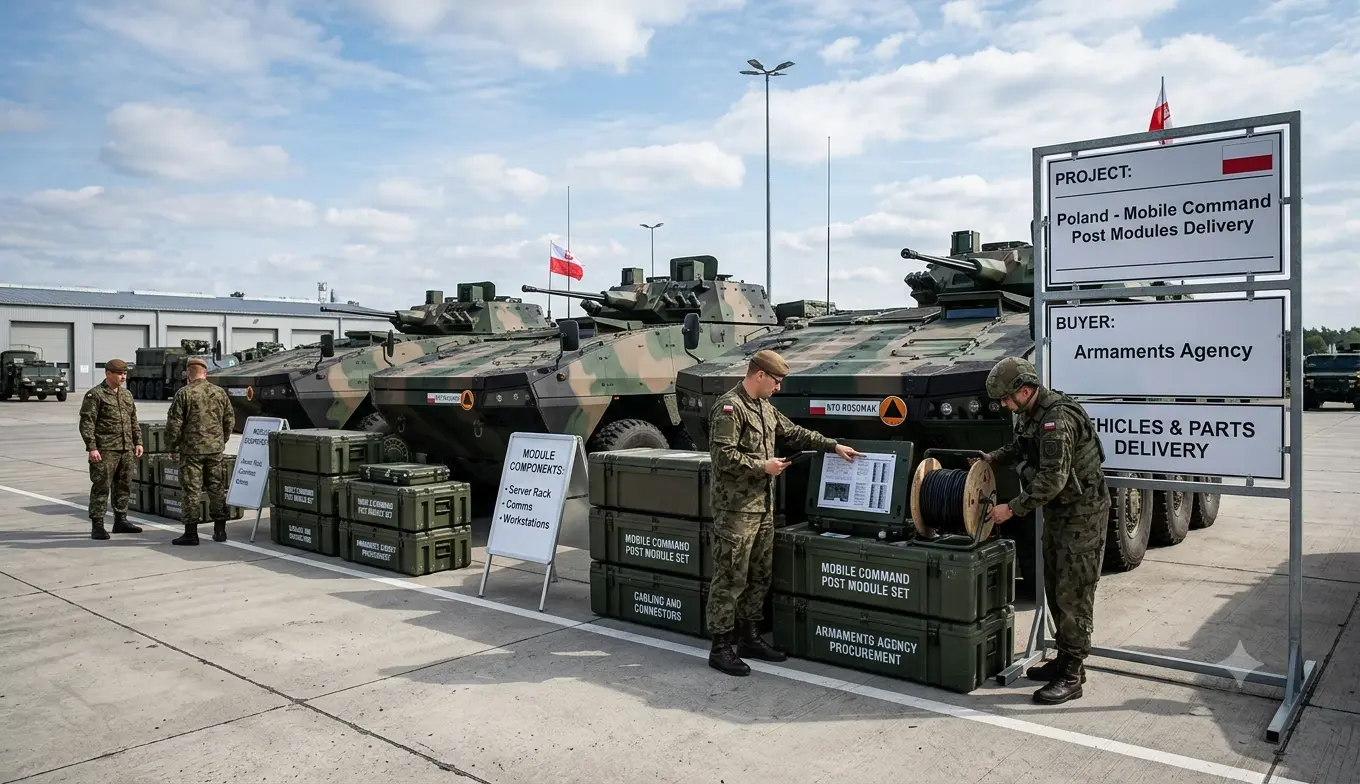
Poland Military Command Post Modules Procurement Closes Without Award
08 Oct 2026
Standfirst Poland's Agencja Uzbrojenia launched a procurement for Mobile Command Post Module Sets with cabling to support highly mobile military command and communications capabilities. The procurement covered small, medium and large module configurations based on 20-foot containers designed for deployment on high-mobility military vehicles and transport trailers. Despite the strategic nature of the requirement, the single-lot competition closed without an award because no tenders, requests to participate or projects were received. The result was published in the Official Journal of the European Union under TED notice 694694-2026. Introduction Poland's defence procurement programme has highlighted the continuing importance of mobile command, communications and field-support infrastructure for military operations. A recent procurement conducted by Agencja Uzbrojenia sought suppliers capable of delivering Mobile Command Post Module Sets, known in the notice as MMSD sets, together with the required cabling. The requirement was designed around highly mobile containerised infrastructure. The planned systems were to use 20-foot containers that could be transported using high-mobility off-road military trucks and transport trailers. The specification also called for hydraulic self-levelling and loading systems, expandable working areas, secure telecommunications capabilities and environmental control systems. However, the procurement did not reach the contract award stage. TED records that the single lot was closed with no winner because no tenders, requests to participate or projects were received. This makes the notice significant not because of an awarded contract value but because it reveals a technically demanding defence requirement and a procurement opportunity that may need to be reconsidered or brought back to market in the future. Why This Procurement Matters Mobile command infrastructure is a critical component of modern defence communications. Command units need to operate away from permanent military facilities while maintaining secure communications, operational coordination and access to multiple information networks. The Polish requirement goes beyond the supply of ordinary transportable shelters. The planned MMSD systems were expected to combine mobility, expandable workspace, telecommunications infrastructure, power supply, climate control, filtration and technical support functions within a modular containerised architecture. The procurement also required the command containers to support up to four telecommunications networks with different security classifications. This indicates that interoperability, secure communications and the ability to operate in demanding field environments were important elements of the planned solution. The unsuccessful competition is therefore relevant to suppliers in military vehicles, deployable command systems, tactical communications, containerised infrastructure, military electronics, power systems and specialist engineering. The absence of tenders does not remove the underlying operational requirement. Instead, it may indicate that the market should monitor Poland's future procurement activity for a revised or renewed requirement. Contract Timeline Previous TED notice: 338523-2024. Internal procurement identifier: AU/39/V/2024. Procedure: Negotiated with prior publication of a call for competition / competitive with negotiation. Result: No winner was chosen and the competition was closed. Reason for closure: No tenders, requests to participate or projects were received. Notice dispatch date: 7 October 2026. TED publication: 694694-2026. Official Journal issue: OJ S 195/2026. Publication date: 8 October 2026. Contract Overview The procurement concerned the delivery of Mobile Command Post Module Sets with cabling. The notice describes three possible configurations: small, medium and large sets. The systems were to be built around 20-foot containers and configured for high mobility. The procurement consisted of one lot, identified as LOT-0001. The main CPV classification was 35400000, Military vehicles and associated parts. The additional CPV classification was 32520000, Telecommunications cable and equipment. The place of performance was Zegrze in the Warszawski wschodni NUTS region of Poland. The procurement was classified as a supply contract and was conducted under a defence procurement framework referencing Directive 2009/81/EC and Polish public procurement legislation. Key Contract Details TED notice694694-2026 OJ S issue195/2026 Publication date8 October 2026 CountryPoland BuyerAgencja Uzbrojenia Buyer activityDefence ProcurementMobile Command Post Module Sets with cabling Contract natureSupplies ProcedureNegotiated with prior publication of a call for competition / competitive with negotiation Number of lotsOne Main CPV35400000 - Military vehicles and associated parts Additional CPV32520000 - Telecommunications cable and equipment Performance locationZegrze, Poland Award criteriaPrice 95 points; guarantee 5 points Framework agreementNo WinnerNone OutcomeCompetition closed without award ReasonNo tenders, requests to participate or projects received Project Scope The planned MMSD systems were intended to provide mobile command-post infrastructure for military users. The notice specifies that the sets should be based on 20-foot containers and designed for deployment on high-mobility off-road truck chassis and transport trailers. Each container was expected to include a hydraulic self-levelling system. This system was intended to allow the container to be loaded onto or unloaded from a military truck or trailer without the use of lifting equipment. It would also allow the container to be levelled when deployed on uneven terrain. The command containers were required to provide expandable internal workspace. The specification called for automatic or manual extension of two side modules to create an internal working area capable of accommodating between 12 and 16 personnel. The systems were also expected to support the deployment of up to four telecommunications networks with different security classifications. This requirement makes the communications architecture a central part of the procurement rather than a secondary feature. Other containers within the overall set were expected to perform supporting technical and operational functions. These included a conference room, social or welfare area, power station, IP equipment room and cabling room. Environmental conditions were also addressed. Containers intended for personnel workspaces were expected to have heating, air conditioning and filtration and ventilation systems. Together, these requirements indicate that the planned equipment was intended for sustained field deployment rather than temporary shelter use. About the Contracting Authority Agencja Uzbrojenia was identified as the buyer and contracting authority. The organisation is classified in the notice as a body governed by public law and its contracting activity is identified as defence. The relevant department is the Szefostwo Dowodzenia i Łączności, or Command and Communications Directorate. The buyer's registered address in the notice is ul. Królewska 1/7, 00-909 Warszawa, Poland. The notice also identifies Agencja Uzbrojenia as the organisation responsible for providing additional information on review procedures. About the Organisations Involved The procurement documentation identifies several organisations in different roles. Agencja Uzbrojenia is the buyer and the organisation providing information on review procedures. Its procurement activity is focused on defence and the notice records its Command and Communications Directorate as the relevant department. Krajowa Izba Odwoławcza is identified as the review organisation. The organisation is based in Warsaw and is responsible for the review function associated with the procurement process. The notice provides information concerning appeal deadlines under Article 515 of the Polish Public Procurement Law. The Publications Office of the European Union is identified as the TED eSender organisation. It is responsible for the publication infrastructure through which the procurement result notice was made available through TED. Procurement Analysis The most important procurement fact is the absence of competition. TED records that no tenders, requests to participate or projects were received for the single lot. As a result, no supplier was selected and no contract value was reported. The use of a negotiated procedure with prior publication of a call for competition indicates that the contracting authority was seeking a market-based solution for a technically complex defence requirement. Such procedures can be appropriate where the contracting authority expects discussions or refinement around complex technical, operational or performance requirements. The award criteria were weighted heavily toward price, with 95 points assigned to price and five points to guarantee. Although the technical specification was extensive, the published result notice does not indicate that any supplier reached the evaluation stage because no tenders were received. The lack of participation may therefore be particularly relevant for future market engagement. Potential suppliers would need to evaluate whether they can deliver the complete system rather than isolated components. The requirement combines vehicle mobility, container engineering, hydraulic handling, communications infrastructure, power, climate control and field deployment capabilities. Additional Procurement Facts The procurement had one lot. The internal identifier was AU/39/V/2024. The previous TED notice referenced by the procurement was 338523-2024. The main CPV was 35400000 for military vehicles and associated parts. The additional CPV was 32520000 for telecommunications cable and equipment. The procurement location was Zegrze in the Warszawski wschodni NUTS region. The contract nature was supplies. The procedure was negotiated with prior publication of a call for competition / competitive with negotiation. Price accounted for 95 points. Guarantee accounted for five points. No framework agreement was used. No winner was selected. No tenders, requests to participate or projects were received. Market & Industry Perspective The requirement illustrates the convergence of several defence procurement markets. A supplier participating in a future version of the requirement may need expertise in military mobility, containerised infrastructure and secure communications rather than only one conventional product category. The combination of 20-foot containers with high-mobility vehicles and trailers creates an engineering challenge involving weight, structural integrity, deployment time and field survivability. The hydraulic loading and self-levelling requirement also means that mobility extends beyond transportation to the process of establishing an operational command post. The telecommunications requirements add another layer of complexity. The ability to deploy multiple networks with different security classifications means that suppliers must understand secure communications environments and the physical infrastructure required to support them. For the wider European defence supply chain, such requirements can create opportunities for prime contractors, specialist subsystem manufacturers, military vehicle suppliers, communications companies, container manufacturers and systems integrators. Economic Significance No contract value was awarded because the competition received no tenders or requests to participate. Therefore, the notice does not provide an awarded financial value that can be used to measure the size of the contract. Nevertheless, the procurement demonstrates demand for specialised defence infrastructure in Poland. Future procurement activity associated with mobile command systems could generate opportunities across multiple technology and manufacturing segments. For suppliers, the commercial importance lies in the potential recurrence of the requirement rather than in an awarded value in this particular notice. Companies able to offer integrated solutions may be better positioned if the requirement is relaunched or modified. Future Procurement Opportunities The closure without an award does not establish that the underlying operational requirement has disappeared. However, the TED notice itself does not state whether or when a new procedure will be launched. Suppliers should therefore avoid assuming that a re-tender will occur on a specific timetable. Companies interested in this market should monitor future Polish defence procurement notices for terms associated with mobile command posts, command-and-control infrastructure, military containers, tactical communications, field headquarters, deployable communications and military vehicle integration. Specialist suppliers should also consider partnership strategies. A future requirement with similar characteristics could require a combination of container engineering, vehicle integration, telecommunications, power systems, environmental systems and secure network deployment. Opportunities for Suppliers Military vehicle manufacturers: assess integration opportunities for high-mobility vehicle platforms and transport systems. Container and modular infrastructure companies: develop deployable command and technical modules suitable for military operations. Telecommunications suppliers: provide secure cabling and network infrastructure compatible with multiple security classifications. Systems integrators: combine vehicle, container, power, communications and environmental subsystems into a complete solution. Hydraulic equipment specialists: address self-loading, unloading and levelling requirements. Power-system suppliers: support deployable power-station requirements for field command environments. Defence engineering companies: explore consortium or partnership models where a single company cannot provide the entire solution. What Businesses Should Watch Businesses tracking this market should watch Polish defence procurement announcements for any new requirement derived from the MMSD concept. Particular attention should be paid to changes in technical specifications, qualification requirements, participation conditions, procurement procedure and evaluation criteria. Suppliers should also monitor whether future procurement separates the requirement into multiple lots. The current notice placed the entire requirement into one lot, which may have required participants to provide or coordinate a broad range of capabilities. Another important factor is the balance between price and technical requirements. The published criteria allocated 95 points to price and five points to guarantee. Any future procedure could retain or modify this approach, depending on the contracting authority's assessment of market conditions and operational requirements. PolandTenders.com Procurement Intelligence This procurement represents a broader defence procurement trend toward mobile, modular and network-enabled military infrastructure. Modern command capabilities increasingly require equipment that can move with operational units while preserving secure communications, environmental protection, power availability and sufficient workspace. The unsuccessful procurement is strategically important because it highlights a potential gap between a sophisticated public-sector requirement and available or willing market participation. When a technically demanding defence requirement attracts no tenders, suppliers and contracting authorities both gain an important market signal. The issue may relate to technical complexity, commercial risk, qualification barriers, contract structure, participation requirements or the ability of individual companies to deliver an integrated solution. For suppliers, the notice demonstrates the importance of monitoring procurement requirements before the formal tender stage. Companies that can identify a future requirement early can evaluate the technical specification, build partnerships, prepare compliance documentation and determine whether a consortium is necessary. Defence suppliers should not assume that expertise in one subsystem will automatically translate into eligibility for an integrated procurement. Future opportunities could develop around mobile command posts, tactical communications, military containers, field power systems, secure network infrastructure and vehicle-mounted command facilities. Suppliers should position themselves by mapping their capabilities against the full operational requirement and tracking subsequent Polish and European defence procurement notices for similar CPV codes and terminology. Supplier Takeaways The procurement concerned Mobile Command Post Module Sets with cabling for Poland's defence sector. The requirement combined containerised infrastructure with military mobility and communications capabilities. The procurement used one lot. The procedure was negotiated with prior publication of a call for competition / competitive with negotiation. Price represented 95 points while guarantee represented five points. No tenders, requests to participate or projects were received. No winner was selected and no contract was awarded. The lack of participation creates an important market signal for suppliers capable of providing integrated defence solutions. Potential suppliers should monitor future Polish procurement activity for similar mobile command and communications requirements. Key Takeaways Buyer: Agencja Uzbrojenia, Poland. Procurement: Mobile Command Post Module Sets with cabling. Sector: Defence. Main CPV: 35400000, Military vehicles and associated parts. Additional CPV: 32520000, Telecommunications cable and equipment. Location: Zegrze, Poland. Lot structure: One lot. Award result: No winner. Reason: No tenders, requests to participate or projects were received. Contract value: No awarded value reported. Conclusion Poland's procurement for Mobile Command Post Module Sets demonstrates the complexity of modern defence infrastructure requirements. The planned systems were expected to combine highly mobile containerised facilities, expandable command workspaces, secure telecommunications capabilities, power and environmental systems with specialised loading and levelling mechanisms. The procurement ultimately closed without an award because no tenders, requests to participate or projects were received. While the TED result notice does not state whether the requirement will be relaunched, the operational capabilities described in the procurement provide useful intelligence for defence suppliers monitoring Poland's future command-and-control and tactical communications programmes. For businesses active in military mobility, secure communications, modular infrastructure and defence systems integration, the notice should be viewed as a market signal rather than an awarded contract. Companies that can combine complementary capabilities and prepare early for future procurement opportunities may be better positioned for similar requirements when they return to the market. Source: TED, Contract or concession award notice 694694-2026, OJ S 195/2026, published 8 October 2026.
View Details
TRAFFORD IT Secures 716,000 PLN Cybersecurity Contract for Polish Institute of Aviation
07 Oct 2026
Standfirst TRAFFORD IT sp. z o.o. sp. k. has been awarded a 716,499.60 PLN contract by the Łukasiewicz Research Network – Institute of Aviation to supply an Endpoint Detection and Response (EDR) system for stations and servers. The procurement includes the software subscription, implementation, maintenance, and technical support services. This tender result highlights the Polish public research sector's ongoing commitment to fortifying its digital infrastructure against advanced cyber threats through competitive, quality-driven procurement processes. Introduction The protection of critical research data and aviation infrastructure requires robust, proactive cybersecurity ecosystems. In Poland, the Łukasiewicz Research Network – Institute of Aviation has initiated a targeted procurement strategy to upgrade its digital defenses by acquiring a comprehensive EDR solution. This recent contract award represents a significant step toward ensuring the operational continuity and data sovereignty of one of the country's premier aerospace research institutions. By executing this procurement through a transparent open procedure utilizing a reversed evaluation sequence, the contracting authority ensured a rigorous assessment of both financial efficiency and technical capability. The selection criteria balanced cost with additional system functionalities and the speed of deployment. This holistic approach guarantees that public funds are deployed effectively while prioritizing rapid threat detection and response capabilities across the institute's network. Why This Contract Matters This procurement is vital for safeguarding sensitive aviation research, intellectual property, and operational data from increasingly sophisticated cyber threats. The transition to an advanced EDR model shifts the institute's security posture from reactive to proactive. For the domestic IT security sector, securing this public procurement validates the technical capabilities of local system integrators. It also demonstrates how public research institutions leverage public procurement to drive continuous improvement in cybersecurity resilience while strictly adhering to national security and sanctions compliance. Contract Timeline The procurement process concluded with the formal selection of the winning bidder on July 24, 2026. Following standard administrative procedures and the verification of the selected contractor's qualifications, the formal contract was signed on September 7, 2026. The official contract awards notice was published in the Official Journal of the European Union on October 7, 2026. The agreement spans a duration of 53 weeks, ensuring comprehensive coverage and support throughout the contract lifecycle. Contract Overview The agreement covers the delivery of a subscription-based EDR security system, alongside mandatory implementation, maintenance, and technical support services. The total awarded value is 716,499.60 PLN. The supplier is responsible for ensuring the seamless integration of the software into the institute's existing IT environment, providing continuous monitoring, and delivering rapid technical assistance to mitigate potential security incidents. Key Contract Details Contract Title Supply of EDR Station and Server Protection System subscription with Implementation and Support Services Contracting Authority Sieć Badawcza Łukasiewicz – Instytut Lotnictwa Contract Value 716,499.60 PLN Procedure Type Open Procedure (Reversed Sequence) Number of Bids Received 4 Winner TRAFFORD IT sp. z o.o. sp. k. Contract Conclusion Date September 7, 2026 Main CPV Code 48730000 (Security software package) Project Scope The core scope involves the deployment of a modern EDR solution designed to protect both workstations and servers within the institute's network. The contractor must provide the necessary software licenses via a subscription model, execute the full implementation of the system, and deliver ongoing maintenance and technical support. Crucially, the procurement documentation included strict exclusion criteria barring entities from third countries and prohibiting the use of third-country resources or subcontractors, ensuring absolute alignment with national security protocols and EU sanctions regulations. About the Contracting Authority Sieć Badawcza Łukasiewicz – Instytut Lotnictwa (Łukasiewicz Research Network – Institute of Aviation) is the primary buyer for this procurement. It is a leading Polish research institute operating under the Łukasiewicz Research Network, dedicated to advancing aviation technology, space exploration, and related scientific research. About the Organisations Involved Sieć Badawcza Łukasiewicz – Instytut Lotnictwa is the contracting authority and buyer. It manages national aviation research initiatives and drives the procurement of essential IT and security infrastructure to protect its scientific assets. TRAFFORD IT sp. z o.o. sp. k. is the successful bidder and a medium economic operator. Based in Warsaw, the company specializes in IT security solutions and systems integration, bringing significant operational capacity to this award. Krajowa Izba Odwoławcza is the review organisation. This national body handles any legal appeals or disputes related to public procurement procedures in Poland, ensuring fair competition and strict regulatory compliance. Procurement Analysis The open procedure attracted four bids, all submitted electronically by micro, small, or medium enterprises. The award criteria utilized a comprehensive Most Economically Advantageous Tender (MEAT) approach, assigning 60 percent weight to price, 30 percent to additional system functionalities, and 10 percent to the shortening of the implementation launch deadline. Furthermore, the authority applied a reversed procedure sequence, evaluating the technical and financial bids before verifying the formal qualifications of the top-ranked contractor. This method indicates that the technical baselines were strict, ensuring that only highly capable firms with proven, feature-rich, and rapidly deployable solutions could advance. Additional Procurement Facts The procurement project is not financed with European Union funds, relying entirely on the institute's operational budget. While the procedure is covered by the Government Procurement Agreement (GPA), the contracting authority explicitly excluded economic operators from third countries and barred the use of third-country resources or subcontractors, reflecting stringent national cybersecurity and geopolitical security requirements. Market & Industry Perspective The Polish public sector cybersecurity market is characterized by a strong presence of specialized domestic integrators capable of meeting stringent security and compliance specifications. The success of a medium-sized enterprise highlights the importance of localized support, deep domain expertise, and agile deployment capabilities in winning government IT contracts. Suppliers must continuously update their security portfolios to align with evolving threat landscapes and the specific technical requirements detailed in public sector RFPs. The explicit exclusion of third-country entities signals a broader industry shift toward digital sovereignty and secure, verified supply chains in critical research and infrastructure sectors. Economic Significance An investment of over 716,000 PLN represents a targeted injection of capital into the domestic IT security and software distribution sector. This spending supports local jobs in cybersecurity engineering, system implementation, and technical support within the region. By securing these services through a competitive, quality-driven tender, the public sector ensures cost predictability while stimulating continuous investment in national digital resilience. Future Procurement Opportunities Suppliers who were not successful should monitor the official Tenders Portal for upcoming cybersecurity renewals or new digital transformation projects across other institutes within the Łukasiewicz Research Network. As administrative and research needs evolve, public institutions will continuously generate new tenders opportunities for specialized IT security services. Stakeholders should also track the Latest Active Tenders Procurement notices to anticipate upcoming infrastructure projects in the broader European research and aviation sector. Opportunities for Suppliers While the primary software contract has been awarded, specialized subcontractors can find valuable opportunities. Firms offering niche threat intelligence feeds, advanced data analytics for security logs, or specialized compliance auditing may position themselves to support the primary contractor in fulfilling the detailed technical requirements of the institute's broader security ecosystem. What Businesses Should Watch Industry observers should monitor the implementation phase of this contract to gauge the effectiveness of the mandated rapid deployment metrics and the integration of the additional functionalities. The enforcement of strict third-country exclusion criteria will be a key metric for future live tender evaluations in the public research sector. Stakeholders should also review Live Notices for Tenders to anticipate upcoming security modernization projects funded by national defense or research programs. PolandsTenders.com Procurement Intelligence This contract represents a clear trend in European public procurement toward the strategic adoption of bundled cybersecurity services that combine software subscriptions with mandatory implementation and ongoing support. By weighting the award criteria heavily toward additional functionalities and deployment speed alongside price, the contracting authority signaled that operational readiness and advanced threat detection capabilities are far more critical than marginal cost savings. This approach is highly effective for mission-critical research environments, allowing public buyers to secure high-quality, rapidly deployable solutions that ensure long-term operational stability. Strategically, this award is important because it demonstrates how public research institutions can balance technical quality with fiscal responsibility through weighted evaluation criteria and reversed procedural sequences. Suppliers can learn that offering verifiable, value-added security features and guaranteeing rapid launch timelines are primary gateways for winning public sector cybersecurity contracts. To position themselves for future RFPs and RFQs, relevant suppliers must invest in secure, sovereign supply chains and ensure their operational practices align with the strict geopolitical and sanctions compliance mandates of public buyers. Supplier Takeaways Bundled SaaS security models that include implementation and ongoing support are increasingly preferred for critical public research infrastructure. Meeting strict geopolitical and third-country exclusion baselines is a primary gateway for winning government cybersecurity contracts. Evaluation criteria heavily weighting additional functionalities and deployment speed require suppliers to offer agile, feature-rich solutions. Monitoring the official Tenders Portal is crucial for anticipating future cybersecurity renewals across national research networks. Key Takeaways TRAFFORD IT sp. z o.o. sp. k. won the 716,499.60 PLN EDR cybersecurity contract for the Institute of Aviation. The procurement utilized an open procedure with a reversed evaluation sequence, resulting in four bids from domestic SMEs. Award criteria were balanced at 60 percent price, 30 percent additional functionalities, and 10 percent deployment speed. The contract duration is 53 weeks, encompassing subscription, implementation, and technical support. Strict exclusions regarding third-country entities and resources were applied to ensure national security compliance. Conclusion This contract secures vital cybersecurity capabilities for the Łukasiewicz Research Network – Institute of Aviation, enhancing operational resilience and protecting sensitive research data. The transparent, quality-driven procurement process ensures optimal value for public money while supporting the domestic IT security industry and advancing national digital sovereignty goals. Source: Tenders Electronic Daily (TED), Contract Award Notice 689143-2026, Official Journal of the European Union, published on 07/10/2026.
View Details
Poland's Regional Funds Ministry Renews Its Web Portal Contract in a Close Two-Bid Race
06 Oct 2026
Standfirst: Poland's Ministry of Funds and Regional Policy has awarded a 30-month contract for the maintenance, support and modification of its ministerial internet portals, known by the Polish acronym PIM. The contract went to Centrum Informatyki "ZETO" S.A., a medium-sized IT company based in Białystok, at a value of PLN 1,639,590. Two bids were received, both from SMEs, and the contract is co-financed by the European Regional Development Fund. The scope includes migrating the portals, hosting them, providing technical support and delivering a defined change. Introduction Government ministries run on information. Portals that publish funding programmes, explain how to apply for EU money, track project progress and communicate with beneficiaries are not decorative. They are the operational front door for billions of euros in public investment. If those portals go down, or if they are slow, unclear or insecure, the consequences reach far beyond the IT department. Poland's Ministerstwo Funduszy i Polityki Regionalnej, the Ministry of Funds and Regional Policy, manages the country's access to European Union funding. It runs the programmes that distribute cohesion and recovery money to regions, businesses, universities and public bodies. Its network of ministerial internet portals — Portale Internetowe Ministerstwa, or PIM — is central to that work. The ministry has now awarded a contract for the maintenance, support and defined modification of those portals. The contract is worth PLN 1,639,590 over 30 months and has gone to Centrum Informatyki "ZETO" S.A., a Polish IT company. Two bids were received, both from SMEs, and the award was decided through a mixed price-and-quality evaluation. The contract is co-financed by the European Regional Development Fund under the Technical Assistance for European Funds programme. This article examines what was procured, who was involved, how the procurement was structured and what the award signals for suppliers in Poland's public sector IT market. Why This Contract Matters This contract matters because it keeps a critical piece of EU funding infrastructure running. Poland is the largest beneficiary of EU cohesion policy, and the Ministry of Funds and Regional Policy is the body that manages much of that money. The PIM portals are the interface between the ministry and the beneficiaries, applicants and citizens who depend on EU funding. It also matters because of how it was structured. The contract combines four distinct services: migration of the portals to the contractor's or the ministry's infrastructure, ongoing hosting and maintenance, technical support and software changes, and a defined change identified by the ministry. Bundling these into one contract gives the ministry a single point of accountability for the portals' operation and evolution. The procurement was also competitive by the standards of Polish public sector IT. Two bids were received, both from SMEs, which suggests that the requirements were accessible to smaller suppliers and that the contract terms were attractive enough to justify the cost of bidding. The winner, ZETO S.A., is a medium-sized company based in Białystok, not in Warsaw, which shows that regional suppliers can compete for central government work. Finally, the contract matters because of its evaluation model. Price carried only 50% of the score, while service level agreement conditions and the migration concept carried 15% and 35% respectively. That is a quality-sensitive evaluation. The ministry was not simply buying the cheapest hosting and support arrangement. It was buying a carefully planned migration and a committed service level. Contract Timeline Previous notice: 453931-2026 Winner selected: 24 August 2026 Contract concluded: 1 October 2026 Notice dispatched: 5 October 2026 Notice published: 6 October 2026 Estimated duration: 30 months Contract Overview The contract covers the maintenance, support and defined change of the Ministry of Funds and Regional Policy's internet portals, known as PIM. It is a services contract, classified under CPV 72262000 (software development services), with additional classifications covering programming services, software configuration services, software implementation services, website operation and hosting services, general IT services and system support services. It is a single-lot procurement, identified as LOT-0001, with the internal identifier BDG-V.2611.27.2026.ML. The place of performance is Miasto Warszawa (PL911), Poland. The estimated value excluding VAT was PLN 2,046,651.55, and the awarded value was PLN 1,639,590. The procurement was conducted as an open procedure under Directive 2014/24/EU. It is not a framework agreement and does not use a dynamic purchasing system. It is not covered by the Government Procurement Agreement. The contract is fully or partially financed with EU funds, specifically the European Regional Development Fund under the Technical Assistance for European Funds programme 2021-2027. Key Contract Details Notice ID 689077-2026 OJ S issue 193/2026 Publication date 6 October 2026 Contracting authority Ministerstwo Funduszy i Polityki Regionalnej (Ministry of Funds and Regional Policy) Contract type Services Main CPV code 72262000 – Software development services Procedure type Open procedure Legal basis Directive 2014/24/EU Lot LOT-0001 Winner Centrum Informatyki "ZETO" S.A. Winning bid PLN 1,639,590.00 Estimated value excluding VAT PLN 2,046,651.55 Number of bids 2 Award criteria Price – 50%; SLA conditions – 15%; migration concept – 35% Estimated duration 30 months Framework agreement No Dynamic purchasing system No EU funding Yes – European Regional Development Fund, Technical Assistance for European Funds 2021-2027 GPA covered No Subcontracting No SME participation 2 SME tenders received Contract identifier DI/BDG-III/34/2026 Project Scope The scope is set out in four separate attachments to the tender specification, each covering a different service. They are: maintenance services, migration services, support services and the defined change service. Migration services cover moving the PIM portals to the contractor's IT infrastructure or to infrastructure designated by the ministry. That is a significant undertaking. Migrating live government portals requires careful planning, testing and rollback arrangements, because any downtime affects beneficiaries and citizens who depend on the portals. Maintenance services cover the provision of the hardware and software infrastructure needed for the PIM portals to operate, and ensuring continuity of production operation. This is essentially a hosting and availability obligation, backed by service level agreements. Support services cover technical support for the PIM portals and the delivery of changes to the PIM software. This is the day-to-day operational work of keeping the portals current, fixing problems and implementing smaller changes. The defined change service is a single, identified change to the PIM software that the ministry specified in advance. Bidders were required to submit a "migration concept" as part of their offer, describing how they would deliver that change. The notice does not disclose which specific portals are covered, how many users they serve, what technology stack they run on, or what the defined change involves. The contracting authority has not disclosed this information. An important practical detail is that the ministry offered bidders the opportunity to inspect the PIM system's source code and technical documentation on site. That is unusual in public procurement, where access to source code is often restricted. It gave bidders a rare opportunity to understand the system before pricing their offers, and it likely contributed to the quality of the two bids received. About the Contracting Authority The buyer is the Ministerstwo Funduszy i Polityki Regionalnej, the Ministry of Funds and Regional Policy. It is classified as a central government authority with economic affairs as its main activity. Its registration number is 5262895199, and its address is Wspólna 2/4, Warszawa, postcode 00-926. The ministry is responsible for Poland's regional development policy and for managing the country's access to European Union funds. It oversees the operational programmes that distribute cohesion and recovery money, and it is the body that negotiates with the European Commission on Poland's funding allocations. The ministry's procurement department handled this tender under the internal reference BDG-V.2611.27.2026.ML. Its email address for procurement matters is zamowienia@mfipr.gov.pl, and its telephone number is 22 250 01 30. The tender documents were published on the ministry's procurement platform at zamowienia.mfipr.gov.pl. The ministry is both the buyer and the organisation signing the contract. It also acts as the beneficiary of the EU funding that co-finances the contract. Its role is to define the requirements, run the procurement, evaluate the two bids and manage the contract over its 30-month term. About the Organisations Involved Ministerstwo Funduszy i Polityki Regionalnej The Ministry of Funds and Regional Policy is the contracting authority. It is a Polish central government ministry responsible for regional development and the management of EU funds. Its role in this procurement is as buyer, signatory of the contract and beneficiary of the EU funding. It is registered in Warsaw, with registration number 5262895199. Its address is Wspólna 2/4, 00-926 Warszawa. It runs the PIM portals that are the subject of this contract, and it will manage the contractor's performance over the 30-month term. The ministry's decision to combine migration, maintenance, support and a defined change into a single contract reflects its need for a coherent operational arrangement. Rather than procuring each service separately, it has bundled them into one engagement, with a single supplier accountable for the portals' operation and evolution. Centrum Informatyki "ZETO" S.A. Centrum Informatyki "ZETO" S.A. is the winning bidder. It is classified as a medium-sized economic operator. Its registration number is 5420202807, and its registered office is at Skorupska 9, Białystok, postcode 15-048. The notice records its NUTS region as Miasto Warszawa (PL911), which is inconsistent with its Białystok address, but the address itself is clearly stated. ZETO is a Polish IT company with a long history in public sector computing. It submitted the winning tender for LOT-0001, valued at PLN 1,639,590. It declared no subcontracting, meaning it will deliver the full scope itself. The notice does not disclose its technical approach, the migration concept it proposed, or the SLA conditions it committed to. The contracting authority has not disclosed this information. The company's role is as tenderer and winner of LOT-0001. It will migrate the PIM portals, host and maintain them, provide technical support and deliver the defined change over the 30-month contract term. Krajowa Izba Odwoławcza The Krajowa Izba Odwoławcza (National Appeal Chamber) is Poland's central review body for public procurement disputes. It is listed as the review organisation. Its registration number is 5262239325, and its address is Postępu 17, Warszawa, postcode 02-676. Its role is to hear appeals from bidders who believe a procurement has been conducted improperly. The notice sets out the review rights available to bidders and other interested parties under Title IX of the Polish Public Procurement Law, and notes that organisations on the list maintained under Article 469(15) of the law, as well as the Ombudsman for Small and Medium-sized Enterprises, also have access to legal remedies. Publications Office of the European Union The Publications Office of the European Union is listed as the TED eSender. Its role is administrative: it operates Tenders Electronic Daily, the official journal supplement where EU procurement notices are published. It is based in Luxembourg and is not involved in the procurement itself. Other organisations The notice does not identify the non-winning bidder by name. It records that two tenders were received, both from SMEs, but only the winner is named. No consortium members, framework participants or subcontractors are disclosed. No other organisation materially affects the understanding of this award. Procurement Analysis The procurement was conducted as an open procedure under Directive 2014/24/EU. The open procedure is the standard route for a contract of this size and allows any qualifying supplier to bid. The evaluation was structured around three criteria. Price carried 50% of the score. Service level agreement conditions carried 15%. The migration concept carried 35%. This is a quality-sensitive evaluation: half the score was determined by non-price factors, and the migration concept alone was worth more than twice the SLA criterion. The weighting reflects the ministry's priorities. Migrating live government portals is the riskiest part of the contract, because downtime or data loss would directly affect beneficiaries and citizens. By weighting the migration concept at 35%, the ministry signalled that it wanted a carefully planned, well-evidenced approach rather than the cheapest possible migration. The SLA criterion, at 15%, addressed the ongoing service quality, while price at 50% kept cost discipline in the evaluation. Two bids were received, both submitted electronically, and both from micro, small or medium-sized enterprises. No bids came from other EEA countries or from outside the EEA. The competition was therefore domestic but genuinely contested between two SMEs. Both admissible tenders were valued at PLN 1,639,590. That is notable. The notice records the value of the lowest admissible tender and the highest admissible tender as identical, which means both bidders submitted the same price. If that is correct, the decision was determined entirely by the quality criteria — the SLA conditions and the migration concept. The notice does not disclose which bidder scored higher on those criteria, but the winner must have done so. The winning bid of PLN 1,639,590 came in below the estimated value of PLN 2,046,651.55. The awarded value is approximately 80% of the estimate. That suggests either that the ministry's estimate was conservative or that competition brought the price down. The contract is not covered by the Government Procurement Agreement. The notice does not explain why, but the contract is co-financed by EU funds and is open to EEA suppliers under the general EU procurement rules. The GPA exclusion may reflect the specific nature of the funding or the contract. The contract is not a framework agreement and does not use a dynamic purchasing system. It is a direct contract with a single supplier for a defined 30-month term. A notable procedural feature is the ministry's decision to allow bidders to inspect the PIM system's source code and technical documentation on site. This is unusual. Access to source code is often restricted for security and intellectual property reasons, and giving bidders direct access creates a risk of information leakage. But it also gives bidders a much clearer understanding of the system they are bidding to maintain, which improves the quality of bids and reduces the risk of post-award disputes about scope. The ministry appears to have judged that the benefits outweighed the risks. The ministry also applied the so-called reversed procedure, evaluating and scoring the bids before carrying out the subjective qualification of the winning bidder. That speeds up the process but means bidders must be confident in their qualification status before bidding. Additional Procurement Facts Legal basis: Directive 2014/24/EU. Procedure: Open procedure, not accelerated, with reversed evaluation under Article 139(1) of the Polish Public Procurement Law. Award criteria: Price – 50%; SLA conditions – 15%; migration concept – 35%. Number of bids: 2, both from SMEs, both submitted electronically. Estimated value: PLN 2,046,651.55 excluding VAT. Awarded value: PLN 1,639,590.00. Estimated duration: 30 months. EU funding: Yes – European Regional Development Fund, Technical Assistance for European Funds 2021-2027. GPA: Not covered by the Government Procurement Agreement. Framework agreement: None. Dynamic purchasing system: None. Subcontracting: The winning tenderer declared no subcontracting. Source code access: Bidders could inspect the PIM system's source code and technical documentation on site. Review body: Krajowa Izba Odwoławcza (National Appeal Chamber). Data note: Both admissible tenders are recorded at the same value, PLN 1,639,590, which suggests the decision was determined by the quality criteria. Market & Industry Perspective Poland's public sector IT market is one of the largest in Central and Eastern Europe. Central government ministries, agencies and regional authorities spend significant sums on software development, maintenance and hosting. The market includes large international integrators, established Polish IT companies and a long tail of smaller regional suppliers. This contract sits in the maintenance and support segment, which is less visible than new system development but often more valuable over time. Government portals that publish funding information must remain available, secure and current. The work is continuous rather than project-based, and it requires a supplier with the infrastructure, staffing and processes to deliver reliable service over years. ZETO S.A., based in Białystok, is an example of a regional Polish IT company competing successfully for central government work. Its victory over another SME shows that the market is not dominated exclusively by Warsaw-based suppliers or large international firms. That is a positive sign for competition in the Polish public sector IT market. The migration concept criterion is notable from a market perspective. Migration is often the riskiest and least visible part of an IT contract. By weighting it at 35%, the ministry put it at the centre of the evaluation. Suppliers bidding for similar contracts should expect to invest significant effort in preparing a credible migration plan, including methodology, risk management, testing and rollback arrangements. The source code access provision is also notable. It suggests that the ministry wants bidders to understand the system they are taking on, rather than bidding blind. That is good practice in maintenance contracts, where the incumbent supplier often has an information advantage. It may become more common in Polish public sector IT procurement if it proves effective. Economic Significance At PLN 1.64 million over 30 months, this contract is modest in absolute terms. It is small relative to Poland's overall public sector IT spending and small relative to the ministry's budget. Its economic significance lies mainly in what it enables: the continued operation of the portals through which EU funding is communicated and managed. Poland receives tens of billions of euros in EU cohesion funding. The portals that explain programmes, accept applications and track projects are the operational interface for that money. If they fail, the consequences reach beneficiaries, businesses, universities and regional authorities. The contract therefore protects a small but critical piece of the EU funding pipeline. The contract also has a direct economic effect. The money flows to ZETO S.A., a medium-sized Polish company, and supports employment in Białystok and beyond. Because the winner declared no subcontracting, the economic benefit is concentrated in the winning company rather than spread across a supply chain. The EU funding dimension is important. The contract is co-financed by the European Regional Development Fund under the Technical Assistance for European Funds programme. That means part of the cost is borne by the EU budget rather than solely by Polish taxpayers. It also means the procurement is subject to EU rules and published in TED, which increases transparency. Future Procurement Opportunities The most obvious future opportunity is the renewal or replacement of this contract. The contract duration is 30 months. The notice does not disclose a start date, but the contract was concluded on 1 October 2026, so it is likely to run into early 2029. A follow-on procurement could be expected as that date approaches. There may also be opportunities arising from the defined change and from subsequent changes to the PIM portals. The contract includes one defined change, but government portals evolve continuously as programmes change, new funding rounds open and user requirements shift. The ministry may need additional changes beyond the current contract, either through this contract or through a separate procurement. More broadly, the Ministry of Funds and Regional Policy is likely to have ongoing IT needs as it manages EU funding programmes. Suppliers with capability in portal development, hosting, maintenance and EU funding systems should monitor the ministry's procurement platform at zamowienia.mfipr.gov.pl for future notices. Other Polish ministries and agencies also run portals and information systems that require maintenance and support. Suppliers with a proven track record in this segment may find opportunities across central government. The contract is co-financed by EU funds, which means similar arrangements may exist in other programmes and institutions. Opportunities for Suppliers Portal maintenance and hosting providers: Suppliers with experience in hosting and maintaining government portals are the most likely candidates for similar contracts. Migration specialists: The migration concept was weighted at 35%. Suppliers with proven migration methodology and risk management capability are better positioned. SLA-focused service providers: The SLA criterion was worth 15%. Suppliers with strong service management credentials and measurable performance commitments will score better. SME suppliers: Both bids came from SMEs, which shows that the contract was accessible to smaller companies. Regional suppliers should not assume central government contracts are out of reach. EU-funded projects: The contract is co-financed by the ERDF. Suppliers should monitor EU-funded IT procurements across Polish central government. Monitoring the buyer: The ministry's procurement platform at zamowienia.mfipr.gov.pl is the best source for future opportunities. What Businesses Should Watch Whether the contract is renewed or replaced: The 30-month term will end in early 2029. Suppliers should watch for a follow-on procurement. Whether additional changes are procured: Government portals evolve continuously. Additional change work may be needed beyond the current contract. Whether source code access becomes standard: The ministry allowed bidders to inspect the PIM source code. If this practice spreads, it could change how maintenance contracts are bid. Whether the value discrepancy is explained: Both admissible tenders are recorded at the same value. Suppliers should watch for clarification of the evaluation outcome. Whether other ministries follow suit: If this contract model works well, other Polish ministries may adopt similar approaches to portal maintenance. Whether competition improves: Only two bids were received. If future procurements attract more bidders, that would indicate a healthier market. PolandTenders.com Procurement Intelligence This contract represents a broader procurement trend in EU-funded public administration: ministries are bundling the migration, hosting, maintenance and evolution of their digital portals into single contracts with quality-sensitive evaluation. That approach recognises that a government portal is not a one-off project but a continuous service. It also recognises that migration is the highest-risk element, and that weighting the migration concept heavily is a rational way to manage that risk. The award is strategically important because it keeps a critical piece of Poland's EU funding infrastructure running. The PIM portals are the interface between the Ministry of Funds and Regional Policy and the beneficiaries, applicants and citizens who depend on EU money. The contract ensures that those portals will be migrated, hosted, supported and changed over the next 30 months. The fact that the contract is co-financed by the ERDF underlines its importance to the EU funding pipeline. Suppliers can learn several things from this procurement. First, migration planning matters. The migration concept was worth 35% of the score, more than twice the SLA criterion and second only to price. Suppliers bidding for similar contracts must invest in a credible, detailed migration plan. Second, service levels matter. The SLA criterion at 15% shows that the ministry cares about ongoing performance, not just the initial transition. Third, price still matters most. At 50%, price was the single largest criterion, and both bidders apparently priced identically. Fourth, source code access can be a differentiator. The ministry allowed bidders to inspect the system, which improved bid quality and reduced information asymmetry. Fifth, SMEs can compete. Both bids came from SMEs, and the winner is a regional company based in Białystok. Suppliers should position themselves accordingly. They should develop a repeatable migration methodology with clear risk management, testing and rollback arrangements. They should be able to commit to measurable service levels. They should be prepared to compete on price without sacrificing quality. And they should monitor EU-funded IT procurements across Polish central government, because these contracts are often published in TED and open to EEA suppliers. Future contracts in this market are likely to evolve in two directions. First, more ministries will bundle portal migration, hosting, maintenance and change into single contracts, following the logic that a portal is a service rather than a project. Second, quality criteria such as migration concept and SLA commitments will become more important, particularly where the risk of downtime or data loss is high. Suppliers that can demonstrate strong migration and service management capability, alongside competitive pricing, will be well positioned. Suppliers that compete on price alone will find themselves in a market where the real value lies in reliable delivery. Supplier Takeaways The migration concept was weighted at 35%, making it the second most important criterion after price. Suppliers must invest in a credible migration plan. Price was weighted at 50%, and both admissible tenders were valued identically at PLN 1,639,590. Quality decided the outcome. SLA conditions were weighted at 15%. Suppliers should be able to commit to measurable service levels. Both bids came from SMEs, and the winner is a regional company based in Białystok. Central government contracts are accessible to smaller suppliers. The contract is co-financed by the European Regional Development Fund under the Technical Assistance for European Funds 2021-2027 programme. The contract covers four services: migration, maintenance, support and a defined change. Bidders were allowed to inspect the PIM system's source code and technical documentation on site. This is unusual and improves bid quality. The winner declared no subcontracting. Suppliers should be prepared to deliver the full scope themselves. The contract runs for 30 months from a date not disclosed in the notice. A follow-on procurement is likely in early 2029. The review body is the Krajowa Izba Odwoławcza (National Appeal Chamber). Key Takeaways The Polish Ministry of Funds and Regional Policy awarded a contract for the maintenance, support and defined change of its PIM internet portals to Centrum Informatyki "ZETO" S.A. The contract value is PLN 1,639,590, against an estimated value of PLN 2,046,651.55. Two bids were received, both from SMEs and both submitted electronically. Both admissible tenders were valued at the same price. Award criteria were price (50%), SLA conditions (15%) and migration concept (35%). The procurement was an open procedure under Directive 2014/24/EU, with reversed evaluation under Article 139(1) of the Polish Public Procurement Law. The contract is co-financed by the European Regional Development Fund under the Technical Assistance for European Funds 2021-2027 programme. It is not a framework agreement, not a dynamic purchasing system and not GPA-covered. The winning bidder declared no subcontracting. The contract covers migration, maintenance, support and a defined change to the PIM portals. The review body is the Krajowa Izba Odwoławcza (National Appeal Chamber). Conclusion Poland's Ministry of Funds and Regional Policy has renewed the operational arrangement for its ministerial internet portals, awarding a 30-month contract to Centrum Informatyki "ZETO" S.A. for PLN 1,639,590. The contract covers the migration, hosting, maintenance, support and modification of the PIM portals, which are central to how the ministry communicates and manages EU funding. The procurement was competitive by Polish standards, with two SME bids and a quality-sensitive evaluation that weighted the migration concept at 35% and SLA conditions at 15%. Both bidders priced identically, which means the decision turned entirely on quality. The winner, a medium-sized company based in Białystok, will deliver the full scope without subcontracting. For suppliers, the contract reinforces the importance of migration planning, service level commitment and quality differentiation alongside competitive pricing. For the ministry, the challenge will be to manage the migration without disrupting the portals that beneficiaries and citizens depend on. The notice leaves some questions unanswered — the start date, the specific portals covered, the defined change itself — but the core award is clear: ZETO will keep Poland's EU funding portals running and evolving for the next two and a half years. Source: Tenders Electronic Daily (TED), Contract Award Notice 689077-2026, Official Journal of the European Union, OJ S 193/2026, published on 6 October 2026.
View Details