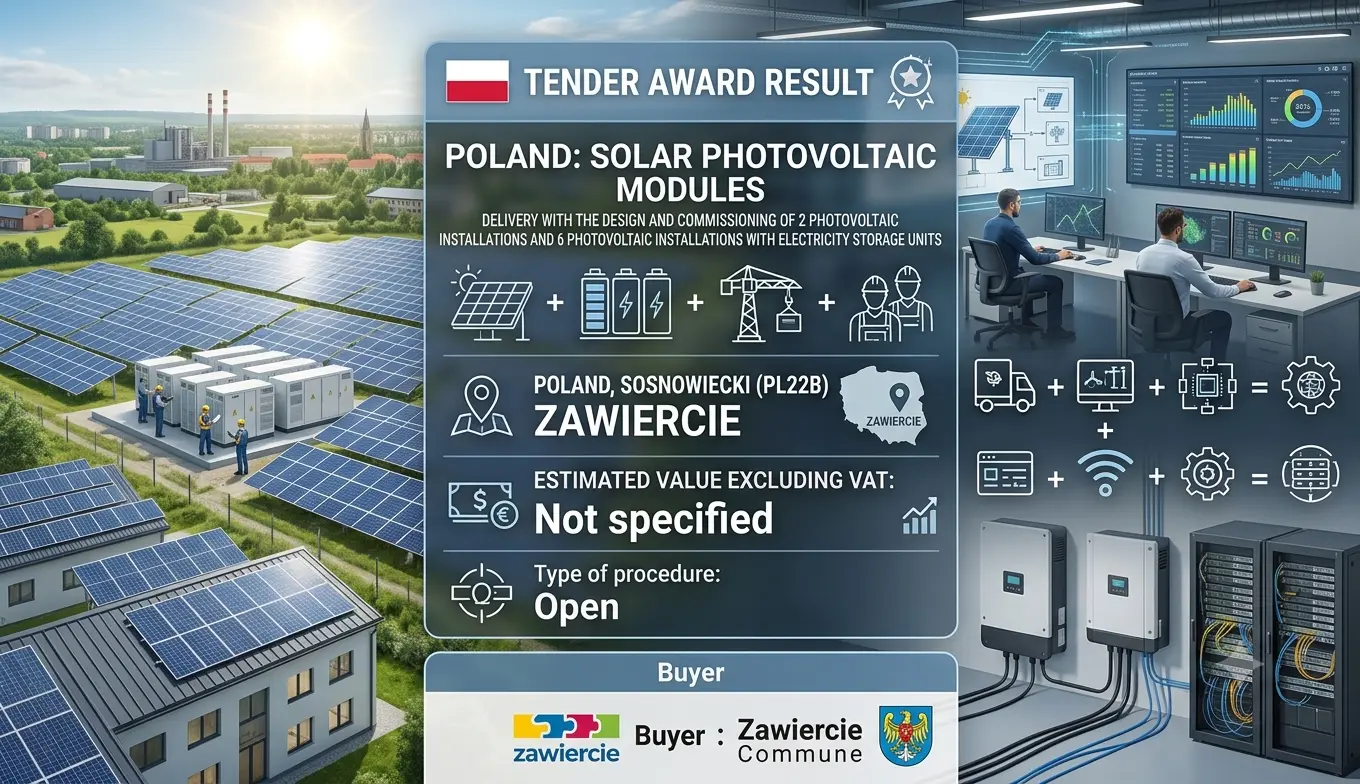
Zawiercie Turns Public Buildings Into a Distributed Solar Network in a PLN 2.66 Million Contract
05 Oct 2026
Standfirst: The Polish municipality of Zawiercie has awarded a contract to design, supply, install and commission eight solar photovoltaic installations, six of which include battery energy storage. The contract went to EkoEnergia Polska sp. z o.o., a small Warsaw-based company, at a tender value of PLN 2,655,619.06. Ten bids were received, all from SMEs, making this one of the more competitive renewable energy procurements. The installations will power a town hall, three primary schools, a fire station, a heritage building, a cemetery and a municipal housing management office. Introduction Municipalities across Europe are under pressure to cut energy costs and reduce carbon emissions at the same time. For many, the most practical route is to generate their own electricity on the buildings they already own. Schools, town halls, fire stations and maintenance depots all have roofs or land that can host solar panels. Adding battery storage lets a municipality use that electricity when it needs it rather than only when the sun shines. The Gmina Zawiercie, a municipality in southern Poland, has taken that approach at scale. It has awarded a contract to design, build and commission eight separate photovoltaic installations across publicly owned buildings, six of which will be paired with battery energy storage systems. The total installed capacity is at least 297.12 kWp. The project is being carried out under the banner of developing distributed renewable energy for public buildings in the municipality. The contract is funded in part by EU funds, which is significant. It shows how EU cohesion and energy transition funding is being channelled into practical, locally visible projects rather than only large-scale infrastructure. It also shows that Poland's small and medium-sized renewable energy contractors are actively competing for this work. Why This Contract Matters This contract matters because it is a template for how small and medium-sized municipalities can decarbonise their building stock. Rather than procuring one large installation, Zawiercie has bundled eight smaller installations into a single contract, each tailored to the building it serves. That approach spreads the benefit across the community and gives the municipality a single point of accountability for design, installation and commissioning. It also matters because of the storage component. Six of the eight installations include battery energy storage, with capacities ranging from 30 kWh at the municipal cemetery to between 290 kWh and 300 kWh at the town hall. Storage changes the economics of solar for a municipality. It allows excess generation to be used in the evening or during peak demand, reducing reliance on grid electricity and improving the resilience of the buildings concerned. The competition is notable. Ten bids were received, all from micro, small or medium-sized enterprises. That is a healthy outcome. It suggests that the contract was attractive to the Polish SME market and that the requirements were not drawn so tightly that only one or two suppliers could respond. The winning tender, however, came in above the value recorded for all contracts awarded in the notice, a discrepancy that the notice does not explain. Contract Timeline Previous notice: 112824-2026 Contract concluded: 25 September 2026 Notice dispatched: 2 October 2026 Notice published: 5 October 2026 Estimated duration: 3 months Contract Overview The contract covers the design, supply, installation and commissioning of two photovoltaic installations without storage and six photovoltaic installations with battery energy storage. It is a single-lot procurement, identified as LOT-0001, with the internal identifier ZP.271.89.2025.AS. The main nature of the contract is supplies, classified under CPV 09331200 (solar photovoltaic modules). Additional classifications cover building installation work, electrical installation work, installation services, engineering design services, site preparation work, solar installation, electrical machinery and apparatus, architectural services, building construction work and dismantling works. This is a broad scope that reflects the fact that the contractor must handle everything from design and permitting through to commissioning and handover. The place of performance is the municipality of Zawiercie, postcode 42-400, in the Sosnowiecki NUTS region (PL22B). The procurement was conducted as an open procedure under Directive 2014/24/EU. It is not a framework agreement and does not use a dynamic purchasing system. It is covered by the Government Procurement Agreement and is fully or partially financed with EU funds. Key Contract Details Notice ID 683932-2026 OJ S issue 192/2026 Publication date 5 October 2026 Contracting authority Gmina Zawiercie Contract type Supplies Main CPV code 09331200 – Solar photovoltaic modules Procedure type Open procedure Legal basis Directive 2014/24/EU Lot LOT-0001 Winner EkoEnergia Polska sp. z o.o. Value of the tender PLN 2,655,619.06 Value of all contracts awarded in this notice PLN 2,174,503.47 Number of bids 10 Award criteria Gross offer price – 60 points; warranty period – 20 points; fault removal time – 20 points Estimated duration 3 months Framework agreement No Dynamic purchasing system No EU funding Yes – fully or partially financed with EU funds GPA covered Yes Subcontracting No SME participation 10 SME tenders received Contract identifier 669/2026 Project Scope The scope is unusually detailed and site-specific. The contractor must design, supply, install and commission eight photovoltaic installations across municipal buildings, with battery storage at six of them. The total minimum capacity is 297.12 kWp, distributed across the sites as follows. OSP w Skarżycach (fire station), ul. Skarżycka 4: minimum 2.40 kWp on the roof, no storage. Pałacyk nad Wartą (heritage building), ul. Filaretów 1: minimum 6.24 kWp on the roof, no storage. Urząd Miejski w Zawierciu (town hall), ul. Leśna 2: minimum 99.84 kWp on the roof, with storage of not less than 290 kWh and not more than 300 kWh, mounted externally. Maximum capacity not greater than 100 kW. Szkoła Podstawowa nr 3 (primary school), ul. M. Skłodowskiej-Curie 16: minimum 41.28 kWp on the roof, with 80 kWh storage inside the building. Szkoła Podstawowa nr 6 (primary school), ul. Wierzbowa 4: minimum 31.68 kWp on the roof, with 60 kWh storage inside the building. Szkoła Podstawowa nr 7 (primary school), ul. Oświatowa 55: minimum 55.68 kWp on the roof, with 110 kWh storage inside the building. Cmentarz Komunalny (municipal cemetery), ul. Przyjaźni 184: minimum 17.28 kWp on the ground, with 30 kWh storage inside the building. ZGM w Zawierciu (municipal housing management), ul. Towarowa 30: minimum 42.72 kWp on the roof, with 90 kWh storage in an internal technical room. The work includes a wide range of tasks. The contractor must inventory the existing electrical installations, obtain all necessary permits and decisions, including grid connection conditions and building permits, and prepare and agree the design documentation with the municipality. It must modernise and equip the main distribution boards, install mounting structures and PV modules, install inverters and battery storage, lay DC and AC cabling, connect the PV installation to the building's main distribution board, provide lightning protection, and for ground-mounted installations, build a fence with a technical entrance. Additional tasks include sealing and post-installation repairs, commissioning and adjustment, labelling of distribution boards and cable joints, electrical measurements, training for the municipality's staff and users, notification of the micro-installation to the energy company, submission of the fire-safety-approved design to the relevant fire service unit, and preparation of as-built documentation. The notice does not disclose the specific PV module brands, inverter models or battery storage products to be used. The contracting authority has not disclosed this information. About the Contracting Authority The buyer is the Gmina Zawiercie, a municipality in the Silesian Voivodeship of southern Poland. It is classified as a local authority with general public services activity. Its registration number is 276258871, and its procurement department is the Wydział Zamówień Publicznych (Public Procurement Department). The municipality's contact points for this procurement are Jarosław Felczuk and Anna Siejka. Its email address is zamowieniapubliczne@zawiercie.eu, and its telephone number is +48 32 494 12 52. Its website is hosted at zawiercie.bip.net.pl, and it uses the Logintrade platform for electronic procurement at zawiercie.logintrade.net. The Gmina Zawiercie is both the buyer and the entity responsible for the project. It is the beneficiary of the EU funding that supports the installations. Its role is to define the requirements, run the procurement, evaluate the ten bids and conclude the contract with the winner. It will also manage the project during construction and operate the installations afterwards. About the Organisations Involved Gmina Zawiercie The Gmina Zawiercie is the contracting authority. It is a Polish municipality responsible for local public services, including schools, municipal buildings, cemeteries and housing management. Its role in this procurement is as buyer and beneficiary of the EU funding. It is registered in Zawiercie, postcode 42-400, with registration number 276258871. Its procurement department handles public tenders on its behalf. The municipality has chosen to bundle eight separate installations into a single contract, which simplifies management but places a significant coordination burden on the winning contractor. EkoEnergia Polska sp. z o.o. EkoEnergia Polska sp. z o.o. is the winning bidder. It is classified as a small economic operator. Its registration number is 9591953988, and its registered office is in Warszawa, postcode 00-133, in the Miasto Warszawa NUTS region (PL911). The company submitted the winning tender for LOT-0001. The value of the tender is recorded as PLN 2,655,619.06. The notice records that the company declared no subcontracting, meaning it will deliver the full scope itself. The notice does not disclose the company's technical approach, the products it proposed, or how it will manage eight simultaneous installations across the municipality. The contracting authority has not disclosed this information. It is worth noting that the company is based in Warsaw, not in Zawiercie or the surrounding region. That is not unusual in Polish public procurement, but it does mean the municipality will be relying on a contractor from outside the local area. Krajowa Izba Odwoławcza The Krajowa Izba Odwoławcza (National Appeal Chamber) is Poland's central review body for public procurement disputes. It is listed as the review organisation and the organisation providing more information on review procedures. Its registration number is 5262239325, and its address is ul. Postępu 17a, Warszawa, postcode 02-676. Its role is to hear appeals from bidders who believe a procurement has been conducted improperly. The notice sets out the review rules in considerable detail, referring to the Polish Public Procurement Law and specifying the deadlines for filing an appeal depending on the value of the contract and the nature of the challenge. Publications Office of the European Union The Publications Office of the European Union is listed as the TED eSender. Its role is administrative: it operates Tenders Electronic Daily, the official journal supplement where EU procurement notices are published. It is based in Luxembourg and is not involved in the procurement itself. Other organisations The notice does not identify the other nine bidders by name. It records that ten tenders were received, all from SMEs, but it does not list them. No consortium members, framework participants or subcontractors are disclosed. No other organisation materially affects the understanding of this award. Procurement Analysis The procurement was conducted as an open procedure under Directive 2014/24/EU. The open procedure is the standard route for a contract of this size and allows any qualifying supplier to bid. The evaluation was structured around three criteria. Price carried 60 points out of 100. Two quality criteria accounted for the remaining 40 points: warranty period (20 points) and fault removal time (20 points). This is a moderately quality-sensitive evaluation. With 60% of the score determined by price, cost remains the primary consideration, but a bidder offering a longer warranty and faster fault response could close a meaningful gap. The quality criteria are revealing. Both relate to the post-installation phase of the project: how long the installation is guaranteed and how quickly faults are fixed. That suggests the municipality is not just buying hardware. It is buying long-term reliability and service. A solar installation with storage is a long-lived asset, and the municipality wants assurance that problems will be addressed quickly and that the equipment will be covered for an extended period. Ten bids were received. All were submitted electronically. All ten came from micro, small or medium-sized enterprises. None came from other EEA countries or from outside the EEA. The competition was therefore domestic but genuinely contested, with a broad field of SME bidders. There is a discrepancy in the notice regarding the contract value. The value of all contracts awarded in this notice is recorded as PLN 2,174,503.47, but the value of the winning tender is recorded as PLN 2,655,619.06. These figures do not match. The notice does not explain the difference. It is possible that the first figure represents the awarded value after evaluation or that the second figure includes an element such as VAT, but the notice does not clarify this. The contracting authority has not explained the discrepancy. The contract is covered by the Government Procurement Agreement, which means it is open to suppliers from GPA member countries on the same terms as EU suppliers. That is notable for a municipal-level contract. The contract is also fully or partially financed with EU funds, which is consistent with its inclusion under the GPA. The contract has an estimated duration of three months. That is a short implementation window for eight installations, including design, permitting, installation and commissioning. It suggests that the municipality expects the contractor to move quickly and that the sites are already prepared for the work. The contract is not a framework agreement and does not use a dynamic purchasing system. It is a direct contract with a single supplier. The notice does not disclose the estimated contract value, so it is not possible to compare the awarded value to the municipality's pre-tender estimate. The contracting authority has not disclosed this information. Additional Procurement Facts Legal basis: Directive 2014/24/EU. Procedure: Open procedure, not accelerated. Award criteria: Gross offer price (60 points); warranty period (20 points); fault removal time (20 points). Number of bids: 10, all from SMEs. EU funding: The procurement project is fully or partially financed with EU funds. GPA: Covered by the Government Procurement Agreement. Framework agreement: None. Dynamic purchasing system: None. Subcontracting: The winning tenderer declared no subcontracting. Estimated duration: 3 months. Total minimum capacity: 297.12 kWp across eight sites. Storage: Six of the eight installations include battery energy storage, ranging from 30 kWh to between 290 and 300 kWh. Review body: Krajowa Izba Odwoławcza (National Appeal Chamber). Value discrepancy: The value of all contracts awarded is recorded as PLN 2,174,503.47, while the winning tender is recorded as PLN 2,655,619.06. The notice does not explain the difference. Market & Industry Perspective The Polish solar market has grown rapidly over the past decade, driven by falling technology costs, rising electricity prices and generous support schemes. Municipalities have become significant buyers, using EU funds and national programmes to install solar on public buildings. The market includes a large number of small and medium-sized installation companies, which compete for local and regional contracts. This procurement reflects that market structure. Ten SMEs bid for the contract, which suggests a healthy level of competition in the segment. The winner, EkoEnergia Polska, is a small company based in Warsaw. Its victory over nine other SMEs indicates that the evaluation criteria — price, warranty and fault response — were decisive. The inclusion of battery energy storage is significant. Storage is still a relatively new component in Polish municipal solar projects. It adds cost and complexity, but it also adds value: stored electricity can be used when the sun is not shining, reducing the building's reliance on the grid. The town hall's 290 to 300 kWh storage system is large by municipal standards and suggests the municipality is treating the town hall as a flagship installation. The three-month implementation window is tight. Delivering eight installations, including design, permitting, installation and commissioning, in three months requires careful planning and coordination. It also requires the contractor to have established relationships with equipment suppliers and subcontractors, even though the winner declared no subcontracting. The EU funding is central to the project's viability. Municipalities in Poland often rely on EU cohesion and recovery funds to finance renewable energy investments. The fact that this project is funded in part by the EU explains its inclusion under the GPA and its publication in TED. Economic Significance A contract worth roughly PLN 2.66 million is modest in absolute terms, but it has a disproportionately large local impact. It creates work for the winning contractor and its supply chain, and it delivers long-term energy savings for the municipality. The installations will reduce the electricity bills of eight public buildings, freeing up resources for other services. The contract also has an environmental dimension. By generating electricity from solar rather than fossil fuels, the installations will reduce the municipality's carbon footprint. That contributes to Poland's national climate targets and to the EU's broader energy transition objectives. The economic significance extends to the local labour market. Installation work will be carried out in Zawiercie, and the contractor will need to engage local labour and possibly local subcontractors, even if it has not formally declared subcontracting. The three-month duration means the work will be concentrated in a short period, providing a burst of local economic activity. The storage component has an economic dimension too. Battery storage allows the municipality to shift solar generation to times of higher demand or higher prices, improving the return on investment. Over the lifetime of the installations, that can translate into meaningful savings. Future Procurement Opportunities The most immediate future opportunity is the maintenance and servicing of the eight installations. The contract includes a warranty period and a fault removal time, both of which were scored at the award stage. Once the warranty expires, the municipality will need to procure ongoing maintenance, either from the original installer or from a third party. There may also be opportunities to extend the project. If the eight installations perform well, the municipality may wish to add solar and storage to other public buildings. That would create a follow-on procurement, possibly structured similarly to this one. More broadly, municipalities across Poland are pursuing similar projects, supported by EU funds. Suppliers with a proven track record in municipal solar and storage installations will be well positioned to bid for that pipeline. The fact that ten SMEs competed for this contract suggests that the market is active and that there is no shortage of capable bidders. Suppliers should monitor the Gmina Zawiercie's procurement platform at zawiercie.logintrade.net and its BIP page for future notices. They should also monitor national and EU funding programmes for municipal renewable energy projects, as these often signal upcoming procurements. Opportunities for Suppliers Solar installation contractors: The market for municipal solar installations in Poland is active, with EU funding supporting a steady pipeline of projects. Battery storage specialists: Storage is becoming a standard component of municipal solar projects. Suppliers with storage expertise will be better positioned. Maintenance providers: Once the warranty period expires, the municipality will need ongoing maintenance. Suppliers should watch for that opportunity. Local subcontractors: Although the winner declared no subcontracting, installation work in Zawiercie may still generate opportunities for local trades and suppliers. Design and permitting specialists: The contract requires design documentation, permits and grid connection approvals. Suppliers with these capabilities can differentiate themselves. Monitoring the buyer: Suppliers should monitor the municipality's procurement platform and BIP page for future opportunities. What Businesses Should Watch How the implementation proceeds: Eight installations in three months is ambitious. Suppliers should watch for any delays or changes that might indicate follow-on work. Whether the value discrepancy is explained: The notice records two different values for the contract. Suppliers should watch for clarification. Whether the municipality expands the project: If the installations perform well, the municipality may add solar and storage to other buildings. Whether maintenance is procured separately: Once the warranty expires, a maintenance contract is likely. Suppliers should prepare for that opportunity. Whether other municipalities follow suit: Zawiercie's approach — bundling multiple installations into one contract — could be replicated by other Polish municipalities. Whether EU funding continues: The project depends in part on EU funds. Changes to funding programmes could affect the pipeline of similar projects. PolandTenders.com Procurement Intelligence This contract represents a broader procurement trend in Central and Eastern Europe: municipalities are bundling multiple small renewable energy installations into single contracts to achieve scale, simplify management and attract competitive bids. That approach is becoming more common as EU funding for local energy transition projects expands. It favours contractors that can manage multi-site delivery, coordinate permitting and design across different buildings, and offer long-term warranty and service commitments. The award is strategically important because it shows how a mid-sized Polish municipality is approaching its energy transition. Zawiercie did not simply install solar on one building. It designed a distributed network of eight installations, six with storage, spread across the community. That creates visible, local benefits and gives the municipality direct control over its energy generation. It also gives the winning contractor a portfolio of reference sites that could support future bids elsewhere in Poland. Suppliers can learn several things from this procurement. First, multi-site delivery capability matters. The contract covers eight locations with different characteristics, including roof-mounted and ground-mounted systems, and different storage configurations. Contractors that can manage that complexity will be better positioned. Second, post-installation service matters. The two quality criteria — warranty period and fault removal time — account for 40% of the score. That means the municipality is buying reliability, not just hardware. Third, price still matters most. At 60 points, price is the single largest factor, and with ten bidders competing, price pressure was real. Fourth, SME participation is strong. All ten bidders were SMEs, which shows that the Polish municipal solar market is accessible to smaller companies. Suppliers should position themselves accordingly. They should build multi-site project management capability. They should be able to offer competitive warranty and fault response terms. They should develop relationships with storage equipment suppliers, since storage is now a standard requirement in many municipal projects. And they should monitor EU and national funding programmes, because these drive the pipeline of municipal renewable energy procurements. Future contracts in this market are likely to evolve in two directions. First, more municipalities will bundle multiple installations into single contracts, following Zawiercie's model. Second, storage will become a standard component rather than an optional extra, as municipalities seek to maximise self-consumption and reduce grid reliance. Suppliers that can deliver integrated solar-plus-storage solutions at competitive prices, with strong warranty and service commitments, will be well positioned. Suppliers that cannot will find themselves squeezed out of a market that is growing but increasingly demanding. Supplier Takeaways Multi-site delivery capability is essential. The contract covers eight locations with different mounting types and storage configurations. Battery storage is now a standard component of municipal solar projects in Poland. Suppliers should develop storage expertise. Post-installation service matters. Warranty period and fault removal time account for 40% of the evaluation. Price dominates at 60 points out of 100. Suppliers must be price-competitive. Ten bids were received, all from SMEs. The market is competitive and accessible to smaller companies. The winner, EkoEnergia Polska sp. z o.o., is a small company based in Warsaw, not in Zawiercie. Regional presence is not a barrier. The winner declared no subcontracting. Suppliers should be prepared to deliver the full scope themselves. The contract is EU-funded and GPA-covered. That means it is open to suppliers from GPA member countries. The implementation window is only three months. Contractors must be able to mobilise quickly. The notice contains a value discrepancy: PLN 2,174,503.47 for all contracts awarded versus PLN 2,655,619.06 for the winning tender. Suppliers should seek clarification. Key Takeaways The Gmina Zawiercie awarded a contract for the design, supply, installation and commissioning of eight solar photovoltaic installations to EkoEnergia Polska sp. z o.o. The contract covers two installations without storage and six with battery energy storage, with a total minimum capacity of 297.12 kWp. The winning tender is valued at PLN 2,655,619.06, while the value of all contracts awarded in the notice is recorded as PLN 2,174,503.47 — a discrepancy the notice does not explain. Ten bids were received, all from micro, small or medium-sized enterprises. Award criteria were gross offer price (60 points), warranty period (20 points) and fault removal time (20 points). The procurement was an open procedure under Directive 2014/24/EU. The contract is fully or partially financed with EU funds and is covered by the Government Procurement Agreement. The contract has an estimated duration of three months and is not a framework agreement. Installations will be located at a fire station, a heritage building, the town hall, three primary schools, a municipal cemetery and a municipal housing management office. The review body is the Krajowa Izba Odwoławcza (National Appeal Chamber). Conclusion The Gmina Zawiercie has taken a practical and ambitious step towards local energy transition. By bundling eight solar installations into a single contract, six of them with battery storage, the municipality has created a distributed renewable energy network across its public buildings. The contract, worth PLN 2,655,619.06, went to EkoEnergia Polska sp. z o.o., a small Warsaw-based company, after competition from ten SME bidders. The procurement was well contested, which is a positive sign for the Polish municipal solar market. The evaluation balanced price against warranty and fault response, reflecting the municipality's interest in long-term reliability as well as upfront cost. The inclusion of storage at six sites shows that battery technology is becoming a standard part of municipal renewable energy projects. For suppliers, the contract reinforces the importance of multi-site delivery capability, storage expertise, competitive pricing and strong post-installation service. For the municipality, the challenge will be to manage the three-month implementation window and to ensure that the installations deliver the expected energy and cost savings. The notice leaves one notable question unanswered — the discrepancy between the two recorded contract values — but the core award is clear: Zawiercie is investing in its own energy future, one building at a time. Source: Tenders Electronic Daily (TED), Contract Award Notice 683932-2026, Official Journal of the European Union, OJ S 192/2026, published on 5 October 2026.
View Details
Lublin Closes Public GIS Expansion and Public Land Inventory Procurement Without Award
02 Oct 2026
Standfirst Gmina Lublin in Poland has closed a major procurement covering the expansion of its spatial information system, API development and public-area inventory without selecting a winner. The procurement was divided into two lots under an accelerated open procedure and was linked to the European Regional Development Fund-supported project “Development and expansion of e-services and strengthening cybersecurity”. Lot 1, covering spatial information system expansion and API development, was closed because the buyer reported insufficient funds. Lot 2, covering the inventory of public areas in Lublin, was closed because no tenders, requests to participate or projects were received. Introduction Gmina Lublin has concluded a procurement process for digital spatial information services and public-area data collection without awarding either of the two planned lots. The procurement, identified by internal reference ZP-P-I.271.35.2026, was published as a standard contract or concession award notice under TED Notice 680880-2026, with publication in OJ S 191/2026 on 2 October 2026. The planned procurement combined two related but distinct areas of municipal digital infrastructure. The first lot focused on expanding Lublin's spatial information system, developing APIs and introducing additional tools including a municipal geoportal, reporting module and registry module. The second lot focused on creating a database-based inventory of public areas within specified parts of Lublin. Although the procurement was designed as an EU-funded digitalisation initiative, the result notice confirms that no contract was awarded. For Lot 1, the competition was closed because the buyer determined that available funds were insufficient. For Lot 2, the competition was closed because no tenders, requests to participate or projects were received. Why This Procurement Matters The procurement illustrates the breadth of municipal digital transformation projects being developed around geographic information, data accessibility, public infrastructure inventories and cybersecurity. Lublin planned to combine software development with structured data collection to strengthen the city's ability to manage and present spatial information. The first lot was particularly significant because it involved the development of mechanisms for sharing reference data through APIs, implementation into CKAN and tools for presenting spatial information. It also included expansion of the city's spatial information system through a municipal geoportal, reporting functionality and a registry module. The second lot addressed the physical information layer supporting municipal planning and management. The planned database was intended to contain information on communication routes, surface elements, technical infrastructure, small architecture, low greenery and digitised greenery designs. The fact that the two lots ended without awards also provides an important procurement signal. A technically ambitious digital programme can depend on both adequate funding and sufficient market participation. In this case, the two lots encountered different obstacles recorded directly in the TED result notice. Contract Timeline The procurement was connected to a preliminary information notice published on 17 April 2026. The buyer subsequently used an accelerated procedure, stating that the publication of the prior information notice allowed the deadline for submission of tenders to be shortened under the applicable Polish Public Procurement Law provisions. The planned tender opening date was 11 August 2026 at 12:30. The notice states that the contractor would have been bound by its tender until 8 November 2026. The result notice was dispatched on 1 October 2026 at 11:19:54 UTC and published on 2 October 2026 as TED Notice 680880-2026 in OJ S 191/2026. Contract Overview The procurement was titled “Zakup usług rozbudowy systemu informacji przestrzennej, opracowania API oraz wykonania inwentaryzacji terenów publicznych”, referring to the purchase of services for expansion of the spatial information system, API development and inventory of public areas. The procurement was classified as services. The principal CPV code was 72212000 for programming services of application software. Additional CPV classifications were 72314000 for data collection and collation services, 71510000 for site-investigation services and 72310000 for data-processing services. The overall estimated value excluding VAT was PLN 1,866,871.44. Lot 1 had an estimated value of PLN 1,267,271.44 while Lot 2 had an estimated value of PLN 599,600.00. Key Contract Details BuyerGmina Lublin CountryPoland LocationLublin, Lubelski, PL814 Procurement referenceZP-P-I.271.35.2026 ProcedureOpen procedure, accelerated Main CPV72212000 - Programming services of application software Additional CPVs72314000, 71510000, 72310000 Estimated total valuePLN 1,866,871.44 excluding VAT Lot 1 estimated valuePLN 1,267,271.44 excluding VAT Lot 2 estimated valuePLN 599,600.00 excluding VAT Lot 1 resultNo winner selected due to insufficient funds Lot 2 resultNo winner selected because no tenders were received Framework agreementNo Dynamic purchasing systemNo FundingEuropean Regional Development Fund-supported project Project Scope Lot 1 was designed to expand Lublin's spatial information system and develop APIs under the city's “Development and expansion of e-services and strengthening cybersecurity” project. The work was divided into two implementation stages. Stage 1 was intended to prepare, implement and launch mechanisms for providing data from the buyer's existing reference databases. This was to be preceded by a pre-implementation analysis. The planned functions included API-based data-sharing mechanisms, implementation into the CKAN tool and tools for presenting spatial information data. Stage 2 was intended to deliver, implement and launch services for expanding the spatial information system. The planned components included a Municipal Geoportal Module, a Reporting Module and a Registry Module. Lot 2 covered an inventory of public areas in database form for specified parts of Lublin. The planned database was to include detailed information about communication routes and other surface elements, technical infrastructure, small architecture, low greenery and digitised greenery designs. Both lots had a planned duration of 270 calendar days from contract signature. For Lot 1, Stage 1 was planned for completion within 210 calendar days while Stage 2 was planned for completion within 270 calendar days. The stages could run concurrently, subject to a minimum period of 20 working days between stage acceptances. For Lot 2, the greenery inventory was required to be carried out during the vegetation period. About the Contracting Authority Gmina Lublin was the contracting authority and buyer. The TED notice classifies it as a local authority whose principal activity is general public services. Its registered address is Pl. Króla Władysława Łokietka 1, 20-109 Lublin, Poland. Gmina Lublin also provided additional information about the procurement procedure. Communication between the buyer and potential contractors was conducted through the Polish e-Zamówienia platform. The notice identifies the city's procurement reference as ZP-P-I.271.35.2026. About the Organisations Involved Gmina Lublin is the principal organisation in the procurement, serving as buyer and as the organisation responsible for additional procurement information. Krajowa Izba Odwoławcza is identified as the review organisation and the organisation providing additional information on review procedures. The notice gives its address as ul. Postępu 17a, 02-676 Warszawa, Poland. The Publications Office of the European Union is identified in the notice as the TED eSender. It is listed with its address in Luxembourg and is responsible for the electronic transmission role associated with TED publication. Procurement Analysis The procurement used an accelerated open procedure. The buyer explained that a prior information notice had been published on 17 April 2026 and that the shortened tender submission period was based on the relevant provision of the Polish Public Procurement Law. The procurement also applied the procedure described in Article 139 of the Polish Public Procurement Law, under which the contracting authority first examines and evaluates tenders before carrying out the subject-matter qualification of the highest-rated contractor regarding exclusion grounds and participation requirements. The two lots used different award structures. Lot 1 assigned 60% of the weighting to price, 20% to the time required to remove failures and 20% to the time required to correct errors. Lot 2 used price as its sole award criterion with a 100% weighting. This difference is relevant to suppliers because Lot 1 placed measurable service-performance factors alongside price. The buyer planned to assess the contractor's proposed time for resolving failures and errors during the warranty period, whereas Lot 2 was structured entirely around price. Additional Procurement Facts The procurement was fully or partially financed with European Union funds. The project was associated with the European Regional Development Fund under the European Funds for Lubelskie 2021-2027 programme, Action 2.2 Digital Lubelskie within Integrated Territorial Investments of Urban Functional Areas. For Lot 1, the buyer included specific cybersecurity-related requirements. The offered ICT products, ICT services and ICT processes were not permitted to include products, services or processes identified under the relevant Polish cybersecurity legislation as having a negative impact on the fundamental security interest of the state. The requirements also addressed ICT products associated with high-risk suppliers under the applicable legislation. Neither lot involved a framework agreement or a dynamic purchasing system. The procurement therefore concerned defined project requirements rather than a recurring purchasing mechanism. Market & Industry Perspective The procurement demonstrates how municipal digital transformation increasingly connects application development, geographic information, data processing and physical asset inventories. For technology suppliers, these requirements create opportunities that extend beyond conventional software development because successful delivery can require APIs, data integration, GIS interfaces, database design and ongoing technical capabilities. The Lot 1 requirements indicate a demand for interoperability and structured access to municipal reference information. The planned use of APIs and CKAN suggests an emphasis on making existing datasets more accessible and usable across digital services. Lot 2 shows the complementary importance of accurate underlying data. A geoportal or spatial information platform is dependent on reliable information about physical infrastructure and public spaces. The proposed inventory therefore represented a data-generation component supporting broader municipal information management. Economic Significance The combined estimated value of PLN 1.866 million excluding VAT made the procurement a meaningful municipal digitalisation project. However, the absence of an award means that the estimated value did not translate into a contracted expenditure through this procurement procedure. The Lot 1 closure was specifically attributed to insufficient funds. This highlights the importance of maintaining alignment between project scope, available financing and procurement estimates in technology projects where requirements can cover several software and integration components. For Lot 2, the absence of received tenders represents a different market challenge. The notice does not provide a reason explaining why suppliers did not participate, so no additional cause should be inferred from the result notice. Future Procurement Opportunities The result creates the possibility of future procurement activity around the same or related municipal digital requirements. However, the notice itself does not state a future relaunch decision for either lot beyond recording the closure outcomes. Potential future opportunities could involve spatial information system development, API services, geoportal functionality, data-processing services and field-based public-area inventories if the contracting authority subsequently initiates another procurement. Suppliers should rely on official procurement publications for confirmation of any new procedure rather than assuming that the same scope will automatically be reissued. Opportunities for Suppliers Technology companies specialising in GIS, municipal software, API development, data integration and open-data platforms can identify relevant capability areas from the Lot 1 specification. Suppliers with experience in CKAN, spatial databases, geoportals, reporting systems and registry applications would find the published requirements particularly relevant to their service portfolios. Companies providing surveying, site investigation, geospatial data collection and environmental inventory services can also identify a clear demand profile from Lot 2. The planned inventory required detailed classification of physical infrastructure and public-space features alongside greenery data and digitised greenery projects. For future competitions, suppliers should also monitor cybersecurity eligibility requirements where ICT products, services or processes are involved. The notice demonstrates that cybersecurity restrictions can become an explicit procurement requirement rather than remaining an internal technical consideration. What Businesses Should Watch Future Lublin procurement notices relating to spatial information systems and municipal digital services. Potential re-procurement of public-area inventory and geospatial database services. Expansion of municipal geoportal, API and open-data requirements. Cybersecurity eligibility requirements for ICT products and services. EU-funded digital transformation programmes under the European Funds for Lubelskie 2021-2027 framework. Procurement opportunities involving CKAN, APIs, GIS, spatial databases and municipal data-processing services. Changes in tender structures where price and service-quality criteria are combined. PolandTenders.com Procurement Intelligence From a procurement intelligence perspective, this notice represents an important distinction between a procurement opportunity and a realised contract. The original opportunity was substantial enough to combine application software development, data integration and physical inventory work, but the result demonstrates that market opportunity does not necessarily lead to contract formation. Monitoring result notices alongside tender notices is therefore essential for understanding the actual procurement pipeline. The two unsuccessful outcomes also illustrate two different procurement signals. Lot 1 was closed because of insufficient funds, which is a buyer-side constraint explicitly recorded in the notice. Lot 2 received no tenders, which is a market-participation outcome. Suppliers analysing procurement trends should distinguish between these situations because they can lead to different future procurement conditions. For suppliers, the case highlights the value of tracking not only CPV codes but also detailed service components. A company monitoring programming services alone could miss the related opportunities in data collection, site investigation and data processing. Combining CPV monitoring with municipal buyer intelligence, project funding information and historical procurement outcomes can provide a more complete picture of where future requirements may emerge. Future competitions in this area could become more modular, more focused on interoperability and more explicit about cybersecurity and service-performance requirements. Suppliers positioning for such opportunities should therefore maintain capabilities across software development, spatial data, APIs, integration, cybersecurity compliance and operational support rather than relying on a single technology category. Supplier Takeaways Track both tender notices and result notices to distinguish active opportunities from completed procurement processes. Monitor Gmina Lublin for future spatial information and municipal digital-service procurements. Review CPV 72212000 alongside CPVs covering data collection, site investigation and data processing. Prepare evidence of GIS, API, CKAN, geoportal and municipal data-management capabilities. Consider cybersecurity compliance requirements early when preparing ICT procurement bids. For service contracts, pay attention to operational performance criteria such as failure and error resolution times. Do not assume that an unsuccessful procurement will automatically be relaunched without a new official notice. Key Takeaways Gmina Lublin closed the procurement without selecting a winner for either lot. Lot 1 covered spatial information system expansion and API development. Lot 1 had an estimated value of PLN 1,267,271.44 excluding VAT. Lot 1 was closed because the buyer reported insufficient funds. Lot 2 covered an inventory of public areas in database form. Lot 2 had an estimated value of PLN 599,600.00 excluding VAT. Lot 2 was closed because no tenders, requests to participate or projects were received. The combined estimated procurement value was PLN 1,866,871.44 excluding VAT. The procurement was linked to an EU-funded digitalisation and cybersecurity project. No framework agreement or dynamic purchasing system was used. Conclusion Gmina Lublin's procurement for spatial information system expansion, API development and public-area inventory has ended without a contract award. The result notice provides two distinct reasons: insufficient funds for Lot 1 and no received tenders for Lot 2. The procurement nevertheless provides valuable insight into the digital infrastructure requirements being considered by a major Polish municipality. The planned scope combined software development, APIs, CKAN implementation, geoportal functionality, reporting and registry modules with detailed public-area data collection and processing. For suppliers, the notice reinforces the importance of monitoring the complete procurement lifecycle. Future opportunities may arise from related municipal digitalisation programmes, but any new procurement should be confirmed through an official tender publication. The current TED result establishes only that this particular procedure closed without an awarded contract. Source Source: EU Tenders Electronic Daily (TED), Contract or concession award notice, Notice 680880-2026, OJ S 191/2026, published 2 October 2026.
View Details
Poland Closes Water Meter and Remote Reading System Procurement Due to Insufficient Funds
01 Oct 2026
Standfirst: Poland's ZAKŁAD GOSPODARKI KOMUNALNEJ SP. Z O.O. has closed a procurement for the supply and installation of metering and communication devices with remote reading modules and the delivery and implementation of a stationary remote reading system. The procurement covered water meters and associated software and information systems for the Wrocławski region. The procedure was conducted as an open procedure under Directive 2014/24/EU. The TED result notice confirms that no winner was selected because the buyer determined that there were insufficient funds to proceed with the procurement. Introduction The procurement concerned the delivery and installation of metering and communication devices equipped with remote reading modules together with the delivery and implementation of a stationary remote reading system in Poland. The contracting authority was ZAKŁAD GOSPODARKI KOMUNALNEJ SP. Z O.O., a public undertaking controlled by a local authority whose activity is classified as housing and community amenities. The procurement was structured as a supplies contract and covered the Wrocławski NUTS region, identified as PL518. The main CPV classification was 38421100 for water meters, with an additional classification of 48000000 for software package and information systems. Although the notice is a result notice, it does not record a successful award. The result section states that no winner was chosen and the competition was closed. The stated reason was a decision by the buyer based on insufficient funds. The notice records two electronically submitted tenders, including one tender from a micro, small or medium sized tenderer, while no tender was recorded from tenderers registered in other European Economic Area countries outside Poland. Why This Procurement Matters The procurement is relevant to the water utility and metering technology market because its scope combined physical water meters, remote communication modules, installation and a stationary system for remote data reading. The technical requirements indicate that the intended solution involved radio based data transmission and LoRaWAN infrastructure, making the procurement relevant to suppliers operating across metering, telecommunications, Internet of Things and utility data management. The notice also demonstrates that the buyer sought suppliers with established experience in remote reading systems. The participation conditions required experience with two projects involving delivery, installation and implementation of a remote reading system together with LoRaWAN infrastructure, with each project valued at no less than PLN 1 million gross. The requirements also referred to remote transmission of data from at least 2,000 devices using radio technology and at least 10 transmitting or receiving devices deployed across different locations. The unsuccessful outcome is also significant from a procurement intelligence perspective. A procurement can attract market participation yet still close without an award when the contracting authority determines that available funds are insufficient. For suppliers monitoring this category, the result therefore provides information about buyer requirements and market participation without establishing that a supplier has secured the contract. Contract Timeline The TED result notice was dispatched on 30 September 2026 and published on 1 October 2026 in OJ S issue 190/2026 under publication number 677533-2026. The notice identifies itself as a contract or concession award notice under the standard regime, with the result confirming closure without a winner. The notice provides an estimated contract duration of 180 days for the single lot. It also states that there are no renewals. However, the result notice does not provide a successful contract conclusion date, contract start date or contract end date because no contract was awarded. Contract Overview The procurement was a single lot identified as LOT-0001. Its subject was the supply and installation of metering and communication devices with remote reading modules together with delivery and implementation of a stationary remote reading system. The main CPV code was 38421100 for water meters, while the lot also carried CPV 48900000 for miscellaneous software package and computer systems. The procurement used an open procedure and was not accelerated. The main nature of the contract was supplies. The estimated value recorded for the lot was PLN 0.00 excluding VAT. As the result section states that no winner was chosen due to insufficient funds, this figure should not be interpreted as an awarded contract value. The notice does not provide a successful contract value. Key Contract Details CountryPoland BuyerZAKŁAD GOSPODARKI KOMUNALNEJ SP. Z O.O. ProcurementDelivery and installation of metering and communication devices with remote reading modules and delivery and implementation of a stationary remote reading system LocationWrocławski, NUTS PL518, Poland LotLOT-0001 Main CPV38421100, Water meters Additional CPV48000000, Software package and information systems; 48900000, Miscellaneous software package and computer systems ProcedureOpen procedure Legal basisDirective 2014/24/EU Contract natureSupplies Estimated duration180 days Maximum renewals0 Estimated value excluding VATPLN 0.00 EU fundingNot financed with EU Funds GPA coverageNo Framework agreementNo Dynamic purchasing systemNo WinnerNo winner was chosen Reason for non awardDecision of the buyer because of insufficient funds Electronically submitted tenders2 Tenders from SMEs1 Review organisationKrajowa Izba Odwoławcza Project Scope The procurement was designed around the deployment of water metering equipment with communication capabilities for remote reading. The scope covered the supply and installation of new metering and communication devices with remote reading modules, together with the supply and implementation of a stationary system capable of receiving remote meter data. The lot description therefore combined physical equipment with the software and systems needed to support remote data collection. The procurement also included an option allowing the contracting authority to expand the order with additional water meters. The option could be exercised multiple times through partial orders, subject to a combined limit of 30% of the basic order value or a maximum of 1,000 water meters in the DN15 to DN150 range. The option could be exercised for up to five years from the signing of the final acceptance protocol for the basic order. About the Contracting Authority ZAKŁAD GOSPODARKI KOMUNALNEJ SP. Z O.O. was identified as the buyer. TED classifies the organisation as a public undertaking controlled by a local authority, with housing and community amenities listed as the activity of the contracting authority. Its address is Żernicka 17, 55-010 Święta Katarzyna, Poland, in the Wrocławski NUTS region. About the Organisations Involved ZAKŁAD GOSPODARKI KOMUNALNEJ SP. Z O.O. was the contracting authority and also provided additional information about the procurement procedure and offline access to procurement documents. The organisation is based in Święta Katarzyna in Poland. Krajowa Izba Odwoławcza was identified as the review organisation and as the organisation providing further information on review procedures. It is located at ul. Postępu 17a, Warszawa, Poland. No winning supplier or consortium was identified because the result notice expressly states that no winner was chosen and that the competition was closed. Procurement Analysis The procurement was conducted through an open procedure under Directive 2014/24/EU. The award criterion was price, with a weight of 100%. The notice explains that the score for price would be calculated by dividing the lowest offer value by the value of the offer being assessed, then multiplying the result by 100 and rounding to two decimal places. The result data records two electronically submitted tenders. One of these was identified as coming from a micro, small or medium sized tenderer. The notice also separately records zero tenders from tenderers registered in other European Economic Area countries outside the buyer's country. This indicates that the competition received electronic participation but did not result in an award. The procurement was not structured as a framework agreement and did not use a dynamic purchasing system. The single lot approach meant that the procurement combined the water meter supply and installation requirements with the remote reading system implementation rather than dividing these requirements across multiple lots. Additional Procurement Facts The procurement was not financed with EU funds and was not covered by the Government Procurement Agreement. The notice also specified extensive exclusion requirements under Polish public procurement legislation as well as applicable restrictions linked to EU sanctions relating to Russia's actions destabilising the situation in Ukraine. The participation requirements included financial capacity, professional and technical capability and documentary evidence relating to the offered equipment. The buyer required evidence of financial capacity of at least PLN 1 million through bank funds or account balances and also required civil liability insurance with a guarantee sum of at least PLN 1 million. Market and Industry Perspective The procurement sits at the intersection of water utility equipment, smart metering, telecommunications and utility information systems. Its combination of water meters, radio communication, remote reading and LoRaWAN infrastructure indicates a procurement model in which the physical meter is only one component of a broader digital monitoring solution. The technical qualification requirements create a relatively specialised supplier profile. The buyer sought evidence of previous projects involving remote reading systems and LoRaWAN infrastructure, together with experience transmitting data from at least 2,000 devices through a distributed radio network. The requirements also called for a telecommunications service design specialist with experience in at least two LoRa network design projects. The participation data shows that two electronic tenders were received, including one from an SME. The result therefore provides evidence of supplier participation in this procurement category while the absence of an award means that no supplier can be treated as the successful market participant for this particular opportunity. Economic Significance The TED notice records an estimated value of PLN 0.00 excluding VAT for the lot. Because the competition was closed without a winner due to insufficient funds, the notice does not establish an awarded contract value or expenditure resulting from this procurement. The economic relevance of the procurement therefore lies primarily in the intended infrastructure and supplier requirements rather than in a completed contract award. The option provisions could have allowed additional purchases of up to 1,000 water meters within the stated conditions if the procurement had proceeded to implementation. Future Procurement Opportunities Suppliers active in smart water metering can monitor future opportunities from ZAKŁAD GOSPODARKI KOMUNALNEJ SP. Z O.O. and other public utility organisations in the Wrocławski region. Relevant monitoring should include water meters, remote meter reading systems, utility communication equipment, LoRaWAN infrastructure and related software systems. The five year period specified for exercising the option is relevant to the original procurement design, but it should not be interpreted as evidence that a new procurement will definitely be issued. Businesses may watch for future notices involving replacement or expansion of water meters, remote reading infrastructure and utility data communication systems. Opportunities for Suppliers The technical requirements indicate relevance for water meter manufacturers, smart metering technology companies, telecommunications specialists, LoRaWAN solution providers, software suppliers and system integrators. Suppliers capable of combining equipment delivery with installation and remote reading system implementation would be particularly aligned with the scope described in the notice. The procurement also demonstrates potential relevance for SMEs because one of the two electronic tenders received was identified by TED as coming from a micro, small or medium sized tenderer. Companies that do not independently meet all technical or professional requirements may also need to assess whether compliant consortium arrangements are appropriate for similar future procurement procedures, subject to the conditions of the individual notice. What Businesses Should Watch Businesses monitoring this procurement category should track CPV 38421100 for water meters together with relevant software and computer system classifications. The buyer, Wrocławski region and the combination of water metering with remote reading technology are also useful search parameters. Suppliers should pay particular attention to technical qualification requirements in comparable tenders. The notice required experience in remote reading systems, LoRaWAN infrastructure and radio based data transmission from at least 2,000 devices. It also required a specialist with experience in designing LoRa networks. Price was the sole award criterion in this procedure with a 100% weighting. Businesses should therefore monitor both qualification requirements and pricing structures when assessing similar opportunities, while recognising that each future procurement may establish different criteria. PolandTenders.com Procurement Intelligence This procurement provides an important signal about the structure of demand for digitally enabled water metering solutions in Poland. The scope was not limited to the supply of conventional meters. It combined metering equipment with remote communication modules, a stationary remote reading system and implementation requirements. From a supplier monitoring perspective, CPV 38421100 provides a direct classification signal for water meter opportunities, while the additional software classifications indicate the technology component of the procurement. The technical requirements provide further intelligence because they identify LoRaWAN experience, radio based data transmission and large scale device deployment as relevant capabilities for the planned solution. The result also demonstrates why procurement intelligence should distinguish tender participation from successful awards. Two electronic tenders were received, including one SME tender, yet the competition was closed without a winner because of insufficient funds. Supplier databases that record only awarded contracts could therefore miss useful information about buyer requirements, market participation and unsuccessful procurement cycles. For businesses tracking this market, the key signals are the buyer, Wrocławski geography, CPV 38421100, remote reading technology, LoRaWAN infrastructure, water meter installation and software integration. Monitoring these elements together can help suppliers identify related opportunities without assuming that this particular procurement will be reissued. Supplier Takeaways The procurement concerned water meters and remote reading infrastructure in Poland. The contracting authority was ZAKŁAD GOSPODARKI KOMUNALNEJ SP. Z O.O. The procurement covered the Wrocławski NUTS region, PL518. The procedure was an open procedure. The contract nature was supplies. The main CPV was 38421100 for water meters. Additional classifications covered software package and computer systems. The procurement contained one lot, LOT-0001. The estimated duration was 180 days. No framework agreement was used. No dynamic purchasing system was used. The award criterion was price with a 100% weighting. Two electronic tenders were received. One received tender was from an SME. No winner was selected. The stated reason for non award was insufficient funds. The procurement was not financed with EU funds. The procurement was not covered by the GPA. The original procurement included an option for additional water meters. The option could cover up to 1,000 DN15 to DN150 water meters subject to the stated conditions. Key Takeaways Country: Poland. Buyer: ZAKŁAD GOSPODARKI KOMUNALNEJ SP. Z O.O. Procurement: Water metering and stationary remote reading system. Location: Wrocławski, PL518. Lot: LOT-0001. Main CPV: 38421100, Water meters. Procedure: Open procedure. Legal basis: Directive 2014/24/EU. Estimated duration: 180 days. Estimated value recorded: PLN 0.00 excluding VAT. Winner: No winner was chosen. Result: Competition closed. Reason: Buyer decision because of insufficient funds. Tenders received: Two electronically submitted tenders. SME tenders: One. EU funding: No. GPA: No. Framework agreement: No. Review organisation: Krajowa Izba Odwoławcza. Conclusion Poland's procurement for water meters and a remote reading system ended without an awarded contract after the buyer determined that insufficient funds were available. The result nevertheless provides useful procurement intelligence on the technical capabilities, supplier experience and digital metering infrastructure sought by the contracting authority. The notice should therefore be treated as an unsuccessful procurement result rather than a contract award. Suppliers active in water metering, LoRaWAN, remote reading systems and utility software can use the documented requirements and CPV classifications to monitor comparable opportunities in Poland. Source: TED result notice 677533-2026, OJ S 190/2026, published 01 October 2026.
View Details