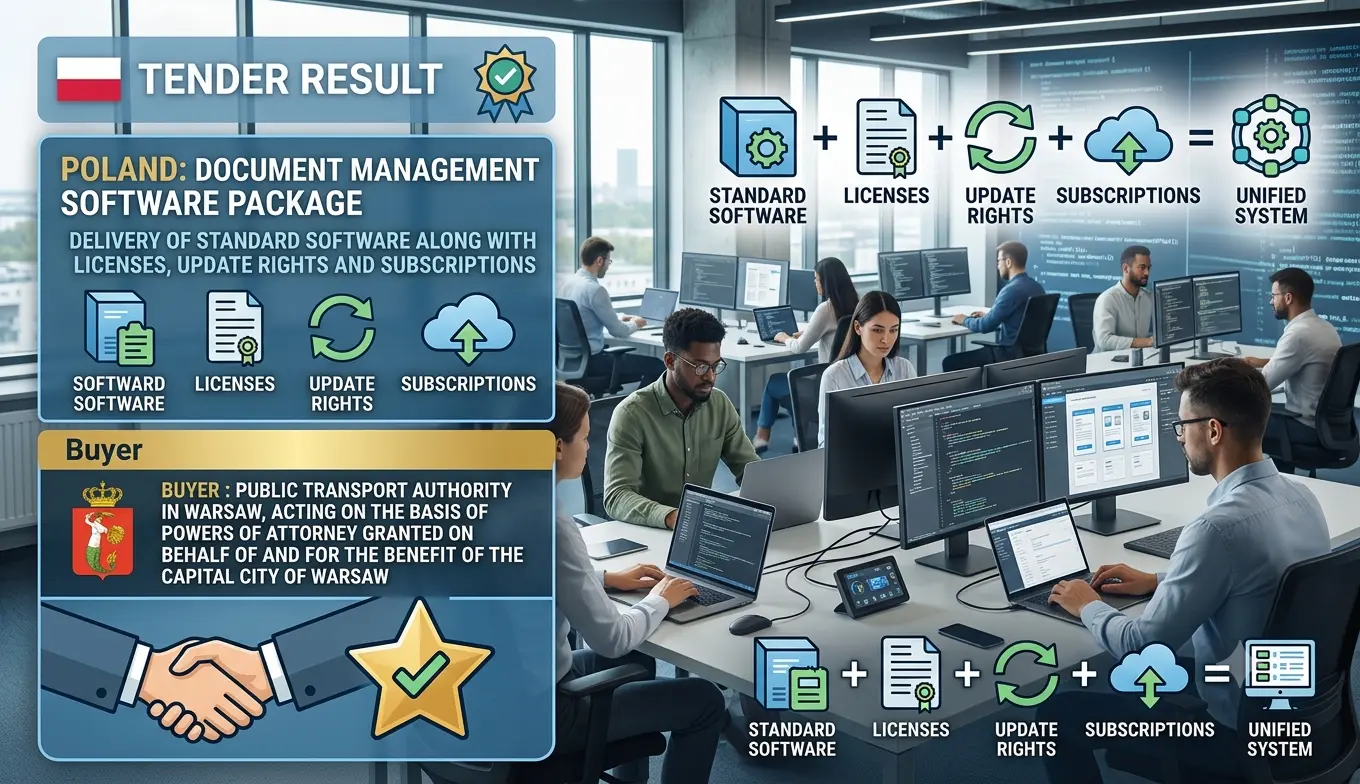
Warsaw's Tram and Bus Network Bets on a 36-Month Software Subscription Deal Worth PLN 5.78 Million
30 Sep 2026
Standfirst Warsaw's public transport authority has locked in a three-year software licensing and subscription arrangement to keep the digital backbone of its operations running. The contract, awarded to SPAN POLSKA Sp. z o.o., covers standard software, licences, update rights and subscriptions for the city's transport management body. The deal matters because it is not a one-off purchase: it is a recurring subscription model, and it shows how public transport operators are shifting from owning software to renting it. The winning bid was PLN 5,780,061.60, narrowly beating a rival offer of PLN 5,829,026.40. Only two bids were received, both from large Polish companies, and price was the only award criterion. The contract runs for 36 months, starting from 1 November 2026, with an option for additional products during the first and second subscription periods. Introduction Public transport authorities across Europe are running increasingly complex digital operations. Timetables, vehicle scheduling, ticketing, passenger information and internal administration all depend on software that must be licensed, updated and supported continuously. Buying that software outright is no longer the norm. Subscription licensing has become the default model for many public buyers because it spreads costs, guarantees access to updates, and reduces the risk of running outdated systems. The Zarząd Transportu Miejskiego w Warszawie, the body that manages Warsaw's bus and tram network, has just completed a procurement for exactly this kind of arrangement. The contract is for standard software, licences, update rights and subscriptions. It is a supplies contract, not a services contract, but the subscription structure means the authority is effectively paying for ongoing access rather than a permanent transfer of ownership. This article examines what was bought, who won, how the procurement was structured, and what the award signals for suppliers and for the wider public transport software market. Why This Contract Matters Warsaw's tram and bus network is one of the largest urban transport systems in Central Europe. Keeping it running requires reliable software for planning, operations and administration. When that software is licensed on a subscription basis, the authority is not just buying a product. It is committing to a long-term relationship with a supplier that must keep the software current, secure and compatible with the authority's existing systems. The contract also matters because of how it was procured. The authority used an open procedure under the EU's utilities directive, which governs procurement by entities operating in the water, energy, transport and postal services sectors. That choice reflects the fact that the transport authority is a utility-sector buyer, not a general public administration buyer. The rules are slightly different, and suppliers need to understand them. Finally, the contract matters because of its size relative to the market. A PLN 5.78 million subscription deal over three years is significant for the Polish software licensing sector. It shows that public transport authorities are willing to pay for continuity and compliance, not just for the cheapest available product. Contract Timeline Previous notice: 551996-2026 Winner selected: 10 September 2026 Contract concluded: 25 September 2026 Notice dispatched: 29 September 2026 Notice published: 30 September 2026 Subscription period begins: 1 November 2026 Subscription duration: 36 months Contract Overview The contract is for the supply of standard software, together with licences, update rights and subscriptions. It is a single-lot procurement. The authority has structured it as a basic scope plus an option right. The basic scope covers delivery and activation of subscriptions. The first subscription period starts on 1 November 2026. If the contract is signed after that date, the supplier must ensure continuity of the authority's licensing rights in line with the manufacturer's licensing rules. Subsequent subscription periods begin immediately after the previous one ends, for a total subscription period of 36 months. The option right covers additional product deliveries during the first and second subscription periods. The authority has explicitly stated that it does not guarantee purchases under the option right. Option purchases will happen as needed and as budget allows. Unit prices for subscription products under the option must be identical to the unit prices for the corresponding basic products in the supplier's offer. The authority has also specified that the supplier must hold an official document from Microsoft confirming Licensing Solution Provider (LSP) status in Poland. If equivalent products are offered, the supplier must hold an official document from the manufacturer confirming official distributor status in Poland. The supplier must also declare and guarantee that ICT products and services, including cloud services, comply with Poland's National Cybersecurity System Act. Key Contract Details Notice ID 673943-2026 OJ S issue 189/2026 Publication date 30 September 2026 Contracting authority Zarząd Transportu Miejskiego w Warszawie, acting on behalf of the City of Warsaw Contract type Supplies Main CPV code 48311000 – Document management software package Procedure type Open procedure Legal basis Directive 2014/25/EU; Polish Public Procurement Law (PZP) Lot LOT-0001 Winner SPAN POLSKA Sp. z o.o. Winning bid PLN 5,780,061.60 Non-winning bidder A.P.N. PROMISE S.A. – PLN 5,829,026.40 Number of bids 2 Award criterion Price – 100% Contract duration 36 months Subscription start 1 November 2026 Options Additional deliveries in first and second subscription periods; not guaranteed Framework agreement No Dynamic purchasing system No GPA covered No Subcontracting No SME participation 0 SME tenders received Contract identifier ZTM/UM/0541/2026/EU Project Scope The scope is the supply of standard software, licences, update rights and subscriptions. The notice does not disclose the specific software products or the manufacturer, beyond the requirement that the supplier must be a Microsoft Licensing Solution Provider or an equivalent authorised distributor. The authority has built in a detailed equivalence regime. Where the specification refers to trademarks or specific products, the authority allows equivalent products to be offered. However, the burden of proving equivalence falls on the bidder. Bidders offering equivalent products must submit one copy of the equivalent product with their offer, along with instructions on how to access it. The authority will then test the product in production conditions within its existing system, using its own peripherals, spreadsheets, databases and files, and connecting to its Active Directory service. A negative test result leads to rejection of the offer. This is a rigorous approach. It means bidders cannot simply claim equivalence on paper. They must demonstrate it in the authority's own environment. That raises the cost of bidding for suppliers offering alternatives to the named products, and it favours incumbents or suppliers with deep familiarity with the authority's systems. The subscription structure is also notable. The authority is not buying perpetual licences. It is buying access for 36 months, with the option to buy more during the first two subscription periods. This aligns with the broader shift in enterprise software toward subscription and cloud-based models. About the Contracting Authority The Zarząd Transportu Miejskiego w Warszawie is the public transport authority for Warsaw. It manages the city's bus, tram and trolleybus network. It operates under delegated authority from the City of Warsaw, meaning it acts on behalf of the municipality in procurement matters. The authority is classified as a local authority buyer with general public services activity, but it also has a specific activity classification for urban railway, tramway, trolleybus or bus services. That dual classification matters because it determines which procurement rules apply. As a utility-sector buyer, the authority operates under Directive 2014/25/EU rather than the general public sector directive. The authority's registered office is at ul. Grochowska 316/320, 03-839 Warszawa. Its procurement department is the Dział Zamówień Publicznych. It uses an electronic procurement platform at ztmwaw.ezamawiajacy.pl. About the Organisations Involved Zarząd Transportu Miejskiego w Warszawie As the contracting authority, the Zarząd Transportu Miejskiego w Warszawie is the buyer and the organisation signing the contract. It is also the organisation providing additional information about the procurement procedure and offline access to the procurement documents. Its role is central: it defined the scope, ran the procedure, evaluated the bids and will manage the contract. The authority acts on the basis of powers of attorney granted by the City of Warsaw. This means that while the authority is the operational buyer, the legal and financial responsibility ultimately rests with the municipality. SPAN POLSKA Sp. z o.o. SPAN POLSKA Sp. z o.o. is the winning bidder. It is classified as a large economic operator. Its registered office is at Domaniewska 39A, 00-078 Warszawa. Its registration number is 5253047595. The notice confirms that SPAN POLSKA submitted the winning tender for LOT-0001 with a value of PLN 5,780,061.60. It was ranked first. The company has no subcontracting arrangements for this contract, according to the notice. SPAN POLSKA is a Polish company. The notice does not disclose its parent company, its ownership structure or its specific capabilities beyond its status as a large economic operator and its winning bid. It is a tenderer and the winner of LOT-0001. A.P.N. PROMISE S.A. A.P.N. PROMISE S.A. is the non-winning tenderer. It submitted the second-ranked bid for LOT-0001, valued at PLN 5,829,026.40. Its registered office is at ul. Domaniewska 44a, 02-672 Warszawa. Its registration number is 5210088682. Like SPAN POLSKA, A.P.N. PROMISE is a Polish company based in Warsaw. The notice does not disclose its size classification, but it is listed as a tenderer. It did not win the contract. The difference between the two bids was PLN 48,964.80, or approximately 0.84% of the winning bid. That narrow margin is significant. It shows that the competition was close on price, and that the winner was not able to command a large premium. In a price-only competition, a sub-1% difference decided the outcome. Krajowa Izba Odwoławcza The Krajowa Izba Odwoławcza, or National Appeal Chamber, is Poland's review body for public procurement disputes. It is listed in the notice as the mediation organisation, the review organisation, and the organisation providing more information on review procedures. Its role is to hear appeals from bidders who believe the procurement was conducted improperly. The notice states that bidders who have or had an interest in obtaining the contract, and who have suffered or may suffer loss as a result of a breach of the Polish Public Procurement Law, have access to legal remedies under Title XIX of the PZP. The Krajowa Izba Odwoławcza is the body that handles those remedies. Its registered office is at ul. Postępu 17A, 02-676 Warszawa. Its registration number is 5262239325. Publications Office of the European Union The Publications Office of the European Union is listed as the TED eSender. Its role is administrative: it operates Tenders Electronic Daily, the official journal supplement where EU procurement notices are published. It is based in Luxembourg. It is not involved in the procurement itself. Procurement Analysis The procurement was conducted as an open procedure under Directive 2014/25/EU and the Polish Public Procurement Law. The authority used the so-called reversed procedure under Article 139(1) of the PZP. In a reversed procedure, the authority first evaluates the bids and then checks whether the winning bidder meets the qualification criteria. This can speed up the process, but it also means that bidders who do not meet the criteria may have their bids evaluated before being excluded. The procedure was not accelerated. The contract was awarded on the basis of price alone, with a weighting of 100%. No technical quality criterion was applied at the award stage. However, technical compliance was enforced through the equivalence testing regime. Bidders offering equivalent products had to pass production tests in the authority's environment. That is a de facto technical barrier, even though the formal award criterion was price only. Two bids were received. Both were submitted electronically. Neither came from an SME. Neither came from a tenderer registered in another European Economic Area country or outside the EEA. No bids were rejected as inadmissible or abnormally low. The competition was therefore limited to two large Polish companies. The low number of bids is notable. For a contract of this size, in a market with many software licensing providers, two bids is a thin field. The equivalence testing requirement may have deterred some potential bidders. The requirement to hold Microsoft LSP status or equivalent distributor status may also have narrowed the field. These are not unusual requirements for Microsoft licensing contracts, but they do restrict who can bid. The contract is not covered by the Government Procurement Agreement. That means it is not open to suppliers from GPA member countries on the same terms as EU suppliers. However, the notice does not explain why the GPA does not apply. The authority has not disclosed this information. The contract is not a framework agreement. It is a direct contract with a single supplier. There is no dynamic purchasing system. There are no renewals beyond the initial 36-month subscription period, though the option right allows additional purchases within that period. The value of all contracts awarded in this notice is PLN 5,780,061.60. That is the value of the winning tender. The notice does not disclose an estimated value, so it is not possible to compare the awarded value to the authority's pre-tender estimate. Additional Procurement Facts Legal basis: Directive 2014/25/EU and the Polish Public Procurement Law (PZP). The procedure is a sectoral procurement conducted as an open tender under Article 132 et seq. in conjunction with Article 376(1)(1) and Article 378 of the PZP, with a value equal to or greater than the thresholds set out in regulations issued under Article 3(2) of the PZP. Reversed procedure: The authority applied the reversed procedure under Article 139(1) of the PZP. Performance security: The winning bidder must provide a performance security of 3% of the gross contract value for the basic scope, no later than the date of contract signature. Cyber security: The supplier must declare and guarantee that ICT products and services, including cloud services, comply with the current requirements of Poland's National Cybersecurity System Act. Equivalence testing: Bidders offering equivalent products must submit one copy of the product with their offer and allow the authority to test it in production conditions. A negative test result leads to rejection under Article 226(1)(5) of the PZP. Option right: The authority does not guarantee purchases under the option right. Option purchases depend on need and budget availability. Unit price consistency: Unit prices for option products must be identical to unit prices for corresponding basic products in the winning offer. Subcontracting: The winning tenderer declared no subcontracting. SME participation: No SME tenders were received. Cross-border participation: No tenders from other EEA countries or non-EEA countries were received. Review body: Krajowa Izba Odwoławcza. Market & Industry Perspective The market for public sector software licensing in Poland is dominated by a small number of large resellers and licensing specialists. Microsoft licensing, in particular, is channelled through a limited set of authorised Licensing Solution Providers. The requirement to hold LSP status is therefore a significant barrier to entry for smaller resellers or generalist IT suppliers. The contract also reflects a broader trend: public transport authorities are moving from perpetual licences to subscription models. This shift has implications for suppliers. Subscription models generate recurring revenue, but they also require ongoing customer relationship management, compliance monitoring and update delivery. They are not a one-time sale. For software manufacturers, subscription models provide predictable revenue streams. For public buyers, they provide access to the latest versions and reduce the risk of running unsupported software. For resellers, they require a different business model: less emphasis on upfront licence sales, more emphasis on service, support and compliance. The equivalence testing regime in this procurement is also notable. It shows that the authority is not simply accepting whatever product the winner offers. It is insisting on demonstrated compatibility with its existing systems. That is a form of technical risk management. It also means that bidders must invest in demonstrating equivalence, which raises the cost of bidding and may reduce competition over time. The fact that only two bids were received, both from large Polish companies, suggests that the market for this kind of contract is concentrated. That concentration may be a concern for the authority in the long run, because limited competition can lead to higher prices. However, the narrow price gap between the two bids suggests that the two bidders were competing closely. Economic Significance A PLN 5.78 million contract over three years is a modest but meaningful piece of public spending. It represents a recurring commitment to software licensing and support for Warsaw's transport network. The money flows to a Polish company, SPAN POLSKA, which is classified as a large economic operator. The contract therefore supports employment and economic activity in Poland's IT sector. The contract also has an indirect economic effect. Reliable software is essential for running a transport network that moves millions of passengers. If software fails, timetables are disrupted, passenger information goes down, and operational efficiency suffers. The economic cost of software failure in a transport network can far exceed the cost of the software itself. The subscription model also has economic implications for the authority's budgeting. Instead of a large upfront capital expenditure, the authority spreads the cost over 36 months. That makes budgeting more predictable, but it also creates a recurring obligation that must be funded year after year. If the authority's budget tightens, the subscription still has to be paid, or the software access is lost. The option right gives the authority some flexibility. It can buy additional products if needed, at pre-agreed unit prices. But it does not have to. That is a sensible way to manage uncertainty, but it also means the supplier cannot count on the option revenue. Future Procurement Opportunities The most obvious future opportunity is the renewal of this contract. The subscription period is 36 months, with no renewals beyond that. That means the authority will need to re-procure the software licensing and subscription arrangement before the current contract expires. If the authority follows a similar timeline, a new procurement could be expected in 2029. There may also be opportunities arising from the option right. The authority has reserved the right to buy additional products during the first and second subscription periods. If those options are exercised, they will be supplied by SPAN POLSKA at the unit prices in its offer. Other suppliers cannot compete for that option work. Beyond this specific contract, the authority may have future needs for related software, integration services or support. The notice does not disclose any pipeline of future contracts, but the authority's ongoing digital operations will require ongoing software investment. Suppliers should monitor the authority's buyer profile at ztmwaw.ezamawiajacy.pl for future notices. There is also a broader opportunity in the Polish public transport sector. Other transport authorities in Poland may be considering similar subscription-based software licensing arrangements. Suppliers that can demonstrate success with Warsaw's authority may be well positioned to win work elsewhere. Opportunities for Suppliers Licensing solution providers: Companies with Microsoft LSP status or equivalent distributor status are best positioned to bid for similar contracts. The requirement is a significant barrier to entry for others. Equivalence specialists: Suppliers offering equivalent products can compete, but they must be prepared to demonstrate equivalence in the authority's production environment. That requires technical depth and a willingness to invest in testing. Cybersecurity compliance: Suppliers must be able to guarantee compliance with Poland's National Cybersecurity System Act. That is a non-negotiable requirement for ICT and cloud services. Subscription management: Suppliers need to be able to manage subscription activation, continuity and renewal. The contract requires continuity of licensing rights if the contract is signed after the subscription start date. Price competitiveness: With price as the only award criterion, suppliers must be able to offer competitive pricing. The winning margin in this case was less than 1%, so there is little room for pricing error. Monitoring the buyer: Suppliers should monitor the authority's buyer profile for future notices. The authority uses an electronic procurement platform, and future opportunities will be published there. What Businesses Should Watch Whether the option right is exercised: The authority has reserved the right to buy additional products during the first and second subscription periods. If it does, that will be additional revenue for SPAN POLSKA. Whether the contract is renewed: The subscription period is 36 months. The authority will need to decide whether to renew, re-procure or change its approach. That decision will create a new procurement opportunity. Whether competition increases: Only two bids were received. If the authority wants more competition, it may need to adjust its requirements. Suppliers should watch for any changes in future notices. Whether other Polish transport authorities follow suit: If Warsaw's subscription model works well, other authorities may adopt similar arrangements. That could create a pipeline of similar contracts. Whether Microsoft's licensing model changes: The contract is built around Microsoft LSP status. If Microsoft changes its licensing model or its partner requirements, that could affect future procurements. Whether cybersecurity requirements tighten: The contract requires compliance with Poland's National Cybersecurity System Act. If that law is amended or tightened, future contracts may have stricter requirements. PolandTenders.com Procurement Intelligence This contract is a clear example of a broader procurement trend: the shift from perpetual software licences to subscription-based access. Public buyers are increasingly reluctant to make large upfront capital investments in software that may become outdated. Instead, they are paying for ongoing access, updates and support. That shift changes the economics of public sector software procurement. It favours suppliers that can manage recurring relationships, not just one-off sales. The award is strategically important because it shows how a major Polish transport authority structures its software licensing. The authority did not simply buy the cheapest product. It built in equivalence testing, cybersecurity compliance and licensing status requirements. Those requirements narrow the field of eligible bidders. The fact that only two bids were received, both from large Polish companies, suggests that the market for this kind of contract is concentrated. That concentration may be efficient in the short term, but it carries long-term risks for competition. Suppliers can learn several things from this procurement. First, licensing status matters. Without Microsoft LSP status or equivalent distributor status, a supplier cannot bid. Second, equivalence is not a paper exercise. It must be demonstrated in the buyer's production environment. Third, price is the only award criterion, so suppliers must be able to compete on price without sacrificing compliance. Fourth, subcontracting is not always used, even on large contracts. The winner declared no subcontracting. Suppliers should position themselves accordingly. If they want to compete for similar contracts, they need to secure the necessary licensing status, build the technical capability to demonstrate equivalence, and ensure they can comply with cybersecurity requirements. They should also monitor the buyer's future notices, because the renewal of this contract will be a significant opportunity. Future contracts in this market are likely to evolve in two directions. First, more public transport authorities may move to subscription models, creating a pipeline of similar contracts. Second, the technical requirements may become more demanding, particularly around cybersecurity and system integration. Suppliers that can meet those requirements will be well positioned. Suppliers that cannot will be excluded. The contract also highlights the importance of the reversed procedure. By evaluating bids before checking qualifications, the authority may have sped up the process. But it also means that bidders must be confident in their qualification status before bidding. A bid that is evaluated but then excluded because the bidder does not meet the qualification criteria is a wasted effort. Finally, the contract shows that public procurement is not just about price. Even when price is the only formal award criterion, technical compliance, licensing status and equivalence testing determine who can bid and who can win. Suppliers that understand this will be better prepared for future opportunities. Supplier Takeaways Subscription-based software licensing is becoming the norm in public transport procurement. Suppliers must be able to manage recurring revenue models, not just one-off sales. Licensing status is a hard requirement. Microsoft LSP status or equivalent distributor status is necessary to bid for this kind of contract. Equivalence testing is rigorous. Bidders offering alternatives to named products must demonstrate equivalence in the buyer's production environment. Price is the only award criterion, but technical compliance is enforced through testing and qualification requirements. Cybersecurity compliance is mandatory. Suppliers must be able to guarantee compliance with Poland's National Cybersecurity System Act. Competition was limited to two large Polish companies. The market for this kind of contract is concentrated. The winning margin was less than 1%. Price competition was tight. The option right does not guarantee additional revenue. Suppliers should not count on option purchases when pricing their bids. The contract will need to be renewed or re-procured after 36 months. That creates a future opportunity. Monitoring the buyer's procurement platform is essential for identifying future opportunities. Key Takeaways Warsaw's transport authority awarded a 36-month software licensing and subscription contract worth PLN 5,780,061.60 to SPAN POLSKA Sp. z o.o. The contract covers standard software, licences, update rights and subscriptions, with an option for additional products during the first and second subscription periods. Only two bids were received, both from large Polish companies. A.P.N. PROMISE S.A. submitted the second-ranked bid at PLN 5,829,026.40. Price was the only award criterion, weighted at 100%. The procurement was conducted as an open procedure under Directive 2014/25/EU and the Polish Public Procurement Law, using the reversed procedure. The contract is not a framework agreement and is not covered by the Government Procurement Agreement. The supplier must hold Microsoft LSP status or equivalent distributor status and must comply with Poland's National Cybersecurity System Act. Equivalence testing in the buyer's production environment is required for alternative products. The subscription period begins on 1 November 2026 and runs for 36 months. The contract will create a future re-procurement opportunity when the subscription period ends. Conclusion Warsaw's public transport authority has taken a pragmatic approach to software licensing. It has locked in a 36-month subscription with a single supplier, at a price that was narrowly competitive. The contract ensures continuity of access to essential software, with update rights and the option to buy more if needed. The procurement was structured to protect the authority's technical environment. Equivalence testing, licensing status requirements and cybersecurity compliance were all built in. Those requirements narrowed the field to two large Polish companies. The winner, SPAN POLSKA, offered the lower price and secured the contract. The contract is not large by European standards, but it is significant for the Polish public transport software market. It shows that subscription licensing is now the default model for public transport authorities. It also shows that technical compliance and licensing status matter as much as price, even when price is the only formal award criterion. For suppliers, the message is clear: secure the necessary licensing status, build the technical capability to demonstrate equivalence, and be ready to compete on price. For the authority, the challenge will be to ensure that future procurements attract enough competition to keep prices competitive. With only two bidders this time, that is a question worth watching. Source: Tenders Electronic Daily (TED), Contract Award Notice 673943-2026, Official Journal of the European Union, OJ S 189/2026, published on 30 September 2026.
View Details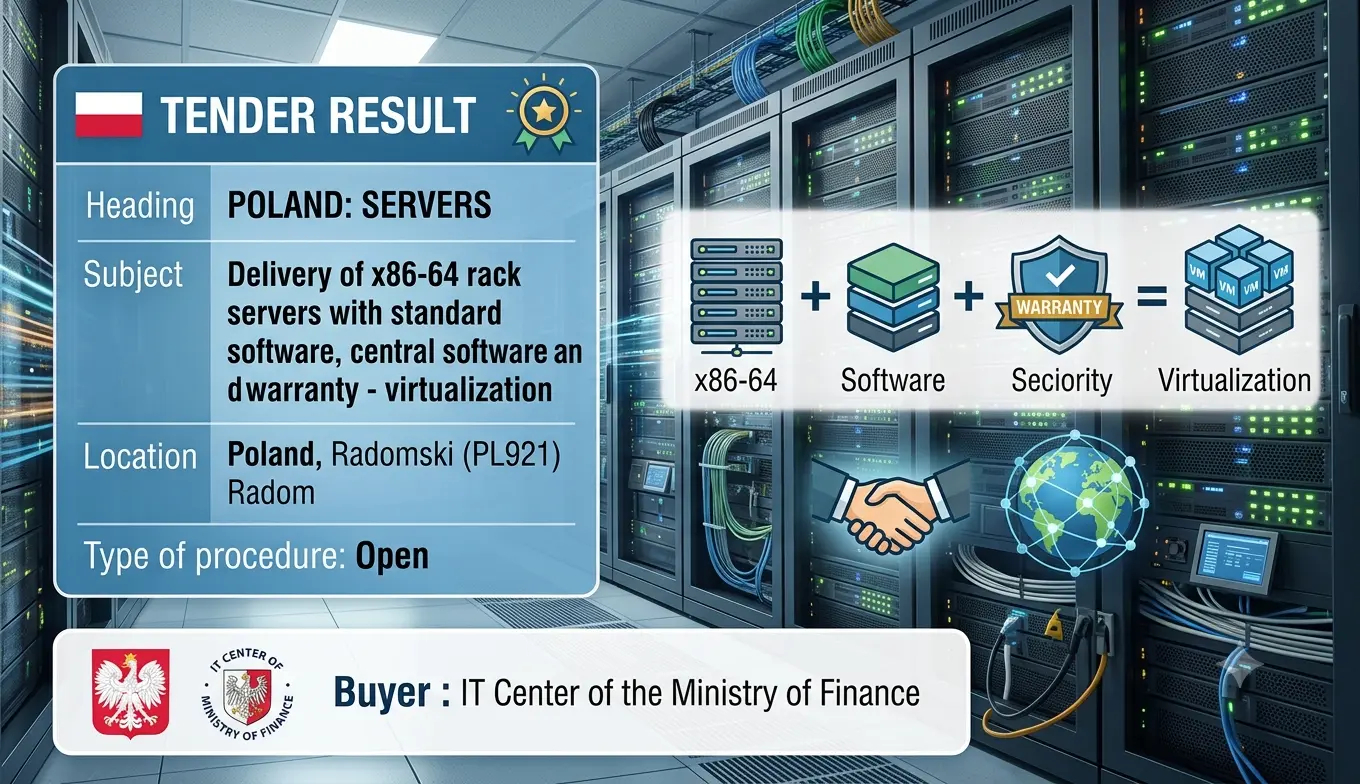
Galaxy Systemy Informatyczne Secures 105 Million PLN Server Contract for Polish Ministry of Finance
29 Sep 2026
Standfirst Galaxy Systemy Informatyczne sp. z o.o. has been awarded a 105.2 million PLN contract to supply x86-64 rack servers and associated software licenses to the IT Center of the Ministry of Finance in Poland. The procurement supports the National Recovery and Resilience Plan and focuses on building a high availability platform for public administration IT services. This tender result follows an accelerated open procedure that attracted five bids from domestic small and medium enterprises. The award highlights the ongoing digital transformation of the Polish public sector and the strategic reliance on local technology integrators to deliver critical virtualization infrastructure. Introduction The modernization of national digital infrastructure requires reliable and scalable computing resources to support public services. In Poland, the IT Center of the Ministry of Finance initiated a targeted procurement strategy to acquire advanced server hardware and virtualization software. This recent contract award ensures the ministry can maintain the high availability and processing power required for its critical administrative networks. By executing this procurement through an accelerated open procedure, the contracting authority leverages national recovery budgets to secure necessary IT infrastructure. The selection criteria balanced financial efficiency with extended warranty periods, ensuring long term operational stability. This approach guarantees that European Union recovery funds are deployed effectively to upgrade national digital public services and improve data processing capabilities across the government sector. Why This Contract Matters This procurement is vital for maintaining the operational integrity of the Polish national financial and administrative computer network. The acquisition of new servers directly supports the broader national strategy to enhance digital public services and data security. For the domestic IT sector, this contract award signals steady demand for enterprise grade hardware and specialized software within the public domain. It also demonstrates how EU recovery funds are actively driving tangible infrastructure upgrades across member states while ensuring sensitive data remains securely hosted on local servers. Contract Timeline The procurement process concluded with the selection of the winning bidder on July 24, 2026. Following standard administrative procedures and mandatory standstill periods, the formal contract was signed on September 23, 2026. The official contract awards notice was published in the Official Journal of the European Union on September 29, 2026. This timeline reflects a streamlined acquisition process typical for well defined hardware supply contracts where rapid deployment is a national priority. Contract Overview The agreement covers the delivery and transfer of ownership of specific server units, alongside extensive software licensing rights and manufacturer warranties. The contract is structured to include a basic order of 30 servers and an optional expansion clause for 50 additional units. The total value of the awarded contract is 105.2 million PLN. The supplier is responsible for ensuring all delivered hardware meets the strict technical specifications and environmental certifications outlined in the procurement documents. Key Contract Details Contract Title Supply of x86-64 rack servers with software and warranty Contracting Authority Centrum Informatyki Resortu Finansów Contract Value 105,200,000.00 PLN Procedure Type Open Procedure (Accelerated) Number of Bids Received 5 Winner Galaxy Systemy Informatyczne sp. z o.o. Contract Conclusion Date September 23, 2026 Main CPV Code 48820000 (Servers) Project Scope The core scope involves the supply of enterprise rack servers and associated operating system and virtualization software packages. The base order includes 30 specific server configurations required for the national financial registry. The contracting authority retains the right to activate an optional order for 50 additional servers and corresponding software licenses within three months of contract signature. This flexibility allows the public buyer to scale its computing capacity in response to growing data processing demands without initiating a new procurement cycle. Additionally, the scope mandates that all supplied servers hold an EPEAT BRONZE certification or equivalent, reflecting a strong commitment to green public procurement. The contractor must also provide extended manufacturer warranties, ensuring long term operational support and minimizing the risk of unexpected maintenance costs for the ministry. The contracting authority also applied strict exclusion criteria related to international sanctions, ensuring no entities linked to restricted jurisdictions under Council Regulation 833/2014 could participate in the tender or supply the hardware. About the Contracting Authority Centrum Informatyki Resortu Finansów is the primary buyer for this procurement. It is a central government body responsible for managing and developing the national digital health and financial information systems and infrastructure in Poland, ensuring that public administration entities have access to secure and efficient data management tools. About the Organisations Involved Centrum Informatyki Resortu Finansów is the contracting authority and buyer. It manages national digital services and drives the procurement of essential IT infrastructure for public administration systems. Galaxy Systemy Informatyczne sp. z o.o. is the successful bidder and a medium enterprise. The company specializes in IT systems integration and hardware supply for public and private sectors, bringing significant operational capacity to this award. Krajowa Izba Odwoławcza is the review organisation. This body handles any legal appeals or disputes related to public procurement procedures in Poland, ensuring fair competition and strict regulatory compliance. Publications Office of the European Union acts as the TED eSender. It is responsible for the official publication of procurement notices to ensure transparency and equal market access across the European continent. Procurement Analysis The accelerated open procedure attracted five bids, all submitted electronically by micro, small or medium enterprises. The award criteria were based on a balanced evaluation, assigning 60 percent weight to price and 40 percent weight to the duration of the manufacturer warranty. This evaluation method indicates that the technical baselines in the bidding documents were sufficiently rigorous to filter out non compliant proposals. Consequently, the competition focused on delivering optimal financial value while ensuring long term hardware reliability through extended warranty commitments. Additional Procurement Facts The procurement is covered by the Government Procurement Agreement, allowing international competition, though all received bids were from domestic Polish entities. The project is fully financed with European Union funds under the National Recovery and Resilience Plan, specifically targeting the construction of a high availability platform for the Ministry of Finance. The contracting authority utilized a reversed procedure sequence, evaluating the bids before verifying the formal qualification of the selected contractor. Market & Industry Perspective The Polish public sector IT market remains highly competitive, with specialized system integrators vying for government hardware contracts. The presence of medium enterprises in this tender result demonstrates that smaller firms can successfully compete for significant state funded technology projects when they possess deep local market knowledge. The reliance on a balanced evaluation for server procurement suggests that the market for standard enterprise hardware is mature. Suppliers must therefore optimize their supply chains and vendor relationships to offer the most competitive pricing while meeting strict technical baselines outlined in BOQs and GPNs. Global supply chain volatility has made local integration capabilities highly valuable. Domestic winners can often navigate logistical hurdles more effectively than international bidders, providing a distinct advantage in fulfilling tight delivery schedules for critical public infrastructure. The inclusion of environmental certifications like EPEAT also signals a broader industry shift toward sustainable IT procurement, requiring suppliers to adapt their product catalogs to meet evolving green mandates and carbon footprint reporting requirements. Economic Significance An investment of over 105 million PLN represents a targeted injection of capital into the domestic IT distribution and services sector. This supports local jobs in technology deployment, system integration and technical support within the country. By utilizing EU recovery funds, the Polish government is accelerating the modernization of its digital infrastructure without placing the entire financial burden on the national budget. This efficient allocation of public procurement resources stimulates the local technology ecosystem and ensures that critical administrative data remains securely hosted within national borders. Future Procurement Opportunities Suppliers who were not successful should monitor the official Tenders Portal for upcoming IT infrastructure renewals. As technology lifecycles are relatively short, public institutions will continuously generate new tenders opportunities for hardware refreshes and software updates. Stakeholders should also track the Latest Active Tenders Procurement notices to anticipate upcoming infrastructure projects in the broader European digital sector. The dynamic nature of public procurement means that new Live Notices for Tenders will emerge as regional authorities update their technology roadmaps and transition toward modern cloud environments. Opportunities for Suppliers While the primary hardware contract has been awarded, specialized subcontractors can find valuable opportunities in providing implementation services, technical support and system integration. Companies offering advanced monitoring software or cybersecurity auditing services may find niche opportunities to complement the supplied server infrastructure and enhance the overall security posture of the national financial registry. What Businesses Should Watch Industry observers should monitor the activation rate of the optional order clause, as this will indicate the immediate scaling needs of the national financial network. The performance of the winning supplier in meeting the strict delivery and warranty requirements will also set a benchmark for future service level agreements. The continued flow of EU funds into Polish digital infrastructure will likely sustain a steady pipeline of live tender announcements in this sector. Stakeholders should also review Live Notices for Tenders to anticipate upcoming infrastructure projects and pay close attention to evolving data sovereignty requirements. PolandTenders.com Procurement Intelligence This contract represents a clear trend in European public procurement toward the streamlined acquisition of standardized IT infrastructure using accelerated procedures. By assigning 60 percent weight to price and 40 percent to warranty duration, the contracting authority signaled that technical compliance and long term support are primary gateways for winning government hardware contracts. Suppliers can learn that maintaining agile supply chains and offering extended manufacturer warranties is critical for success in price driven bids. The strict application of green procurement criteria and international sanctions exclusion clauses also highlights the increasing complexity of public sector RFPs and RFQs. Strategically, this award is important because it highlights the viability of medium enterprises in securing major state technology projects when they can demonstrate absolute compliance with technical baselines and environmental certifications. To position themselves for future contracts, relevant suppliers should focus on optimizing their operational costs and ensuring their product catalogs align with the specific green procurement requirements outlined in GPNs and BOQs. Future contracts in this market will likely feature even stricter data sovereignty and carbon footprint reporting mandates, requiring suppliers to develop transparent supply chains and offer verifiable environmental benefits to succeed in upcoming Active Tenders. Supplier Takeaways Price and warranty evaluation criteria require absolute technical compliance and extended support commitments to win government hardware contracts. Medium enterprises can successfully compete for major state funded technology projects by optimizing supply chains and demonstrating local market knowledge. Optional order clauses require winners to maintain inventory readiness and rapid deployment capabilities for scaling national infrastructure. Green procurement mandates like EPEAT certification are becoming standard requirements in public sector RFPs and RFQs. Key Takeaways Galaxy Systemy Informatyczne sp. z o.o. won the 105.2 million PLN server and software supply contract. The procurement covers 30 base servers and 50 optional servers for the national financial high availability platform. Five bids were received, all from domestic micro, small or medium enterprises. The contract includes strict environmental certifications and extended manufacturer warranty requirements. Award criteria were balanced at 60 percent price and 40 percent warranty duration, reflecting a mature market for standard hardware. Conclusion This contract secures essential computing infrastructure for a vital Polish national initiative while demonstrating the effective use of European Union recovery funds. The transparent and balanced procurement process ensures optimal value for public money while maintaining high technical standards and supporting the domestic IT industry. Source: Tenders Electronic Daily (TED), Contract Award Notice 669848-2026, Official Journal of the European Union, published on 29/09/2026.
View Details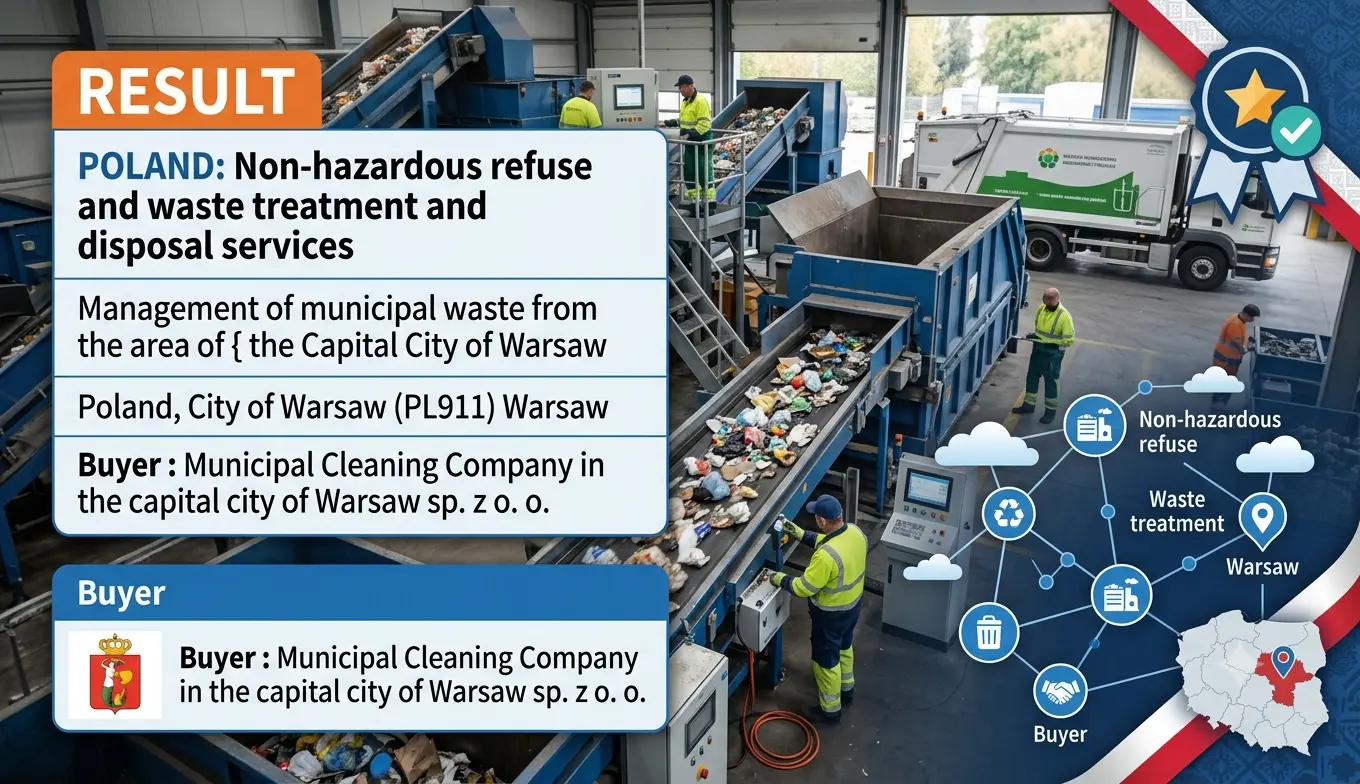
Warsaw Awards PLN 243.8 Million Municipal Waste Management Contracts to BYŚ and REMONDIS
28 Sep 2026
Standfirst Municipal waste management company Miejskie Przedsiębiorstwo Oczyszczania w m. st. Warszawie sp. z o.o. has awarded two contracts for the management of municipal waste generated in Warsaw. BYŚ Wojciech Byśkiniewicz won Lot 1 with a tender value of PLN 121.25 million including the renewal while REMONDIS Sp. z o.o. won Lot 2 with a tender value of PLN 122.545 million including the renewal. The combined value of the two contracts including renewals is PLN 243.795 million while the value without renewals is PLN 195.036 million. Each lot covers a planned maximum quantity of 100,000 tonnes of municipal waste. Introduction Warsaw's municipal waste management procurement has resulted in two contracts covering the treatment and management of up to 200,000 tonnes of municipal waste. The procurement was divided into two lots of 100,000 tonnes each, with BYŚ Wojciech Byśkiniewicz selected for Lot 1 and REMONDIS Sp. z o.o. selected for Lot 2. Both contracts have an initial implementation period of 24 months with one possible six month renewal. The procurement was conducted by Miejskie Przedsiębiorstwo Oczyszczania w m. st. Warszawie sp. z o.o. through an accelerated open procedure. The main CPV classification is 90513000 for non hazardous refuse and waste treatment and disposal services. Both winning tenders were ranked first and both contracts were awarded after two tenders were received for each lot. Why This Contract Matters The procurement is significant for Warsaw because it concerns the continued management of municipal waste generated across the city. The two lots together provide for a planned maximum of 200,000 tonnes of waste, divided equally between the two contracts. The buyer also specifies a minimum quantity of 50,000 tonnes for each lot, while the actual quantity delivered for management can depend on waste generation and other factors. The procurement also follows an earlier tender process in which two comparable lots were cancelled because all submitted offers exceeded the amount the buyer had intended to allocate for those contracts. The buyer therefore shortened the submission period to 15 days for the new procedure, citing the need to ensure continuity of municipal waste management services. Contract Timeline The procedure was identified by internal reference RZP.27.33.2026.KB and followed previous notice 497436 2026. It was conducted as an accelerated open procedure under the Polish Public Procurement Law. The winners for both lots were selected on 24 August 2026. The contract for Lot 1 with BYŚ Wojciech Byśkiniewicz was concluded on 15 September 2026. The contract for Lot 2 with REMONDIS Sp. z o.o. was concluded on 4 September 2026. The result notice was dispatched on 25 September 2026 and published as notice 665780 2026 in OJ S187/2026 on 28 September 2026. Contract Overview The procurement covers municipal waste generated within the City of Warsaw. The main CPV classification is 90513000, Non hazardous refuse and waste treatment and disposal services. The total planned maximum quantity is 200,000 tonnes divided into two lots of 100,000 tonnes each. Lot 1 was awarded to BYŚ Wojciech Byśkiniewicz for PLN 121.25 million including the renewal. Lot 2 was awarded to REMONDIS Sp. z o.o. for PLN 122.545 million including the renewal. The notice states that the corresponding values without renewals are PLN 97 million and PLN 98.036 million respectively. Key Contract Details CountryPoland BuyerMiejskie Przedsiębiorstwo Oczyszczania w m. st. Warszawie sp. z o.o. LocationWarsaw ProcedureAccelerated open procedure Legal BasisDirective 2014/24/EU Main CPV90513000 Total Lots2 Total Maximum Quantity200,000 tonnes Quantity per Lot100,000 tonnes Minimum Quantity per Lot50,000 tonnes Value Without RenewalsPLN 195,036,000 Value Including RenewalsPLN 243,795,000 Lot 1 WinnerBYŚ Wojciech Byśkiniewicz Lot 1 Tender Value Including RenewalPLN 121,250,000 Lot 1 Value Without RenewalPLN 97,000,000 Lot 2 WinnerREMONDIS Sp. z o.o. Lot 2 Tender Value Including RenewalPLN 122,545,000 Lot 2 Value Without RenewalPLN 98,036,000 Initial Duration24 months Maximum Renewals1 Renewal Period6 months Award CriterionCost, 100% Tenders Received per Lot2 EU FundingNot stated Review OrganisationKrajowa Izba Odwoławcza Project Scope The procurement covers the management of municipal waste originating from the territory of the City of Warsaw. Each lot covers a planned maximum quantity of 100,000 tonnes and relates to waste classified under code 20 03 01. The buyer states that the quantity actually transferred for management will depend on the amount of waste generated by Warsaw residents and other factors identified in the procurement documentation. For each lot, the buyer guarantees implementation of the contract to a minimum quantity of 50,000 tonnes. However, suppliers do not have a claim for compensation if the quantity transferred for management is lower than the planned maximum quantity. The service location is the installation and transfer station identified by the contractor in its tender, subject to changes permitted under the contract. About the Contracting Authority Miejskie Przedsiębiorstwo Oczyszczania w m. st. Warszawie sp. z o.o. is the contracting organisation responsible for the procurement. The organisation is based at ul. Obozowa 43 in Warsaw and its contracting authority activity is classified as housing and community amenities. The organisation's Public Procurement Department handled the procurement. The buyer also specified employment requirements under Polish labour law for personnel employed by the contractor or subcontractor in connection with the service. About the Organisations Involved Miejskie Przedsiębiorstwo Oczyszczania w m. st. Warszawie sp. z o.o. acted as the buyer and contracting organisation. It established the two lot structure and the maximum and minimum waste quantities for the procurement. BYŚ Wojciech Byśkiniewicz won Lot 1. The organisation is classified in the notice as a large economic operator and is based in Warsaw. Its ranked tender for Lot 1 has a value of PLN 121.25 million including the renewal and PLN 97 million without the renewal. No subcontracting was reported. REMONDIS Sp. z o.o. won Lot 2. It is also classified as a large economic operator and is based in Warsaw. Its ranked tender has a value of PLN 122.545 million including the renewal and PLN 98.036 million without the renewal. No subcontracting was reported. Krajowa Izba Odwoławcza is identified as the review organisation and as the organisation providing further information about review procedures. It is based in Warsaw. Publications Office of the European Union is identified as the TED eSender responsible for transmission of the notice for publication. Procurement Analysis The procurement used an accelerated open procedure. The buyer explained that the submission period was shortened to 15 days under Article 138(2) of the Polish Public Procurement Law. The justification referred to the need to restart procurement for the relevant waste management scope and maintain continuity of the service. Two tenders were received for Lot 1 and two tenders were received for Lot 2. All received tenders were submitted electronically. The notice records no tenders from other European Economic Area countries and no tenders from countries outside the EEA for either lot. The award criterion was cost with a weighting of 100%. This means the published evaluation framework placed the entire award weighting on the cost of the service. Additional Procurement Facts The notice contains an important distinction between the contract values with and without renewals. The total value of all contracts awarded including renewals is PLN 243.795 million. Without renewals, the total is PLN 195.036 million. For Lot 1, the value without the renewal is PLN 97 million while the value including the renewal is PLN 121.25 million. For Lot 2, the corresponding figures are PLN 98.036 million and PLN 122.545 million. Each contract has one possible renewal lasting another six months. Market and Industry Perspective The procurement demonstrates the scale of municipal waste treatment requirements in a major European capital. The planned maximum quantity of 200,000 tonnes across two contracts creates substantial demand for waste treatment and disposal capacity. The tender structure also provides insight into the competitive environment. Both lots attracted two tenders and both winners were classified as large economic operators. The competition was entirely domestic according to the tender origin information recorded in the notice. The use of cost as the sole award criterion creates a procurement environment where suppliers must compete primarily through the financial terms of their service offers. At the same time, the procurement requires suppliers to provide the waste management capacity and comply with the detailed requirements established in the procurement documents. Economic Significance The combined contract value of PLN 243.795 million including renewals represents a substantial municipal waste management commitment. The base contract value without renewals is PLN 195.036 million. The contracts also cover a potentially significant waste volume. The two lots together provide for a planned maximum of 200,000 tonnes over the initial implementation period, with each lot having a maximum of 100,000 tonnes and a minimum declared quantity of 50,000 tonnes. Future Procurement Opportunities The procurement may generate future opportunities for waste treatment facilities, transfer stations and operators capable of managing municipal waste generated in Warsaw. Suppliers can monitor future procurements using CPV 90513000 and related waste treatment and disposal classifications. The renewal mechanism also provides a procurement intelligence signal. Each contract has one potential six month renewal, meaning the complete commercial period can extend beyond the initial 24 month implementation period. Businesses monitoring the market should distinguish the base service period from the potential renewal period. Opportunities for Suppliers Waste management companies with appropriate treatment capacity can monitor similar municipal contracts across Poland. The Warsaw procurement demonstrates that large volume waste management requirements may be divided into separate lots, allowing buyers to distribute service requirements between multiple contractors. Suppliers should also examine the minimum and maximum volume provisions carefully. Although each lot has a planned maximum of 100,000 tonnes, the buyer guarantees a minimum of 50,000 tonnes and states that the actual quantity may be lower than the planned maximum. What Businesses Should Watch Businesses should monitor Warsaw procurement activity closely because the buyer has already demonstrated the need to restart procurement after an earlier process was cancelled for two comparable lots. The current notice specifically states that the earlier offers for those lots significantly exceeded the amount available to finance the procurement. Suppliers should also watch contract renewal dates and waste volume requirements. The combination of 24 month service periods, six month renewals and variable waste generation means that future market opportunities may depend on both contract expiry and actual municipal waste volumes. PolandTenders.com Procurement Intelligence The Warsaw procurement provides a useful example of how procurement intelligence can identify both contract value and volume based market signals. The most important signals are CPV 90513000, the 200,000 tonne combined maximum quantity and the PLN 195.036 million base contract value. The award also shows why procurement data should separate base contract values from renewal values. Reporting only the PLN 243.795 million total without explaining the renewal component could give suppliers an incomplete picture of the initial contractual commitment. The notice explicitly provides both figures, allowing the market to distinguish between the base value and the maximum value including renewal. The previous cancelled procurement provides another important intelligence signal. The buyer stated that two earlier lots were cancelled because all submitted offers exceeded the available financing. The new procurement was then accelerated to support continuity of waste management services. This sequence can help suppliers understand the procurement background and the buyer's immediate operational requirements. The two successful suppliers also demonstrate the competitive structure of the market. BYŚ Wojciech Byśkiniewicz and REMONDIS Sp. z o.o. both won separate lots and both are classified as large economic operators. Their successful tender values are relatively close, at PLN 121.25 million and PLN 122.545 million respectively including renewals. For suppliers monitoring Polish municipal procurement, this notice can therefore be used as a benchmark for contract size, waste volume, competition and procurement structure. Tracking the buyer, CPV classification, participating suppliers and renewal provisions can help identify subsequent opportunities in the Warsaw waste management market. Supplier Takeaways Warsaw awarded two municipal waste management contracts. BYŚ Wojciech Byśkiniewicz won Lot 1. REMONDIS Sp. z o.o. won Lot 2. The combined maximum quantity is 200,000 tonnes. Each lot has a maximum planned quantity of 100,000 tonnes. Each lot has a minimum quantity of 50,000 tonnes. The main CPV is 90513000. The combined value without renewals is PLN 195.036 million. The combined value including renewals is PLN 243.795 million. Lot 1 is valued at PLN 121.25 million including the renewal. Lot 2 is valued at PLN 122.545 million including the renewal. The initial contract period is 24 months. Each lot has one possible six month renewal. Two tenders were received for each lot. The award criterion was cost at 100%. Both winning suppliers are classified as large economic operators. No subcontracting was reported for either winning tender. The contracts were concluded in September 2026. Key Takeaways Country: Poland. Buyer: Miejskie Przedsiębiorstwo Oczyszczania w m. st. Warszawie sp. z o.o. Location: Warsaw. Project: Management of municipal waste from Warsaw. Main CPV: 90513000. Procedure: Accelerated open procedure. Legal Basis: Directive 2014/24/EU. Total Lots: 2. Total Maximum Quantity: 200,000 tonnes. Lot 1 Winner: BYŚ Wojciech Byśkiniewicz. Lot 2 Winner: REMONDIS Sp. z o.o. Base Contract Value: PLN 195.036 million. Maximum Value Including Renewals: PLN 243.795 million. Initial Duration: 24 months. Renewal: One additional six month period. Award Criterion: Cost, 100%. Tenders: 2 per lot. Review Organisation: Krajowa Izba Odwoławcza. Conclusion Warsaw has awarded two municipal waste management contracts with a combined value of PLN 195.036 million without renewals and PLN 243.795 million including the available six month renewals. BYŚ Wojciech Byśkiniewicz will handle Lot 1 while REMONDIS Sp. z o.o. will handle Lot 2, with each contract covering up to 100,000 tonnes of municipal waste. The procurement highlights the continuing scale of waste management requirements in Warsaw and provides important market intelligence for suppliers monitoring Polish municipal waste opportunities. Source: TED result notice 665780-2026, OJ S187/2026, published 28 September 2026.
View Details