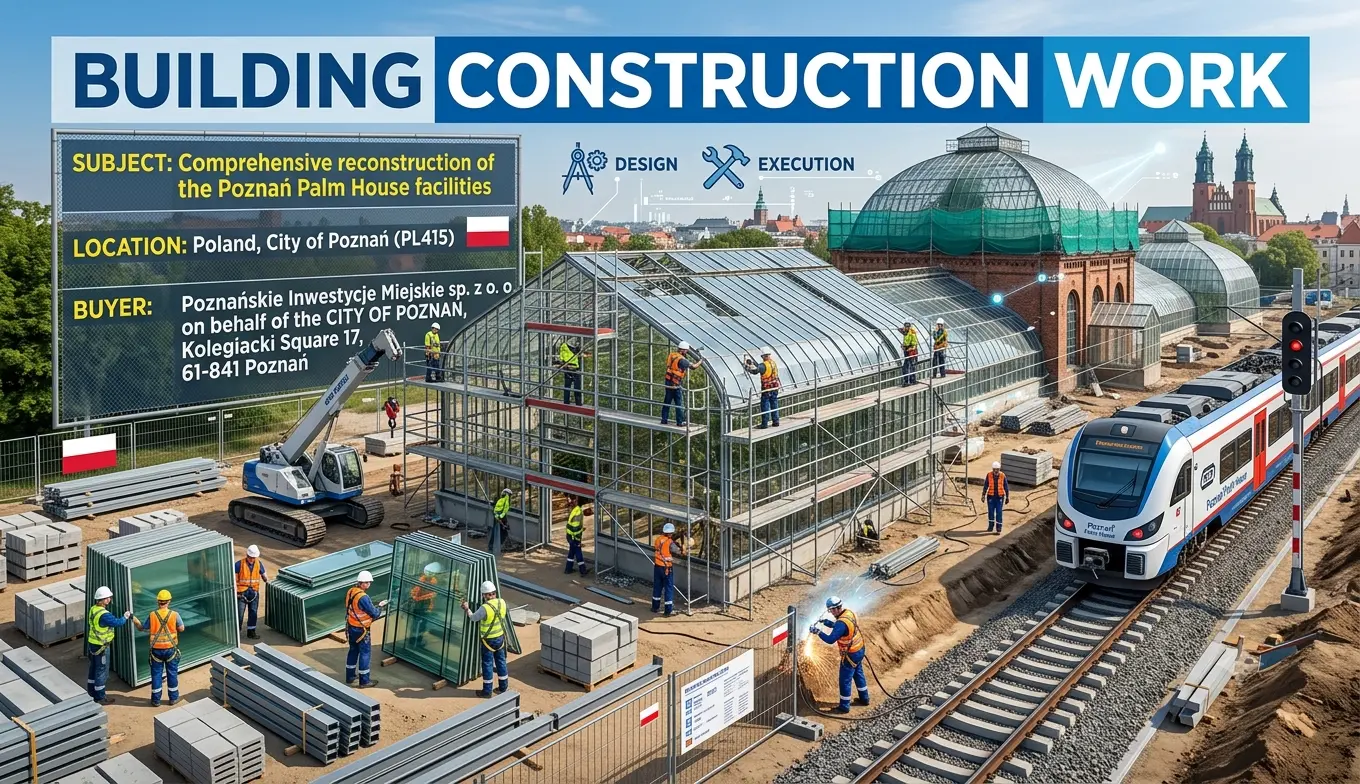
Poland Commits PLN 157.4 Million to the Comprehensive Redevelopment of Poznań Palm House
04 Sep 2026
Standfirst Poznań is moving ahead with a major redevelopment of the Poznań Palm House through a construction contract worth PLN 157.36 million. The project will combine expansion, reconstruction and renovation of the Palm House with a new garage and supporting technical infrastructure. The scope also includes rainwater storage and retention systems, a power generator, a new water connection and extensive demolition work. Dekpol Budownictwo Sp. z o.o. has won the contract after five tenders were received in an open procurement procedure. Introduction The redevelopment of a major public botanical facility is rarely just a construction exercise. It involves preserving an existing civic asset while adapting its buildings and infrastructure to modern operational requirements. In Poznań the challenge is particularly substantial because the project combines reconstruction and expansion with new technical infrastructure and changes to several existing structures. Poland has now reached the contract award stage for the comprehensive redevelopment of the Poznań Palm House. The procurement covers building works and related services required for the investment programme known as the comprehensive reconstruction of the Poznań Palm House facilities. The contract has been awarded to Dekpol Budownictwo Sp. z o.o. for PLN 157,355,827.06. The result notice records a total value of all contracts awarded in the notice of PLN 196,556,292.34. The difference between the winning tender value and the total value reported in the notice should be treated carefully because the award notice does not provide enough detail to attribute the difference to additional payments or separate work packages. The procurement is classified principally under CPV 45210000 for building construction work. It also covers site preparation, demolition, electrical installations, water and sanitary installations, fencing and protective equipment, floor and wall covering, painting and glazing and other finishing work. Why This Contract Matters The significance of the project lies in the combination of heritage style public infrastructure and a modern construction programme. The Palm House is not being treated simply as a building requiring renovation. The procurement brings together structural works, installations, environmental infrastructure, demolition and site development under one principal construction assignment. The contract also shows how municipalities can use a single integrated procurement to manage a technically diverse redevelopment. Instead of separating every construction discipline into unrelated contracts, the buyer has defined a broad package that allows the main contractor to coordinate the construction programme against a common project design and specification. The financial scale is substantial for a municipal infrastructure project. A winning tender of more than PLN 157 million creates a sizeable construction workload while the wider notice reports PLN 196.56 million in awarded contracts. The contract is therefore relevant not only to building contractors but also to specialist companies operating across electrical, sanitary, civil engineering and finishing activities. The procurement is also useful for suppliers because it demonstrates that large public redevelopment programmes can create opportunities across several construction disciplines even when the principal contract is awarded to one lead contractor. Contract Timeline The procurement was conducted under the procedure identified as PIM/08/25/ZP47/2020-258. The previous notice referenced in the award documentation is 299108-2026. The award notice was published in the Official Journal of the European Union as OJ S 171/2026 on 4 September 2026. The winning contract carries the identifier RU-186_PIM_26_TB_2020-258. The contract was concluded on 17 August 2026 with Dekpol Budownictwo Sp. z o.o. as the successful contractor. The planned duration is 1,280 days. The notice also states that detailed implementation deadlines are specified in the relevant procurement documentation and the applicable section of the tender specifications. Contract Overview The project concerns the execution of construction works and services associated with the investment task titled the comprehensive redevelopment of the Poznań Palm House facilities. The project is located in the City of Poznań within the PL415 NUTS region. The main work includes expansion, reconstruction and renovation of the Poznań Palm House. The programme also provides for construction of a garage for Palm House requirements together with the technical infrastructure required to support the redeveloped facilities. The procurement does not establish a framework agreement and does not create a dynamic purchasing system. It is a conventional works contract with an optional scope governed by the contract model and the detailed description of the subject matter. Key Contract Details CountryPoland CityPoznań Contracting AuthorityPoznańskie Inwestycje Miejskie sp. z o.o. acting on behalf of MIASTO POZNAŃ Procurement TypeWorks ProcedureOpen procedure Internal IdentifierPIM/08/25/ZP47/2020-258 ProjectComprehensive redevelopment of the Poznań Palm House facilities Main CPV45210000 Building construction work Additional CPV45100000 45300000 45400000 45110000 45220000 45310000 45330000 45340000 45430000 45440000 45450000 Contract ValuePLN 157,355,827.06 Total Value of Contracts in NoticePLN 196,556,292.34 Tenders Received5 SME Tenders Received0 Duration1,280 days WinnerDekpol Budownictwo Sp. z o.o. Contract Conclusion17 August 2026 Framework AgreementNo Dynamic Purchasing SystemNo EU FundingNo GPA CoverageNo Project Scope The construction programme covers the expansion, reconstruction and renovation of the Poznań Palm House. The works are planned according to the project documentation and the detailed description of the subject matter prepared by the contracting authority. A new garage is included in the project together with supporting technical infrastructure. This infrastructure includes rainwater tanks, retention and infiltration tanks and a power generator. The project also includes construction of a water supply connection and associated site development. Demolition activities form another important part of the scope. These include demolition of the café building with its connection to pavilion number 3, a chimney with a technical annex, an equipment storage building and a crane. Site development and small architecture are also included. About the Contracting Authority Poznańskie Inwestycje Miejskie sp. z o.o. acting on behalf of MIASTO POZNAŃ is identified as the buyer in the TED notice. The organisation is a body governed by public law and operates on behalf of the City of Poznań for this procurement. The buyer is also responsible for providing additional information concerning the procurement procedure. The notice identifies Artur Pieczykolan and Dawid Kozłowski as contact points for the procurement. About the Organisations Involved Poznańskie Inwestycje Miejskie sp. z o.o. is the organisation identified as the buyer. The notice states that it acts on behalf of MIASTO POZNAŃ. Its role covers the procurement process and the provision of additional information concerning the tender. MIASTO POZNAŃ is the public entity on whose behalf the procurement is conducted. The project is located within the City of Poznań and is intended to deliver the comprehensive redevelopment of the Palm House facilities. Dekpol Budownictwo Sp. z o.o. is the successful tenderer and the contractor selected for LOT-0000. TED classifies the economic operator as a large enterprise. Its tender value was PLN 157,355,827.06. The notice states that subcontracting will be used but does not disclose either the subcontracting value or the percentage of the contract assigned to subcontractors. Prezes Krajowej Izby Odwoławczej is identified as the review organisation. The organisation provides the formal procurement review route under Polish public procurement rules. The notice refers to legal protection measures available during the procurement process and states that appeals are submitted according to the applicable provisions of Polish procurement law. Urząd Zamówień Publicznych is identified as the organisation providing additional information about review procedures. It is therefore connected with the procedural and legal framework surrounding procurement review rather than with project execution. Publications Office of the European Union is identified as the TED eSender. Its role relates to the publication and transmission of the procurement notice through the European Union public procurement publication system. Procurement Analysis The buyer used an open procedure under Directive 2014/24/EU and Article 132 of the Polish Public Procurement Law. An open procedure allows eligible economic operators to submit tenders without a separate restricted first stage. For a major construction programme this structure provides a transparent competitive route while allowing the buyer to evaluate competing offers against predefined criteria. Five tenders were received. The notice records zero tenders from micro small or medium sized tenderers and zero tenders from economic operators registered in other European Economic Area countries. This means all five recorded tenders came from the remaining tender category reported by the notice. The award methodology combined price with three quality related measures. Price carried 60 percent of the weighting. The guarantee or warranty period carried 16 percent while the warranty period for structural elements carried 15 percent. Experience of the contractor's personnel carried the remaining 9 percent. The structure is important because the procurement was not decided on price alone. A 60 percent price weighting gives cost significant influence while the remaining 40 percent rewards longer warranty commitments and personnel experience. This approach gives suppliers a reason to compete through lifecycle assurance and professional capability rather than relying entirely on the lowest initial price. Additional Procurement Facts The procurement was not financed with European Union funds and it is not covered by the Government Procurement Agreement. The buyer did not plan a framework agreement and did not establish a dynamic purchasing system. The tender required a bid security of PLN 4.5 million. The buyer also set performance security at 5 percent of the total price stated in the offer. The notice further provides for an optional order linked to the contract and the detailed procurement documentation. Market & Industry Perspective The Palm House project creates demand across a wide section of Poland's construction supply chain. The principal CPV code points to building construction while the additional codes cover demolition, electrical installations, water and sanitary systems, protective installations, flooring, wall covering, painting, glazing and other finishing work. This combination suggests a project with substantial coordination requirements. The successful contractor must deliver a building redevelopment while managing specialist technical systems and changes to the surrounding site. The presence of demolition and new infrastructure within the same programme adds another layer of sequencing and project management. The five tender submissions indicate that the project attracted several competing suppliers. At the same time the absence of recorded SME tenders is notable. The scale of the project together with the PLN 4.5 million bid security may have contributed to the type of supplier able to participate although the notice does not state why no SME tender was received. For the wider industry the procurement demonstrates the continued importance of integrated construction capability in large public redevelopment projects. It also shows that buyers can balance price with warranty and personnel experience when the long term performance of a refurbished public facility is important. Economic Significance The PLN 157.36 million winning tender represents a sizeable investment in the built environment of Poznań. The project is expected to generate construction activity over 1,280 days with demand extending across several technical disciplines. The notice also reports PLN 196.56 million as the value of all contracts awarded in the notice. Because the published information does not provide a separate explanation for the difference from the winning tender value, the figures should be treated as distinct reported values rather than combined into a larger contract value. Future Procurement Opportunities The project contains an optional scope that can create additional procurement related activity within the existing contractual structure. The notice states that the buyer anticipates an optional order concerning implementation of the project as described in the contract and the procurement description. The buyer also reserves the possibility of awarding similar works or services under Article 214 paragraph 1 point 7 of the Polish Public Procurement Law up to 50 percent of the value of the basic order. Such work can be considered where circumstances arise requiring additional scopes that were not included in the current basic requirement. Any future award under this mechanism would depend on the conditions specified by the procurement rules and the requirements set by the contracting authority. The notice states that the existing contractor must have performed the works on time and with the required level of care while maintaining an equivalent standard for the new work and accepting material conditions of the existing contract. For suppliers outside the current contract the longer term opportunity is the broader Polish public construction pipeline. Large municipal redevelopment programmes can generate specialist packages and future projects even when the main construction contract has already been awarded. Opportunities for Suppliers Suppliers can learn from the technical breadth of the Palm House procurement. Companies operating in electrical installation, sanitary systems, demolition, finishing, civil engineering and building construction can identify potential supply chain opportunities around major municipal projects. The award criteria also indicate that suppliers should prepare evidence around warranty performance and personnel experience. In procurements where quality represents 40 percent of the score, technical credibility can materially affect competitiveness alongside the commercial offer. What Businesses Should Watch Businesses should watch the implementation of the PLN 157.36 million contract over the 1,280 day delivery period. The long construction schedule means that project execution milestones can become important indicators of future supplier requirements and potential changes in work sequencing. Companies should also track any exercise of the optional scope. The buyer has explicitly included optional work within the procurement structure which creates a possible route for additional activity associated with the project. Another important issue is the use of subcontracting. The winning contractor has indicated that subcontracting will occur but the notice does not disclose the value or percentage. Future project information may therefore provide a clearer picture of how the main contract is distributed through the construction supply chain. Procurement professionals should also monitor the next generation of municipal building programmes in Poznań. The Palm House award demonstrates the scale of investment that can emerge from a city infrastructure programme and the breadth of capabilities required to deliver it. PolandTenders.com Procurement Intelligence The Poznań Palm House award represents a broader procurement trend toward integrated redevelopment contracts for complex public assets. Instead of treating structural construction, infrastructure systems and site works as completely separate requirements, the buyer has assembled a programme that places coordination of the major construction activities under one principal contract. The strategic importance of the award is reinforced by the project duration and the mix of work. A 1,280 day programme gives the contractor a long delivery horizon while the scope combines renovation with expansion and new technical infrastructure. This type of contract requires suppliers to think beyond construction capacity and demonstrate their ability to manage interfaces between civil works, installations and finishing activities. The evaluation structure provides another important lesson. Price represents 60 percent of the assessment while warranty and personnel experience account for 40 percent. Suppliers competing for similar public projects should therefore avoid treating the procurement as a simple lowest price contest. The ability to offer credible warranty periods and demonstrate experienced personnel can be part of the commercial strategy. The tender also provides a useful signal about market access. Five companies submitted tenders while no SME tender was recorded. This does not establish that smaller companies were excluded but it highlights the importance of financial capacity and technical readiness for projects carrying a PLN 4.5 million bid security requirement. For construction companies the best positioning strategy is to build a portfolio around the CPV categories used in the project and maintain clear evidence of relevant completed work. Specialist firms should also examine the supply chains of major contractors because large integrated projects can create secondary opportunities even when the principal contract is already awarded. Future contracts in this market may increasingly combine refurbishment with energy systems, water management, resilience infrastructure and modern building services. The Palm House procurement already includes rainwater infrastructure and a power generator within the wider redevelopment. That suggests that public asset renewal can increasingly involve both physical reconstruction and supporting infrastructure requirements. For procurement intelligence purposes the most important development to monitor is therefore not only the final contractor. The real commercial picture will emerge from project execution, optional work, subcontracting activity and related municipal investment programmes. These signals can show where additional demand is developing before a new tender becomes visible. Supplier Takeaways Track major municipal redevelopment programmes in Poland. Monitor Poznań public infrastructure procurement for related construction opportunities. Assess capability across building works and specialist installations. Prepare strong evidence of personnel experience for quality weighted tenders. Consider warranty strategy as part of tender pricing and bid planning. Monitor subcontracting opportunities linked to the Dekpol Budownictwo contract. Watch for optional works associated with the Palm House redevelopment. Review future procurements using CPV 45210000 and related construction codes. Key Takeaways Poland has awarded the Poznań Palm House redevelopment contract to Dekpol Budownictwo Sp. z o.o. The winning tender is valued at PLN 157,355,827.06. The notice reports PLN 196,556,292.34 as the value of all contracts awarded in the notice. The project covers expansion, reconstruction and renovation of the Poznań Palm House. A new garage and supporting technical infrastructure are included. Rainwater tanks, retention and infiltration tanks and a power generator are part of the infrastructure scope. The project includes a new water supply connection and site development. Several existing structures are scheduled for demolition. Five tenders were received through the open procedure. No tender from an SME was recorded in the statistical information. Price carries 60 percent of the award weighting. Warranty and personnel experience together account for the remaining 40 percent. The planned duration is 1,280 days. The procurement is not EU funded and is not covered by the GPA. The contract was concluded on 17 August 2026. Conclusion The PLN 157.36 million award marks a major step in the redevelopment of one of Poznań's prominent public facilities. By combining building reconstruction with new infrastructure and extensive site works the project creates a substantial and technically diverse construction programme. For suppliers the award is equally significant as a market signal. Competition attracted five tenders while the evaluation model placed meaningful weight on warranty and personnel experience. Businesses tracking Polish public construction should therefore watch the project's execution and optional scope while using the procurement as an indicator of the capability requirements emerging in large municipal redevelopment programmes. Source: Tenders Electronic Daily (TED), Contract Award Notice 612467-2026, Official Journal of the European Union, OJ S 171/2026, published on 04/09/2026.
View Details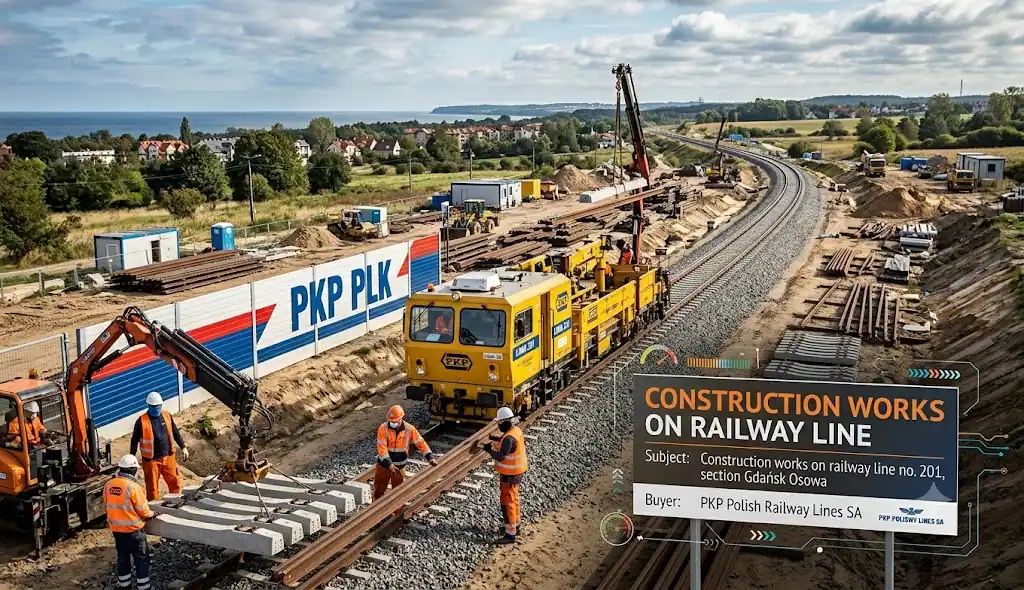
UNIBEP and Track Tec Secure 874 Million PLN Railway Modernization Contract in Poland’s Tri-City
03 Sep 2026
Standfirst A consortium led by UNIBEP S.A. and including Track Tec Construction sp. z o.o. has been awarded a major design-and-build contract worth 874.1 million PLN to modernize a critical railway corridor in northern Poland. The project, commissioned by PKP Polskie Linie Kolejowe S.A., focuses on upgrading railway line 201 between Gdańsk Osowa and Gdynia Główna. This strategic infrastructure investment aims to increase rail capacity, introduce a third track and modernize signalling systems across the densely populated Trójmiasto metropolitan area. The award follows a highly competitive open procedure that attracted ten bids from major construction and engineering firms, highlighting the consolidation of expertise required for complex national infrastructure projects. Introduction The modernization of Poland’s railway network represents a cornerstone of the country’s broader strategy to shift freight and passenger transport from congested roads to more sustainable and efficient rail corridors. The Trójmiasto region, encompassing Gdańsk, Gdynia and Sopot, is a vital economic hub that requires robust, high-capacity rail infrastructure to support its growing population and industrial base. PKP Polskie Linie Kolejowe S.A. has initiated a comprehensive upgrade program to eliminate historical bottlenecks and improve travel times along the Baltic coast. The awarding of this 874.1 million PLN contract marks a significant milestone in the execution of the "Works on the Kościerzyna - Gdynia section" project. By consolidating design and construction responsibilities into a single consortium, the contracting authority seeks to streamline project delivery and mitigate interface risks. This approach reflects a mature understanding of the complexities involved in upgrading active railway lines within dense urban environments. Why This Contract Matters This contract is fundamentally about unlocking latent capacity in one of Poland’s most congested railway corridors. The addition of a third track and the comprehensive overhaul of signalling and traffic control systems will dramatically improve the reliability and frequency of both regional passenger services and cross-border freight trains. For the local economy, the reduction in transit times and the enhancement of rail freight reliability will strengthen the competitive advantage of the Gdańsk-Gdynia port complex. Efficient rail links are critical for the port to handle increasing cargo volumes and maintain its status as a primary logistics gateway for Central and Eastern Europe. Furthermore, the project incorporates significant environmental and civil engineering components, including the demolition of obsolete structures and the implementation of modern noise barriers. The successful execution of this project will serve as a blueprint for subsequent modernization efforts along the broader Baltic coast rail network. Contract Timeline The procurement process culminated in the formal conclusion of the contract on August 24, 2026, following a rigorous evaluation of the submitted tenders. The official contract award notice was subsequently published in the Official Journal of the European Union on September 3, 2026, ensuring full transparency and compliance with EU procurement directives. The project itself is slated for a substantial execution period of 69 months, reflecting the complexity of the civil engineering and railway systems integration required. This extended timeline allows for phased construction, minimizing disruption to existing rail services while the new infrastructure is brought online and certified. Contract Overview The procurement is structured as a comprehensive design-and-build contract, requiring the successful bidder to manage the project from initial engineering design through to final commissioning and handover. The scope encompasses a wide array of disciplines, including track construction, railway signalling, traction power systems, telecommunications and extensive civil engineering works. The contractor is responsible for securing all necessary permits, updating existing project documentation and ensuring full compliance with Polish and European railway safety standards. This turnkey approach places the onus of technical optimization and delivery risk squarely on the shoulders of the awarded consortium. Key Contract Details Contract Title Design and construction works for Section C – construction works on railway line no. 201, Gdańsk Osowa – Gdynia Główna section Contracting Authority PKP Polskie Linie Kolejowe S.A. Contract Value 874,123,058.20 PLN Procedure Type Open Procedure Number of Bids Received 10 Winning Consortium UNIBEP S.A. (Leader) and Track Tec Construction sp. z o.o. Contract Conclusion Date August 24, 2026 Estimated Duration 69 Months Main CPV Code 45000000 (Construction work) Project Scope The core of the project involves the modernization of the double-track railway line 201 between kilometer 191+731 and 205+200, alongside upgrades to line 202 between kilometer 16+900 and 21+500. A critical component of this scope is the construction of a new third track, designated as railway line 794, which will provide dedicated capacity to separate fast passenger services from heavy freight operations. The works extend far beyond simple track laying, encompassing the strengthening of the track bed and subgrade, the construction of new engineering structures and the complete overhaul of the railway traffic control (SRK) and telemetry systems. The contractor must navigate complex hydrological challenges and implement robust traffic organization plans to maintain partial rail operations during the construction phases. The contract also mandates extensive site preparation and environmental management, including the felling of trees, demolition of obsolete cubic structures and the relocation of non-traction utility lines. Additionally, the contracting authority has retained several optional rights, which may be activated during the contract period to expand the project's scope. These optional rights include the update of the European Train Control System (ETCS) to Level 2 and the design and construction of two new passenger stops: "Gdynia Źródło Marii" and "Gdynia Mały Kack". An interface option is also available, allowing for seamless integration with future or adjacent infrastructure projects as the broader network evolves. About the Contracting Authority PKP Polskie Linie Kolejowe S.A. is the state-owned infrastructure manager responsible for the maintenance, modernization and development of the Polish national railway network. As a public undertaking, it operates under the regulatory framework of the EU Utilities Directive, managing billions of zlotys in annual infrastructure investments. The organization plays a pivotal role in executing Poland’s National Railway Program, aiming to bring the country’s rail infrastructure up to modern European standards while ensuring the safe and efficient movement of goods and passengers. About the Organisations Involved PKP Polskie Linie Kolejowe S.A. is the primary contracting authority and buyer for this project. It is the state-owned entity responsible for managing and developing Poland's railway infrastructure, ensuring the strategic modernization of key transport corridors. UNIBEP S.A. is the leader of the successful tendering consortium and a major Polish construction and development company. With a large-scale operational footprint, the company brings extensive experience in complex civil engineering and infrastructure projects, providing the financial and managerial backbone for this major railway contract. Track Tec Construction sp. z o.o. is the consortium member partnering with the leader on this award. This entity specializes in railway construction and track-related engineering works, providing the highly specialized technical expertise required for the core railway systems integration and track laying components of the project. Krajowa Izba Odwoławcza serves as the designated review organisation for this procurement. This independent body is responsible for adjudicating any legal challenges or appeals lodged by unsuccessful tenderers, ensuring the procurement process remains fair, transparent and compliant with Polish public procurement law. Sąd Polubowny przy Prokuratorii Generalnej is the designated mediation organisation. This arbitration court provides a mechanism for resolving potential contractual disputes between the contracting authority and the contractor outside of the traditional, lengthier state court system, promoting efficient conflict resolution. Publications Office of the European Union acts as the TED eSender for this notice. This institution is responsible for the official publication of procurement notices in the Supplement to the Official Journal of the European Union, guaranteeing continent-wide transparency and market access. Procurement Analysis The contracting authority utilized an open procedure, which maximized market participation and resulted in the receipt of ten distinct tenders. Notably, the award criteria were based entirely on price, carrying a 100% weighting, which is a bold strategy for a complex design-and-build railway contract. This approach suggests that the technical specifications and functional requirements outlined in the tender documents were sufficiently rigorous to ensure a baseline of quality, allowing the authority to drive maximum financial efficiency. The absence of bids from micro, small, or medium-sized enterprises indicates that the scale and risk profile of the project naturally restricted competition to large, well-capitalized construction groups. Additional Procurement Facts The notice explicitly states that this specific procurement project is not financed with EU Funds, indicating that the capital is being sourced from the Polish state budget or the contracting authority's own financial resources. Furthermore, the procurement is not covered by the Government Procurement Agreement (GPA), reflecting its status as a domestic utility contract governed primarily by EU Directive 2014/25/EU and corresponding Polish national legislation. Market & Industry Perspective The Polish railway construction market is currently characterized by a high degree of consolidation, with a select group of large domestic contractors dominating major infrastructure tenders. The success of the UNIBEP S.A. and Track Tec Construction sp. z o.o. consortium highlights the market preference for joint ventures that combine broad civil engineering capacity with niche railway systems expertise. International competition remains present but limited, as evidenced by only one tender received from another European Economic Area country. This dynamic suggests that foreign firms may find it challenging to compete without establishing strong local partnerships or joint ventures to navigate domestic regulatory and logistical landscapes. Economic Significance An investment of 874.1 million PLN represents a substantial injection of capital into the Pomeranian Voivodeship’s economy. The project will generate hundreds of direct and indirect jobs over its 69-month lifespan, stimulating demand for local construction materials, engineering services and specialized logistics. Beyond the immediate construction phase, the long-term economic significance lies in the enhanced productivity of the regional transport network. By reducing delays and increasing freight capacity, the upgraded railway will lower logistics costs for businesses operating in and around the Port of Gdańsk, one of the largest and fastest-growing ports in the Baltic Sea. Future Procurement Opportunities The immediate future procurement opportunities lie within the contract itself, specifically the activation of the four optional rights retained by the contracting authority. These include the ETCS Level 2 system update and the construction of two new passenger stops, which will require additional design and construction resources from the incumbent consortium. Beyond this specific contract, PKP Polskie Linie Kolejowe S.A. is likely to continue tendering subsequent sections of the Kościerzyna – Gdynia railway modernization program using similar design-and-build frameworks. Suppliers should monitor the authority’s long-term investment plans for adjacent rail corridors that will eventually connect to this newly upgraded segment. Opportunities for Suppliers While the main contract has been awarded to a consolidated consortium, significant opportunities exist for specialized subcontractors. Firms with expertise in environmental protection, specialized demolition, advanced telemetry installation and the construction of noise barriers can position themselves as tier-two suppliers to the winning consortium. Additionally, manufacturers of railway signalling equipment and traction power components may find opportunities to supply materials through the consortium’s established procurement channels, provided they meet the stringent technical certifications required by the Polish railway authority. What Businesses Should Watch Industry observers should closely monitor the consortium’s ability to execute the complex "optimize and build" methodology within the dense urban environment of the Tri-City area. Any delays in securing environmental permits or coordinating with local municipal authorities could impact the project’s 69-month timeline. Furthermore, businesses should watch for the activation of the optional rights, particularly the ETCS Level 2 upgrade, as this will signal a broader national push toward advanced, interoperable European railway signalling systems. The performance of this consortium will also set a benchmark for how PKP Polskie Linie Kolejowe S.A. evaluates and manages large-scale design-build contractors in future tenders. PolandTenders.com Procurement Intelligence This contract represents a clear and accelerating trend in European public infrastructure procurement: the shift toward comprehensive design-and-build contracts for complex railway projects. By bundling design, permitting and construction into a single agreement, public authorities transfer significant interface and delivery risk to the private sector, demanding higher levels of contractor maturity. Strategically, this award is important because it demonstrates that Polish state-owned enterprises are willing to rely on 100% price-based evaluation criteria for highly complex works, provided the functional specifications are tightly controlled. This indicates a maturing market where the buyer trusts the baseline technical competence of pre-qualified large contractors to deliver on stringent operational requirements. Suppliers can learn from this procurement that forming strategic consortiums is no longer optional but essential for winning mega-projects in the railway sector. The partnership between a large general contractor and a specialized railway firm proved to be the winning formula, balancing financial robustness with technical precision. To position themselves for future contracts, suppliers must develop robust joint venture frameworks and invest in digital engineering capabilities, such as Building Information Modeling (BIM), which are increasingly critical for managing complex railway design and construction interfaces. Future contracts in this market are likely to evolve by incorporating even stricter environmental and sustainability criteria alongside the technical specifications. As the European Union pushes for greener transport, we anticipate that future railway tenders will mandate higher percentages of recycled materials, stricter noise reduction standards and comprehensive carbon footprint reporting, even if the primary award criterion remains price. Suppliers who proactively develop sustainable construction methodologies will gain a distinct competitive advantage in upcoming bids. Supplier Takeaways Consortium formation is essential for competing in large-scale railway design-and-build tenders. Price-only evaluation criteria are being used for complex projects when technical specifications are rigorously defined. Specialized subcontractors can still access value by targeting niche components like environmental management and telemetry. Understanding and preparing for optional contract rights is crucial for long-term revenue planning in infrastructure projects. Key Takeaways A consortium led by UNIBEP S.A. and Track Tec Construction sp. z o.o. won the 874.1 million PLN contract. The project modernizes railway lines 201 and 202, including the addition of a third track in the Tri-City area. Ten bids were received, indicating strong competition among large construction firms. The contract duration is 69 months, with several optional rights for future expansion retained by the buyer. The award criteria were based 100% on price, reflecting confidence in the baseline technical requirements. Conclusion This contract represents a transformative investment in Poland’s northern railway infrastructure, promising enhanced capacity and reliability for decades to come. The successful partnership between UNIBEP S.A. and Track Tec Construction sp. z o.o. will be closely watched as a model for future large-scale, design-build railway projects in Central Europe. Source: Tenders Electronic Daily (TED), Contract Award Notice 608368-2026, Official Journal of the European Union, published on 03/09/2026.
View Details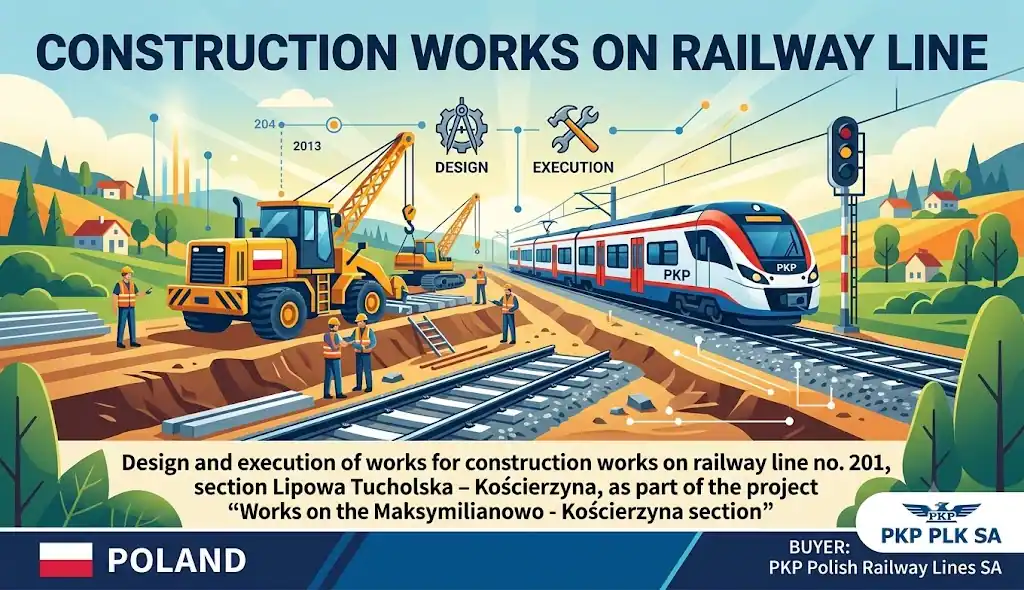
INTERCOR Wins 915 Million Złoty Contract to Rebuild a Key Pomeranian Rail Line
02 Sep 2026
Standfirst PKP Polskie Linie Kolejowe has awarded INTERCOR Sp. z o.o. a contract worth 914.9 million złoty to design and rebuild a section of railway line 201 between Lipowa Tucholska and Kościerzyna in northern Poland, part of the wider Maksymilianowo - Kościerzyna modernisation project financed through EU cohesion funds. Introduction Rebuilding a stretch of active railway line means far more than replacing rails and sleepers. It involves redesigning signalling systems, telecommunications networks, power supply, bridges, platforms and level crossings, all coordinated so the line can reopen safely once work is complete. Poland's rail infrastructure manager has just handed that job for one such stretch, in the Pomeranian region, to a single contractor. Why This Contract Matters This contract covers Section 4 of the broader "Prace na odcinku Maksymilianowo - Kościerzyna" project, itself financed by the European Union through the Fundusze Europejskie na Infrastrukturę, Klimat, Środowisko 2021-2027 programme, the EU cohesion funding stream supporting Polish infrastructure, climate and environment investment. Rebuilding this line supports both passenger and freight connectivity across the Pomeranian region. Contract Timeline This procedure follows an earlier related notice referenced as 62564-2026. The winner was selected on 6 May 2026, and the contract was concluded on 31 August 2026. The notice recording this award was dispatched on 1 September 2026 and published in the Official Journal of the European Union on 2 September 2026, under OJ S issue 169/2026. The works are scheduled to run for 36 months. Contract Overview PKP Polskie Linie Kolejowe S.A. ran an open procedure for the design, in the signalling and telecommunications discipline, and execution of works for Section 4, covering railway line 201 between Lipowa Tucholska and Kościerzyna, classified under CPV code 45000000, Construction work, alongside a wide range of additional classifications spanning engineering design, railway construction, signalling works, track construction, power lines and fire alarm installation. The scope splits into three tasks: Task A covers construction works on the Lipowa Tucholska to Kościerzyna section; Task B covers design and construction of railway traffic control and telecommunications equipment on that same section, including warranty services; and Task C covers design and construction work on railway lines 201 and 215 within the same section, also including traffic control and telecommunications equipment installation and warranty services. An interface option is also included, described separately in the tender documentation. Ten tenders were received, and the winning bid came in at 914,920,503.37 PLN excluding VAT, matching the notice's confirmed value of all contracts awarded. Key Contract Details Contracting AuthorityPKP Polskie Linie Kolejowe S.A. Winning BidderINTERCOR Sp. z o.o. Contract TitleDesign and works for Section 4, railway line 201, Lipowa Tucholska to Kościerzyna, part of the Maksymilianowo - Kościerzyna project Procedure TypeOpen procedure, not accelerated CPV Code45000000 Construction work Awarded Value (excl VAT)914,920,503.37 PLN Award CriteriaTotal gross price, 100 percent, covering both the base scope and the interface option Contract Duration36 months Tenders Received10 Covered by GPAYes Falls Under Foreign Subsidies RegulationYes Winner Selected6 May 2026 Contract Concluded31 August 2026 Place of PerformancePomeranian Voivodeship, spanning Starogardzki, Chojnicki and Kościerski counties, Poland Review OrganisationKrajowa Izba Odwoławcza (National Appeal Chamber) Project Scope The full scope covers track and trackbed works, railway traffic control equipment, telecommunications systems and equipment, overhead traction line and power supply, low voltage electrical installations up to 1 kV, engineering structures, platforms and station buildings, level crossings and crossings, and geological works. It also includes preparation of multidisciplinary design documentation for track and station building works on the connected line 215, plus comprehensive as-built documentation, including technical regulations developed with the buyer, geodetic as-built surveys, chainage and longitudinal profile documentation, and new schematics for traffic control posts and dispatch points. About the Contracting Authority PKP Polskie Linie Kolejowe S.A. PKP Polskie Linie Kolejowe S.A. is a public undertaking with railway services as its classified contracting entity activity. It is Poland's national rail infrastructure manager, responsible for maintaining and modernising the country's railway network, including this section of line 201 in the Pomeranian region. About the Organisations Involved INTERCOR Sp. z o.o. INTERCOR Sp. z o.o., based in Zawiercie and classified as a large enterprise, won this contract. INTERCOR is an established Polish rail infrastructure construction firm with experience delivering large scale track modernisation projects. Krajowa Izba Odwoławcza Krajowa Izba Odwoławcza, Poland's National Appeal Chamber, based in Warsaw, is named as the review organisation for this procurement. Procurement Analysis Ten tenders were received for this contract, a strong competitive field for a rail infrastructure project of this scale and technical complexity. Award criteria were based entirely on total gross price, covering both the base scope and the separately described interface option, with no separate quality scoring disclosed. The buyer explicitly reserved the right, under article 139(1) of Poland's Public Procurement Law, to first evaluate all tenders on price before checking whether the winning bidder met exclusion and qualification criteria, a sequencing approach used to streamline evaluation. The buyer also reserved the right to cancel the procedure if public funds intended to finance it were not ultimately granted, and confirmed it does not accept partial or variant tenders. Additional Procurement Facts This procurement falls under the EU's Foreign Subsidies Regulation, reflecting its scale and the requirement for bidders to disclose relevant foreign financial contributions. The contract is covered by the Government Procurement Agreement. No framework agreement or dynamic purchasing system applies. Market and Industry Perspective Large scale Polish rail modernisation projects of this kind, combining civil works with signalling and telecommunications system installation, typically draw competition from the country's established rail construction contractors, and a field of ten tenders confirms genuine competitive depth in this segment of the Polish construction market. Economic Significance At close to 915 million złoty, this is a substantial rail infrastructure investment, forming one part of the broader EU cohesion funded Maksymilianowo - Kościerzyna modernisation project supporting rail connectivity across the Pomeranian region. Future Procurement Opportunities As one section within a larger multi-section modernisation project, further related contracts covering other segments of the Maksymilianowo - Kościerzyna line are likely to be tendered separately as the broader project progresses. Opportunities for Suppliers Rail construction and signalling contractors should watch for further sections of this EU cohesion funded modernisation project, and should note the strong ten bidder field this contract attracted as a sign of healthy ongoing demand in Poland's rail infrastructure construction market. What Businesses Should Watch Rail infrastructure contractors and signalling specialists should watch for further PKP Polskie Linie Kolejowe tenders tied to the Maksymilianowo - Kościerzyna project, and should monitor Poland's broader EU cohesion funded rail investment pipeline for related opportunities. PolandTenders.com Procurement Intelligence This award reflects the scale and technical breadth typical of major EU cohesion funded rail modernisation projects in Poland, combining civil works, signalling, telecommunications and power infrastructure into a single integrated contract rather than splitting these disciplines across separate tenders. Its strategic importance lies in the strong competitive field it attracted, ten tenders for a contract approaching a billion złoty, confirming that Poland's rail construction sector retains substantial capacity and competitive depth for projects of this scale. Supplier Takeaways Ten tenders were received for this contract, reflecting strong competitive interest Award criteria were based entirely on total gross price, covering both base scope and the interface option The project falls under the EU's Foreign Subsidies Regulation given its scale The contract combines civil works, signalling and telecommunications installation in a single integrated scope Key Takeaways PKP Polskie Linie Kolejowe has awarded INTERCOR Sp. z o.o. a contract worth 914,920,503.37 PLN for Section 4 of the Maksymilianowo - Kościerzyna rail modernisation project Ten tenders were received, and the contract was concluded on 31 August 2026 The project is financed through the EU's Fundusze Europejskie na Infrastrukturę, Klimat, Środowisko 2021-2027 programme Works are scheduled to run for 36 months The contract covers civil works, signalling and telecommunications on railway lines 201 and 215 Conclusion This award moves forward a significant EU funded rail modernisation project in northern Poland, combining track rebuilding with signalling and telecommunications upgrades in a single, closely coordinated contract. For INTERCOR, it is a substantial, multi year engagement reinforcing its position in Poland's rail infrastructure construction sector. Source: Tenders Electronic Daily (TED), Contract Award Notice 604733-2026, Official Journal of the European Union, OJ S issue 169/2026, published on 02/09/2026.
View Details